

Is your English “go” flat? Fix it now. The American Long O /oʊ/ isn’t one sound, but a secret O→U glide. Learn to master it with our easy, step-by-step guide
Hey there, awesome English pronunciation explorers! Get ready to tackle a sound that seems SO familiar but has a secret American twist that changes EVERYTHING: the Long O sound, the one in super common words like “go**”, “no**”, “home“, or “know**”! Its special phonetic code is /oʊ/ (imagine an ‘o’ holding hands with a tiny ‘u’ – that’s your BIG clue!).
“The letter O? I say it all the time!” you might think. And yes, you do! But here’s where the American English plot thickens: the Long O is NOT just one flat ‘O’ sound like in many other languages! If your “so**” /soʊ/ sounds exactly like the start of “sorry” /ˈsɑri/ (which is more of an “ah” or “aw” sound depending on your accent for /ɔ/ or /ɑ/), or if your “note” /noʊt/ is missing a certain “finish” and sounds very short and clipped, then you’re probably missing the American secret! The problem? This American Long O is a DIPHTHONG! That’s a fancy word for a gliding vowel sound that MOVES from one position to another. It’s a little “O-to-OO” journey your mouth needs to take! If you only say the first “O” part, your Long O words will sound flat, unfinished, and like a big neon sign flashing “non-native speaker!” It’s the difference between “coat” /koʊt/ and potentially confusing it with “caught” /kɔt/ (the AW sound /ɔ/) or even “cot” /kɑt/ (the AH sound /ɑ/) if you’re not careful with your jaw and lips! And then the SPELLING! How can ‘O’ (go), ‘OA’ (boat), ‘OW’ (snow), ‘O_E’ (home), ‘OU’ (though), and even ‘EW’ (sew) ALL hide this same O-to-OO /oʊ/ sound?!
But don’t despair! Today, you’re going to become a Long O /oʊ/ Grandmaster! This ultimate, super-easy guide, explained so simply an 8-year-old can follow along, will give you the keys to this essential American sound:
- Meet the “O-Slide” /oʊ/: What IS this two-part “Oooo-ooooh” sound, really? (Hint: Starts like O, finishes like a tiny U!).
- Mouth & Lip Gymnastics (Kid-Friendly!): Easy, step-by-step moves for your lips (TIGHT circle!) and tongue (BACK & TENSE, then a little higher!) to nail that O→U glide!
- The “TENSION” Rule: Why this sound needs muscle power to sound right.
- Vowel Knockouts! NO MORE confusing /oʊ/ (goat) with /ɔ/ (caught, the AW sound) or /ɑ/ (got, the AH sound, for many AmE speakers). We’ll make the differences crystal clear!
- Spelling CHAOS Conquered! O, O_E, OA, OW, OU, OUGH, EW… We’ll show you the MOST common ways the /oʊ/ sound is written so you can spot it!
- Mistake Zapper! Fixing that “flat O” and other common errors instantly!
- “Go-Go-Go” Practice! Fun, effective exercises with crucial words (‘no’, ‘know’, ‘so’, ‘home’, ‘show’, ‘phone’, ‘both’) to get your Long O /oʊ/ sounding native!
Get ready for your “don’t,” “hope,” “told,” and “those” to glide smoothly and sound absolutely, authentically American! Let’s go!
What IS This Long O /oʊ/ Sound? (The Secret “O-to-OO” Glide!)
Let’s properly introduce our celebrity vowel for today: the American Long O, phonetically known as /oʊ/. It’s one of the foundational “single vowel sounds” in American English as categorized by the source, BUT (and this is a big “but” for clarity) it behaves and is produced as a DIPHTHONG – a gliding vowel.
Diphthong = Mouth Movie!
Remember, a diphthong isn’t one static sound; it’s a vowel that MOVES and CHANGES quality from beginning to end, all within one syllable. Think of it as a quick slide or a mini-journey for your mouth!
The /oʊ/ Journey: Starts like /o/, Slides to a Hint of /ʊ/ (“OO” as in “book”)
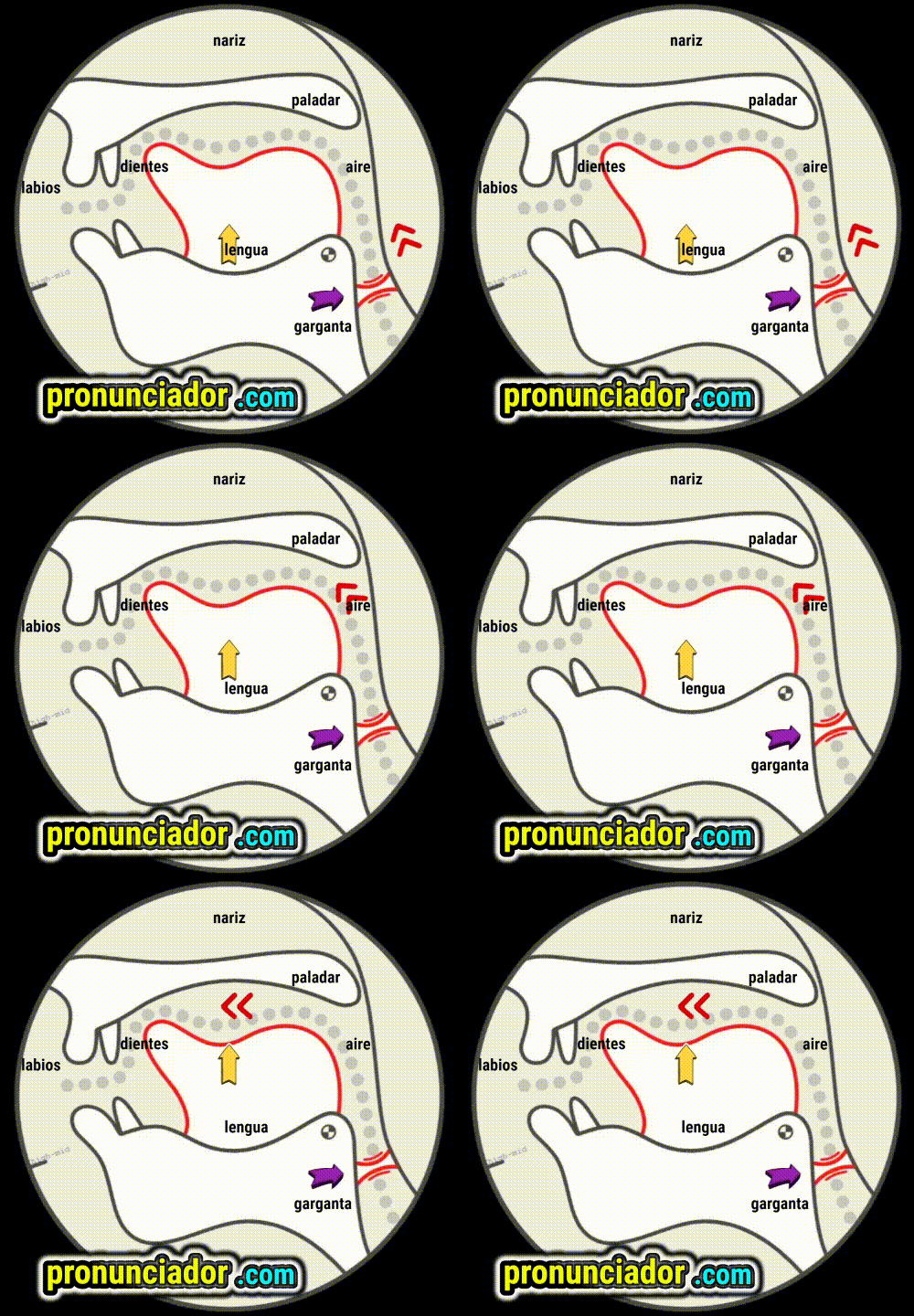
- Starting Sound (Roughly /o/): It begins with your tongue in the BACK of your mouth, at a MID to HIGH-MID position (not super high, not super low). CRITICALLY, your LIPS are ROUNDED and TENSE. This initial position is somewhat like a clear ‘O’ in many languages, but perhaps more tense and further back.
- Ending Sound (Glides TOWARDS /ʊ/): From that starting /o/ position, your tongue moves slightly HIGHER and FURTHER BACK, and your LIPS become even TIGHTER and MORE ROUNDED, gliding towards the position for the Short U /ʊ/ sound (like the “oo” in “book” or “put”).
So, /oʊ/ = Start with lips ROUND & TENSE, tongue BACK & MID-HIGH (/o/-like) → SMOOTHLY GLIDE to lips TIGHTER ROUND, tongue HIGHER & FURTHER BACK (/ʊ/-like).
It’s a fluid “Oooooo-oooooh” motion!
CRITICAL: Long O /oʊ/ (go) vs. Other “O-like” Sounds!
This is where non-native speakers often get tangled!
- /oʊ/ (go, boat, note) vs. /ɔ/ “AW” (law, bought, not):
- /oʊ/: DIPHTHONG (moves O→U). Tongue HIGHER. Lips start TIGHTLY ROUNDED & PUSHED FORWARD, then tighten more.
- /ɔ/: SINGLE VOWEL (static). Tongue LOWER. Lips WIDER ROUNDED (less protruded) & TENSE.
- The Trap: “Coat” /koʊt/ vs. “Caught” /kɔt/. They are NOT the same if an accent distinguishes /ɔ/! Key: /oʊ/ is more closed, moves, and has a different tongue height.
- /oʊ/ (go, snow) vs. /ɑ/ “AH” (got, father) (in unmerged accents):
- /oʊ/: Lips ROUNDED AND TENSE throughout. Back vowel. Gliding.
- /ɑ/: Lips NEUTRAL/UNROUNDED. Back (or central-back) vowel. Static. JAW WIDE OPEN.
- The Trap: Saying “no” /noʊ/ with an “nah” /nɑ/ sound because lips aren’t rounded.
- /oʊ/ (go) vs. How Some Languages Say ‘O’:
- Many languages have a monophthong ‘o’ – one single, flat sound. If you use that for the American Long O /oʊ/, it will sound clipped and un-American. The O→U glide is essential.
Key to /oʊ/: TENSE, ROUNDED lips + TONGUE BACK + the O→U GLIDE!

Your Mouth’s “Long O Slide”: Nailing the /oʊ/ Articulation (Super Simple!)
Ready to make that perfect American “Ooooo-ooh”? Let’s break down the mouth dance!
Step 1: Mouth – Starting Slightly Open
Relax your jaw, and let your mouth open partially. Not super wide, but comfortably open enough to get the sound started.
Step 2: Lips – The “Tight Kissy O” Start! (TENSE & ROUND & FORWARD)
This is where the Long O magic begins!
- Round your lips into a fairly TIGHT, TENSE circle. Think of making a small, firm “O” shape.
- Push them FORWARD a little bit, away from your teeth, like you’re making very deliberate “OOO” or gentle “kissy” lips.
Step 3: Tongue – Start BACK, MID-HIGH, and TENSE!
Get that tongue strong and in position!
- TENSE your tongue! Make it feel active, not floppy.
- The main body of your tongue should be pulled towards your throat (BACK).
- Keep it at a MID-HIGH position (or “just above midline” as the source says) – not super high against the roof, not low on the floor.
Step 4: The GLIDE! Mouth Narrows, Lips Tighten, Tongue Rises Higher & More Back!
This is the MOVEMENT that makes it /oʊ/! From the starting /o/ position:
- Your mouth/jaw CLOSES A LITTLE more.
- Your lips become even TIGHTER and MORE ROUNDED/PROTRUDED as they aim for the /ʊ/ (“book” ooh) end-point.
- The BACK of your TENSE tongue rises a little HIGHER and moves slightly further BACK towards your throat, aiming for that /ʊ/ vowel position.
Step 5: Voice ON! Make it BUZZ and GLIDE!
- Your vocal cords must be VIBRATING throughout this whole O→U movement.
- The sound is a smooth, continuous “Oooooo-ooooohh” or “OH-oooo.” You should HEAR the quality of the vowel change as your mouth moves.
Kid-Friendly Cue: “Start with tight, round ‘OH’ lips, like you’re surprised. Then, without stopping the sound, make your lips even more like a tiny, tight ‘OOO’ tunnel, like you’re going to blow a tiny bubble, while your tongue pulls back and up a bit more in the back of your mouth.”
Feeling Check: TENSE, ROUND lips throughout? Do they get even TIGHTER at the end? Is your tongue BACK and moving HIGHER/FURTHER BACK? Can you hear the sound “slide” from O-ish to U-ish? YES? Then you’re doing it!
O, OW, OA, O_E… The Long O /oʊ/ Spelling Puzzle!
Oh, English spelling, you rascal! The Long O /oʊ/ sound hides behind a LOT of different letter combinations! But thankfully, some are VERY common!
The #1 King: Letter ‘O’ (Often with Magic E or in Open Syllables) (~79%-80%!)
The single letter ‘O’ is by far the MOST common way the /oʊ/ sound is spelled! This includes:
- O + Consonant + Silent E (“Magic E”): This is a HUGE pattern for /oʊ/!
- home, note, hope, close (verb), rope, stone, phone, vote, joke, those, whole.
- O in an Open Syllable (ends the syllable, often at the end of a short word):
- go, no, so, hello (stress on final ‘o’), also (stress on ‘o’).
- O before certain consonant clusters (esp. LD, LT, sometimes ST, LL):
- old, cold, bold, fold, told, gold.
- bolt, colt.
- most, post, ghost, host.
- roll, poll, scroll.
- O in other common words: open, over, only, moment, program, okay.
- DANGER! ‘O’ also spells /ɒ/ or /ɑ/ (hot, stop), /ɔ/ (off, dog), /ʌ/ (son, love), /ʊ/ (woman)! You can’t assume! But the patterns above are strong /oʊ/ clues.
The “Snowy” Partner: ‘OW’ (~10%-11%)
‘OW’ is very common for /oʊ/, especially at the END of words, or before L or N.
- snow, know, blow, grow, show, flow, low, slow, throw, bow (arco para flechas).
- own, grown.
- bowl, follow, yellow, window, tomorrow, pillow.
- SUPER DANGER! ‘OW’ is ALSO a primary spelling for the /aʊ/ DIPHTHONG (“now”, “how”, “cow”)! You absolutely MUST learn which ‘OW’ words are /oʊ/ and which are /aʊ/ by sound and memorization.
The “Boat” Team: ‘OA’ (~7%-8%)
‘OA’ is a pretty RELIABLE spelling for /oʊ/, usually in the middle of words.
- boat, coat, goal, road, loan, soap, toast, coach, oak, oat, loaf, groan.
- (Very rare exceptions: ‘broad’ is /brɔd/).
The “Though/Soul” Crew: ‘OU’ & ‘OUGH’ (Small but Mighty! “Etc.” & “OU”)
These are less frequent for /oʊ/ but include VERY common words.
- OU :
- though /ðoʊ/ (gh silent!)
- although /ɔlˈðoʊ/
- dough /doʊ/ (gh silent!)
- soul /soʊl/
- poultry /ˈpoʊltri/
- shoulder /ˈʃoʊldər/
- (DANGER: ‘OU’ is a spelling nightmare! It’s also /aʊ/ (out), /u/ (group), /ʊ/ (could), /ʌ/ (tough), /ɔ/ (bought)! These /oʊ/ words are specific exceptions you learn).
- OUGH (Specifically with ‘GH’ silent giving /oʊ/ – not common for /oʊ/, often part of OU list above).
- though /ðoʊ/
- although /ɔlˈðoʊ/
- dough /doʊ/
- (DANGER: ‘OUGH’ has at least 6-7 pronunciations! ‘rough’/rʌf/, ‘through’/θru/, ‘cough’/kɔf/, ‘bought’/bɔt/, etc.)
The Ultra-Rare ‘EW’ / ‘OE’ / ‘OO’ (Very Specific!)
- EW:
- sew /soʊ/ (coser – sounds like “so”!)
- OE:
- doe /doʊ/ (hembra ciervo – sounds like “dough”!)
- toe /toʊ/ (dedo del pie – sounds like “to” the preposition or “too” adverb!)
- foe /foʊ/ (enemigo)
- whoe /woʊ/ (aflicción – arcaica)
- OO (Extremely rare for /oʊ/ – usually /u/ or /ʊ/):
- brooch /broʊtʃ/ (broche – /tʃ/ ending from ‘C’)
Long O /oʊ/ Spelling – Key Takeaways:
- O (Magic E; Open; +LD/LT/OST/OLL) = Your #1 MOST COMMON bet! (go, home, old, most, roll)
- OW (often END or before L/N): snow, know, own, bowl. (BEWARE /aʊ/ ‘now’ words!)
- OA (often MIDDLE): boat, coat, road. (Pretty reliable!)
- OU / OUGH: Only specific MEMORIZED words (though, dough, soul). HIGHLY UNPREDICTABLE otherwise!
- EW / OE: Very few, learn “sew,” “doe,” “toe.”
The Ultimate Rule for /oʊ/ Spelling? LISTEN to native speakers + Check IPA /oʊ/! There are too many overlaps to guess reliably from spelling alone for O, OW, OU.

Uh-Oh! Common Long O /oʊ/ Mistakes & Instant Fixes!
Where do non-native speakers typically get stuck with this “O-to-OO” glide?
- MISTAKE #1: THE ABSOLUTE BIGGEST! NO GLIDE! (Using a Flat, Short “O”)
- What’s Happening: You’re only making the first part of the diphthong (/o/-like sound) and missing the essential glide up and back towards the /ʊ/ (“ooh” in book). “No” sounds like a short, clipped “noh,” not the American “nooo-ooh.”
- THE FIX: THINK “O → U” SLIDE! Your mouth MUST move! Start with lips round and tense, tongue back and mid-high. THEN, smoothly let your jaw close a little more, lips get even tighter and more puckered, and the back of your tongue rise a bit higher and further back. “No–oo–oo.” Exaggerate this glide when practicing!
- MISTAKE #2: LIPS NOT ROUNDED or NOT TENSE ENOUGH (Or Relaxing Too Soon).
- Problem: If your lips aren’t actively rounded AND tense throughout the glide, the /oʊ/ loses its characteristic fullness and can sound like /ɑ/ (ah) or even /ə/ (uh). Or you start round, but your lips spread at the end instead of tightening for the /ʊ/.
- The Fix: MAINTAIN THE “KISSY LIPS”! Keep them round from start to finish. Start with a firm “O” circle and make it an even tighter, more forward “OOO” circle as you finish. Look in a mirror! “Old” not “Ahld”.
- MISTAKE #3: TONGUE NOT FAR ENOUGH BACK or NOT TENSE ENOUGH.
- Problem: If tongue is too far forward or too lax, it won’t produce the “back vowel” quality needed for /oʊ/. Sound might be too bright or unclear.
- The Fix: Actively pull the body of your TENSE tongue BACK towards your throat. And feel it rise for the glide.
- MISTAKE #4: Confusing /oʊ/ (coat) with /ɔ/ (caught – “AW” sound).
- Problem: Using the wider-mouthed, lower-tongued /ɔ/ when /oʊ/ is needed. Both are back and rounded, causing confusion.
- The Fix: /oʊ/ is HIGHER and MORE CLOSED MOUTH than /ɔ/. And /oʊ/ GLIDES O→U, while /ɔ/ is a single, static vowel. Feel “coat” (mouth closes, O-U slide) vs. “caught” (mouth stays wider open, lips O, tongue lower, one sound).
- MISTAKE #5: Getting TRICKED by ‘O’, ‘OW’, ‘OU’ spellings that are NOT /oʊ/!
- Problem: Seeing ‘O’ and always trying to make /oʊ/ (e.g., “son” or “off”). Seeing ‘OW’ and always trying /oʊ/ (e.g., “now”, “cow”). Seeing ‘OU’ and trying /oʊ/ (e.g., “out”, “tough”).
- The Fix: ACCEPT ENGLISH SPELLING MADNESS! ‘O’, ‘OW’, and ‘OU’ are notorious for representing multiple sounds. You HAVE to learn which common words with these spellings take /oʊ/ and which take other sounds (/ʌ/, /ɔ/, /ɑ/, /aʊ/, /u/, /ʊ/). There’s no way around this for these letters.
“Go For It!” Long O /oʊ/ Sound Workout!
Time to get those lips and tongue gliding to a perfect American /oʊ/!
Exercise 1: The “O → U” Glide – Slow Motion!
- Part 1 (Start – /o/): Lips TIGHTLY ROUNDED & FORWARD, TENSE. Tongue BACK, MID-HIGH, TENSE. Make a clear, tense “Ohhhh” sound (like a slightly deeper version of how you’d say the letter O’s name if it were just one sound).
- Part 2 (End – /ʊ/): Lips TIGHTER ROUNDED & MORE FORWARD, TENSE. Tongue HIGHER, FURTHER BACK, TENSE. Make a short, tense “ooooh” (like a very firm version of the ‘oo’ in “book”).
- NOW GLIDE SLOWLY: “Ohhhhhh-ooooooh” … “Ohh-ooh” … /oʊ/! Feel the continuous sound and the definite shift in mouth shape and tongue.
Exercise 2: Flat “O” vs. Gliding /oʊ/ – Record & Hear!
- Try saying “no” like a single, flat ‘o’ sound (how it might be in another language).
- Now say “no” /noʊ/ with the distinct O→U glide, making sure lips get tighter and jaw closes slightly at the end.
- RECORD YOURSELF! Can you HEAR the glide in the second one? That’s the American way!
Exercise 3: Crucial Contrasts! /oʊ/ (coat) vs. /ɔ/ (caught) vs. /ɑ/ (cot – unmerged)
Master these lip and jaw differences!
- Coat /koʊt/: Starts mid-closed, ROUND TENSE LIPS, glides MORE CLOSED & TIGHTER.
- Caught /kɔt/: WIDER open, ROUND TENSE LIPS, STATIC vowel, tongue lower/backer.
- Cot /kɑt/: WIDEST open, NEUTRAL LIPS, STATIC vowel, tongue low/central-back.
- Drill: Note /noʊt/ — Naught /nɔt/ — Not /nɑt/.
- Soap /soʊp/ — Saw /sɔ/ (Implied) — Sop /sɑp/.
Exercise 4: Spellcheck Time! Practice the /oʊ/ Sound with Its Many Disguises!
All these have the SAME Long O /oʊ/ (O→U glide)!
- O (Magic E/Open/etc.): go, no, so, home, close (v), note, open, over, old, most, both, told, moment.
- OW: know, snow, show, blow, grow, low, bowl, follow, window, tomorrow.
- OA: boat, coat, goal, road, loan, soap, toast, coach, oak.
- OU/OUGH (Memorize!): though, although, dough, soul / though, dough.
- EW/OE: sew / doe, toe, foe.
Exercise 5: Common Word Workout (From Source – Top 30!)
(Use the list from Sounds American for /oʊ/: go, no, know… moment, follow). For EACH WORD, actively think: TIGHT ROUND LIPS to start, then GLIDE them TIGHTER and MORE FORWARD as your tongue moves higher/backer!)
Exercise 6: “A Ghost Hopes for a Home” – The Source’s Magic /oʊ/ Phrase!
The Sounds American video offers this fantastic phrase for practice:
- “A ghost hopes for a home.”
- /ə ɡoʊst hoʊps fɔr ə hoʊm/ (Note ‘for’ is /fɔr/ with AW!)
This highlights how /oʊ/ repeats. Focus on the GLIDE in ‘ghost’, ‘hopes’, ‘home’.
| PHONETICAL PRONUNCIATION |
| PHONETICAL PRONUNCIATION |
FAQs: Your American Long O /oʊ/ (“go”) Questions Answered!
Q1: Is the Long O /oʊ/ really TWO sounds (O→U)? My native language ‘O’ is just one!
Yes, for American English, think of it as a two-part GLIDE! It starts with an /o/-like sound and smoothly moves towards an /ʊ/-like (“book”) sound. If you only make a single, flat ‘o’ (like in many languages), it will sound distinctly non-native for words like “go,” “no,” “home.” The glide is key!
Q2: What’s the #1 MOST important thing for my LIPS when making /oʊ/?
TIGHT, TENSE, and ROUND, moving to EVEN TIGHTER and MORE ROUNDED/FORWARD!
Start with a firm “O” circle, lips somewhat pushed out. As you make the “ooooh” glide, the circle might get a tiny bit smaller and often more protruded (pushed out) and definitely stays (or gets more) tense. Don’t let your lips relax or spread!
Q3: How can ‘OW’ spell Long O /oʊ/ (“snow”) AND the /aʊ/ in “now”?!
Welcome to the wonderful, wacky world of English spelling! ‘OW’ is a notorious two-timer. There is NO reliable spelling rule to tell you if ‘OW’ is /oʊ/ or /aʊ/.
- /oʊ/ words with OW: snow, know, low, show, grow, blow, throw, own, bowl, follow.
- /aʊ/ words with OW: now, how, cow, brown, town, down, crowd, power, flower.
You simply HAVE to learn by ear and memorize which common ‘OW’ words take which sound.
Q4: Why does ‘O’ sometimes sound like /oʊ/ (go), sometimes /ɔ/ (dog), sometimes /ʌ/ (son), sometimes /ʊ/ (woman)?!
The single letter ‘O’ is the most versatile (and frustrating!) vowel letter in English. The sound it makes depends ENTIRELY on the specific word and its history.
- /oʊ/ (go, home, old, no, so, open) – Pattern is often O+Consonant+E, or O at end of syllable.
- /ɔ/ (on, off, dog, long, cost) – Often before L, G, NG, ST, FF.
- /ʌ/ (son, love, come, money, month, other) – A specific set of VERY common words to memorize.
- /ʊ/ (woman, wolf) – Only these two common ones!
Again: For ‘O’, dictionary + listening are your best friends!
Q5: You keep saying “tense” lips and tongue for /oʊ/. Does it really need to be that strong?
Yes, “tense” is a key feature compared to lax vowels. It means the muscles are actively engaged, not floppy. This helps create the clear, distinct quality of the /oʊ/ and especially facilitates the glide to the high-back /ʊ/ ending. If it’s too relaxed, it can easily slip into an /ɔ/-like sound or just be a flat monophthong. Tense doesn’t mean “stiff and unnatural,” but rather “actively holding the position with engaged muscles.”
Key Insights: Your American Long O /oʊ/ Will GLOW!
Amazing work! You’ve taken a deep dive into the American Long O /oʊ/ sound. You now understand it’s not a simple ‘O’, but a dynamic O→U glide that needs tense, consistently rounded lips and a specific back tongue movement.
Your /oʊ/ cheat sheet:
- /oʊ/ = O→U DIPHTHONG! Starts /o/-like, GLIDES smoothly to /ʊ/-like.
- LIPS = TIGHT, TENSE, ROUNDED, & FORWARD! And they stay/get tighter through the glide.
- TONGUE = BACK, TENSE, mid-high → HIGHER/FURTHER BACK!
- Vs. /ɔ/ “AW” (caught): /oʊ/ is MORE CLOSED MOUTH, tongue HIGHER, and it GLIDES. /ɔ/ is WIDER MOUTH, tongue LOWER, STATIC.
- Vs. /ɑ/ “AH” (cot): /oʊ/ has ROUNDED TENSE LIPS. /ɑ/ has NEUTRAL RELAXED LIPS.
- SPELLING = VERY VARIED! O (in patterns) is #1. OW (endings) and OA (middle) are good clues. OU/OUGH/EW/OE are specific words. LISTEN and CHECK IPA for ‘O’, ‘OW’, ‘OU’!
- #1 MISTAKE: NO O→U GLIDE! Making a flat, short ‘o’.
The crucial part is to FEEL THAT GLIDE from the initial O-shape to the slightly tighter, higher U-shape, all while keeping your lips rounded and tense and your tongue active in the back. Practice those “O-to-OO” movements in words like “no,” “go,” “snow,” “boat.” Record yourself! You’ll be saying “I know!” with perfect American flair in no time!
👇🔥👇🔥👇🔥👇🔥👇🔥👇🔥
👉 RETURNS in the YEAR 2031 ! WHO? CLICK HERE ! 🔥



👇🔥👇🔥👇🔥👇🔥👇🔥👇🔥
👉 RETURNS in the YEAR 2031 ! WHO? CLICK HERE ! 🔥
👇🔥👇🔥👇🔥👇🔥👇🔥👇🔥
👉 RETURNS in the YEAR 2031 ! WHO? CLICK HERE ! 🔥
👉 RETURNS in the YEAR 2031 ! WHO? CLICK HERE ! 🔥