

Your ‘W’ sounds like a ‘V’? Learn the simple lip-rounding trick (no teeth!) to fix your pronunciation and master the true American /w/ sound. Practice today!
Hey there, aspiring American accent pros! Get ready to ride the wave with one of the smoothest, most “glidey” sounds in English: the W sound, as in “way”, “we”, or even the ‘O’ in “one”! Its IPA secret code is just a lowercase /w/.
“The W sound? That’s easy, right? Like ‘water’!” And you’re mostly correct! But hold on – this seemingly simple sound has a few sneaky tricks up its sleeve, especially for non-native speakers! Do you sometimes find your “west” sounding a tiny bit like “vest”? Or maybe your “wine” and “vine” sound confusingly similar? This happens because many languages don’t have both a distinct /w/ AND a distinct /v/ sound, or their ‘W’ is made differently. And then there’s the spelling! How can ‘W’ (way), ‘U’ (quiet, language), and ‘O’ (one, choir) all make this same “woo” sound? It’s enough to make you feel a little… “wobbly”!
But don’t worry! Today, we’re smoothing out all the W-wrinkles! This MEGA-guide, explained so easily your kid cousin could understand it, will help you MASTER the American /w/ glide:
- Meet the W-Glide /w/: What IS this unique “semivowel” sound? (Hint: Lips like ‘OO’, then SPREAD!).
- Mouth Magic: The “OO-to-SMILE” Move! SUPER simple, step-by-step guide to the lip and tongue action. (It’s all about that quick change!).
- The Critical V vs. W Showdown! Why they are NOT the same, and how to keep them perfectly distinct (Lips vs. Teeth!).
- Spelling UNMASKED! W, WH, U (in QU, GU, SU), and that weird ‘O’ in “one”. We’ll cover the main patterns!
- Mistake Meltdown! Fixing the most common /w/ blunders (like the V-for-W swap) instantly!
- W-Workout Time! Easy exercises and essential words (‘what’, ‘we’, ‘one’, ‘quick’, ‘always’) to make your /w/ wonderfully American!
Get ready for your “way,” “why,” “when,” “quick,” and even “one” and “choir” to sound incredibly smooth and native! Let’s woosh right into it! 😉

What Exactly is This /w/ “Way” Sound? (The “Gliding Woo”)
Let’s get to know the /w/ sound. It’s called a glide consonant or a semivowel. Fancy words! But what do they mean?
- Glide: Think of it like sliding! Your mouth starts in one vowel-like position (kinda like for “oo” in “food”) and then quickly glides or slides into the position for the next vowel sound in the word. It’s a super quick movement!
- Semivowel (or Semiconsonant): This means it acts like a consonant (it usually can’t be the main sound of a syllable by itself) but it’s made more like a vowel, with the air flowing pretty freely, not blocked like for ‘t’ or ‘k’.
You hear the /w/ sound at the beginning of these common words:
- way /weɪ/
- we /wi/
- will /wɪl/
- work /wɜrk/
- why /waɪ/
- what /wʌt/ (or /wɑt/)
And in the middle of words too, often after Q, G, or S (when followed by U): - quick /kwɪk/
- language /ˈlæŋɡwɪdʒ/
- persuade /pərˈsweɪd/
And famously, in the word: - one /wʌn/!
Its Secret Sound DNA (Easy Version!)
The sound experts call /w/ a “labio-velar, voiced, glide consonant.” Let’s make that super clear:
- Labio-Velar (Lips AND Back-of-Tongue Work Together!): This is the WHERE!
- Labio (Lips): Your lips start ROUNDED and a bit pushed forward, like you’re about to blow a kiss or say “OOOO”.
- Velar (Back of Tongue): At the SAME time, the BACK of your tongue is raised HIGH UP towards the soft palate (the soft roof at the back of your mouth), just like for the “oooo” /u/ sound or the ‘g’ in ‘go’.
- Voiced (Voice Box ON – It BUZZES!): Yes! For /w/, your vocal cords in your throat are VIBRATING. It’s a humming, buzzing sound.
- Glide (Quick Slide to Next Vowel!): From that “OOO”-like start (rounded lips, back-tongue high), your mouth then QUICKLY changes shape to get ready for the next vowel in the word. The lips spread or relax, the tongue moves. It’s a very fast “WOO-then-VOWEL” transition.
Super-Duper Simple Summary: To make the /w/ (W in ‘way’) sound:
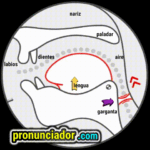
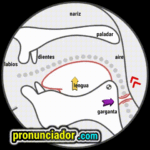
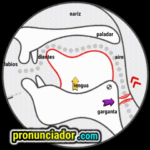
- Start like you’re going to say “OO” (like in “moon”): Make a small, tight circle with your lips and push them out a little. Have the back of your tongue high up.
- Turn ON your voice box (make it buzz).
- Then QUICKLY SLIDE out of that “OOO” lip shape, relaxing or spreading your lips as you move into the next vowel sound. “Wooooo-[next vowel]”.
It’s that quick “OOO-to-SomethingElse” glide that makes the /w/ sound!

The HUGE Showdown: /w/ (Way) vs. /v/ (Vay) – Lips vs. Teeth!
This is a MAJOR point of confusion for many English learners! /w/ and /v/ can sound similar if you’re not careful, but they are made in COMPLETELY different ways!
| Feature | /w/ Sound (Way, Wine) | /v/ Sound (Vay, Vine) |
| WHAT makes it? | LIPS working together! | TOP TEETH + BOTTOM LIP! |
| Lips Start As: | ROUNDED & Puckered (“OOO” shape) | NEUTRAL (or slightly spread for next vowel) |
| Main Action: | Lips GLIDE open from “OOO” | Bottom lip touches top teeth, AIR SQUEEZES with friction |
| Tongue Action: | Back of tongue is HIGH | Tongue usually neutral or preps for next vowel (not critical for /v/) |
| Blocked Air? | NO (air flows freely for glide) | YES, partially (air squeezes with FRICTION for /v/) |
| Sounds Like: | Soft, smooth “wooo” glide | Buzzy friction “vvvv” |
MEGA MISTAKE: Using your TOP TEETH on your BOTTOM LIP (like for /v/) when you want to say /w/. “Way” /weɪ/ sounds like “Vay” /veɪ/. “Wine” /waɪn/ sounds like “Vine” /vaɪn/.
THE EASY FIX: For /w/, your teeth and lips DON’T touch each other like for /v/!
- /w/: Think LIPS ONLY! Round them like an “O” then glide. No teeth involved with lips!
- /v/: Think TEETH ON LIP! Your top teeth GENTLY bite/touch your bottom lip, and air buzzes through.
Your “Woo-Woo” Mouth Moves: Making the /w/ Glide (Kid-Friendly!)
Ready to get that perfect, smooth /w/ glide? It’s like getting your mouth ready for “OOO” and then quickly changing your mind!
Step 1: Mouth – Just a Little Bit Open!
No need for a wide jaw drop. Just a comfortable, slight opening.
Step 2: Lips – The “Kiss & Smile” Move!
This is the star of the show for /w/!
- Start with “KISSY LIPS”: Round your lips like you’re about to say “OOO” in “moo” or blow a kiss. Make a small, tight circle and push them slightly forward, away from your teeth.
- THEN… QUICK SMILE/RELAX!: From that tight “OOO” circle, quickly release and stretch/relax your lips wide (or to a neutral position) as you glide into the next vowel sound. It’s a fast “Round → Spread” or “Round → Relax” movement.
Step 3: Tongue – Back & High, then Moves!
- When your lips are in that initial “OOO” tight circle, the BACK of your tongue should be RAISED HIGH UP towards the soft roof of your mouth (like for an /u/ sound), and pulled a bit towards your throat. Keep it tense.
- IMPORTANT NOTE from source: Make sure your tongue isn’t blocking the airflow anywhere in the middle or front! The air needs to flow pretty freely OVER the tongue for this glide.
- As your lips release from the “OOO” and move to the next vowel, your tongue will also move to position itself for that next vowel.
Step 4: Air Stream & Voice – Smooth & BUZZING!
- Air Flows Between Lips: Let the air release smoothly between your lips as they move from rounded to spread/relaxed. No major blockages inside.
- VOICE BOX ON! Remember, /w/ is a VOICED sound! Your vocal cords need to be vibrating the whole time. “Wwwwwoooo…”
Putting It ALL Together (OOO → Vowel):
- Start mouth slightly open.
- Lips go “OOO” (tight circle, pushed out) + Back of tongue HIGH.
- Turn VOICE ON.
- Quickly RELEASE/SPREAD lips & move tongue FOR the next vowel sound, letting the “wooo” sound glide smoothly into it.
The result: “Wuh-AY” (way), “Wuh-EE” (we), “Wuh-ORK” (work).
Feel It! Start by just making a clear “OOOOOO” sound. Now, from that “OOOOOO”, quickly open your lips into a smile while still making sound – “OOOOO-EEEE!” You just said “we” with a strong /w/!
What Letters Spell the /w/ Sound? (W, U, O!)
The spelling for /w/ can be a bit surprising! While ‘W’ is common, it’s not the only player!
The Main Star: Letter ‘W’! (~77%-78%)
This is the most obvious and frequent spelling for the /w/ sound!
- Way, we, was, with, want, well, will, why, when, work.
- Away, always, between, sweet, twice.
- Snow, new, few (usually only if ‘ew’ forms its own sound, not the vowel of /u/ as in ‘flew’ – nuance for advanced users).
- WH Words: In American English, ‘WH’ in words like what, when, why, where, while is almost always pronounced just like a plain /w/! The ‘h’ is silent. (Some older/regional dialects might have a breathy /hw/ but standard AmE = /w/).
The Sneaky ‘U’ (After Q, G, S)! (~20%)
Yes, the letter ‘U’ very often creates the /w/ sound when it follows Q, G, or S, especially before another vowel!
- QU (+ Vowel): Always makes a /kw/ sound combo! The ‘U’ is the /w/ part!
- Quick /kwɪk/, Queen /kwin/, Quiet /ˈkwaɪət/, Quarter /ˈkwɔrtər/, Question /ˈkwɛstʃən/.
- GU (+ Vowel, sometimes):
- Language /ˈlæŋɡwɪdʒ/, Penguin /ˈpɛŋɡwɪn/, distinguish /dɪˈstɪŋɡwɪʃ/.
- (Careful! GU before A/O/U is often hard /g/ like ‘guard’, ‘guess’).
- SU (+ Vowel, sometimes):
- Suite /swit/ (like ‘sweet’!), Persuade /pərˈsweɪd/.
- (Careful! SU usually /s/ or /ʃ/ – these are specific exceptions).
The One and ONLY “O” (~1%)
This is a famous one! The letter ‘O’ makes the /w/ sound in:
- One /wʌn/ (sounds like “won”!)
- (And words with OI that are more /wa/ or /wɑ/ like Choir /ˈkwaɪər/ – the ‘o’ starts a /w/ glide).
Silent ‘W’! (Where W is Written BUT NOT Pronounced!)
Sometimes ‘W’ is a ninja and completely disappears! Especially:
- In ‘WR-‘ at the beginning: The ‘W’ is silent!
- Write /raɪt/, Wrong /rɔŋ/, Wrap /ræp/, Wreck /rɛk/, Wrestle /ˈrɛsəl/.
- In specific words:
- Answer /ˈænsər/ (W is silent!)
- Sword /sɔrd/ (W is silent!)
- Two /tu/ (W is silent! Sounds like “too”.)
- Who, Whole, Whom (WH= /h/ or silent W)
Spelling Takeaway for /w/:
- W is King (way, with).
- U after Q, G, S is the Prince (quick, language).
- O in ‘one’ is the Jester!
- Be aware of silent W (write, answer, sword, two).
W-Oops! Common /w/ Mistakes & Easy Fixes!
Where do learners often stumble with this “gliding OOO”?
- Mistake #1: The V/W Swap! (Using /v/ for /w/ )
- What’s Happening: Your top teeth are touching your bottom lip (making /v/) instead of your lips rounding and gliding for /w/. “Way” sounds like “Vay”.
- The Fix: NO TEETH ON LIP! /w/ is made with LIPS rounding then spreading. /v/ needs TEETH + LIP friction. Keep them separate! Watch yourself in a mirror.
- Mistake #2: Not Enough Lip Rounding (Weak /w/).
- What’s Happening: Lips are too relaxed or spread at the START of /w/. The “ooo” part is missing. “Way” might sound more like “ay” or a very weak “way”.
- The Fix: Start with a TIGHT “OOO”! Really pucker those lips like for a kiss, then glide out. The contrast from tight round to spread/relaxed is what creates a strong /w/.
- Mistake #3: Tongue Blocks Air (Not a True Glide).
- What’s Happening: The back of your tongue might be too high and touching the soft palate, or the middle part of your tongue creates too much friction, stopping it from being a smooth glide.
- The Fix: AIR MUST FLOW FREELY! While the back tongue is high (like for /u/), ensure it doesn’t create a * blockage or strong friction*. The sound comes primarily from the lip movement combined with the high back tongue shaping the sound like a vowel. It’s vowel-like.
- Mistake #4: Forgetting the /w/ in QU, GU, SU or “One”.
- What’s Happening: Pronouncing “quick” as “kick”, “language” as “langage”, or “one” as “on” (without the /w/ start).
- The Fix: Remember the Patterns! QU = /kw/ almost always. Language needs that /w/. “One” = /wʌn/. Memorize and practice!
- Mistake #5: Pronouncing a Silent W.
- What’s Happening: Trying to say the ‘w’ in “write” or “answer”.
- The Fix: Learn the Silent W words! There aren’t too many common ones. Write, wrong, wrap, wreck, who, whole, whom, two, answer, sword are the biggies.

W-Glide Workout! Exercises for a Perfect /w/!
Let’s get those lips moving!
Exercise 1: The “OOO-to-Smile” Glide (W Isolated)
- Start lips TIGHTLY ROUNDED (“OOO”).
- Turn voice ON.
- Quickly SPREAD lips wide to a smile, keeping voice on: “OOOOO-EEEEE!” → You just said “WE” /wi/ perfectly!
- Try OOOO-AAAA (“WAH” /wɑ/). OOOO-AYYY (“WAY” /weɪ/). OOOO-AIIII (“WHY” /waɪ/).
- Feel that rapid lip movement from small circle to spread/relaxed.
Exercise 2: V vs W Battle Drill! (NO Teeth on Lip for W!)
This is essential!
- West /wɛst/ (Lips round → spread) — Vest /vɛst/ (Top teeth on bottom lip)
- Wine /waɪn/ — Vine /vaɪn/
- Wail /weɪl/ (lament) — Veil /veɪl/ (velo)
- Wet /wɛt/ — Vet /vɛt/ (veterinarian)
- Use a mirror! For /w/, lips ONLY. For /v/, teeth MUST touch bottom lip!
Exercise 3: Words Starting with W/WH
Focus on that initial strong “OOO” pucker then quick release.
- Way, we, was, with, want, one, well, will, why, when, would, where, were, work, wait, won, away, always, which, what, while, woman, white.
Exercise 4: Words with U = /w/ (QU, GU, SU)
Feel the /kw/, /ɡw/, /sw/ combos.
- QU: quick, queen, quiet, quarter, question, quite, quality, equal, require, request.
- GU: language, penguin,anguish, distinguish, linguist.
- SU: suite, persuade, suave.
Exercise 5: Silent W Words – DON’T Say It!
- Write, wrong, wrap, wreck, sword, answer, two, who, whole, whom.
Exercise 6: Word List Power-Up (Source List + Extra)
| PHONETICAL PRONUNCIATION |
| PHONETICAL PRONUNCIATION |
Exercise 7: Real Sentences in Motion + Recording!
Record yourself! Is your /w/ smooth and distinct from /v/? Lips rounding?
- “We [w] will [w] wait [w] for wonderful [w] weather [w].”
- “What [w] was [w] one [w] white [w] wave [w]?”
- “The queen [kw] quickly [kw] questioned [kw] the quality [kw].”
- “His language [ɡw] skills are quite [kw] unique [k].” (Mixing QU and Hard C!)
- “Don’t write (silent W) the wrong (silent W) answer (silent W) to two (silent W)!”
FAQs: Your American W /w/ Sound Questions Answered!
Q1: What’s the ABSOLUTE EASIEST way to think about making the /w/ sound?
Think “Kissy Lips to Smile/Relax – FAST!“
- Start your lips like you’re going to give a little kiss (small, tight “OOO” circle).
- Voice ON.
- QUICKLY spread or relax your lips as you say the vowel that comes after W.
That quick OOO-to-VOWEL movement IS the /w/!
Q2: My /w/ sounds like /v/ (“wine” = “vine”). What’s wrong?
Your TOP TEETH are touching your BOTTOM LIP! That’s how you make /v/.
For /w/, your teeth and lips should NOT make that kind of contact. /w/ is made by the lips rounding then unrounding. It’s a LIP-ONLY glide (with tongue helping in the back). Keep teeth AWAY from your bottom lip!
Q3: How is /w/ different from the /u/ vowel sound (like in “blue”)?
They both involve rounded lips and a high back tongue, so great question!
- /u/ (blue): Is a stationary TENSE VOWEL. Your lips stay tightly rounded AND your tongue stays very high and back. “Ooooooo.”
- /w/ (way): Is a GLIDE. It starts in a very similar lip/tongue position to /u/ (tightly rounded, back tongue high), but it IMMEDIATELY MOVES or glides out of it by unrounding the lips and shifting the tongue for the next vowel.
/w/ is all about that quick OOO-to-NEXT-VOWEL movement. /u/ just stays OOO.
Q4: The word “one” starts with ‘O’ but has a /w/ sound? WHY?!
English spelling is wonderfully weird! Yes, “one” /wʌn/ historically had a different pronunciation, but over centuries, it shifted to start with a /w/ sound, even though the ‘O’ spelling stuck. Same with “once” /wʌns/. Just memorize them as special!
Q5: When is the ‘W’ letter SILENT in English?
Mainly in these common patterns:
- WR- at the start: “write”, “wrong”, “wrap”, “wreck”.
- Specific words: “answer”, “sword”, “two”, “who”, “whole”, “whom”.
Learn these by heart!
Final Words: Your W /w/ is Now Wonderful!
Congratulations! You’ve unraveled the American /w/ sound! It’s not just a letter, but a cool “OOO-to-Vowel” GLIDE made with your lips and back tongue.
Keep these W-inning tips in mind:
- /w/ = KISSY LIPS start → QUICKLY SPREAD/RELAX into next vowel. Back tongue HIGH at start. Voice ON!
- VS /v/ (Vine) = LIPS-ONLY vs. TEETH-ON-LIP! HUGE difference.
- Vs /u/ (Blue) = GLIDE vs. STAY-PUT! /w/ moves, /u/ is static.
- SPELLING SURPRISES: W (main), U (in QU/GU/SU), O (in “one”). Plus silent Ws!
- KEY ERRORS: /v/ for /w/, not enough lip round, forgetting /w/ in QU/GU.
Focus on that quick, smooth “OOO-to-SPREAD” lip movement. Record yourself saying “way” vs. “vay”. Listen for the /w/ in “quick” and “one”. With a bit of practice, your W’s will be wonderfully, authentically American!
👇🔥👇🔥👇🔥👇🔥👇🔥👇🔥
👉 RETURNS in the YEAR 2031 ! WHO? CLICK HERE ! 🔥



👇🔥👇🔥👇🔥👇🔥👇🔥👇🔥
👉 RETURNS in the YEAR 2031 ! WHO? CLICK HERE ! 🔥
👇🔥👇🔥👇🔥👇🔥👇🔥👇🔥
👉 RETURNS in the YEAR 2031 ! WHO? CLICK HERE ! 🔥
👉 RETURNS in the YEAR 2031 ! WHO? CLICK HERE ! 🔥