

Struggling with the /ɔɪ/ sound in ‘boy’ or ‘coin’? Learn the simple AW→IH mouth-glide, fix common mistakes, and master OI/OY spelling. Start sounding clearer now!
Hey there, American English enthusiasts! Today, we’re diving into a fun, bouncy vowel sound that can really make your English pop: the sound in words like “boy**”, “toy**”, “coin”, or “joy“!. This cool sound has a secret code: /ɔɪ/ (looks like a backward ‘c’ married to an ‘I’). And guess what? It’s another one of English’s special DIPHTHONGS!
Now, “diphthong” sounds super technical, but it just means it’s a vowel that MOVES! It’s not one flat, boring sound. Instead, your mouth takes a little trip, starting in one vowel position and gliding smoothly to another, all within one quick breath. For our star /ɔɪ/, it’s like starting with an “AW” sound (like the /ɔ/ in “law” or “caught”) and then zipping up to a short “IH” sound (the /ɪ/ in “kid” or “sit”). It’s an AW → IH slide!
What’s the problem for learners? Often, it’s not making that full slide! Maybe you say “boy” and it sounds a bit too much like “bah,” or “coin” sounds more like “cahn.” The “IH” part gets lost! Or perhaps you use an ‘O’ sound that’s too much like the ‘O’ in “go” (/oʊ/), missing that open “AW” start. Your “join” might sound a bit off, or your “voice” doesn’t quite have that American ring. You might also get super confused by the spelling – is it ‘OI’ or ‘OY’? When do I use which? It feels like a guessing game!
But don’t you annoy /əˈnɔɪ/ yourself any longer! This ULTIMATE, super-easy guide (so simple, an 8-year-old could teach their teddy bear!) will make you an /ɔɪ/ Diphthong Boss! We will:
- Unmask the “AW-IH Super-Glide” /ɔɪ/: What exactly is this fun, two-part vowel?
- Your Mouth’s Happy Dance (Kid-Style!): Super-clear, step-by-step instructions: JAW OPEN/LIPS ROUND for “AW” → JAW CLOSING/LIPS STRETCHING for “IH”!
- The “Loud Start, Quick End” Secret: Why “AW” is the star, and “IH” is the snappy finish.
- Sound-Alike Showdown! Stop mixing /ɔɪ/ (“choice”) with /ɔ/ (“chores”* not quite*) or /aɪ/ (“ice”)! Self-correction: /ɔ/ (chores) is often followed by /r/, better examples are /ɔ/ in “law” vs /ɔɪ/ in “loin”.
- Spelling Simplified! OI vs OY: We’ll crack the code – it’s actually pretty easy!
- Zap Common “OY-VEY!” Errors: No more flat “AW”s! Get your glide just right!
- “Ahoy, Matey!” Practice Time! Fun drills and tons of useful words (‘boy’, ‘toy’, ‘noise’, ‘choice’, ‘enjoy’, ‘voice’) to get your /ɔɪ/ sounding on point!
Get ready for your “point,” “oil,” “join,” and “choice” to sound sharp, dynamic, and perfectly American! Let’s make some noise /nɔɪz/! 🎉

What is This /ɔɪ/ “OY” Sound? (The “AW-IH” Glide!)
First things first, let’s get acquainted with the /ɔɪ/ sound, which is the sound you hear clearly in “boy**” and “toy**.” It’s one of American English’s three main diphthong vowel sounds (along with /aɪ/ as in “my” and /aʊ/ as in “now”).
Diphthong = A Vowel That MOVES! (Super Simple!)
Remember, a diphthong isn’t just one sound where your mouth stays still. Nope! It’s a gliding vowel. Your mouth STARTS in the position for one vowel sound and then SMOOTHLY MOVES (or glides) to the position for a second vowel sound. All this happens in one quick, connected motion, within the same syllable. Think of it like a quick little vocal slide!
The /ɔɪ/ Journey: Starting at “AW” (/ɔ/) and Sliding to “IH” (/ɪ/)
This is the secret recipe for the “OY” sound!
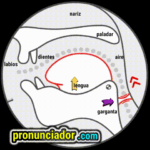
- The Starting Vowel – Open “AW” /ɔ/: Your mouth starts by making the /ɔ/ vowel sound. This is the “AW” sound like in “law“, “caught”, or “thought”. To make it, your mouth is quite open, your lips are rounded, and your tongue is low and pulled back.
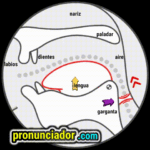
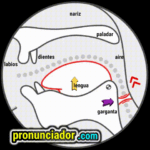
- The Ending Vowel – Short “IH” /ɪ/: From that “AW” position, your mouth quickly changes! Your jaw CLOSES up a bit, your lips SPREAD or stretch slightly (unround), and your tongue moves UP and FORWARD to make the Short I /ɪ/ sound (like in “kid”, “sit”, “big”).
The Magic Formula for the “Boy” Sound /ɔɪ/:
/ɔɪ/ = Start WIDE & ROUNDED for “AW” (/ɔ/) → GLIDE SMOOTHLY UP & FORWARD, SPREADING LIPS to → “IH” (/ɪ/) (mouth more closed, tongue high/front)
It’s one continuous, flowing “Awwwwh-ih!” sound.
Important Note: Length & Loudness!
Like other diphthongs in English, the first part of the /ɔɪ/ glide (the /ɔ/ “AW”) is usually a bit longer and a bit louder than the second part (the /ɪ/ “IH”). The “AW” is the main event, and the “IH” is the quick, smooth finish that gives the diphthong its distinct quality.
Don’t Confuse /ɔɪ/ (Boil) With…
- Just /ɔ/ (Ball): The Flat “AW”
- If you only make the starting /ɔ/ sound (“AW”) and forget to glide to the /ɪ/ (“IH”), you’re missing the diphthong! Your “boil” /bɔɪl/ will sound like “ball” /bɔl/ (or “bawl”).
- ERROR: “Boy” sounds like “Bah.”
- FIX: Remember the “IH” ending! Make sure your jaw rises and lips unround!
- The Long O /oʊ/ (Boat): Too Much Like “Go”
- Sometimes learners might use an /oʊ/ sound (like in “go” or “no“) when they see ‘OI’ or ‘OY’. But /oʊ/ starts more closed, with lips very round, and glides to a /ʊ/ (like in “book”). /ɔɪ/ starts more open with the “AW” sound.
- ERROR: “Choice” sounds like “Chose.”
- FIX: Open your mouth WIDER for the starting “AW” /ɔ/ of /ɔɪ/. It’s a lower, more open starting point than the /oʊ/ in “go”.

Your Mouth’s “AW→IH” Adventure: Making the /ɔɪ/ Sound (Kid-Friendly!)
Let’s get your mouth gliding like a pro! These steps are super simple if you take them one by one.
Step 1: The “AWESOME AW” Start! (Position for /ɔ/)
- Mouth WIDE Open (Like a Yawn… Almost!): Drop your jaw and open your mouth nice and wide, but comfortably. Think of the “aw” in “law” or “saw“.
- Lips ROUNDED (Like you’re surprised! “Ooooh!”): Your lips should make a nice, open circle. Not super tight, just rounded.
- Tongue LOW & BACK: Let your tongue rest low in your mouth, and pull the body of it back a bit, towards your throat.
This is your starting position for the “AW” /ɔ/ sound. Make it clear and strong!
Step 2: The Quick Slide to “ITCHY IH”! (Position for /ɪ/)
Now for the glide! From that open “AW” position, without stopping the sound…
- Jaw MOVES UP (Mouth Closes Partially): Quickly and smoothly bring your jaw up, so your mouth closes to a more narrow, “sliver” opening.
- Lips SPREAD Slightly (From Round to Almost-Smile!): As your jaw rises, your rounded lips quickly change and stretch a little bit to the sides, unrounding from the “AW” shape.
- Tongue MOVES UP & FORWARD! This is key! The front/middle of your tongue rises HIGH in your mouth and moves FORWARD, towards your top front teeth, into the position for the Short I /ɪ/ sound (like in “kid” or “sit”).
Step 3: The Smooth Blend! “AW-ih!” = /ɔɪ/!
The real magic of a diphthong is that it’s ONE unbroken, flowing sound. Your mouth moves while you’re making the sound!
- Start with that strong, open, rounded “AWWW” (/ɔ/).
- Keep your voice going, and let your jaw, lips, and tongue glide smoothly and quickly into the “ih” (/ɪ/) position.
- It should be a fast, connected: “Awwwwwh-ih!” → /ɔɪ/ → “OY!”
- Remember: The “AW” part is a bit longer and louder; the “ih” part is quick and softer, the destination of the glide.
Kid-Friendly Cue: “Imagine you see something AWESOME! (Mouth open, lips round: AWWW!). Then, super fast, you point at it and say ‘IH!’ (Mouth closes a bit, lips unround, tongue shoots up front: IH!). Now do it really fast like one sound: AWW-IH! OY! Like a toy!”
Feeling Check: Do you feel your jaw drop and lips round for the “AW,” then quickly lift and unround for the “IH”? Is the sound smooth and connected? You’re nailing it!
OI or OY? Spelling the Fun /ɔɪ/ Sound!
Good news! Unlike some other English vowels (cough Long E /i/ cough), the spelling for the /ɔɪ/ sound is pretty straightforward! There are really only TWO main ways to spell it.
Pattern #1: ‘OI’ (Usually in the Middle or Beginning) (~60%)
This is the most frequent spelling. If you see ‘OI’ together, it’s very likely the /ɔɪ/ “OY” sound!
- coin /kɔɪn/
- point /pɔɪnt/
- voice /vɔɪs/
- choice /tʃɔɪs/
- noise /nɔɪz/
- avoid /əˈvɔɪd/
- oil /ɔɪl/
- soil /sɔɪl/
- boil /bɔɪl/
- join /dʒɔɪn/
- exploit /ɪkˈsplɔɪt/
- annoy* /əˈnɔɪ/ (Ends in Y but ‘noi’ uses OI)
- appointment /əˈpɔɪntmənt/
- poison /ˈpɔɪzən/
- toilet /ˈtɔɪlət/
- moist /mɔɪst/
Pattern #2: ‘OY’ (Usually at the END of a word or syllable) (~40%)
This is the second most common, and a very reliable clue when it’s at the end!
- boy /bɔɪ/
- toy /tɔɪ/
- joy /dʒɔɪ/
- enjoy /ɛnˈdʒɔɪ/
- destroy /dɪˈstrɔɪ/
- annoy /əˈnɔɪ/
- employ /ɛmˈplɔɪ/
- royal /ˈrɔɪəl/ (OY is before the next syllable)
- loyal /ˈlɔɪəl/
- voyage /ˈvɔɪɪdʒ/ (or /ˈvɔɪədʒ/)
- cowboy /ˈkaʊbɔɪ/
- boyfriend* /ˈbɔɪfrɛnd/ (Compound word with OY at end of first part).
Spelling Tip:
- Think ‘OI’ for the MIDDLE of words (coin).
- Think ‘OY’ for the END of words (boy, toy).
This isn’t 100% foolproof (like “loyal” with ‘oy’ in the middle), but it’s a great general guideline!
The Exception: The Sneaky “Lawyer”
The source material points out one tricky exception:
- lawyer /ˈlɔɪər/ (or more commonly /ˈlɔjər/ where the ‘y’ sound might blend). Here, ‘AWY’ isn’t a typical /ɔɪ/ pattern but can be pronounced with it by some, or the glide to /ɚ/ creates a similar feel. It’s often grouped with ‘OY’ words because of the ‘Y’ and sound quality. It’s a bit of a unique case, just be aware of it! (For simplicity, this guide won’t over-focus on this single, complex exception beyond acknowledging it).
EASY Spelling Summary for /ɔɪ/:
- OI (coin, point): Most common overall.
- OY (boy, toy): Super common at the end of words.
That’s pretty much it! Much easier than many other vowels!
Watch Out! Common “OY-VEY!” Mistakes & Quick Fixes
Where do learners often slip up with this “AW→IH” glide?
- MISTAKE #1: THE FLAT “AW” – NO GLIDE!
- What’s Wrong: You only say the first “AW” /ɔ/ part and forget to slide to the “IH” /ɪ/. Your “boy” sounds like “bah” or “baw.” Your “coin” sounds like “cahn” or “cawn.” It sounds very unfinished.
- THE FIX: MAKE THE SLIDE! Remember it’s a two-part journey: AW → IH. Your jaw MUST close a bit, your lips MUST unround/spread slightly, and your tongue MUST move up/forward for that quick “IH” at the end. Practice “choice” /tʃɔɪs/ and feel the “ih” end.
- MISTAKE #2: Starting Vowel WRONG (Not an Open “AW” /ɔ/).
- Problem: You might start with an /oʊ/ (“go”) sound, or even an /ɑ/ (“hot”) sound, making the whole diphthong sound off.
- The Fix: WIDE MOUTH, ROUND LIPS for the start! Make sure you begin with a clear, open “AW” /ɔ/ sound (like in “law”). Drop your jaw, round your lips. That’s your launching pad.
- MISTAKE #3: Ending Vowel WRONG (Not a Clear “IH” /ɪ/, or maybe too much “EE” /i/).
- Problem: If the glide doesn’t reach a clear /ɪ/ (Short I “ih”) position, it’s weak. If you go too high and tense, making it an “EE” /i/ sound, it will sound like “AW-EE,” which is too much.
- The Fix: Aim for that relaxed Short I /ɪ/ (“sit,” “kid”) as your ending point. Tongue high and front, jaw almost closed, lips neutral or slightly spread. It’s a quick, light touch.
- MISTAKE #4: Making it TWO CHOPPY SOUNDS (AW… IH) Instead of a SMOOTH GLIDE.
- Problem: There’s a noticeable break or bump between the “AW” and the “IH.” It doesn’t flow.
- The Fix: ONE SMOOTH MOTION! Think of it like sliding down a mini-slide – your mouth moves continuously while you’re making the sound. The transition should be seamless. “Aaaaaawwwwww-ih.”
- MISTAKE #5: Not Holding the FIRST Sound (/ɔ/) Longer/Louder.
- Problem: Giving equal time/stress to both parts, or even stressing the “IH” more.
- The Fix: Remember, the “AW” /ɔ/ part is the star of the show. It’s longer and louder. The “IH” /ɪ/ is the quick, softer ending. Emphasize the “AW.”
“Ahoy! Let’s Practice!” /ɔɪ/ Sound Workout!
Time to get that mouth gliding from “AW” to “IH”!
Exercise 1: Isolate the Glide – Slow Motion “AW → IH”!
- Part 1 (Start – /ɔ/): Mouth WIDE OPEN. Lips ROUNDED. Tongue LOW & BACK. Make a clear “AWWW.” (Like in “law”).
- Part 2 (End – /ɪ/): Mouth ALMOST CLOSED. Lips SLIGHTLY SPREAD (Unrounded). Tongue HIGH & FORWARD. Make a quick “IH.” (Like in “kit”).
- NOW GLIDE SLOWLY: Start the “AWWW,” and while keeping sound going, smoothly raise your jaw, unround your lips, and move your tongue up/forward until it becomes “IH.” → “Aaaaaaaawwwwww-iiiiiiih.”
- Speed it up: /ɔ/-/ɪ/… /ɔ/-/ɪ/… /ɔɪ/! /ɔɪ/! /ɔɪ/! (The “OY” sound!)
Exercise 2: Single “AW” (/ɔ/) vs. “OY” Glide (/ɔɪ/)!
This really helps you feel the “IH” ending!
- Law /lɔ/ (SINGLE sound, mouth stays fairly open/round)
- Loyal /ˈlɔɪəl/ (GLIDE, mouth closes, lips unround)
- Ball /bɔl/ (SINGLE)
- Boil /bɔɪl/ (GLIDE)
- Caught /kɔt/ (SINGLE)
- Coin /kɔɪn/ (GLIDE)
- Saw /sɔ/ (SINGLE)
- Soy /sɔɪ/ (GLIDE)
Exercise 3: OI vs OY – Get Used to Both Spellings!
Read these aloud, focusing on the SAME /ɔɪ/ “AW→IH” glide.
- OI: coin, point, voice, choice, noise, avoid, oil, soil, boil, join, poison, moist, broil.
- OY: boy, toy, joy, enjoy, destroy, annoy, employ, royal, loyal, voyage, cowboy.
Exercise 4: The Source’s Top 30 Word Drill!
| PHONETICAL PRONUNCIATION |
| PHONETICAL PRONUNCIATION |
- Start with a good, open, rounded “AW” /ɔ/.
- Make sure you smoothly GLIDE to the “IH” /ɪ/ by raising your jaw and unrounding/spreading your lips.
- The “AW” part should be a bit longer and louder.
RECORD YOURSELF! Can you hear both parts of the slide?
Exercise 5: “The Boy’s Toy Makes Noise!” – /ɔɪ/ Sentences + Recording!
Time to put it all together! Record and listen carefully for that smooth “AW→IH” glide.
- “The boy‘s [ɔɪ] toy [ɔɪ] makes a lot of noise [ɔɪ].”
- “It’s my choice [ɔɪ] to enjoy [ɔɪ] the voice [ɔɪ] of the coin [ɔɪ].”
- “Avoid [ɔɪ] poison [ɔɪ]! Boil [ɔɪ] the oil [ɔɪ] on the soil [ɔɪ].”
- “The royal [ɔɪ] employee [ɔɪ] will exploit [ɔɪ] the joint [ɔɪ].”
- “I appoint [ɔɪ] the cowboy [aʊ][ɔɪ] to destroy [ɔɪ] the void [ɔɪ].” (Tricky cowboy!)

FAQs: Your American /ɔɪ/ (“boy”) Questions Answered!
Q1: What is the /ɔɪ/ “OY” sound, in super simple terms?
It’s like saying “AW” (mouth open, lips round) and then quickly, smoothly sliding your mouth to say “IH” (mouth more closed, lips stretched a bit, tongue up front). AW→IH = OY!
Q2: My “boy” just sounds like “bah” or “boh.” What’s wrong?
You’re likely missing the second half of the slide – the “IH” /ɪ/ part! You MUST make that upward jaw movement and slight lip spread to finish the sound correctly. Don’t just make the open “AW” /ɔ/.
Q3: Is ‘OI’ or ‘OY’ more common for the /ɔɪ/ sound?
‘OI’ is slightly more common overall (around 60%), usually found in the middle or beginning of words (like ‘coin’, ‘voice’). ‘OY’ is very common at the end of words (around 40%, like ‘boy‘, ‘toy‘). Knowing this helps a lot with spelling and pronunciation!
Q4: How is this /ɔɪ/ (“boy”) different from the “OW” in “cow” /aʊ/?
They both glide to an “IH” or “UH” sound, but they START very differently!
- /ɔɪ/ (“boy”): Starts with “AW” /ɔ/ (MOUTH OPEN, LIPS ROUNDED, tongue low/back).
- /aʊ/ (“cow”): Starts with “AH” /ɑ/ (MOUTH WIDE OPEN, LIPS NEUTRAL/UNROUNDED, tongue low/back).
The starting lip shape (rounded vs. unrounded) is a huge difference!
Q5: I find it hard to make the two sounds (/ɔ/ and /ɪ/) flow smoothly. Any tips?
Practice slowly at first, then speed up!
- Say a long “AWWWWWWWWW.”
- Then say a short “ih.”
- Now try to melt the end of the “AWWW” directly into the “ih” without any stop or pause. “AWwww-ih.”
Think of it as one single, changing sound, not two separate ones. Your jaw should be moving UP as you transition.
Final Thoughts: Your American “OY” /ɔɪ/ Will Bring You Joy!
You’ve done it! You’ve explored the fun, gliding “AW→IH” world of the American /ɔɪ/ diphthong! It’s no longer a mystery why “boy” and “coin” have that special twist.
Remember these key treasures:
- /ɔɪ/ = DIPHTHONG GLIDE = “AW” (/ɔ/) smoothly to “IH” (/ɪ/)!
- ARTICULATION: Mouth WIDE/Lips ROUND for /ɔ/ → Jaw CLOSES/Lips SPREAD for /ɪ/. Tongue LOW/BACK → HIGH/FRONT.
- THE GLIDE IS KING! Don’t skip the “IH” ending!
- “AW” IS LOUDER/LONGER: The /ɔ/ part leads.
- SPELLING = OI or OY! (‘OI’ mid-word, ‘OY’ end-word is a good rule of thumb).
- #1 MISTAKE = FLAT “AW” (No IH-glide)! Make that mouth move!
Keep practicing that “AW-IH” slide. Exaggerate the starting “AW” and the ending “IH” at first. Record yourself saying words like “boy,” “toy,” “choice,” “voice,” “join.” Listen to native speakers. Before you know it, your /ɔɪ/ will be bringing you pronunciation joy! You’ve got this!
👇🔥👇🔥👇🔥👇🔥👇🔥👇🔥
👉 RETURNS in the YEAR 2031 ! WHO? CLICK HERE ! 🔥



👇🔥👇🔥👇🔥👇🔥👇🔥👇🔥
👉 RETURNS in the YEAR 2031 ! WHO? CLICK HERE ! 🔥
👇🔥👇🔥👇🔥👇🔥👇🔥👇🔥
👉 RETURNS in the YEAR 2031 ! WHO? CLICK HERE ! 🔥
👉 RETURNS in the YEAR 2031 ! WHO? CLICK HERE ! 🔥