

Struggling with the ‘T’ in “water” or “city”? You’re likely missing the Flap T. Learn the simple rule for this fast, D-like sound and start sounding native today!
When learning American English, many learners stumble oveHey there, American accent aspirants! Get ready for a HUGE pronunciation breakthrough! Ever wondered why Americans often say “water” and it sounds like “waDer”? Or “city” sounds like “ciDy”? And “better” comes out like “beDDer”? If this has made you scratch your head, thinking, “Is it a T? Is it a D? What’s going on?!” – you’re not alone! You’ve just encountered one of the COOLEST and most RHYTHM-DEFINING sounds in American English: the Flap T (or Tap T)! Its secret phonetic codes are /t̬/ (a ‘t’ with a little voiced tick) or, very commonly, /ɾ/ (a fishhook symbol).
This isn’t about being lazy or sloppy; it’s a standard, natural feature of spoken American English! But for learners, it’s a pronunciation minefield!
- The “Too Much T” Trap: You might be carefully pronouncing a very crisp, airy [tʰ] sound in “water” or “party.” It’s understandable, but it can make you sound a bit too formal, more British, or just break the smooth flow of American speech.
- The “Heavy D” Drag: Or, knowing it sounds like D, you might use a full, sometimes heavy /d/ sound. While closer, it’s not quite the super-fast flick of a Flap T.
- The “Is it an R?” Ruse: Some learners even hear it as a type of ‘R’ and try to use their native language’s tapped ‘R’ – big no-no!
- And the BIGGEST Question: WHEN does this magic T-to-D-like transformation happen, and when should I still say a clear T [tʰ] or a held T [t̚]? There IS a simple rule!
You feel frustrated because your T’s sound “off,” your speech isn’t as smooth as you’d like, and this one little sound can make a huge difference in how native-like you sound.
But wave goodbye to “T” confusion! Today, we’re giving you the Golden Key to the Flap T Kingdom! This ULTIMATE, kid-simple guide will make you a Flap T whiz:
- Meet the Speedy Flap T /ɾ/: What is this “fast D-like T” and why is it a “positional variant”?
- The #1 UNDISPUTED RULE for Flap T: We’ll reveal the EASY 2-part secret for when ‘T’ (and often ‘D’!) flips! (Hint: Voiced Neighbors + NO STRESS After!). This is CRITICAL!
- Mouth Moves for a Flashy Flap (EASY-PEASY!): Super-simple, step-by-step on how your tongue does a lightning-fast TAP!
- Flap T vs. Real T vs. Real D vs. Foreign R! Crystal-clear comparisons so you’re never confused again!
- D-Flapping! The “Writer/Rider” Homophone Secret! Why do these sometimes sound THE SAME for Americans?
- When NOT to Flap! Just as important – when to keep your T strong! (Hint: Stress matters!).
- Spelling? Super Easy! (It’s just ‘T’ or ‘TT’ behaving differently!).
- Zap Common Flap Flubs! Fix over-enunciation, heavy D’s, or R-confusion!
- “Water, Better, Party!” Flap T Practice Fiesta! Fun drills with essential words to get your Flap T flying!
Get ready to transform your American T’s and D’s! Your “beautiful,” “daughter,” “computer,” and “hospital” are about to get a major upgrade in natural flow and rhythm! Let’s get it /ˈɡɛɾɪt/!

Unmasking the Flap T /ɾ/ or /t̬/: The “Quick D-Like Tap”
First things first, let’s get properly introduced. The Flap T isn’t a completely new sound like /p/ or /m/. Instead, it’s a special way the /t/ consonant (and often the /d/ consonant too!) is pronounced in American English in specific situations. Sound experts call it a “positional variant” or an “allophone.” Fancy words, but it just means the /t/ sound changes its costume depending on its neighbors in a word!
So, what does it sound like?
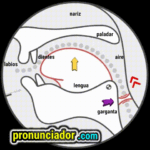
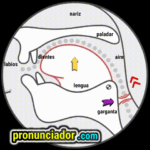
The Flap T [ɾ/t̬] sounds very much like a quick, light American /d/ sound. It’s made by a very fast TAP or FLAP of the tip of your tongue against the alveolar ridge (that bumpy spot just behind your upper front teeth).
Key Characteristics of the Flap T [ɾ/t̬]:
- Alveolar (Tongue-Tip Tap!): The action happens with the tip of your tongue making a very brief contact with the alveolar ridge. It’s the SAME PLACE as for /t/ and /d/!
- VOICED (Throat Buzz ON!): This is HUGE! Even though it often comes from the voiceless /t/, the Flap T sound itself IS VOICED. Your vocal cords VIBRATE when you make it. This is why it sounds so D-like!
- TAP or FLAP (Super Fast Contact!): This isn’t a full stop of air like a regular /t/ or /d/. It’s an extremely quick, light touch of the tongue. The contact is much briefer than for a standard /d/.
- Often an ALLOPHONE of /t/ (and /d/): This means it’s one way the /t/ phoneme (or /d/ phoneme) can sound in American English. It doesn’t change the word’s meaning; it just changes the pronunciation to be more natural and flowing.
Kid-Friendly Summary: “The Flap T is like a super-fast, secret D! When a ‘T’ is feeling relaxed and has nice, buzzy sound-friends around it, instead of doing a big ‘Tuh!’ pop, it just does a quick, little ‘duh!’ tap with its tongue tip behind the top teeth, keeping its voice motor ON! It’s like the T is in a hurry!”
Flap T [ɾ] vs. True /d/ [d]: Speed is the Difference!
While they sound incredibly similar (both voiced alveolar stops/taps), the MAIN perceptible difference is DURATION and FORCE of contact:
- Flap T [ɾ]: Extremely RAPID and LIGHT tap. Tongue flicks quickly.
- True /d/ [d]: Can be a slightly LONGER closure, potentially with more pressure, and a more distinct “stop” quality before release, especially if it’s being clearly enunciated as a /d/.
For many listeners, they are almost indistinguishable in rapid speech. The Flap is essentially the quickest, lightest way to make a voiced alveolar stop.
Flap T [ɾ] vs. Some Foreign “R” Taps: Not the Same!
Some languages (like Spanish, Italian, Portuguese) have a tapped ‘R’ [ɾ] that sounds IDENTICAL to the American Flap T. If your native language has this sound (like the ‘r’ in Spanish “pero” or “cara”), you’re in luck – you can already make the physical motion!
BUT, be careful: Don’t confuse the function. In English, this [ɾ] sound is a variant of T (or D). It’s NOT the English /r/ consonant (which is an approximant, “errr”). So, you wouldn’t use it for the ‘R’ in “red” or “very.”
The GOLDEN RULE for Flap T: WHEN Does ‘T’ Turn into a Fast ‘D’ [ɾ]?
This rule is your superpower for sounding American! The letter ‘T’ (or ‘TT’) very often becomes a Flap T [ɾ/t̬] when it meets TWO critical conditions at the same time:
CONDITION #1: The ‘T’ (or ‘TT’) is BETWEEN TWO VOICED SOUNDS.
- “Voiced sounds” are any sounds where your vocal cords are buzzing. This includes:
- ALL Vowels (a, e, i, o, u, and all their variations).
- Voiced Consonants like /d, b, g, v, ð, z, ʒ, m, n, ŋ, l, r, w, j/.
- Classic Pattern: VOWEL + T/TT + VOWEL
- Water (A is voiced, E is voiced → T between voiced) → /ˈwɔɾɚ/
- City (I voiced, Y (/i/) voiced) → /ˈsɪɾi/
- Better (E voiced, E voiced) → /ˈbɛɾɚ/
- Notice (O voiced, I voiced) → /ˈnoʊɾəs/
- Pattern: R-Sound + T + VOWEL (American /r/ is voiced)
- Party (AR /ɑr/ voiced, Y /i/ voiced) → /ˈpɑrɾi/
- Forty (OR /ɔr/ voiced, Y /i/ voiced) → /ˈfɔrɾi/
- Dirty (IR /ɝ/ voiced, Y /i/ voiced) → /ˈdɜrɾi/
- Pattern: L-Sound + T/TT + VOWEL (or Syllabic L) (American /l/ is voiced)
- Little (I voiced, L syllabic /əl/ voiced) → /ˈlɪɾəl/
- Metal (E voiced, L syllabic /əl/ voiced) → /ˈmɛɾəl/
- Bottle (O voiced, L syllabic /əl/ voiced) → /ˈbɑɾəl/
CONDITION #2: The Vowel Sound (or Syllable) IMMEDIATELY FOLLOWING the ‘T’/’TT’ is UNSTRESSED (Weak).
- This is a CRUCIAL but often under-taught part of the rule! If the syllable right after the ‘T’ has the main stress of the word, the ‘T’ will usually stay as a clear, aspirated [tʰ]!
- Compare:
- Atom /ˈæɾəm/ (T between vowels, ‘om’ is UNSTRESSED → Flap T [ɾ])
- Atomic /əˈtʰɑmɪk/ (T between vowels, BUT ‘tom’ IS STRESSED → Aspirated T [tʰ], NO Flap!)
- Water /ˈwɔɾɚ/ (T between vowels, ‘-er’ is UNSTRESSED → Flap T [ɾ])
- Retain /rɪˈtʰeɪn/ (T between voiced R and vowel, BUT ‘-tain’ IS STRESSED → Aspirated T [tʰ], NO Flap!)
Why does Flapping happen? For EASE & FLOW!
It’s much easier and smoother for your mouth to keep the voicing (throat buzz) going (Voiced Sound → Voiced Flap [ɾ] → Voiced Sound) rather than quickly turning the voice OFF for a voiceless [tʰ] and then back ON again in the middle of a word. It helps American English sound more connected and flowy.
The “D” Flap Too! Writer vs. Rider = Twins!
Here’s something cool: The SAME Flap T [ɾ] rule often applies to the letter ‘D’ as well!
When ‘D’ (or ‘DD’) is between two voiced sounds and the syllable after it is unstressed, that ‘D’ often also becomes a fast, voiced Flap [ɾ]!
- Ladder /ˈlæɾɚ/
- Medal /ˈmɛɾəl/
- Riding /ˈraɪɾɪŋ/
This is why pairs of words like:
- Writer (T flaps) AND Rider (D flaps) can sound EXACTLY THE SAME for many Americans: /ˈraɪɾɚ/!
- Latter (T flaps) AND Ladder (D flaps) can sound EXACTLY THE SAME: /ˈlæɾɚ/!
This is called “Neutralization” – the difference between /t/ and /d/ disappears in this specific Flap context. This is a key feature of General American English!
Your Mouth’s Quick Flick: Making the Flap T [ɾ] (Easy as 1-2-3!)
Ready to make that super-fast, D-like T? It’s like a tiny, quick dance move for your tongue!
Step 1: Mouth Slightly Open, Lips Chillin’.
Keep it relaxed! Mouth is only slightly open. Lips are neutral and relaxed, not doing anything special.
Step 2: Tongue Tip’s QUICK TAP! (Alveolar Ridge)
This is the star of the show!
- The very TIP of your tongue (or the flat blade just behind it) quickly shoots UP.
- It makes a very BRIEF, LIGHT TAP or FLAP against the ALVEOLAR RIDGE (that bumpy spot right behind your upper front teeth).
- It’s much FASTER and LIGHTER contact than for a full /d/ or /t/. Don’t press hard, don’t hold it. Just flick it!
Step 3: Voice BOX ON! (Buzz that Tap!)
Crucial! As your tongue makes that quick tap, your vocal cords MUST be VIBRATING. It’s a VOICED sound.
The Whole Flap T Action: Slightly open mouth, neutral lips + lightning-fast VOICED tap of tongue tip on alveolar ridge = Flap T [ɾ]!
Kid-Friendly “Drum Tap” Cue: “Imagine your tongue tip is a tiny drumstick and the bumpy part behind your top teeth is a tiny drum. Keep your voice motor ‘humming’ in your throat, and then give that drum a super-quick, light TAP with your drumstick tongue: ‘duh!’ but REALLY fast! That’s your Flap T!”
Key Feeling: It’s a very quick, almost effortless flick of the tongue that sounds like a very soft, very fast ‘D’. If you can say the ‘r’ in Spanish “pero” or “cara” quickly, you’re already making this sound!
Flap T Spelling: Simple! Just ‘T’ or ‘TT’ in Disguise!
Great news! The spelling for Flap T is easy because the letters on the page DON’T change!
It’s always the letter ‘T’ or the double letters ‘TT’ that are simply pronounced as a Flap T [ɾ] when they meet the Golden Rule conditions.
- ‘T’ Spelled Words that Become Flap T [ɾ]:
- water, city, data, party, forty, notice, beauty, duty, auto, artist, later, editor, motor, visitor, daughter, dramatic, authority, computer. (List from source + others)
- (Source Pie Chart shows ‘T’ words are ~84% of Flap T instances).
- ‘TT’ Spelled Words that Become Flap T [ɾ]:
- better, little, matter, butter, kitty, tittle (obsolete for small mark), bottle, battle, cattle, settle, chatter, attic, pretty. (List from source + others)
- (Source Pie Chart shows ‘TT’ words are ~16% of Flap T instances).
So, you don’t need to learn new spellings! You just need to learn to RECOGNIZE when a written ‘T’ or ‘TT’ will sound like a Flap T [ɾ] based on its neighbors and the word’s stress!
When NOT to Flap Your T! (Keeping Your T’s “True”!)
Just as important as knowing when to Flap your T, is knowing when NOT to! If you Flap T everywhere, it will sound wrong.
Do NOT Use Flap T [ɾ] in these situations (use Aspirated [tʰ] or Unaspirated/Held [t̚]/[t] instead):
- When ‘T’ is at the VERY BEGINNING of a Word:
- Time, take, toy, tell. (These get a strong ASPIRATED [tʰ] puff!)
- When ‘T’ is at the BEGINNING of a STRESSED Syllable:
- Attack /əˈtʰæk/, Contain /kənˈtʰeɪn/, Return /rɪˈtʰɜrn/. (Strong ASPIRATED [tʰ] puff!)
- When ‘T’ is part of an ST-, STR-, -TS consonant CLUSTER:
- Stop /stɑp/, street /strit/, lists /lɪsts/, acts /ækts/. (Here /t/ is UNASPIRATED [t], a clean pop without the puff, because of the /s/.)
- When ‘T’ is at the VERY END of a Word before a PAUSE:
- Cat, light, what, get. (These are usually UNRELEASED/HELD [t̚] or softly released UNASPIRATED [t], no puff, no voice).
- The Special Case of “T before N” (Glottal T!):
- Button, kitten, certain, important. (This is usually a Glottal Stop [ʔn̩], NOT a Flap T. A different /t/ variation!).
The BIG CLUE for NOT FLAPPING: If the syllable immediately AFTER the ‘T’ is STRESSED, the ‘T’ almost always stays a “True T” (usually [tʰ]). The Flap T [ɾ] LOVES weak, unstressed environments.

“Water” Woes! Common Flap T Blunders & How to Fix ‘Em!
What are the typical trip-ups with this quick D-like T?
- MISTAKE #1: THE “HARD T” HABIT! (Using Aspirated [tʰ] or True [t] where Flap T [ɾ] belongs).
- What It Sounds Like: “WaT-Her” instead of “Wa[ɾ]er.” “CiT-Hy” instead of “Ci[ɾ]y.” It sounds too “crisp,” over-enunciated, and breaks the smooth American flow. It can sound British or very formal.
- THE #1 FIX: EMBRACE THE FLAP! Once you spot the Flap T context (T/TT between voiced sounds, before an unstressed vowel), intentionally make that QUICK, VOICED tap. Let your T “relax” into a [ɾ].
- MISTAKE #2: THE “HEAVY D” DRAG! (Using a full, slower /d/ instead of the quick Flap [ɾ]).
- The Problem: You hear the D-like quality, but you make a full, slightly longer /d/ sound. “WaDDer” (with a clear, full D). While better than a hard T, it’s not quite the light, quick Flap.
- The Fix: SPEED & LIGHTNESS! The Flap T is a very FAST flick of the tongue. Think “tap,” not “stop.” Make the contact with the alveolar ridge super brief.
- MISTAKE #3: THE “FOREIGN R” CONFUSION! (Using a tapped R from another language).
- What Happens: If your native language has a tapped R [ɾ] (like Spanish “pero”), you might use that, which physically is the same sound! But you might be thinking of it as an “R” sound, not as a “T acting like a D.” This isn’t a pronunciation error per se if the sound is right, but it can lead to confusion if you start using it where English actually needs an /r/ approximant (e.g. in “red”).
- The Fix: Just be AWARE that the English Flap T [ɾ] is a variant of the T (and D) sound, not the English /r/ sound (which is very different). The [ɾ] sound is useful, but know its English job description!
- MISTAKE #4: Forgetting the “VOICED SOUNDS ON BOTH SIDES” Rule.
- Problem: Trying to flap a T that’s next to a voiceless sound (like ‘s’ in “faster” – here the ‘t’ would just be unaspirated [t]).
- Fix: Always check the sounds directly BEFORE and AFTER the T/TT. Both must be “buzzy” (voiced).
- MISTAKE #5: IGNORING THE UNSTRESSED SYLLABLE AFTER! (The BIG one!)
- Glitch: Flapping the T in words like “attack” /əˈtæk/ or “retail” /riˈteɪl/ because the T is between vowels.
- Critical Fix: STRESS MATTERS! If the syllable right after the T/TT is STRESSED, the T stays a True T (usually aspirated [tʰ]). Flap T needs that weak, unstressed syllable following it.
Flap T Fiesta! Exercises for a Fabulous Fast Flick!
Let’s get that tongue tapping quickly and lightly!
Exercise 1: Isolate the Quick Voiced Tap [ɾ]
- Start by trying to make a very fast, light American /d/ sound. “D-D-D-D” but make each one super short, like a tiny blip. “də-də-də.”
- If you speak a language with a tapped R [ɾ] (like Spanish “pero,” “caro”), try making that sound. That’s your target!
- Practice: [ɾɑ], [ɾɛ], [ɾɪ], [ɾɔ], [ɾʊ], [ɾeɪ], [ɾaɪ], [ɾɔɪ], [ɾaʊ]. (Flap + Vowel).
Exercise 2: True T [tʰ] vs. Flap T [ɾ] – The Transformation!
Say these pairs, consciously changing from an aspirated T to a Flap T.
- Aspirated: ATOM [əˈtʰɑm] (UK/formal) — Flap: Atom [ˈæɾəm] (AmE)
- Aspirated: WATER [ˈwɔːtʰər] (UK/formal) — Flap: Water [ˈwɔɾɚ] (AmE)
- Aspirated: CITY [ˈsɪtʰi] (UK/formal) — Flap: City [ˈsɪɾi] (AmE)
- Aspirated: BEAUTIFUL [ˈbjutʰɪfəl] (UK/formal) — Flap: Beautiful [ˈbjuɾəfəl] (AmE)
Exercise 3: True D [d] vs. Flap T [ɾ] – Speed & Lightness!
Feel the Flap T being much quicker and lighter than a full /d/.
- Mader (comparative of mad) /ˈmædər/ (Fuller D) — Matter /ˈmæɾɚ/ (Quicker Flap T)
- Ladder /ˈlædər/ (Fuller D) — Latter /ˈlæɾɚ/ (Quicker Flap T)
- Rider /ˈraɪdər/ (Fuller D) — Writer /ˈraɪɾɚ/ (Quicker Flap T)
(Remember, for many Americans, “rider” and “writer” become homophones due to D-flapping, both using [ɾ]!)
Exercise 4: The “When to Flap, When NOT to Flap” Decision Game!
Look at these words. Apply the Flap T rule (Voiced Neighbors + UNSTRESSED Vowel After). Flap or No Flap?
- Waiting (T between vowels I – I, “-ing” unstressed) → YES, Flap! [ˈweɪɾɪŋ]
- Atlas (T between vowel A – L (voiced), “-las” unstressed) → YES, Flap! [ˈæɾləs]
- Potato (T between vowels O – A, “-ta-” is STRESSED for many, “-to” unstressed) → Central ‘t’ becomes flap: /pəˈteɪɾoʊ/. First T often clear, second becomes flap. Careful analysis for ‘potato’: PO-TA-TO. T in TA is often aspirated [tʰ] because ‘TA’ can take stress. T in TO often flaps to [ɾ] because ‘TO’ is unstressed. So po-[tʰ]ei-[ɾ]o. A complex one!
- Retake (verb – stress on TAKE) (T after voiced R, but ‘take’ is STRESSED) → NO Flap for T in ‘take’! [riˈtʰeɪk]
- Dentist (T after N (voiced), but “-tist” often takes stress or T is followed by S (voiceless)) → NO Flap normally. [ˈdɛntɪst] (Unaspirated T after N).
- Outtake (TT between vowels, but ‘take’ is stressed if root word focus, if ‘-take’ is primary stress of compound like noun) → NO Flap for TT in ‘take’. [ˈaʊtˌtʰeɪk]
Exercise 5: Top 30 Flap T Word Workout!
| PHONETICAL PRONUNCIATION |
| PHONETICAL PRONUNCIATION |
- Identify the ‘T’ or ‘TT’.
- Check: Is it between VOICED sounds? YES.
- Check: Is the vowel/syllable AFTER it UNSTRESSED? YES for these.
- Make that VOICED, QUICK alveolar TAP [ɾ]!
RECORD YOURSELF! Are you flapping lightly, or pushing too hard (like D) or too airy (like T)?
Exercise 6: “A Lot of Little Butter” – Flap T Sentences!
Put your Flap T skills to work! Record and listen for smooth, D-like T’s.
- “There’s a lot of [ɾəv] little [ɾəl] butter [ɾɚ] in the city [ɾi].”
- “It doesn’t matter [ɾɚ]; get a better [ɾɚ] bottle [ɾəl] of water [ɾɚ].”
- “The daughter [ɾɚ] and the artist [ɾɪst] had a party [ɾi].”
- “Whatever [ɾɚ] the data [ɾə], notice [ɾəs] the beauty [ɾi].”
- “The visitor [ɾɚ] found a title [ɾəl] for the narrator [ɾɚ].”
FAQs: Your American Flap T (/t̬/, /ɾ/) Questions Answered!
Q1: What IS the Flap T, really? Is it a ‘T’ or a ‘D’? (Kid-Friendly Answer!)
Think of the Flap T /ɾ/ as the “super-fast, secret agent D”! It’s usually a ‘T’ (or ‘TT’) in disguise. When a ‘T’ is chilling out between two “buzzy” (voiced) sounds (like two vowels), and the sound right after it is weak (unstressed), the ‘T’ gets lazy and just does a super-quick, buzzy TAP with its tongue tip behind the top teeth. It SOUNDS almost exactly like a very quick ‘D’, but it’s lighter and faster! So, “water” becomes “wa-[quick D]-er.”
Q2: So, the Flap T is ALWAYS voiced? Even if it comes from ‘T’?
YES! That’s the magic! Even though the letter ‘T’ usually stands for a voiceless sound [tʰ] or [t], when it turns into a Flap T /ɾ/ in American English, it BECOMES VOICED (your throat buzzes). That’s why it sounds so much like a /d/.
Q3: Is Flap T /ɾ/ the SAME as the ‘R’ sound in Spanish “peRo” or “caRa”?
The SOUND is PHYSICALLY IDENTICAL or extremely similar! Both are “voiced alveolar taps.” So, if you can say that Spanish ‘r’, you can make the Flap T sound perfectly!
BUT REMEMBER: In English, this [ɾ] sound is a version of ‘T’ (or ‘D’). It’s NOT the actual English /r/ sound (which is very different – think “red,” “run” – made with a tense, continuous airflow, not a tap). Don’t start using your Spanish tapped ‘r’ for all English ‘R’s! Only for this T/D Flap situation.
Q4: When should I ABSOLUTELY NOT use a Flap T (and use a True T [tʰ]/[t̚] instead)?
The BIGGEST rule for NOT flapping: If the syllable IMMEDIATELY FOLLOWING THE ‘T’ IS STRESSED.
- Examples: attack /əˈtʰæk/ (stress on ‘tack’), return /rɪˈtʰɜrn/ (stress on ‘turn’), until /ʌnˈtʰɪl/ (stress on ‘til’). Here, the ‘T’ will be an aspirated [tʰ].
Also, at the very beginning of words (“time” [tʰaɪm]) or in ‘ST’ clusters (“stop” [stɑp]), you use a True T.
Q5: Does the letter ‘D’ also become a Flap T? So “writer” and “rider” can sound the same?
YES, often! This is a key feature of American English. ‘D’ in the same Flap T environment (between voiced sounds, before an unstressed vowel) very frequently “flaps” to become the same [ɾ] sound.
- So, “writer” (/ˈraɪtər/ → /ˈraɪɾɚ/) and “rider” (/ˈraɪdər/ → /ˈraɪɾɚ/) often sound IDENTICAL for many Americans! Same for “latter” and “ladder” (both /ˈlæɾɚ/).
This doesn’t mean the words are the same in meaning or spelling, just in sound in that context!
Key Takeaways: Your American Flap T Will Make You Sound Super Smooth!
You’ve done it! You’ve dived deep into the Flap T /ɾ/ or /t̬/ – that quick, D-like tap that makes American English flow so naturally. It’s not as mysterious as it seems once you know the rules!
Your “Flap T” Superpowers:
- Flap T /ɾ/ = A Super-FAST, VOICED (Buzzy) Tongue-Tip TAP on the ridge behind your top teeth. Sounds like a quick ‘D’.
- THE GOLDEN RULE: Happens to ‘T’ (or ‘TT’, and often ‘D’/’DD’) when it’s BETWEEN two VOICED sounds AND the vowel/syllable IMMEDIATELY AFTER IT is UNSTRESSED (Weak).
- ARTICULATION: Relaxed mouth, tongue tip QUICKLY taps alveolar ridge, VOICE ON! Much FASTER and LIGHTER than a full /d/.
- WRITER = RIDER! Because of T-flapping and D-flapping, these (and many other) pairs can sound the same!
- WHEN NOT TO FLAP: If the T starts a STRESSED syllable (“aTTACK”), or is initial (“Time”), or in ST- (“STop”), or final (“caT“).
- SPELLING = T or TT. The letters don’t change; only the sound does in the right context.
The key is training your ear to hear Flap T contexts and your tongue to make that quick, light, voiced tap instead of a hard, airy [tʰ]. Listen for it in native speech (it’s everywhere!). Practice with words like “water,” “city,” “better,” “little,” “party.” Record yourself. Soon, your American English will have that smooth, connected, native-like rhythm! You’re on your way!hat the correct pronunciation becomes second nature.
👇🔥👇🔥👇🔥👇🔥👇🔥👇🔥
👉 RETURNS in the YEAR 2031 ! WHO? CLICK HERE ! 🔥



👇🔥👇🔥👇🔥👇🔥👇🔥👇🔥
👉 RETURNS in the YEAR 2031 ! WHO? CLICK HERE ! 🔥
👇🔥👇🔥👇🔥👇🔥👇🔥👇🔥
👉 RETURNS in the YEAR 2031 ! WHO? CLICK HERE ! 🔥
👉 RETURNS in the YEAR 2031 ! WHO? CLICK HERE ! 🔥