
Unlock natural American speech by mastering the /n/ sound. Learn the secret of assimilation, the clear difference between n, m, & ng, and fix common errors
Hey there, future fluent English speakers! Get ready to understand a sound that’s in nearly every English word, yet has a secret life of its own that can completely change how you’re understood: the /n/ sound, like in “nice,” “now,” “open,” or “sunny**”! Its phonetic symbol is just /n/.
You’re probably thinking, “The ‘N’ sound? Easy! My language has an ‘N’!” And you’re right, 80% of the world’s languages have an ‘N’ sound, so it should be no big deal. BUT, in American English, this “N” sound can be quite the chameleon, subtly changing its form depending on the sounds around it. This is where most learners trip up, often without even realizing it!
What’s the “N”-igma?
- “Then” vs. “Them”: Have you ever said “then” and heard people understand “them” instead? It’s a super common error that can mess up your sentences and make you wonder if people truly get your message. This happens because the /n/ subtly changes its mouth position in quick speech!
- “Sin” vs. “Sing”: Or you try to say “sin” but it sounds like “sing”! This is another classic case of the /n/ changing to match the next sound’s place of articulation.
- The Vanishing “N”: Do you sometimes accidentally reduce or even drop the /n/ sound at the end of words, making your English sound less clear?
- Silent ‘N’inja ‘N’s: And just when you think you’ve got it, words like “know” or “sign” appear, where the ‘N’ is present, but the ‘K’ or ‘G’ is totally silent! Confusing!
These “N” dilemmas make your English sound less fluid and can really chip away at your speaking confidence. You want your “money” to be understood and your “open” sentences to flow seamlessly!
But fear not, “N”-lightened learners! Today, we’re cracking the American /n/ code! This ULTIMATE, super-EASY guide (explained so simply your 8-year-old cousin could ace it!) will make you an /n/ native:
- Meet the “Humming N” /n/: What IS this essential “tongue-tip-to-ridge-NOSE-air-ONLY” sound, really?
- The #1 N-Secret: NOSE AIR + Voice ON! Learn how this “nasal consonant” is uniquely different from all other sounds!
- N vs. M vs. NG: The Nasal Family Reunion! Understand their differences by knowing exactly where your tongue (or lips!) makes the block in your mouth!
- The “N-Chameleon” Trick (ASSIMILATION!): Discover how /n/ naturally (and smoothly!) changes its sound to /m/ or /ŋ/ before certain neighbor sounds. This is KEY to sounding natural and overcoming the “then” vs. “them” dilemma!
- Mouth Moves for a Natural /n/ (Kid-Style!): Easy, step-by-step instructions for that perfect tongue-tip-to-ridge connection and nose airflow!
- Zap Common “N”-oisy Errors! Fix dropping /n/, confusing it with /m/ or /ŋ/, and make sure your silent ‘N’s stay silent!
- “Nine Natural N’s!” Practice! Awesome drills with essential words (‘now’, ‘open’, ‘sunny’, ‘nine’, ‘and’, ‘in’, ‘money’, ‘know’) to make your American /n/ sound native and smooth!
Get ready for your “name,” “need,” “next,” and “nothin'” to sound undeniably fluent and naturally American! Let’s get “n”-terested!

What is This “Humming” /n/ Sound? (The Nose-Only Consonant!)
First, let’s properly introduce our star for today: the American English /n/ sound. You hear it everywhere: at the beginning of “nice” or “now,” in the middle of “sunny” or “open,” and at the end of “then” or “run“! . Its phonetic symbol is just /n/.
The /n/ sound is one of the three Nasal Consonants in American English. The other two are /m/ (“man,” “hum“) and /ŋ/ (“sing,” “think“).These are special because the air flows out ONLY through your nose, not your mouth! This is why they sound like hums.
Its Core “N”-utrients (Kid-Friendly Version!)
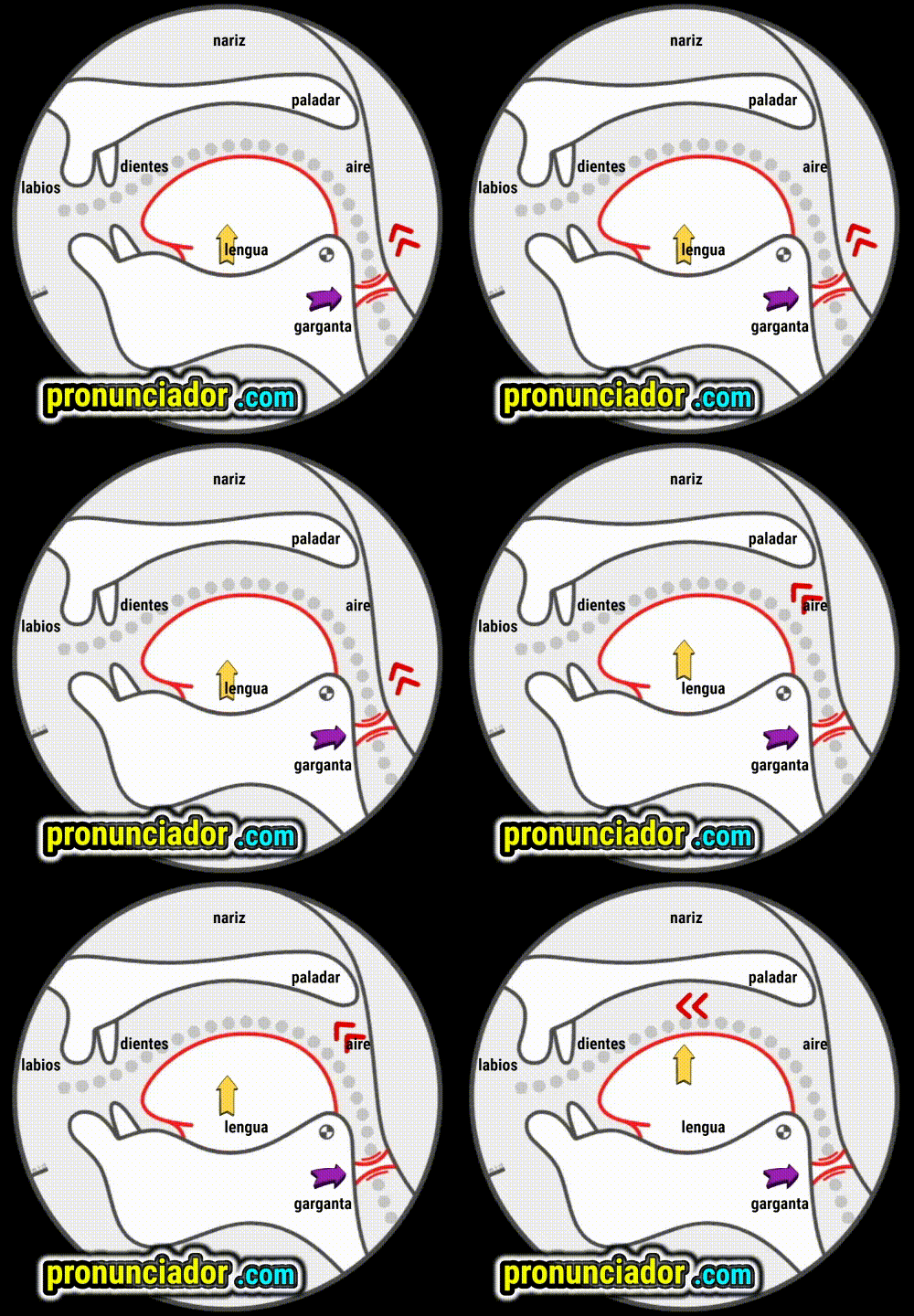
Sound experts call /n/ an “alveolar, voiced, nasal consonant.” Let’s break that down for real life:
- Alveolar (Tongue Tip Blocks Front of Mouth!): “Alveolar” tells you where the sound is made. It’s the alveolar ridge – that bumpy spot on the roof of your mouth right behind your upper front teeth. For /n/, the TIP of your tongue (or the flat part just behind it, the blade) presses FIRMLY against this alveolar ridge, completely blocking all airflow from coming out of your mouth!
- VOICED (Throat BUZZES ON!): “Voiced” means your vocal cords (voice box in your throat) are TURNED ON and VIBRATING continuously while you make the /n/ sound. You should feel a steady BUZZ or HUM in your throat and inside your nose!
- Nasal (AIR OUT NOSE ONLY!): This is what makes it unique! While your tongue blocks the air in your mouth, your SOFT PALATE (velum, the squishy back part of your mouth’s roof) lowers. This opens up the path to your nasal cavity, and the voiced, buzzing air flows OUT THROUGH YOUR NOSE! Your mouth should stay closed or nearly closed for the air to escape only nasally.
Super-Simple “Humming Nose” Summary for /n/:
- Open your mouth slightly, lips relaxed.
- Press the TIP of your tongue against that bumpy ridge behind your top front teeth. Block the mouth path!
- Turn ON your throat buzz! Feel the humming.
- Let that humming air flow ONLY out through your NOSE (your mouth should be closed, no air coming out there!). “Nnnnnnnnnn!” Like a soft, gentle hum from your nose!
The Nasal Family Reunion: /n/ vs. /m/ vs. /ŋ/ (Place of Blockage is KEY!)
These are the three nasal consonants in American English. They all involve air flowing through the nose and vocal cords vibrating (they are all voiced nasals). The ONLY thing that separates them is WHERE in the mouth the air is blocked!
| Consonant | IPA | Place of BLOCKAGE | Articulators Used | Example Word |
| /m/ | /m/ | Front – Both Lips | Lips together | man, hum |
| /n/ | /n/ | Middle – Tongue Tip to Alveolar Ridge | Tongue Tip to Alveolar Ridge | nice, run |
| /ŋ/ | /ŋ/ | Back – Back of Tongue to Soft Palate | Back of Tongue to Soft Palate (velum) | sing, think |
Common Errors & Why Knowing These Helps:
Learners often confuse /n/, /m/, and /ŋ/ especially at the end of words or when words are linked quickly. Knowing where to put your tongue (or lips!) is the precise fix!

The “N”-Chameleon: When /n/ Subtly Changes its Sound (Assimilation!)
Here’s the American English secret! The /n/ sound (and other nasals) likes to be super smooth and efficient. So, in fast, natural speech, its place of articulation (where the tongue tip blocks the air) will often change to match the place of articulation of the consonant that comes RIGHT AFTER it! This is called assimilation. It helps your speech flow without pausing to reposition your tongue.
Change #1: /n/ Becomes /m/ Before “Lip Sounds” (Bilabial Consonants)
- When /n/ is immediately followed by a bilabial consonant (made with BOTH lips: /p, b, m/), the /n/ will often naturally (and subtly) change to an /m/ sound! This happens because it’s easier to just close your lips (for /m/) than lift your tongue to the alveolar ridge (for /n/) if your lips are already moving for the next sound.
- Original Sounds American Problem 1: The contrast “Then” /ðɛn/ vs “Them” /ðɛm/. The SA source describes the mistake as pronouncing final /n/ as /m/ in “then” making it “them.” But linguistically, “then” /ðɛn/ vs. “them” /ðɛm/ are distinct words, the mistake is substitution. However, the deeper lesson (which the original video may not explicitly state but assimilation theory explains) is how the N assimilates to /m/ or /ŋ/. This will be framed as a coarticulation.
- Common Assimilation (N → M):
- “ten pounds” /tɛm ˈpaʊndz/ (sounds like “tem pounds”)
- “in bed” /ɪm ˈbɛd/ (sounds like “im bed”)
- “run many” /rʌm ˈmɛni/ (sounds like “rum many”)
- (This often happens across word boundaries or inside words, but not so commonly that ‘then’ fundamentally shifts to ‘them’ as its standard pronunciation. The problem illustrated by the source is mistaking final /n/ for /m/ where /m/ has its own articulation place.)
- Common Assimilation (N → M):
- Why does this happen naturally? To make the flow of sound easier between /n/ and the following /p, b, m/. Your tongue starts to move the easiest way.
Change #2: /n/ Becomes /ŋ/ Before “Back-of-Mouth Sounds” (Velar Consonants)
- When /n/ is immediately followed by a velar consonant (made with the BACK of the tongue: /k, ɡ/), the /n/ will often (and subtly) change to an /ŋ/ sound! This happens because it’s easier to just use the back of your tongue for /ŋ/ than lift your tongue tip for /n/ if your tongue is already preparing for the next sound.
- Original Sounds American Problem 2: The contrast “Sin” /sɪn/ vs “Sing” /sɪŋ/. The SA source says confusion leads to pronouncing final /n/ as /ŋ/. This is the error as /n/ is alveolar, not velar. However, assimilation (which the video highlights as a distinction that happens, though not necessarily the mistake per se but where N becomes /ŋ/) helps learners distinguish sounds like the final N of ‘sin’ vs. ‘sing’ directly in place of the mistake, which is to pronounce ‘n’ as ‘ng’. This will be clarified as learners must not confuse the two unless it’s specific natural assimilation.)
- Common Assimilation (N → ŋ):
- “in case” /ɪŋ ˈkeɪs/ (sounds like “ing case”)
- “ten games” /tɛŋ ɡeɪmz/ (sounds like “teng games”)
- Common Assimilation (N → ŋ):
- (Remember: The written ‘NG’ is typically the /ŋ/ sound in English. We’re talking about words where the ‘N’ changes sound here.)
The BIG Takeaway: These “changes” from /n/ to /m/ or /ŋ/ are natural and often unstressed in native speech. For learners, the key is not to force this assimilation unless you are fluent, but to recognize it and understand why you’re hearing it. For individual words, always make the True N unless a word is historically ‘m’ or ‘ng’ in its base form. The problem in the source is learners making the “error” (sin vs sing).
Challenges with the Final /n/: Dropping, Over-Articulation, and Its Core Nature
- Dropping or Reducing Final /n/: This is a common problem Learners might shorten words, making “runnin'” sound like “runni'” or “gonna” like “gonna-” (without the final N). The American /n/ should always be present at the end of words where it is spelled (unless it’s silent).
- Over-Articulating Final /n/: Some learners might release the /n/ with an unwanted oral “pop” at the end, adding a vowel sound, making “run” sound like “ruh-NUH.”
- True Nature of Final /n/: Remember, it’s nasal! The air only comes out of your nose. Keep your mouth path blocked with your tongue.
Your Mouth’s “Humming N” Action: Making the /n/ Step-by-Step!
Ready to get that buzzing nose-only sound flowing smoothly?
Step 1: Mouth Slightly Open, Lips Chillin’.
Your mouth is slightly open, lips are neutral and relaxed. They stay out of the way for /n/ (unless preparing for /m/ if N assimilates!).
Step 2: Tongue Tip – The Oral Blocker!
- Bring the TIP of your tongue (or the blade part just behind it) up and PRESS it FIRMLY against the ALVEOLAR RIDGE (that bumpy spot right behind your top front teeth). This makes a complete seal, blocking all airflow from coming out of your mouth!
Step 3: Voice Motor ON! (BUZZ That Hum!)
- This is nasal! As your tongue makes the seal, turn ON your voice motor! Your vocal cords MUST be vibrating. Feel that steady buzz in your throat and the vibration going up into your nose.
Step 4: Airstream – OUT THROUGH THE NOSE ONLY!
- While your tongue blocks the air in your mouth AND your vocal cords are buzzing, ensure the SOFT PALATE (velum) is lowered. This opens the pathway to your nasal cavity.
- Direct all the buzzing airflow OUT THROUGH YOUR NOSE! Your mouth must remain sealed by the tongue tip. No air escapes from your mouth. “Nnnnnnnn!”
Kid-Friendly “Nose Hum” Cue: “Imagine you’re humming, but you’re trying to keep the sound locked inside your mouth with your tongue tip touching that bumpy spot behind your top teeth. All the sound comes out of your NOSE, buzzing softly! ‘Nnnnnnnnnn!’ Feel your nose wiggle!”
Key Feeling: Tongue tip pressed firmly at the alveolar ridge. Throat buzzing. Air flowing ONLY out through the nose. Your mouth remains still while you hum through your nose.
Spelling the “N”-Sound: Mostly ‘N’, but Some Nasty Ninjas!
Thankfully, the /n/ sound’s spelling is pretty consistent!
The CHAMPION: Letter ‘N’! (~99% of /n/ sound instances)
The vast, vast majority of the time, the /n/ sound is simply spelled with the letter ‘N’!
- nice, now, name, navy, need, neighbor, new, next, night, nose, not, note, none.
- In, on, man, run, fun, done, can, known, seen.
- Sunny, lenguage, single, final, sentence, winter, lunch.
- nn: sunny, dinner, tennis, connect. (These often mark preceding vowel as short.)
The “N”-inja Silent Letters: ‘KN’ and ‘GN’!
These are the main spelling traps! Sometimes ‘N’ makes the sound, but another letter nearby is SILENT!
- ‘KN’ at the BEGINNING of a word: The ‘K’ is SILENT; you only hear the /n/ sound.
- Know /noʊ/ (sounds like “no”)
- Knee /ni/ (“nee”)
- Knife /naɪf/ (“nife”)
- Knight /naɪt/ (“night”!)
- Knock /nɑk/ (“nock”)
- Knit /nɪt/ (“nit”)
- Knob /nɑb/ (“nob”)
- Knowledge /ˈnɑlɪdʒ/ (“nol-edge”)
- ‘GN’ at the BEGINNING or END of a word: The ‘G’ is SILENT; you only hear the /n/ sound.
- Gnat /næt/ (G silent, sounds like “nat”)
- Gnaw /nɔ/ (G silent)
- Sign /saɪn/ (G silent, sounds like “sine”)
- Reign /reɪn/ (G silent)
- Foreign /ˈfɔrən/ (G silent)
- Design /dɪˈzaɪn/ (G silent)
- Campaign /kæmˈpeɪn/ (G silent)
- (Careful! If ‘gn’ is in the middle and pronounced, both sounds usually heard: ‘mag_net’ /mæɡnət/.)
Spelling Summary for /n/: Mostly ‘N’, plus the silent ‘K’ (KN-) and silent ‘G’ (GN-) patterns!
Oops! Common /n/ Nonsense & Super Fixes!
What are the typical “N” mistakes that can trip you up?
- MISTAKE #1: “N” Sounds Like “M”! (Confusing /n/ with /m/ or Final Position Error)
- The Glitch: Especially at the end of a word or before words starting with /p, b, m/. Your tongue tip isn’t firmly touching the alveolar ridge. Instead, you’re closing both lips. So “then” sounds like “them,” “run” sounds like “rum.”
- THE FIX: TONGUE TIP ACTIVELY TOUCHES RIDGE! Even in fast speech where some assimilation might occur, for standard, clear speech, focus on your tongue tip firmly pressing the alveolar ridge for /n/. For /m/, only your lips close. Make sure your mouth is open slightly at the beginning for /n/ and for /m/, your lips meet tightly. Compare “rum” (lips closed) with “run” (tongue tip at ridge).
- MISTAKE #2: “N” Sounds Like “NG”! (Confusing /n/ with /ŋ/)
- The Problem: Your tongue tip is not reaching the alveolar ridge. Instead, the back of your tongue is closing against the soft palate. “Sin” sounds like “Sing.”
- THE FIX: TONGUE TIP ACTIVELY TOUCHES RIDGE! For /n/, the very tip of your tongue (or blade) must block the front of the mouth at the ridge. For /ŋ/, the back of your tongue blocks the back of the mouth. Feel where your tongue blocks!
- MISTAKE #3: REDUCING OR DROPPING Final /n/s!
- Uh-Oh: Your /n/ sound just disappears at the end of words or phrases, making words unclear.
- The Fix: FULLY FORM THAT /n/! Consciously ensure your tongue tip touches the alveolar ridge, and you release the sound through your nose. Practice holding the final /n/ for a moment: “Ruunnnnnn.” “Thhheeennnnnn.”
- MISTAKE #4: Pronouncing Silent ‘K’ or ‘G’ in KN-/GN- words!
- Oops! Saying “KUH-now” for “know,” or “GIH-nat” for “gnat,” or “SIH-gn” for “sign.”
- Solution: LEARN THE SILENT RULES! Remember that ‘K’ in ‘KN-‘ and ‘G’ in ‘GN-‘ at the beginning or end are usually GHOSTS.
- MISTAKE #5: Not Getting Enough NASAL AIRFLOW!
- What Happens: Your /n/ sounds muffled or blocked in the nose, or some air might leak out of your mouth.
- The Fix: NOSE BREATH & BUZZ! Ensure your soft palate is fully lowered, allowing air to escape through your nose ONLY. Practice holding your nose for a moment as you make the sound to check if any air escapes orally! You should feel the strong nasal buzz.

The “N”-Sensation: Your American /n/ Practice Power-Up!
Let’s make that humming nasal sound absolutely perfect!
Exercise 1: The “Humming Nose” Drill – Pure /n/ Power!
- Tongue tip pressed firmly to alveolar ridge (bumpy part behind top teeth). Lips neutral. Throat buzzing.
- Blow air ONLY through your NOSE (mouth path blocked!).
- Make a long, steady hum: “Nnnnnnnnnnnnnnnnnn…”
- Hold it for 5-10 seconds. Feel the strong nasal buzz. If air comes from mouth, you’re not sealing tight!
Exercise 2: N vs. M vs. NG – Mastering the Blockage!
Feel WHERE the sound blocks in your mouth. All are voiced and nasal.
- M (Lips) — N (Tongue Tip on Ridge) — NG (Back of Tongue to Soft Palate)
- Hum (block lips) — Hun (block tip) — Hung (block back of tongue)
- Come (block lips) — Cone (block tip) — (No word for conG)
Exercise 3: The “N-Chameleon” Assimilation Test! (When N Changes!)
Focus on naturally shifting where N blocks its air, making it sound like M or NG for smoother flow. (This usually happens faster in everyday speech, but practice slowly to feel the change.)
- N → M (before P, B, M, W):
- “ten people” → “tem people” (mouth wants to close for P)
- “in bed” → “im bed” (mouth wants to close for B)
- “one minute” → “om minute”
- N → NG (before K, G):
- “ten cents” → “teng cents” (back of tongue wants to block for K)
- “in green” → “ing green” (back of tongue wants to block for G)
Exercise 4: Final /n/ Focus – Keep It Clear!
Practice words ending in /n/, ensuring it’s clear and fully nasal (not dropped, not changed, no oral pop).
- Run. Fun. Gun. Sun. Then. When. Known. Open. Lane. Plane. Phone. Wine. Nine. One. An. On.
Exercise 5: Silent ‘N’inja ‘N’ Drill! (DO NOT Say K or G!)
Practice these words, remembering the K or G is silent!
- Know (no)
- Knife (nife)
- Knight (night)
- Knee (nee)
- Sign (sine)
- Foreign (foren)
- Gnat (nat)
Exercise 6: Top 30 “N” Word Workout!
| PHONETICAL PRONUNCIATION |
| PHONETICAL PRONUNCIATION |
For EACH word:
- Is the /n/ blocked at the alveolar ridge (True /n/)? Or does it assimilate to /m/ or /ŋ/?
- Is the airflow ONLY nasal?
- Is the voice ON and humming?
- If silent (like know, sign), is the preceding K/G gone?
RECORD yourself! Listen carefully for tongue placement and nasal airflow!
Exercise 7: “N”-at-ural Sentences! Put your /n/ to the Test! + RECORD!
Record yourself. Listen for those clear N’s, and check for natural assimilation or dropping issues.
- “No [n] one [n] can [n] run [n] to that fun [n] win [n].”
- “Now [n], know [n] the name [n] and number [n] for the next [n] linen [n] drain.” (Subtle N->M for numb/er, nasal /n/ in linen, drainage /dɹeɪnɪdʒ/)
- “When [n] ten [n] men [n] mentioned [n] my known [n] opinion [n], I’d be in [n] panic [n].” (Mixing assimilated /m/ from /n/ for ten men)
- “Knives [n] and knobs [n] are no [n] longer [ŋ] in use.” (Silent K, N vs NG here!).
- “A unicorn [n] has one [n] horn, and is [n] fine [n].”
FAQs: Your American N Sound /n/ (“Nice, Now”) Questions Answered!
What makes the American N /n/ sound special compared to just ‘any’ N sound?
The American /n/ is characterized by:
- Precise Oral Blockage: The tip of your tongue firmly presses against your alveolar ridge (behind upper front teeth).
- Strictly Nasal Airflow: The sound, with your voice on, must ONLY escape through your nose. Your mouth is blocked!
- Its Role in Assimilation: It frequently (and naturally) changes its place of articulation to match neighboring sounds (sounding like /m/ or /ŋ/) for smoother speech.
How is N /n/ different from M /m/ and NG /ŋ/ sounds? They all hum through the nose!
They are all voiced nasal consonants, meaning air goes through the nose with voice ON. The only difference is the PLACE WHERE YOUR MOUTH BLOCKS THE AIR:
- /m/ (Man, Hum): Air is blocked by BOTH LIPS together. (Front of mouth).
- /n/ (Nice, Run): Air is blocked by TONGUE TIP on the ALVEOLAR RIDGE. (Middle of mouth).
- /ŋ/ (Sing, Think): Air is blocked by BACK OF TONGUE on the SOFT PALATE. (Back of mouth).
Practice feeling WHERE the block is in your mouth for each sound!
Why does ‘N’ sometimes sound like ‘M’ (e.g., “ten pounds” sounds like “tem pounds”) or ‘NG’ (e.g., “in case” sounds like “ing case”)?
This is a natural process called ASSIMILATION! Your mouth is being efficient!
- ‘N’ becomes ‘M’: When /n/ is followed by a bilabial consonant (made with lips: /p, b, m/), it’s easier to move your tongue to close your lips (for /m/) than to move it to the alveolar ridge.
- ‘N’ becomes ‘NG’: When /n/ is followed by a velar consonant (made with back of tongue: /k, ɡ/), it’s easier to move your tongue to block the back of your mouth (for /ŋ/).
As a learner, focus on recognizing this rather than forcing it, but know it makes speech smoother!
I often reduce or drop the final ‘N’ sound in words like “then.” How can I make it clear?
This is a common issue!
- Fully Form the /n/: Make sure your tongue tip actually touches the alveolar ridge firmly for the /n/.
- Direct Nasal Airflow: Consciously ensure the air is flowing ONLY through your nose with a clear buzz.
- Practice Exaggerating: Say “thennnnnn” or “runnnnnn” slowly, holding the /n/ for a moment, to build the muscle memory and awareness.
What are common words where ‘K’ or ‘G’ are silent, but ‘N’ is still pronounced?
- Silent ‘K’: In words starting with KN-, the ‘K’ is silent and you only hear the /n/ sound: know, knee, knife, knight, knock.
- Silent ‘G’: In words starting with GN- or ending in -GN, the ‘G’ is silent: gnat, gnaw, sign, reign, foreign, design.
These are common exceptions to memorize!
Key Takeaways: Your American N Sound is Now “Naturally Native”!
Excellent work! You’ve unlocked the subtle but super-important world of the American /n/ sound! You now know it’s not just a letter, but a buzzing, nasal consonant with specific articulation points and fascinating chameleon-like assimilation patterns.
Remember these “N”-credible points:
- /n/ = TONGUE TIP Blocks Mouth (Alveolar Ridge) + VOICE ON + AIR Out NOSE ONLY! (Voiced Alveolar Nasal).
- NASAL FAMILY: Differentiated by where air is blocked: Lips (/m/), Tongue Tip (/n/), Back Tongue (/ŋ/).
- ASSIMILATION MAGIC! /n/ naturally changes to /m/ before /p, b, m/ (e.g., “ten pounds”→”tem pounds”) and to /ŋ/ before /k, ɡ/ (e.g., “in case”→”ing case”). Recognize this in native speech!
- FINAL /n/: Keep it clear, fully nasal, and don’t drop it!
- SILENT ‘N’INJA ‘N’s: Master KN- and GN- words (know, sign).
- COMMON ERRORS: Confusing /n/ with /m/ or /ŋ/ (especially in finals), and reducing/dropping final /n/.
The core of mastering /n/ is consistently blocking air with your tongue tip at the alveolar ridge and releasing it only through your nose while buzzing. Practice feeling those blockage points. Listen carefully for nasal assimilation. Record yourself saying those final N’s clearly! Your English will sound noticeably smoother and more American! You’re on the nice [naɪs] road to native [ˈneɪtɪv] clarity!
👇🔥👇🔥👇🔥👇🔥👇🔥👇🔥
👉 RETURNS in the YEAR 2031 ! WHO? CLICK HERE ! 🔥




👇🔥👇🔥👇🔥👇🔥👇🔥👇🔥
👉 RETURNS in the YEAR 2031 ! WHO? CLICK HERE ! 🔥
👇🔥👇🔥👇🔥👇🔥👇🔥👇🔥
👉 RETURNS in the YEAR 2031 ! WHO? CLICK HERE ! 🔥
👉 RETURNS in the YEAR 2031 ! WHO? CLICK HERE ! 🔥