
Confuse “hot” and “hut”? Your American AH /ɑ/ vowel might be the problem. Learn the #1 fix for a clear, confident sound with step-by-step drills
Hey there, awesome American English learners! Ready to conquer a super common vowel sound that seems simple, but often hides surprising secrets? We’re talking about the AH Vowel sound, like the ‘O’ in “got**”, “stop**”, “hot**”, or the ‘A’ in “father” and “calm“! Its secret phonetic symbol is /ɑ/.
Now, you might think, “The ‘AH’ sound? Easy! Like ‘ahh’ in almost any language!” And you’re partly right. This sound is common worldwide BUT, the American /ɑ/ (especially compared to similar vowels) has some unique “power moves” in your mouth that, if you miss them, can lead to real confusion!
What kinds of “AH”-cidents do learners often make?
- The “Hut” Hijack! This is a huge one. Does your “got” accidentally sound like “gut” /ɡʌt/? Or “hot” like “hut” /hʌt/? This happens when your mouth isn’t open wide enough or your tongue isn’t low and flat enough for /ɑ/!
- The “Hat” Mix-Up! You try to say “dock” /dɑk/ (for boats), but it accidentally sounds like “duck” /dʌk/ (the bird), or perhaps “dack” (like a name using /æ/ in ‘cat’)! It sounds subtle, but it matters!
- The “Caught” Catastrophe! Are you saying “caught” and “cot” exactly the same way, but aren’t sure why? For many American English speakers, there is a subtle (or big!) difference in lip rounding between these sounds, which affects words like “hot” vs “thought”!
- Spelling Surprises! What’s with the ‘A’ in “want” and “wash” sounding like an ‘O’ /ɑ/? And why is ‘O’ in “got” the most common spelling for /ɑ/? It’s confusing!
You’re trying to communicate with confidence, but these subtle vowel differences cause clarity problems, leading to awkward moments and hitting your speaking confidence. You want your “father” to sound warm and clear, not fuzzy or strange!
But good news! Today, we’re unlatching the Ultimate Guide to the American AH Vowel /ɑ/! This super-duper-EASY explanation will turn you into an /ɑ/ master:
- Meet the POWERFUL AH /ɑ/: What is this “jaw-dropping, tongue-flat-and-low” sound?
- The #1 Game-Changer: MOUTH WIDE OPEN! This is THE core secret to perfecting your /ɑ/ (and avoiding /ʌ/ or /æ/ confusion!).
- AH vs. UH vs. AAH: Sound Battles De-Mystified! We’ll give you crystal-clear tricks to tell the difference between /ɑ/ (“got”), /ʌ/ (“hut”), and /æ/ (“hat”) – game-changing clarity!
- Spelling Super-Tips! O is king! But ‘A’ and ‘AL’ can also make this sound (‘want,’ ‘calm’)! We’ll map it out.
- Zap Common “AH”-ccident Errors! No more confusion between “hot” and “hut”!
- “Top That!” Practice! Awesome drills with essential words (‘not’, ‘want’, ‘got’, ‘stop’, ‘box’, ‘father’, ‘job’, ‘hot’) to make your /ɑ/ flawlessly natural!
Get ready for your “dock,” “hop,” “lot,” and “watch” to sound open, clear, and perfectly American! Let’s go!

What IS This /ɑ/ “AH” Vowel Sound? (The Jaw-Dropping Truth!)
First, let’s properly introduce our vowel of the day: the American English /ɑ/ sound. You hear it at the beginning of “October” (for some!), or in the middle of “got,” “hot,” “stop,” “dock,” and “father.” Its phonetic symbol is /ɑ/.
The /ɑ/ is one of the twelve basic “single” vowel sounds in American English. This sound is quite common across the globe, but its precise execution in American English has some distinct characteristics!
Its Core “AH”-tributes (Explained Super Simply!)
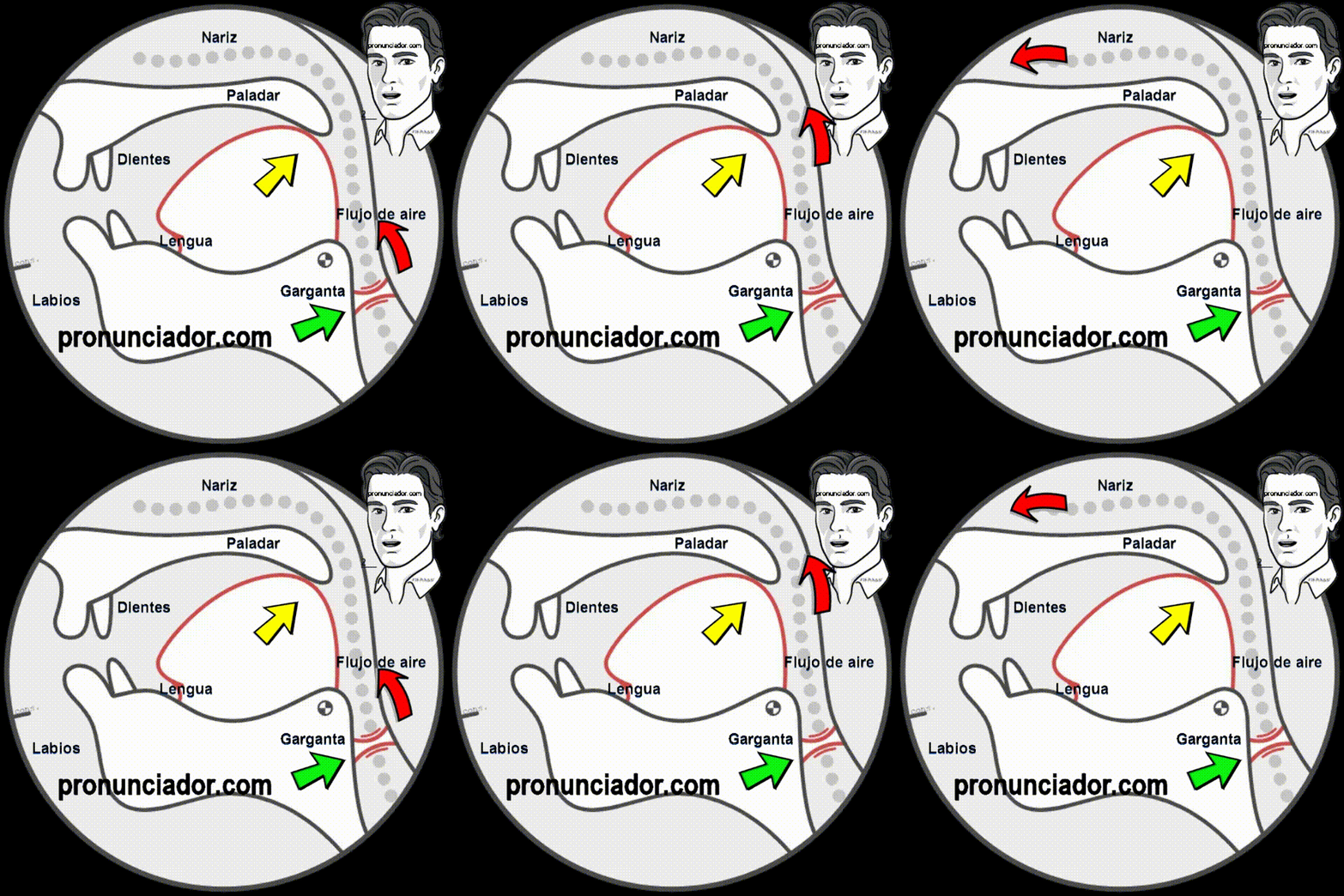
Sound experts (the “vowel geeks!”) describe /ɑ/ as a “low, tense, central vowel.” Let’s break that down into easy action steps:
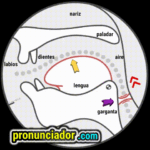
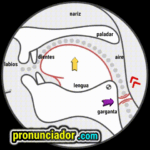
- Low (MOUTH WIDE OPEN!): This is THE #1 rule for /ɑ/! “Low” means your jaw must drop VERY WIDE (the lowest point of your mouth opening for any vowel). Open your mouth as wide as possible, comfortably! Like saying “AHHH” for the doctor!
- Central (Tongue in the Middle!): Your tongue generally stays flat and relaxed in the center of your mouth, quite low. It’s not pulled far forward (like for /i/ or /æ/) nor pushed extremely far back (like for /u/).
- Tense (Muscles Active, But NOT Strained!): The sound needs to be sustained with some active muscularity in your tongue. It’s not floppy or completely passive. Your tongue needs to be “flat and low” (as per steps below) but “tense.” Don’t let your tongue feel completely like jelly; there’s subtle engagement.
- Neutral Lips (NO Rounding!): This is important! Your lips should be relaxed and in a neutral position. They should NOT be rounded (like for /oʊ/ or /ɔ/) nor overly spread (like for /i/ or /æ/). Just natural, open.
Super-Simple “Doctor’s AHHH” Summary for /ɑ/:
- Drop your JAW down WIDE. Like eating a big slice of pizza.
- Keep your LIPS totally RELAXED and neutral. Don’t round them!
- Let your TONGUE lie flat and low in the middle of your mouth. Make it active (tense!) not limp.
- Then, just make a clear “AHHHHH!” sound from there. “AHHHH!”
Key Feeling: The defining feeling is that MASSIVE jaw drop and wide-open mouth, with a flat, low tongue. It’s an open, bright “AH” sound!
The Big “AH” Battle: /ɑ/ (Got) vs. /ʌ/ (Gut) vs. /æ/ (Gat) vs. /ɔ/ (Bought)
These are often confused! Let’s clear the air for your ears and mouth!
- /ɑ/ (Got): WIDE Mouth, Tense Tongue, Neutral Lips. This is our star. Lowest jaw, relatively neutral tongue position, lips do nothing.
- Cot /kɑt/, Dock /dɑk/, Father /ˈfɑðər/, Watch /wɑtʃ/.
- /ʌ/ (Gut): Mid-Low Mouth, Relaxed Tongue, Neutral Lips. This is the “UH” sound from “cup” or “sun.” The biggest mix-up!
- The Key Difference: The /ʌ/ has a less extreme jaw drop (mouth is less wide) and the tongue is relaxed, where /ɑ/ has a very wide jaw drop and a tense tongue.
- Mix-Up: “Got” sounds like “Gut”!
- FIX: Make sure your jaw drops VERY WIDE for /ɑ/, and the tongue is tensed! For /ʌ/, relax everything more, less jaw drop.
- /æ/ (Gat): Wide Mouth, Tongue FORWARD, Stretched Lips. This is the “AAH” from “cat” or “hat.”
- The Key Difference: Both /ɑ/ and /æ/ have wide jaw drops. BUT for /æ/, the tongue is pulled forward, and lips are stretched into a slight, flat smile. For /ɑ/, the tongue is in the center/back and lips are neutral.
- Mix-Up: “Mock” /mɑk/ (imitate) might sound like “Mack” /mæk/ (name/brand).
- FIX: For /ɑ/, tongue is back/center, lips neutral. For /æ/, tongue forward, lips spread.
- /ɔ/ (Caught): Wide Mouth, Tense Tongue, LIPS ROUNDED! This is the “AWW” sound from “law” or “thought.” (This vowel often merges with /ɑ/ in many American dialects, making “cot” and “caught” sound the same. However, other dialects keep them separate, and articulating the distinction improves clarity and is what Sounds American is teaching).
- The Key Difference: Both /ɑ/ and /ɔ/ have a wide mouth opening and low tongue. But /ɔ/ has LIPS ROUNDED, where /ɑ/ has LIPS NEUTRAL.
- Mix-Up: “Hot” /hɑt/ (mouth wide, lips neutral) sounds like “Hawt” /hɔt/ (“Hott” in words like ‘thought’, ‘caught’) where lips are rounded. This leads to confusion if you use /ɔ/ for all ‘O’ words.
- FIX (if distinguishing): Consciously round your lips for /ɔ/. Keep lips neutral for /ɑ/.
Super Vowel Distinctions Table:
| Vowel | IPA | Jaw | Tongue | Lips | Feel/Sound Like | Key Words |
| /ɑ/ | /ɑ/ | WIDE | Low, Center/Back | Neutral | Deep, open “AHHH!” | got, stop, father |
| /ʌ/ | /ʌ/ | Mid-Low | Mid-Low, Center | Neutral | Quick, relaxed “UH” | cut, sun, love |
| /æ/ | /æ/ | WIDE | Low, Front | Spread | Bright, tense “AAH!” | cat, happy, back |
| /ɔ/ | /ɔ/ | Wide | Low, Back | Rounded | Open “AWW!”, rounded lips | caught, thought, law |

Your Mouth’s “Open AH!” Action: Making /ɑ/ (Step-by-Step!)
Ready to drop that jaw and perfect your “AH” sound? It’s all about extreme openness! [Video: 0:52 /ɑ/ articulation diagram leads to vocal production].
Step 1: Mouth – WIDE OPEN!
This is the non-negotiable step! Your mouth needs to be open as wide as it comfortably can be. Drop your jaw down significantly. This creates a large oral cavity.
Step 2: Lips – Neutral & Relaxed!
- Your lips should be completely relaxed and in a neutral position. They are neither rounded (like for /u/ or /oʊ/) nor actively spread (like for /i/ or /æ/). Just natural and soft.
Step 3: Tongue – Flat, Low, & Centered!
- TENSE your tongue. It should feel active, not floppy.
- Let your tongue lie FLAT and very LOW on the bottom of your mouth.
- Keep it in the center of your mouth, perhaps slightly pulled back towards the throat, but not extremely far back or forward.
- The tip of your tongue will typically rest gently behind your bottom front teeth.
Step 4: The Strong, Open “AHH!”
- With your mouth wide open, lips neutral, and tongue low/flat/centered, push voiced air out continuously. [Video: 1:38 audio demonstration of the sound].
- It should be a clear, deep, “AHHH!” sound. You can hold it for a few seconds.
Kid-Friendly “Surprise!” Cue: “Imagine you’re surprised, and your mouth drops open and you go ‘AAAHHHH!’ (like seeing a huge treat!). Make sure your lips aren’t doing anything funny, and your tongue stays flat and low in the middle. Just open WIDE and make a clear ‘AHHH!’.”
Key Feeling: Major jaw drop. Tongue very low and flat/central (but active!). Lips neutral. A loud, clear, open “AHH” sound from the center of your mouth.
Spelling the AH Vowel /ɑ/: O, A, AL – The Usual Suspects!
Thankfully, the /ɑ/ vowel sound isn’t too crazy with spelling, but there are definitely different ways to write it!
#1: The Letter ‘O’ – The Dominant One! (~87%)
Yes! Most often, when you see the letter ‘O’ in a stressed syllable, it represents our /ɑ/ sound! This is your #1 go-to!
- on /ɑn/, not /nɑt/, off /ɑf/, doll /dɑl/, dock /dɑk/, drop /drɑp/, flop /flɑp/, fox /fɑks/, got /ɡɑt/, hot /hɑt/, hop /hɑp/, job /dʒɑb/, knock /nɑk/, lock /lɑk/, lot /lɑt/, possible /ˈpɑsəbəl/, rod /rɑd/, shop /ʃɑp/, spot /spɑt/, stop /stɑp/, top /tɑp**, want /wɑnt/. (Note for clarity: some speakers will say want with /ɔ/)
- Cop, clock, crop.
#2: The Letter ‘A’ – The “Want/Calm/Father” Crew! (~13%)
This is less frequent, but ‘A’ can also spell the /ɑ/ sound in certain key words. These often involve specific patterns or are words where regional dialects have differences.
- want /wɑnt/ (often pronounced /wɔnt/ by some as /ɔ/ sound is rounded and similar phonologically. However, /ɑ/ is specifically listed for this word in source material)
- wash /wɑʃ/ (often pronounced /wɔʃ/ or /wɒʃ/)
- father /ˈfɑðər/ (The classic example of /ɑ/ with ‘A’!)
- calm /kɑlm/ (L is silent!)
- palm /pɑlm/ (L is silent!)
- quality /ˈkwɑləti/ (The QU here also creates /wɑ/ often. Again, some might use /ɔ/).
- large /lɑrdʒ/ (But this is an /ɑr/ sound! So the /ɑ/ component is present.) -> This word from source is likely listed as example of /ɑr/ but not just /ɑ/. The original source list seems to use it, but for an isolated vowel is better to stick to other ‘A’ words.
- Better example: Ah! /ɑ/, Allah /ˈɑlə/.
#3: Combination ‘AL’ – Usually ‘AH’ with a Silent ‘L’! (Part of ‘A’ ~13%)
In certain words, when ‘AL’ is present, the ‘L’ is silent, and the ‘A’ becomes our /ɑ/ sound! This is often within the ‘A’ (13%) group of words for spelling.
- Calm /kɑm/ (L is silent, ‘a’ becomes /ɑ/!)
- Palm /pɑm/ (L is silent!)
- Balm /bɑm/ (L is silent!)
- Psalm /sɑm/ (PS silent, L silent!)
Super /ɑ/ Spelling Summary:
- ‘O’ is the BOSS: Most frequent (got, stop).
- ‘A’ in special words: Want, wash, father, calm.
- ‘AL’ with Silent ‘L’: calm, palm.
The other main contender, ‘AU’ or ‘AW’ making the /ɔ/ sound (“caught”, “law”), is usually distinguished from /ɑ/ if your dialect retains the difference (by rounded lips).
Whoops! Common /ɑ/ “AH” Mistakes & Fixes!
Let’s stomp out those frustrating “AH” blunders!
- MISTAKE #1: “HUT” vs. “HOT”! (Using /ʌ/ ‘uh’ instead of /ɑ/ ‘ah’!)
- The Problem: Your jaw doesn’t drop wide enough, and/or your tongue isn’t flat/low/tense. You make a lazier, slightly more closed “uh” sound like in “cup” or “hut” /hʌt/. So “hot” /hɑt/ sounds like “hut” /hʌt/!
- THE #1 FIX: JAW DROP WIDE! This is non-negotiable for /ɑ/! Open your mouth as wide as possible! Your jaw should literally drop much lower than for /ʌ/. Get your tongue flat and low (and tense). Feel the extreme openness!
- MISTAKE #2: “HAT” vs. “HOT”! (Using /æ/ ‘aah’ instead of /ɑ/ ‘ah’!)
- Problem: Your jaw drops wide (good!), but your tongue is pulled too far FORWARD and perhaps lips are too spread. So “dock” /dɑk/ (for boats) might sound like “dack” (like a name), or “mock” /mɑk/ (imitate) might sound like “mack” /mæk/.
- THE FIX: TONGUE IN THE CENTER/BACK, LIPS NEUTRAL! For /ɑ/, the tongue is not pushed forward. It’s in the center/back. And your lips must stay neutral, not stretched. This gives it a deeper sound.
- MISTAKE #3: CONFUSING /ɑ/ with /ɔ/ (“HOT” vs “CAUGHT”)!
- The Problem (if distinguishing): You use neutral lips for /ɔ/ or round lips for /ɑ/. If your dialect merges them, this is harder to fix. But if you aim for distinction, make sure your lip rounding is right.
- The Fix (if distinguishing): ROUND LIPS for /ɔ/! LIPS NEUTRAL for /ɑ/! Both open wide, but lip shape is key. “Got” /ɡɑt/ (neutral lips). “Caught” /kɔt/ (rounded lips). This also applies to words like “on” /ɔn/ (often /ɑn/ in AmE too!) or “office” /ˈɔfɪs/ (often /ˈɑfɪs/).
- MISTAKE #4: Not Keeping the Tongue TENSE and FLAT!
- Problem: If your tongue is floppy or not flat enough, the sound becomes less clear or drifts.
- The Fix: ACTIVATE YOUR TONGUE! Make it lie low and flat, holding its shape actively. It’s a “tense” vowel!
- MISTAKE #5: Pronouncing ‘O’ as Long ‘O’ /oʊ/!
- Problem: Seeing ‘O’ and automatically making a Long O diphthong (OH→OO). “Got” becomes “Goat.” “Hot” becomes “Hote.”
- The Fix: SHORT & OPEN! Remember, /ɑ/ is a single, short, very open sound. Not a gliding diphthong. Don’t let your mouth close at the end!

“AHH-Mazing!” Practice Time for /ɑ/ (Got, Stop)!
Let’s make that open, clear “AHH” sound a masterpiece!
Exercise 1: The “Mouth Wide!” Drill – Pure /ɑ/ Power!
- Drop your jaw WIDE OPEN. Keep lips neutral. Tongue low/flat/centered (tense).
- Make a continuous “AHHH!” sound: “Aaaaaaaaaaaaaaaaaaaa…”
- Hold it for 5-10 seconds. Feel the extreme openness and clear, resonant sound. No rounding! No jaw tension (just jaw dropped open!).
Exercise 2: “AHH!” vs. “UH!” (Distinguishing /ɑ/ vs. /ʌ/)
The JAW DROP is the KEY difference here!
- Cot /kɑt/ (Jaw WIDE, Tense Tongue) — Cut /kʌt/ (Jaw MID-LOW, Relaxed Tongue)
- Dock /dɑk/ — Duck /dʌk/
- Hot /hɑt/ — Hut /hʌt/
- Mock /mɑk/ — Muck /mʌk/ (dirt)
- Rod /rɑd/ — Rud /rʌd/ (no common word)
- Better pair: Pod /pɑd/ (capsule) — Pud (no common word).
- How about just: Got /ɡɑt/ — Gut /ɡʌt/ (belly)
RECORD YOURSELF! Can you clearly hear and feel the jaw openness difference?
Exercise 3: “AHH!” vs. “AAH!” (Distinguishing /ɑ/ vs. /æ/)
Focus on Tongue Placement: Back/Center vs. Forward!
- Box /bɑks/ (Tongue Back/Center) — Back /bæk/ (Tongue Forward)
- Dock /dɑk/ — Dack /dæk/ (common in some informal speech/names)
- Lock /lɑk/ — Lack /læk/
- Shop /ʃɑp/ — Chap /tʃæp/ (young man – a better pair to contrast the A sounds in similar word length context)
- Not /nɑt/ — Nat /næt/ (gnat)
Exercise 4: “AHH!” vs. “AWW!” (Distinguishing /ɑ/ vs. /ɔ/ for those who differentiate)
Focus on LIPS: NEUTRAL vs. ROUNDED!
- Cot /kɑt/ (Neutral lips) — Caught /kɔt/ (Rounded lips)
- Dock /dɑk/ — Daughter /ˈdɔtər/ (Rounded lips)
- Hot /hɑt/ — Thought /θɔt/
- Rod /rɑd/ — Raw /rɔ/
- Song /sɑŋ/ (if you pronounce it /sɑŋ/) — Law /lɔ/
RECORD and listen for lip shape!
Exercise 5: Conquer ALL the Spellings! Read These /ɑ/ Words!
Make the SAME deep, wide, open “AHH” sound for all of these:
- O: not, want, got, stop, god, lot, top, box, wash, hop, hot, job, drop, clock, cob, cod, cotton, crop, dock, doll, dot, fog, follow, form, honk, hospital, honor, boss, copy.
- A: father, calm, palm, what, quality, yacht.
- AL (silent L): calm, palm, psalm, balm.
Exercise 6: Top 30 /ɑ/ Workout!
| PRONUNCIATION |
| PRONUNCIATION |
For EACH word:
- JAW DROPS WIDE.
- LIPS NEUTRAL.
- TONGUE LOW, FLAT, CENTERED (tense).
RECORD & CRITIQUE! Is your /ɑ/ truly open and distinct from /ʌ/, /æ/, /ɔ/?
Exercise 7: “Hot Coffee in the Shop!” – /ɑ/ Sentences + RECORD!
Put your best /ɑ/ into action! Record and listen for consistent, wide “AHH” sounds.
- “Got [ɑ] a lot [ɑ] of hot [ɑ] coffee [ɔfi/ɑfi] from the shop [ɑ]?”
- “The father [ɑ] said not [ɑ] to dock [ɑ] the boat [oʊt].” (Note: ‘boat’ has Long O /oʊ/!).
- “On the dock [ɑ], Bob [ɑ] got [ɑ] a lot [ɑ] of cod [ɑ] in a box [ɑ].”
- “My hot [ɑ] lot [ɑ] of watch [ɑ] sales dropped [ɑ] from the top [ɑ].”
- “The fox [ɑ] got [ɑ] a shock [ɑ] in a shop [ɑ].” (Bonus track sentence from SA!)
FAQs: Your American AH Vowel /ɑ/ (“Got,” “Stop”) Questions Answered!
What’s the ABSOLUTE EASIEST way to make the American AH Vowel /ɑ/? (Kid-Friendly Answer!)
DROP YOUR JAW WIDE OPEN! That’s the main thing. Like you’re yawning or saying “AHHHH” for the doctor! Keep your lips relaxed and neutral (no rounding, no spreading), and let your tongue lie flat and low in the center of your mouth. Just “AAAHHH!”
My “got” sounds like “gut.” What’s the problem (/ɑ/ vs. /ʌ/)?
The problem is your jaw! For /ɑ/ (“got”), your jaw needs to drop VERY WIDE. For /ʌ/ (“gut,” “cup”), your jaw opens much less (it’s mid-low).
FIX: For /ɑ/, practice dropping your jaw even lower, consciously making your mouth as wide open as comfortable. This creates a deeper, tenser “AHH” sound.
Why does ‘O’ often sound like /ɑ/ in American English, but sometimes also /oʊ/ (Long O)?
It’s just English!
- ‘O’ as /ɑ/: (like “got,” “stop,” “hot”). This is when ‘O’ is in a stressed syllable and followed by certain consonants (often -T, -D, -K, -X, -G) OR just is the spelling for words like “on,” “off.” This is the most common sound for ‘O’ (87%).
- ‘O’ as /oʊ/: (like “go,” “home,” “note”). This is often when ‘O’ is in an open syllable (no consonant blocking the vowel), or followed by Consonant + Silent E, or certain letter combinations like ‘OA’ or ‘OW’.
You just have to learn these common patterns for ‘O’ based on context!
How is the AH /ɑ/ sound (“hot”) different from the AAH /æ/ sound (“hat”)?
Both have a wide open mouth! The difference is your tongue’s horizontal position and lip shape:
- /ɑ/ (“hot”): Tongue is central/back, and lips are neutral (not spread). It’s a deeper sound.
- /æ/ (“hat”): Tongue is pulled FORWARD, and lips are slightly stretched into a flat smile. It’s a brighter, more “front” sound.
Focus on where your tongue is playing in your mouth!
Do all Americans distinguish between /ɑ/ (“hot”) and /ɔ/ (“caught”)? How should I learn it?
No, not all Americans distinguish them! Many American dialects have merged these two sounds, so “cot” and “caught” (and “hot” and “thought”) would sound the same (usually as /ɑ/). However, some dialects, and some careful speakers, do maintain a distinction where /ɔ/ is pronounced with ROUNDED LIPS and /ɑ/ with NEUTRAL LIPS.
- RECOMMENDATION: It’s usually easier to aim for the distinction, using neutral lips for /ɑ/ and rounded lips for /ɔ/. This provides more clarity and allows you to be understood by all American speakers, whether they distinguish them or not.
Final Takeaways: Your American AH /ɑ/ is Hot (in a good way!)
You’ve got this! You’ve deeply explored the American /ɑ/ vowel sound, the wide-open “AHH!” that sits low and center in your mouth. You now know how to differentiate it from confusing vowel neighbors like /ʌ/ (cup), /æ/ (cat), and /ɔ/ (caught).
Remember these “AHH-mazing” points:
- /ɑ/ = MOUTH WIDE OPEN + TONGUE LOW/FLAT/CENTER (Tense) + LIPS NEUTRAL! (Low, Tense, Central Vowel).
- JAW DROP IS KEY! Your mouth opens widest for /ɑ/.
- Vs. /ʌ/ (hut): /ɑ/ has wider jaw drop + tense tongue.
- Vs. /æ/ (hat): /ɑ/ has tongue back/center; /æ/ has tongue forward.
- Vs. /ɔ/ (caught): /ɑ/ has neutral lips; /ɔ/ has rounded lips (if distinguishing).
- SPELLING = Mostly ‘O’. Also ‘A’ (want, father) and ‘AL’ (calm).
- #1 ERROR: Insufficient jaw drop / confusing with /ʌ/ or /æ/.
Practice dropping your jaw dramatically and holding that open, neutral-lipped “AHH” sound. Listen carefully to words like “not,” “want,” “stop,” “job,” “watch.” Record yourself and analyze. Your American English vowels will sound much clearer and more natural! You’re making notable [ˈnoʊtəbəl] progress!
👇🔥👇🔥👇🔥👇🔥👇🔥👇🔥
👉 RETURNS in the YEAR 2031 ! WHO? CLICK HERE ! 🔥




👇🔥👇🔥👇🔥👇🔥👇🔥👇🔥
👉 RETURNS in the YEAR 2031 ! WHO? CLICK HERE ! 🔥
👇🔥👇🔥👇🔥👇🔥👇🔥👇🔥


👉 RETURNS in the YEAR 2031 ! WHO? CLICK HERE ! 🔥

👉 RETURNS in the YEAR 2031 ! WHO? CLICK HERE ! 🔥
