

Does your “caught” sound like “cot”? Master the American “AW” /ɔ/ sound with our guide. Fix lip rounding, tongue position & conquer confusing spellings. Learn now!
Hey there, awesome American English learners! Get ready to dive into a vowel sound that is absolutely EVERYWHERE in American English, but it’s a notorious troublemaker, especially because of its confusing relationship with another common vowel and its absolutely wild spelling! We’re talking about the “AW” sound, the one you hear in words like “on”, “all”, “caught”, “talk”, or “daughter”! Its secret phonetic symbol looks like a backwards ‘c’: /ɔ/.
Now, why is this “AW” sound so tricky?
- The “Caught-Cot” Confusion: MANY non-native speakers (and even some native speakers due to a phenomenon called the “Caught-Cot Merger”!) pronounce words with /ɔ/ (like “caught”) the SAME as words with the /ɑ/ “AH” sound (like in “cot”). This is a HUGE accent tell! You want to say “Law” /lɔ/ (ley), but it sounds like “La” /lɑ/ (the musical note). Or “Talk” /tɔk/ sounds like “Tock” /tɑk/ (like a clock). Big difference!
- Lip Rounding & Tongue Position: Getting the lips correctly rounded AND tense, and the tongue correctly low and back for /ɔ/ can feel unnatural if your native language doesn’t have this specific vowel.
- The SPELLING! Oh, the Spelling! This is where English truly tries to break our brains! How can ‘O’ (on, dog), ‘A’ (all, water), ‘AU’ (cause, daughter), ‘AW’ (saw, law), ‘OUGH’ (thought, bought), and even ‘OA’ (broad) ALL sometimes make this same /ɔ/ “AW” sound?! It feels like a random lottery!
You might be saying “dog” /dɔɡ/ but it sounds more like “dahg” /dɑɡ/. Or you see “water” and pronounce the ‘a’ like in “cat” /æ/ or “father” /ɑ/, when it’s actually often /wɔtər/! It’s frustrating when you can’t get these super common words to sound right, and it really impacts your overall American accent.
But guess what? We are about to CRACK THE CODE on the /ɔ/ “AW” sound! This ULTIMATE guide, explained so simply an 8-year-old can start practicing, will make you an /ɔ/ Boss:
- Meet the American “AW” /ɔ/: What IS this TENSE, ROUNDED, BACK vowel? (Hint: Think WIDE mouth + LOW, BACK tongue + O-shaped TENSE lips!).
- The Caught-Cot MERGER MYSTERY SOLVED! What is it? Should you merge them? We’ll explain it all super clearly!
- /ɔ/ (Caught) vs. /ɑ/ (Cot) vs. /oʊ/ (Coat) – The Ultimate Showdown! We’ll nail the differences so you’re never confused again!
- Mouth & Lip Magic (Kid-Friendly!): EASY, step-by-step guide to the PERFECT /ɔ/ articulation – WIDE jaw, tongue LOW & BACK, lips ROUND & TENSE!
- Spelling CHAOS Conquered! O, A, AU, AW, AL, OUGH, OA… We’ve got the main patterns, frequency clues (from Sounds American!), and tons of examples!
- Zap Those Common “AW” Errors! No more flat “Ah” for “Aw”! We’ll fix insufficient rounding, wrong tongue position, and lack of tenseness!
- “AW-some” Practice Power-Up! Fun exercises and vital words (‘all’, ‘talk’, ‘saw’, ‘daughter’, ‘thought’, ‘dog’, ‘on’, ‘water’) to make your /ɔ/ sound perfect!
Get ready for your “law,” “call,” “walk,” “thought,” and “August” to have that rich, authentic American “AW” sound! Let’s get started! (Hey, ‘start’ has /ɑr/, not /ɔ/! See, it’s tricky! 😉)
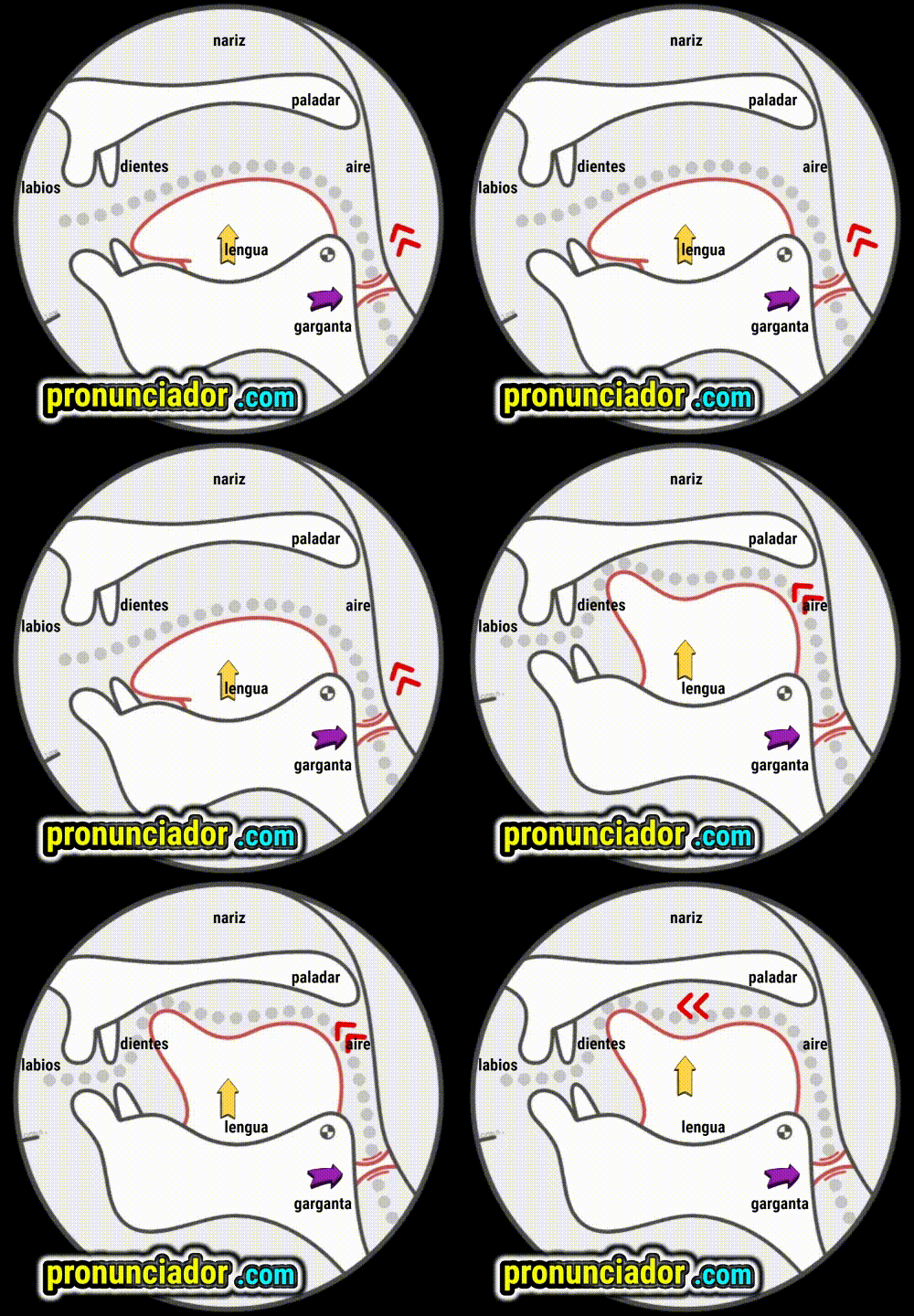
What IS This /ɔ/ “AW” Sound? (The “Caught” & “All” Vowel!)
First, let’s properly identify our vowel of the day: the /ɔ/ sound. You hear it in tons of key American English words. It’s one of the 12 “single” vowel sounds.
Words like:
- on /ɔn/
- off /ɔf/ (or /ɑf/ for merged speakers)
- all /ɔl/
- cause /kɔz/
- saw /sɔ/
- talk /tɔk/ (L is silent!)
- daughter /ˈdɔtər/
- thought /θɔt/
- broad /brɔd/
- dog /dɔɡ/
- lost /lɔst/
- water /ˈwɔtər/ (Yes, the ‘A’ can be /ɔ/!)
Its Secret Ingredients (Super Simple Version!)
The sound scientists call /ɔ/ a “near-low, tense, back vowel” that is also ROUNDED. Let’s make that child’s play:
- Back Vowel (Tongue Way BACK!): Imagine your tongue is a sleepy cat stretching and pulling way back towards your throat. That’s where it lives for /ɔ/!
- Near-Low (or Low-Mid) Vowel (Tongue Low, Jaw WIDE OPEN!): Your tongue isn’t just back, it’s also very LOW in your mouth, almost flat on the floor but maybe with the back part a little bit raised. To get your tongue low, your JAW needs to drop quite a bit, opening your mouth WIDE (though maybe not quite as extremely wide as for /ɑ/ in “father”).
- TENSE Vowel (Muscles FIRM!): ★★★ THIS IS A SUPER KEY! ★★★ Your TONGUE and your LIPS need to be TENSE, firm, and holding their shape actively. It’s not a floppy, lazy sound.
- Lips ROUNDED (Making an “O” shape!): ★★★ THE OTHER SUPER KEY! ★★★ Your lips form a fairly open but definite CIRCLE, and they are TENSE in this rounded position. They might even push out a tiny bit (protrude). This lip rounding is CRITICAL for distinguishing /ɔ/ from /ɑ/ (hot, father) in non-merged accents.
Kid-Friendly “AW” /ɔ/ Summary:
- Open your mouth pretty WIDE (drop your jaw!).
- Pull your tongue LOW and to the BACK of your mouth, make it FIRM (tense).
- Make your lips into a ROUND, FIRM “O” shape, maybe like you’re surprised “AWWWW!”.
- Turn ON your voice and say a rich, somewhat deep “AWWWW” sound.
The EPIC Vowel Battle: /ɔ/ (Caught) vs. /ɑ/ (Cot) – The “Caught-Cot Merger”!!
This is the Mount Everest of American vowel confusion for many! These two sounds are so close, yet so different… and to make it worse, many Americans actually say them THE SAME!
Let’s break down how they are supposed to be different in accents that do distinguish them (like traditional General American, some East Coast/Southern accents):
| Feature | /ɔ/ “AW” (Caught, Law) | /ɑ/ “AH” (Cot, Spa) |
| JAW OPENING? | WIDE (but maybe slightly less than /ɑ/) | VERY WIDE (Max drop) |
| TONGUE POSITION? | LOW & BACK | LOW & further Central/Back |
| TONGUE TENSION? | TENSE | Often more RELAXED (but can be tense for emphasis) |
| ★★★ LIP SHAPE? ★★★ | ROUNDED & TENSE! (O-shape) | NEUTRAL/UNROUNDED! (No O-shape) |
| Sound Quality? | Richer, Rounder “AW” | Open, Flat “AH” |
THE MAIN VISIBLE DIFFERENCE IS THE LIP ROUNDING for /ɔ/! /ɑ/ has no lip rounding.
Now, The Mind-Blowing Part: The CAUGHT-COT MERGER!
In a HUGE part of the United States (most of the West, a lot of the Midwest, Canada, and increasingly among younger speakers everywhere), native speakers DO NOT distinguish between /ɔ/ (caught) and /ɑ/ (cot) anymore!
- For these speakers, BOTH “caught” AND “cot” are pronounced with the unrounded /ɑ/ “AH” sound: /kɑt/.
- “Dawn” and “Don” both become /dɑn/.
- “Talk” might sound like “tock” (/tɑk/, though with a dark L often still affecting vowel).
This is a massive, ongoing sound change in American English.
What Does This Mean For YOU, the Learner?
- Awareness is Key: You NEED to know this merger exists! If an American says “coffee” as /ˈkɑfi/ (sounding like “cAHffee”), they’re not “wrong”; they likely have the merger.
- Which to Learn? Most Accent Coaches Still Advise…
- LEARNING TO MAKE BOTH /ɔ/ AND /ɑ/ distinctly.
- Why?
- Understanding Everyone: It allows you to understand speakers who do distinguish (parts of East Coast, South, older speakers, most British/International English).
- Decoding Spelling: Knowing “AW,” “AU,” “OUGHT,” “ALL” often target /ɔ/ helps make sense of why those words don’t sound like “cat” /æ/ or “father” /ɑ/ in distinguished accents. It explains patterns.
- Clarity & Choice: You have the option to produce a more traditional/”fully distinguished” American accent if you wish, which some argue is clearer internationally.
- Avoiding Hypercorrection: If you only learn to merge, you might accidentally unround words that traditionally always stay /ɔ/ in all accents (like words before /r/ such as ‘for’ /fɔr/ which isn’t the same as /fɑr/).
- This Guide’s Approach: We will teach you how to make the DISTINCT, ROUNDED /ɔ/ “AW” sound. Knowing how to make it gives you the power. You can always “merge” it (by unrounding your lips and using /ɑ/) later if you want to match specific regional accents. But you can’t un-merge if you never learned to make /ɔ/ in the first place!
/ɔ/ (Law) vs. /oʊ/ (Low) – The “O” Trap!
Another big confusion is /ɔ/ “AW” versus the Long O /oʊ/ “OH” diphthong (like in “go” or “note”).
- /ɔ/ (Law, All): Single, TENSE, STATIC vowel. Mouth WIDER, tongue LOWER BACK. Lips ROUNDED (like a big O). “AWWWW”.
- /oʊ/ (Low, Old): DIPHTHONG (moves O→U). TENSE. Mouth starts MORE CLOSED, tongue HIGHER BACK, lips TIGHTER ROUND. Then jaw closes more, lips get tighter. “OH-OOOOW”.
Don’t make your “bought” /bɔt/ sound like “boat” /boʊt/! Key is /ɔ/ is one sound, jaw more open; /oʊ/ moves and is more closed.

Your “AW-some” Mouth Guide: Making the /ɔ/ Vowel! (Kid-Style!)
Okay, let’s get those lips rounding and that tongue back for a perfect /ɔ/!
Step 1: Mouth – Open WIDE (Like “AHHH” for the Doc!)
Drop your jaw so your mouth is open quite wide. Not a tiny opening! Think like you’re about to say “Ahhhh” for the doctor, or take a big bite of an apple. Let’s aim for “nicely wide.”
Step 2: Lips – Make a TENSE “O” Circle!
This is CRUCIAL for the distinct /ɔ/!
- Round your lips to make a fairly open but definite circle. Imagine you’re saying “Oh!” in surprise, but keep the circle.
- Make those rounded lips TENSE! Firm them up. They aren’t floppy; they are actively holding that “O” shape.
- You can even push them slightly forward (protrude) a little.
Step 3: Tongue – LOW, BACK, and TENSE!
Your tongue is the other key player!
- TENSE your tongue! Make it feel strong, not like a wet noodle.
- Place your tongue LOW in your mouth. The body of the tongue should be pressed down.
- And PULL IT BACK towards your throat. The main activity is at the back of your tongue.
- The tip of your tongue can just chill out, maybe lightly behind your bottom teeth or just low in the mouth. It’s the back of the tongue that does the main work here.
Step 4: The Sound – A Rich, Tense “AWWWWW”!
- With your jaw wide, lips in a tense “O”, and tongue low, back, and tense… let out a voiced sound: “AWWWWWW”.
- It should feel like it’s coming from the back of your mouth.
- It should sound richer and rounder than a flat “AHHH” /ɑ/ (because of the lip rounding and tenseness).
- It’s generally a longer vowel because it’s tense.
Feeling Check: Jaw fairly wide? Lips definitely ROUND and FIRM? Tongue LOW, PULLED BACK, and TENSE? Sound is a full “AWWW” from the back? You’ve got it!
The /ɔ/ Spelling Lottery: O, A, AU, AW, AL, OUGH, OA… What?!
Okay, deep breath! The spelling for the /ɔ/ “AW” sound is one of the most INCONSISTENT and confusing in all of English. Many different letter combinations can make this sound! Let’s look at the main ones from the Sounds American web data, which seems more detailed here.
#1 Tied Champion: Letter ‘O’ (~29-30%)
The single letter ‘O’ is a very common speller, BUT it usually needs specific consonants around it, or is in specific common words. It’s RARELY ‘O’ + Consonant + Silent E (that’s usually /oʊ/ ‘home’).
- Often in short, common words or before L, G, NG, ST, FF, FFE, TH:
- on /ɔn/, off /ɔf/, dog /dɔɡ/, long /lɔŋ/, song /sɔŋ/, wrong /rɔŋ/, strong /strɔŋ/, lost /lɔst/, cost /kɔst/, frost /frɔst/, often /ˈɔfən/, soft /sɔft/, cloth /klɔθ/, broth /brɔθ/.
- coffee /ˈkɔfi/.
- CRITICAL CAVEAT: ‘O’ is ALSO the #1 speller for /ɑ/ (“hot”, “stop”, “top” – AmE), /oʊ/ (“go”, “no”, “home”), /ʌ/ (“son”, “love”, “come”), and /ʊ/ (“woman”, “wolf”)!! The single letter ‘O’ is a PRONUNCIATION MINEFIELD! You must learn which sound it makes in which word!
#2 Tied Champion: Letter ‘A’ (Before L, W, R or in ‘Water’ group) (~23-27%)
Yes, plain ‘A’! Especially:
- ‘AL’ (+ consonant or at end): all /ɔl/, call /kɔl/, fall /fɔl/, ball /bɔl/, tall /tɔl/, wall /wɔl/, small /smɔl/, also /ˈɔlsoʊ/, almost /ˈɔlmoʊst/, already /ɔlˈrɛdi/, always /ˈɔlweɪz/, although /ɔlˈðoʊ/, salt /sɔlt/, malt /mɔlt/, walk* /wɔk/ (L silent!), talk* /tɔk/ (L silent!).
- ‘A’ in “Water” type words: water /ˈwɔtər/, what /wʌt/ or /wɑt/ or even /wɔt/ (dialectal!). → ‘Water’ is a good example.
- ‘WA-‘ or ‘QUA-‘ pattern often becomes /wɔ/ or /kwɔ/: want /wɔnt/ (or /wɑnt/), wash /wɔʃ/ (or /wɑʃ/), watch /wɑtʃ/, quality /ˈkwɔləti/. (These are complex due_ to /w/ influence and vary regionally between /ɔ/ and /ɑ/ for many speakers.)
- Not always: ‘A’ is mostly /æ/ (cat) or /eɪ/ (cake) or /ɑ/ (father)!
#3 Strong Contender: ‘AU’ (~25%)
This combination is a pretty RELIABLE clue for /ɔ/!
- cause /kɔz/, because /bɪˈkɔz/, daughter /ˈdɔtər/, August /ˈɔɡəst/, author /ˈɔθər/, autumn /ˈɔtəm/, pause /pɔz/, fault /fɔlt/, sauce /sɔs/, laundry /ˈlɔndri/, applaud /əˈplɔd/, caught /kɔt/.
- Laugh is /læf/ – the big exception!
#4 The “Saw” Group: ‘AW’ (~11-14%)
Another fairly RELIABLE one! If you see ‘AW’, it’s almost always /ɔ/.
- saw /sɔ/, law /lɔ/, draw /drɔ/, straw /strɔ/, claw /klɔ/, yawn /jɔn/, awful /ˈɔfəl/, awkward /ˈɔkwərd/, dawn /dɔn/, paw /pɔ/, raw /rɔ/.
#5 The “Thought Bubble”: ‘OUGH’ & ‘AUGH’
These are famous for their crazy pronunciations, but for /ɔ/, the key pattern is -OUGHT / -AUGHT.
- thought /θɔt/
- bought /bɔt/
- brought /brɔt/
- fought /fɔt/
- sought /sɔt/
- ought /ɔt/ (modal verb)
- caught /kɔt/ (AUGHT)
- taught /tɔt/ (AUGHT)
- naughty /ˈnɔti/ (AUGHT)
- daughter /ˈdɔtər/ (AUGHTER – AU part carries the /ɔ/)
- Cough /kɔf/ or /kɑf/ (GH=/f/, OUGH=/ɔ/ or /ɑ/). Source listed for /ɔ/.
#6 The Rare “Broad O”: ‘OA’
Almost always /oʊ/ (boat, coat). BUT, a couple of key words:
- broad /brɔd/
- abroad /əˈbrɔd/
Your /ɔ/ “AW” Spelling Cheat Sheet (Based on Sounds American Data & Common Usage):
- O (before certain consonants/in key words): (~30%) on, off, dog, long, cost, soft, often, coffee. (HIGHLY VARIABLE!)
- A (often with L, W): (~23-27%) all, call, walk, talk, water, want, wash. (Also Variable!)
- AU: (~25%) cause, daughter, author, fault. (Generally RELIABLE!)
- AW: (~11-14%) saw, law, draw, awful. (Generally RELIABLE!)
- OUGHT / AUGHT: thought, bought / caught, taught. (Good Pattern!)
- OA (rare): broad, abroad.
BIGGEST LESSON on SPELLING /ɔ/: Outside of AU, AW, OUGHT/AUGHT, the spellings ‘O’ and ‘A’ for /ɔ/ are heavily dependent on the specific word and the sounds around them. No easy shortcut other than learning common words and LISTENING!

Whoops! Common /ɔ/ “AW” Mistakes & How to Fix Them!
Where do learners typically get the “AW” sound wrong?
- MISTAKE #1: NO LIP ROUNDING! (Making it /ɑ/ “AH” – The Caught-Cot TRAP!)
- What Happens: The BIGGEST error! Lips are neutral/spread, not rounded. “Caught” /kɔt/ becomes “Cot” /kɑt/. “Law” /lɔ/ becomes “Lah” /lɑ/.
- THE FIX: ROUND THOSE LIPS! Actively make a somewhat tense, open “O” shape with your lips. Feel the corners come in. Look in a mirror! The difference between /kɔt/ and /kɑt/ is PRIMARILY those lips (and slight tongue backness/tenseness).
- MISTAKE #2: NOT TENSE ENOUGH! (Lax/Floppy Sound)
- Problem: If lips and tongue are too relaxed, the /ɔ/ loses its rich, full quality and can drift towards /ɑ/ or a weak /ɒ/ (British ‘hot’).
- The Fix: ENGAGE THOSE MUSCLES! Feel firmness in your rounded lips. Feel your tongue actively pulling low and back, and holding its position with some tension. It’s not a super-tense sound like /i/ (see), but it’s NOT lax like /ʌ/ (cup).
- MISTAKE #3: TONGUE TOO FAR FORWARD or TOO HIGH.
- Problem: Sound isn’t deep or “back” enough. Might sound like /oʊ/ (go) if tongue too high, or a fronted vowel if too forward.
- The Fix: PULL TONGUE LOW & BACK! Consciously think of making space at the back of your mouth by lowering and retracting the tongue.
- MISTAKE #4: MOUTH NOT OPEN WIDE ENOUGH.
- Problem: Sound is too closed, might again drift towards /oʊ/ (go) or sound muffled.
- The Fix: DROP THAT JAW! /ɔ/ needs a fairly wide mouth opening to allow the tongue to go low and back.
- MISTAKE #5: BEING TRICKED BY “A” and “O” SPELLINGS!
- Problem: Seeing ‘A’ and always thinking /æ/ (cat) or /eɪ/ (cake). Seeing ‘O’ and always thinking /oʊ/ (go) or /ʌ/ (son).
- The Fix: ENGLISH SPELLING IS CRAZY! Accept it. Learn that ‘A’ can be /ɔ/ (all, water) and ‘O’ can be /ɔ/ (on, dog) in specific, common words. Don’t assume the “obvious” sound.
“AW-some” /ɔ/ Practice! Get That Sound Down!
Time to get those lips rounded and that “AW” resonating!
Exercise 1: Just the Sound – The Tense, Round “AWWW” /ɔ/
- Mouth WIDE. Lips ROUND & TENSE (O-shape). Tongue LOW, BACK, TENSE.
- Make a sustained, rich “AWWWWWWWWW”: /ɔɔɔɔɔɔɔɔɔɔ/. Feel it deep in the back.
Exercise 2: THE CRITICAL CONTRAST: /ɔ/ (Caught) vs. /ɑ/ (Cot)
Non-merged speakers, THIS IS YOUR GOLD! Focus on LIPS: ROUND for /ɔ/, NEUTRAL for /ɑ/.
- Caught /kɔt/ (Round Lips) — Cot /kɑt/ (Neutral Lips)
- Law /lɔ/ (Round) — La (musical note) /lɑ/ (Neutral – if you just said the “ah”)
- Saw /sɔ/ (Round) — Sock /sɑk/ (Neutral)
- Naught /nɔt/ (UK for zero – Round) — Not /nɑt/ (Neutral)
- Talk /tɔk/ (Round – L silent) — Tock /tɑk/ (Neutral – as in tick-tock)
- Paw /pɔ/ (Round) — Pop /pɑp/ (Neutral)
Exercise 3: “AW” /ɔ/ (All) vs “OH” /oʊ/ (Old)
Mouth WIDER for /ɔ/, tongue LOWER, SINGLE sound. Mouth MORE CLOSED for /oʊ/, tongue HIGHER, GLIDING O→U sound.
- Law /lɔ/ — Low /loʊ/
- Call /kɔl/ — Coal /koʊl/
- Saw /sɔ/ — So /soʊ/ (sew/so)
- Bought /bɔt/ — Boat /boʊt/
- Walk /wɔk/ — Woke /woʊk/
- Cloth /klɔθ/ — Close* (verb) /kloʊz/ (Not perfect for ‘close’, which has /oʊz/. Maybe Cloth /klɔθ/ vs Clone /kloʊn/).
Exercise 4: Master the Many Spellings of /ɔ/!
Practice these, focusing on making the SAME rich /ɔ/ “AW” sound.
- O: on, off, dog, long, strong, lost, cost, frost, soft, often, coffee.
- A (with L/W/etc.): all, call, fall, ball, walk, talk, water, want, wash, always, salt.
- AU: cause, because, daughter, August, author, autumn, pause, fault, sauce, caught.
- AW: saw, law, draw, raw, claw, lawn, yawn, awful, awkward, dawn.
- OUGH/AUGH: thought, bought, brought, fought, ought / caught, taught, naughty.
- OA: broad, abroad.
Exercise 5: Word List Workout (Source Top 30!)
(Use the provided list: on, all, talk, call… strong, offer). For each, FEEL the WIDE jaw, LOW/BACK/TENSE tongue, and ROUND/TENSE lips!)
Exercise 6: “AW”-ful Sentences + Recording! (In a good way!)
Record yourself! Is your /ɔ/ rich, round, and clearly different from /ɑ/ “AH”?
- “Daughter [ɔ] taught [ɔ] her dog [ɔ] to walk [ɔ] in the fog [ɔ].”
- “Paul [ɔ] called [ɔ] his boss [ɔ] because the law [ɔ] was wrong [ɔ].”
- “We all [ɔ] saw [ɔ] the awful [ɔ] cost [ɔ] of the long [ɔ] war [ɔ/ɑ – ‘war’ is tricky, usually /ɔr/].” -> Change to: “We all [ɔ] saw [ɔ] the awful [ɔ] cost [ɔ] of that thought [ɔ].”
- “The tall [ɔ] author [ɔ] drank [æ] coffee [ɔ].” (Mix in an /æ/ ‘drank’!)
| PHONETICAL PRONUNCIATION |
| PHONETICAL PRONUNCIATION |
FAQs: Your American /ɔ/ “AW” (Caught, All) Questions Answered!
Q1: What’s the EASIEST way to tell if I’m saying /ɔ/ (“caught”) right, not /ɑ/ (“cot”)?
Check your LIPS!
- For /ɔ/ “AW” (caught): Your lips MUST be ROUNDED (like a fairly open “O”) and TENSE.
- For /ɑ/ “AH” (cot): Your lips are NEUTRAL/UNROUNDED (relaxed, no “O” shape).
If your lips aren’t rounded, you’re likely making /ɑ/ (or have the Caught-Cot merger, meaning you naturally say them the same as /ɑ/).
Q2: I hear many Americans say “caught” and “cot” the same! What’s up with that?
That’s the “Caught-Cot Merger”! In many parts of the US (especially West/Midwest), native speakers DO pronounce both words with the unrounded /ɑ/ “AH” sound (/kɑt/). So, if you’re aiming for that specific accent, merging them is fine. BUT, learning the distinct /ɔ/ (with rounded lips) is still valuable for understanding all speakers and for words that don’t merge (like ‘for’ vs ‘far’).
Q3: Why do letters like ‘A’ (in “all,” “water”) or ‘O’ (in “dog,” “on”) sound like “AW” /ɔ/?
English spelling is a historical adventure!
- ‘A’ before ‘L’ (all, call) or in ‘wa-‘ patterns (water, want) very often takes on this /ɔ/ sound.
- ‘O’ before certain consonants (g, ng, st, ff) or in specific words (on, off) can also be /ɔ/.
There are NO perfect rules for single ‘A’ or ‘O’. AU (cause) and AW (saw) are much more reliable for /ɔ/. For A and O, learn common word pronunciations.
Q4: Is the /ɔ/ sound supposed to be long or short? Tense or Relaxed?
It’s a TENSE vowel. And because tense vowels are generally held a bit longer than lax/relaxed vowels, you can think of /ɔ/ as a relatively longer sound compared to something like /ʊ/ (book) or /ɪ/ (it). The TENSION in lips and tongue helps you sustain it.
Q5: What about words like “thought” or “bought”? That ‘OUGH’ is crazy!
Yes, ‘OUGH’ is famously unpredictable! BUT, the specific patterns -OUGHT and -AUGHT are pretty consistent for the /ɔ/ sound:
- thought, bought, brought, fought, sought, ought = ALL /ɔt/
- caught, taught, naughty, daughter = ALL have /ɔ/ in the -aught part.
This is one ‘OUGH’ pattern you CAN trust for “AW”!
Key Points for Your “AW-some” /ɔ/ Vowel!
Fantastic! You’ve navigated the world of the American English “AW” /ɔ/ sound. It’s a rich, tense, back vowel with essential lip rounding.
Remember these “AW” highlights:
- /ɔ/ “AW” = WIDE Jaw + TONGUE Low/Back/TENSE + LIPS ROUND & TENSE!
- VS /ɑ/ (“cot”, “hot”): LIP ROUNDING IS THE #1 KEY! /ɔ/ rounds, /ɑ/ doesn’t.
- VS /oʊ/ (“coat”, “low”): /ɔ/ is a SINGLE WIDER/LOWER sound. /oʊ/ is a CLOSER DIPHTHONG (O→U glide).
- CAUGHT-COT MERGER: Many Americans say /ɔ/ and /ɑ/ the SAME (as /ɑ/). Learning distinct /ɔ/ is still useful!
- SPELLING MADNESS: ‘O’ and ‘A’ are common but tricky! AU (cause) & AW (saw) are your best bets. OUGHT/AUGHT is good too. Learn common words for O/A spellings.
- MISTAKES: Not rounding lips! Not enough tension! Tongue too far forward!
The main things to drill are the lip rounding and the low, back, tense tongue. Contrast /ɔ/ and /ɑ/ daily if your goal is a distinguished accent. Record yourself. Listen to words like “all,” “talk,” “daughter,” “on,” “dog.” Soon, your American “AW” will be a thing of beauty!rall English pronunciation and make you sound more natural when you speak. It will also help you understand native speakers more easily. Plus, it’s a great step towards mastering the nuances of the American English accent!
👇🔥👇🔥👇🔥👇🔥👇🔥👇🔥
👉 RETURNS in the YEAR 2031 ! WHO? CLICK HERE ! 🔥



👇🔥👇🔥👇🔥👇🔥👇🔥👇🔥
👉 RETURNS in the YEAR 2031 ! WHO? CLICK HERE ! 🔥
👇🔥👇🔥👇🔥👇🔥👇🔥👇🔥
👉 RETURNS in the YEAR 2031 ! WHO? CLICK HERE ! 🔥
👉 RETURNS in the YEAR 2031 ! WHO? CLICK HERE ! 🔥