

Is your Long I sound flat? Learn to pronounce the /aɪ/ vowel like an American. This guide fixes common mistakes with the easy AH→IH mouth slide.
Hey there, American English pronunciation explorers! Get ready to tackle one of THE most important and frequently used vowel sounds – the one that is a word itself: the Long I sound, as in “I“, “my“, “like“, or “kind“! Its super-special phonetic code is /aɪ/ (looks like an ‘a’ and an ‘I’ decided to become best friends!).
Now, you might be thinking, “The letter I? That’s in my alphabet!” And you’d be right! But here’s the American English twist: this Long I sound is NOT just one quick, flat sound. Oh no! It’s a DIPHTHONG! Whoa, fancy word alert! But don’t worry, “diphthong” just means it’s a gliding vowel sound that MOVES from one mouth position to another, all in one smooth slide! For the Long I /aɪ/, it’s like starting with an open “AHHH” sound (like /ɑ/ in “spa“) and then quickly, smoothly sliding your mouth up into a small “IH” sound (like /ɪ/ in “kid”). It’s an AH → IH journey!
The BIGGEST mistake learners make is missing that slide! They say “I” as just “Ah,” or “like” as just “lahk.” It makes your English sound flat, a bit clipped, and can cause major confusion (e.g., “not” /nɑt/ vs “night” /naɪt/ or “son” /sʌn/ vs “sign” /saɪn/). And the SPELLING! Goodness gracious! How can ‘I’ (like), ‘Y’ (my), ‘IGH’ (high), ‘IE’ (die), ‘EYE’ (eye), ‘EI’ (height), and even ‘UY’ (buy) ALL magically transform into this SAME “eye” /aɪ/ sound?! It’s a maze! You might feel totally lost!
But wipe those worried brows! Today, you’re going to become a Long I /aɪ/ Jedi Master! This ultimate, super-EASY guide, explained so clearly your little sibling could understand, will give you ALL the secrets:
- Meet the “AH-IH Super-Slide” /aɪ/: What exactly IS this crucial gliding diphthong?
- Mouth Acrobatics (Kid-Style!): Ultra-simple, step-by-step instructions: JAW WIDE OPEN → JAW CLOSING UP, TONGUE LOW/BACK → TONGUE HIGH/FRONT!
- The “Loud & Long Start” Rule: Why the “AH” part gets more oomph!
- Sound-Alike SMACKDOWN! No more confusing /aɪ/ (buy) with /ɑ/ (box), /æ/ (back), or even /eɪ/ (bay)!
- Crazy Spelling CONQUERED! I_E, I, Y, IGH, IE, EY, UY… We’ll map out the main patterns and key words!
- Zap Those Common “EYE” Errors! Stop that flat “AH”! We’ll get your glide GORGEOUS!
- “My Oh My!” Practice Time! Fun exercises and essential words (‘I’, ‘my’, ‘like’, ‘time’, ‘why’, ‘night’, ‘find’) to make your Long I /aɪ/ flawless!
Get ready for your “high,” “sky,” “try,” “life,” and “idea” to sound bright, dynamic, and perfectly American! Let’s say “Hi” /haɪ/ to the Long I! 😉

What IS This Long I /aɪ/ Sound? (The “Eye” Diphthong!)
Alright, let’s get friendly with the American Long I /aɪ/ sound. You know it as the sound of the letter “I” when you say the alphabet. And, of course, it’s the vowel in the word “I” itself! It’s one of the three main diphthong vowel sounds in American English (along with /ɔɪ/ as in “boy” and /aʊ/ as in “now”).
Diphthong = Mouth Moves! (Easy Explanation!)
A diphthong isn’t one boring, still sound. It’s a GLIDING vowel! Your mouth STARTS in one vowel position and then SMOOTHLY SLIDES to a different vowel position, all in one continuous breath, within the same syllable! Like a mini vocal slide!
The /aɪ/ Adventure: Starting at “AH” (/ɑ/) and Sliding to “IH” (/ɪ/)
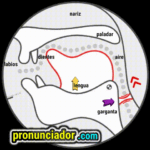
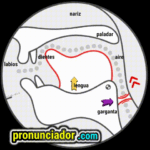
- The Starting Point – Open “AH” /ɑ/: Your mouth starts WIDE OPEN, tongue low and back, making a sound like the /ɑ/ in “father,” “hot,” or “spa.”
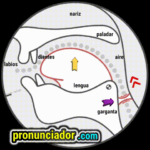
- The Ending Point – Short “IH” /ɪ/: Then, your mouth quickly changes shape! Your jaw CLOSES, your tongue moves UP and FORWARD, and the sound slides towards the Short I /ɪ/ sound (like in “kid,” “sit,” “big”).
The Magic Formula for Long I /aɪ/:
/aɪ/ = Start WIDE & LOW for “AH” (/ɑ/) → GLIDE SMOOTHLY UP & FORWARD to → “IH” (/ɪ/) (mouth more closed, tongue high/front)
It’s one continuous “Aaaaaahhhhh-ih!” sound.
CRITICAL Distinctions: Keep Your Long I /aɪ/ Unique!
- /aɪ/ (Buy) vs. /ɑ/ (Box) – DON’T Forget the “IH” Slide!
- /aɪ/ (Buy): Dynamic GLIDE AH→IH. Mouth MOVES.
- /ɑ/ (Box): Single, STATIC “AH” sound. Mouth STAYS WIDE OPEN.
- #1 Mistake: Saying just “Ah” for “I” or “like”. “Night” /naɪt/ sounds like “not” /nɑt/.
- FIX: You MUST make the upward jaw/tongue movement to add that final “IH” quality!
- /aɪ/ (Time) vs. /æ/ (Tam – a hat) – Start WIDER and BACK for /aɪ/!
- /aɪ/ (Time): Starts with tongue LOW & BACK (/ɑ/), then glides to /ɪ/. Lips NEUTRAL.
- /æ/ (Tam): Single sound. Tongue LOW & FORWARD. Lips SLIGHTLY SPREAD.
- The Trap: If your /aɪ/ starts too far forward (like /æ/), it won’t sound right. “Like” /laɪk/ might sound like “lack” /læk/.
- FIX: Ensure the “AH” start of /aɪ/ is truly open, with the tongue further back than for /æ/.
- /aɪ/ (Why) vs. /eɪ/ (Way – Long A) – Different Starting Points!
- /aɪ/ (Why): Starts LOW & BACK (/ɑ/), glides UP/FORWARD to /ɪ/. JAW moves a LOT (wide to closing).
- /eɪ/ (Way): Starts MID & FRONT (/e/), glides UP/FORWARD to /ɪ/. Jaw starts MID, moves LESS.
- Don’t mix: “Pine” /paɪn/ (tree) with “pain” /peɪn/ (ouch!). “Bye” /baɪ/ with “bay” /beɪ/ (water).
The BIG idea for /aɪ/: It’s a journey from a WIDE OPEN “AH” to a more CLOSED “IH”. Feel that movement!

Your Mouth’s “AH-to-IH” Slide: Making Long I /aɪ/ (Kid-Friendly Steps!)
Let’s get your mouth gliding like a pro! It’s easier than it sounds if you follow these super-simple steps.
Step 1: The Big “AHHH” Start! (Position for /ɑ/)
- Mouth WIDE OPEN! Like you’re about to show the doctor your tonsils or take a HUGE bite of a burger! Drop your jaw as far as it comfortably goes.
- Tongue LOW & CENTER/BACK! Let your tongue lie flat and very low in the center of your mouth. The tip can lightly touch behind your bottom front teeth, but the main body is low and somewhat pulled back.
- Lips NEUTRAL & RELAXED! No smile, no rounding. Just natural, relaxed lips.
This is your starting gate: the “AH” /ɑ/ sound!
Step 2: The Smooth Slide UP & FORWARD to “IH”! (Position for /ɪ/)
Now, the magic GLIDE happens FROM that open /ɑ/ position!
- KEEP MAKING SOUND! Don’t stop the voiced airflow.
- JAW MOVES UP (Mouth Closes Partially): Smoothly bring your jaw up, so your mouth closes quite a bit, going from WIDE open to only SLIGHTLY open.
- TONGUE MOVES UP & FORWARD! As your jaw rises, the FRONT of your tongue also rises HIGH in your mouth and pushes FORWARD towards your top front teeth (but doesn’t usually touch). It’s aiming for the Short I /ɪ/ (“sit”) position.
- LIPS (Tiny Stretch?): As your jaw closes and tongue moves forward for /ɪ/, your lips will naturally stretch just a tiny bit to the sides – like a very subtle, quick, relaxed smile.
Step 3: Blend it Smoothly! “AH-eeeee” = /aɪ/!
The beauty of a diphthong is the unbroken, smooth glide between the two positions.
- Start with the open “AHHH” (/ɑ/).
- Without any pause or break, let your jaw rise and your tongue glide up and forward, transforming the sound into “ih” (/ɪ/).
- It should be one continuous, flowing sound: “Aaaaaaaahhhhh-eeeeeh” –> /aɪ/ “EYE”!
- Key Note from Source: The first vowel sound (/ɑ/) is usually pronounced louder and longer than the second sound (/ɪ/). The “AH” is the star, the “IH” is the quick finish!
- CRITICAL REMINDER from Source: Do NOT reduce (or skip) the second /ɪ/ sound! It HAS to be there to make the true /aɪ/ diphthong!
Kid-Friendly Cue: “Start like you’re shouting ‘AHHH!’ at a funfair ride (mouth super open!). Then, without stopping your voice, quickly change your mouth like you’re about to say a tiny ‘eeek!’ from a mouse (mouth almost closed, tongue up high in front!). Do it fast: AHHH-eeek! That’s your Long I /aɪ/!”
Feeling Check: Big jaw drop for “AH,” then jaw closes and tongue lifts for “IH”? Lips start neutral, then maybe a tiny stretch? Sound slides smoothly? Awesome! You’re making the /aɪ/ sound!
Decoding the /aɪ/ Spellings: I, Y, IGH, IE, EY, UY?! (It’s Simpler Than It Looks!)
Okay, get ready for some classic English spelling craziness! The Long I /aɪ/ sound can be spelled in SO many different ways! But there are patterns, and some spellings are much more common than others.
Let’s look at the Most Common Spellings for /aɪ/ (data from Sounds American web source):
#1 The BIG BOSS: Letter ‘I’ (Often as I + Consonant + E, or just I) (~81%!!)
YES! A whopping 81% of the time, if you see the letter ‘I’ in a word that uses the Long I sound, it’s just… the letter ‘I’! This includes a few patterns:
- I + Consonant + Silent E (“Magic E”): This is a HUGE one! The silent ‘e’ at the end makes the ‘i’ say its “name” (/aɪ/)!
- like, time, fine, life, drive, price, nice, white, nine, wife, kite, ride, shine, smile.
- Single ‘I’ (often when it IS the name of the letter or in specific stressed contexts):
- I /aɪ/ (the word itself!)
- hi /haɪ/ (hello)
- kind /kaɪnd/
- mind /maɪnd/
- find /faɪnd/
- bind /baɪnd/
- wind (verb – to coil) /waɪnd/ (BUT wind (noun – air) is /wɪnd/ with Short I!)
- child /tʃaɪld/
- mild /maɪld/
- wild /waɪld/
- climb* /klaɪm/ (b is silent!)
- ‘I’ before -LD, -ND, -GH (often makes I long): See ‘kind’, ‘find’, ‘child’ above. ‘High’ and ‘light’ are below.
#2 The Flying ‘Y’: Letter ‘Y’ (Usually at the END of short words) (~15%)
The letter ‘Y’ is a very common way to spell /aɪ/, especially when it’s at the end of a one-syllable word.
- my, by, try, cry, fly, why, sky, spy, shy, guy (/ɡaɪ/, not the letter ‘g’!).
- Also in some longer words where Y acts as a vowel: style /staɪl/, type /taɪp/, rhyme /raɪm/, analyze /ˈænəlaɪz/, psychology /saɪˈkɑlədʒi/ (here stress on CO).
The “Etc.” Category (IGH, IE, EY, UY, AI…) (~4%)
This covers the rest, many of which are very reliable for /aɪ/ when you see them!
- ‘IGH’: When you see ‘IGH’, the ‘GH’ is usually SILENT, and the ‘I’ says /aɪ/! Very dependable!
- high, night, light, right, fight, might, sigh, bright, flight, delight, fright.
- ‘IE’ (Often at the END of short verbs):
- die, lie, tie, pie.
- Also: tried, cried (past tenses).
- ‘EYE’:
- eye /aɪ/ (the body part! sounds just like ‘I’)
- ‘EI’ (Rare for /aɪ/, often for specific words to MEMORIZE):
- height /haɪt/ (BEWARE: ‘weight’ is /weɪt/ with Long A!)
- Either* /ˈaɪðər/ (can also be /ˈiðər/ with Long E in AmE!)
- Neither* /ˈnaɪðər/ (can also be /ˈniðər/!)
- ‘UY’:
- buy /baɪ/ (sounds just like ‘by’ and ‘bye’!)
- guy /ɡaɪ/ (can also be spelled ‘Y’)
- ‘AI’ (Very rare for /aɪ/, usually /eɪ/ ‘rain’):
- aisle /aɪl/ (GH silent too – sounds like ‘isle’!)
- kaiser /ˈkaɪzər/
- ISL (island):
- island /ˈaɪlənd/ (S is silent!)
- isle /aɪl/ (S is silent!)
Long I /aɪ/ Spelling – Main Patterns at a Glance:
- I_E (Magic E): like, time (SUPER COMMON)
- I (stressed/before nd, ld, gh): I, kind, high (COMMON)
- Y (end of short words/middle): my, fly, styl**e (COMMON)
- IGH: night, light (GH SILENT – RELIABLE!)
- IE (often verb ends): die, lie, pie (RELIABLE)
- EYE, EI, UY, AI, ISL: MEMORIZE specific words (eye, height, buy, aisle, island)!
The BEST news about /aɪ/ spelling: Even though there are many ways, ‘I’ and ‘Y’ cover MOST of the common words! ‘IGH’ and ‘IE’ are also good friends.
OOPS! Common Long I /aɪ/ Blunders & Quick Fixes!
Where do learners usually mess up the “AH-to-IH” glide? Let’s fix these slip-ups!
- MISTAKE #1: THE BIGGEST! NO GLIDE! (Saying a Flat “AH” /ɑ/ or “AAH” /æ/)!
- What’s Happening: You’re ONLY making the first part of the diphthong (the open /ɑ/ sound) and SKIPPING the crucial slide up to /ɪ/. “I” sounds like “Ah.” “Like” sounds like “Lahk.” “Time” sounds like “Tahm.” This makes your English sound very flat.
- THE FIX: THINK “AH → IH SLIDE”! You absolutely MUST feel your jaw closing and your tongue moving up and forward for that “IH” ending. It doesn’t matter if the “IH” is quick, it HAS to be there! Practice “Liiiiike” and then speed it up: “Like!” Exaggerate the full movement.
- MISTAKE #2: Starting Vowel WRONG (Too Front like /æ/ ‘cat’, or Not Open Enough).
- Problem: If you don’t start with your mouth WIDE OPEN and tongue LOW/BACK for a true /ɑ/, the glide won’t have the right starting flavor. It might sound like /eɪ/ (lake) if you start too front and mid.
- The Fix: DROP THAT JAW for the /ɑ/! Really open up for the “AHHHH” at the beginning. Feel it in the back of your mouth.
- MISTAKE #3: Ending Vowel WRONG (Not High/Front Enough for /ɪ/, or Drifting to /i/ Long E).
- Problem: If your tongue doesn’t get high and front enough for the /ɪ/ (“ih” in sit), the glide is incomplete. If it goes TOO high and tense and smiley, it becomes /ɑi/ (“Ah-EE”), which is too much.
- The Fix: Aim for that relaxed Short I /ɪ/ position at the end – tongue high and front, jaw almost closed, lips fairly neutral or slightly spread (relaxed). The /ɪ/ is QUICK and LESS LOUD than the starting /ɑ/.
- MISTAKE #4: Making it TWO SEPARATE Sounds (AH… IH) Instead of a SMOOTH GLIDE.
- Problem: There’s a break or a chunky transition. “L-AH… …IK”.
- The Fix: Think of it as one continuous “AAAAHeeeeeh” sound where your mouth is MOVING smoothly throughout. Like a singer holding a note that changes pitch.
- MISTAKE #5: CONFUSING it with LONG E /i/ (“see”) Spellings.
- Problem: Seeing “IE” in “pie” and trying to make it sound like “piece”.
- The Fix: Remember “IE” at the END of short words is often /aɪ/ (die, lie, tie, pie). “IE” in the MIDDLE is often /i/ (piece, field). Spelling patterns matter!
“My, Oh My!” Long I /aɪ/ Workout Time!
Let’s get that mouth gliding from “AH” to “IH”!
Exercise 1: Isolate the Glide – Slow-Motion “AH → IH”!
- Part 1 (Start – /ɑ/): Mouth WIDE OPEN. Tongue LOW & BACK. Lips NEUTRAL. Make a clear “AHHHH.”
- Part 2 (End – /ɪ/): Mouth ALMOST CLOSED. Tongue HIGH & FORWARD. Lips NEUTRAL/SLIGHT SPREAD. Make a quick “IH.”
- NOW GLIDE SLOWLY: Start the “AHHH,” and while keeping the sound going, smoothly raise your jaw and move your tongue up and forward until it becomes “IH.” → “Aaaaaaaahhhhhh-iiiiiiih.”
- Speed it up: /ɑ/-/ɪ/… /ɑ/-/ɪ/… /aɪ/! /aɪ/! /aɪ/! (The sound of the letter “I”!)
Exercise 2: NO GLIDE (“Ah”) vs. WITH GLIDE (/aɪ/)!
This is critical. Record yourself!
- Not /nɑt/ (NO GLIDE, ends open) — Night /naɪt/ (GLIDE to closed “ih”)
- Son /sʌn/ (STRUT /ʌ/, NO GLIDE) — Sign /saɪn/ (GLIDE)
- Fond /fɑnd/ (NO GLIDE) — Find /faɪnd/ (GLIDE)
- Lock /lɑk/ (NO GLIDE) — Like /laɪk/ (GLIDE)
Can you hear that extra “ih” movement in the /aɪ/ words?
Exercise 3: Long I /aɪ/ (Buy) vs Long A /eɪ/ (Bay) – Starting Point Matters!
/aɪ/ starts LOW/BACK (/ɑ/). /eɪ/ starts MID/FRONT (/e/). Both glide UP to /ɪ/.
- Buy /baɪ/ (Starts WIDE OPEN) — Bay /beɪ/ (Starts MID OPEN)
- Like /laɪk/ — Lake /leɪk/
- Sigh /saɪ/ — Say /seɪ/
- My /maɪ/ — May /meɪ/
- Right /raɪt/ — Rate /reɪt/
Exercise 4: Conquer ALL the Spellings for /aɪ/!
Practice making the SAME “AH→IH” /aɪ/ glide for all these words:
- I_E (Magic E): like, time, fine, life, drive, price, white, nice, nine, five, wife, while, mine, ride.
- I (Stressed / End): I, hi, kind, mind, find, child, wild, climb, sign, mild.
- Y (End / Middle): my, by, try, cry, fly, why, sky, spy, shy, guy, style, type, rhyme.
- IGH (GH Silent): high, night, light, right, fight, might, sigh, bright, flight, sight.
- IE (End): die, lie, tie, pie, tried, cried.
- EYE/EI/UY/AI/ISL (Exceptions): eye / height, either, neither / buy, guy / aisle / island, isle.
Exercise 5: Top 30 Word Workout
| PHONETICAL PRONUNCIATION |
| PHONETICAL PRONUNCIATION |
Exercise 6: “I Like My Nice White Kite at Night!” – Long I Sentences + Recording!
RECORD yourself! Is your Long I /aɪ/ a dynamic glide? Not flat?
- “I [aɪ] like [aɪ] my [aɪ] nice [aɪ] white [aɪ] kite [aɪ] at night [aɪ].” (A classic!)
- “Why [aɪ] try [aɪ] to find [aɪ] a bright [aɪ] light [aɪ] in the sky [aɪ]?”
- “Five [aɪ] kind [aɪ] guys [aɪ] might [aɪ] buy [aɪ] a pie [aɪ].”
- “My [aɪ] wife‘s [aɪ] eyes [aɪ] shine [aɪ] in July [aɪ].” (July = /dʒʊˈlaɪ/)
- “That’s a fine [aɪ] idea [aɪ][ə] for time [aɪ].” (Idea = /aɪˈdiə/)

FAQs: Your American Long I /aɪ/ (“like”) Questions Cleared!
Q1: So the Long I /aɪ/ (“like”) is really TWO sounds, “AH” then “IH”?
Yes, that’s the easiest way to think about it for making it right! It starts with your mouth open for an /ɑ/-like “AH” sound, and then your jaw closes and tongue moves up/forward to make an /ɪ/-like “IH” sound. Crucially, you GLIDE smoothly between them, “AAAAHeeeh.” Don’t make two separate, choppy sounds!
Q2: My “I” or “like” just sounds like “Ah” or “Lahk”. What’s the #1 fix?
You’re MISSING THE SECOND HALF OF THE GLIDE – the “IH” /ɪ/ part!
You MUST consciously move your jaw UP and your tongue UP & FORWARD to finish the sound. The /ɑ/ “AH” part is usually louder and longer, but if that final /ɪ/ “IH” movement isn’t there, it sounds flat and wrong. PRACTICE the GLIDE: AH → IH. [Video: 4:05 highlights NOT reducing the second sound].
Q3: How is Long I /aɪ/ (“bike”) different from Long A /eɪ/ (“bake”)?
They start differently and have different jaw movements!
- Long I /aɪ/ (“bike”): Starts WIDE OPEN with tongue LOW/BACK (/ɑ/), then jaw CLOSES a lot as tongue glides HIGH/FRONT (/ɪ/).
- Long A /eɪ/ (“bake”): Starts MID-OPEN with tongue MID-HIGH/FRONT (/e/), then jaw CLOSES only a little as tongue glides slightly HIGHER/FRONTER (/ɪ/).
Feel the bigger jaw drop for /aɪ/ compared to /eɪ/!
Q4: With so many spellings (I, Y, IGH, IE…), how do I know if it’s Long I /aɪ/?
It’s tough! But there are strong patterns:
- I + Consonant + Silent E (like, time, nice) = Almost always /aɪ/.
- I before -ND, -LD, -GH (kind, child, high) = Often /aɪ/.
- Y at the end of short words (my, try, sky) = Almost always /aɪ/.
- IGH (night, light, right) = Almost always /aɪ/ (GH is silent).
- IE at the end of verbs (die, lie, tie) = Usually /aɪ/.
For other spellings or unfamiliar words, listen carefully or check an IPA dictionary for /aɪ/!
Q5: The first sound /ɑ/ in the /aɪ/ diphthong – is it exactly like the /ɑ/ in “father” or “hot”?
Very, very close! Phonetically, it’s often described as starting with the same low, back (or central-back for some speakers), unrounded vowel /ɑ/. The key is that it needs to be an OPEN sound, made with a dropped jaw and relaxed, low tongue as the starting point for the glide.
Final Takeaways: Your American Long I /aɪ/ Will Shine Bright!
You’ve done it! You’ve journeyed through the dynamic “AH-to-IH” slide of the American Long I /aɪ/ diphthong! You know it’s a MOVEMENT, not a static sound, and that making the full glide is ESSENTIAL.
Keep these “eye-opening” points in your mind:
- /aɪ/ = DIPHTHONG = “AH” (/ɑ/) gliding smoothly to “IH” (/ɪ/)! Jaw WIDE OPEN → Closes. Tongue LOW/BACK → HIGH/FRONT.
- THE GLIDE IS EVERYTHING! Don’t just say “AH”. You MUST make that upward/forward movement to “IH” at the end.
- LIPS stay NEUTRAL (or a tiny relaxed spread at the end). No rounding!
- SPELLING VARIETY: I_E, Y, IGH, IE are your best friends. Learn the patterns & key words!
- #1 MISTAKE = NO GLIDE (Flat “AH”)! Make the full mouth journey.
Practice that wide jaw drop for the “AH” and the smooth upward slide to “IH.” Say “I like my bright kite at night” in a mirror. Record yourself. Listen to native speakers. Soon, your Long I /aɪ/ will be spot-on, making your American English sound incredibly clear and natural! You’re a star /stɑr/ for mastering this! (Wait, “star” is /ɑr/, another sound! 😉 Keep practicing!)
👇🔥👇🔥👇🔥👇🔥👇🔥👇🔥
👉 RETURNS in the YEAR 2031 ! WHO? CLICK HERE ! 🔥



👇🔥👇🔥👇🔥👇🔥👇🔥👇🔥
👉 RETURNS in the YEAR 2031 ! WHO? CLICK HERE ! 🔥
👇🔥👇🔥👇🔥👇🔥👇🔥👇🔥
👉 RETURNS in the YEAR 2031 ! WHO? CLICK HERE ! 🔥
👉 RETURNS in the YEAR 2031 ! WHO? CLICK HERE ! 🔥