

Struggle with the NG sound? Stop saying “thin” for “thing” or adding a hard ‘g’ to “sing.” Learn the simple tongue-position secret to the true American /ŋ/ sound.
Hey, future American accent champions! Today we’re diving into a sneaky sound that seems easy but often trips up learners: the NG sound, as in “thing“, “sing“, or “long“. Its secret IPA code looks like a lowercase ‘n’ with a monkey tail: /ŋ/.
“Easy!” you might think. “It’s just N + G, right?” WRONG! 🤯 And that’s where the trouble starts! In most cases, especially at the end of words like ‘sing’ or ‘long’, there is NO separate ‘G’ sound pronounced! But many learners add it, making “sing” sound like “sin-guh”. Or, they might go the other way and replace the whole sound with a regular /n/ (like in ‘sun’), making “thing” sound just like “thin“! What about “finger” or “English“? Wait, DOES the ‘G’ sound get pronounced there? And what’s going on in words like “think” or “bank“? Why does the ‘N’ sound different there, almost like the NG sound? AAARGH! It feels random and confusing! You end up unsure, your speech might lack clarity, and this tiny sound subtly flags your accent.
But don’t worry! We’re about to untangle the NG mystery for good! This ULTIMATE guide makes the /ŋ/ sound super simple. We’ll cover EVERYTHING:
- Meet the NG Sound /ŋ/: What is this “back-of-the-throat” nasal sound, really? (Hint: Your tongue TIP does NOTHING!).
- The BIG N vs. NG Battle: We’ll nail the key difference between /n/ (thin – tongue TIP UP) and /ŋ/ (thing – tongue BACK UP).
- When is the ‘G’ Silent? (MOST of the time!): The rule for ‘sing’, ‘long’, ‘king’.
- When DOES the ‘G’ Sound Appear? Cracking the code for ‘finger’, ‘English’.
- The Secret N+K / N+C Link: Why ‘N’ sounds like /ŋ/ in ‘think’ and ‘bank’.
- Mouth Magic Made EASY: Simple, step-by-step instructions to get the BACK of your tongue working!
- Spelling Simplified: NG vs NK/NC – recognizing the clues.
- Mistake Zapper: Fixing the common errors (saying ‘N’, adding ‘G’) instantly!
- Practice Power! Fun exercises and essential words (‘thing’, ‘long’, ‘bank’, ‘English’) to lock in the sound!
Get ready for your “-ing” endings and those “nk” words to sound incredibly clear, natural, and perfectly American! Let’s sing its praises! 🎶

What Exactly IS This NG /ŋ/ Sound? (The “Back-of-the-Tongue Hum”)
First things first, let’s get to know /ŋ/. It’s one of the three nasal consonant sounds in American English (along with /m/ and /n/). What does “nasal” mean? Super simple: the air escapes through your NOSE, not your mouth!
You hear the /ŋ/ sound in super common words:
- thing /θɪŋ/
- sing /sɪŋ/
- long /lɔŋ/
- king /kɪŋ/
- strong /strɔŋ/
- English /ˈɪŋɡlɪʃ/ (Yes, BEFORE the ‘g’ sound!)
- thank /θæŋk/ (Yes, BEFORE the ‘k’ sound!)
- bank /bæŋk/
- uncle /ˈʌŋkəl/
Its Secret Recipe (Easy Version!)
Experts call it a “velar, voiced, nasal consonant”. Let’s break it down:
- Velar (Back of Tongue Party!): This tells you WHERE the action happens. “Velar” means the BACK part of your tongue goes UP and touches the soft part of the roof of your mouth (way back there, called the soft palate or velum). Think about where your tongue goes for /k/ (cat) or /ɡ/ (go) – it’s the same spot!
- Voiced (Voice Box ON – Buzzing!): Your vocal cords VIBRATE! It’s a humming sound. Put your fingers on your throat and feel the buzz when you make it. [Implied: nasal consonants are voiced].
- Nasal (Air Through Nose!): While the back of your tongue blocks the air from going out your mouth, a little door in the back (your soft palate) LOWERS, allowing the air to escape through your NOSE. That’s what makes it hummy and “nasal”.
Super Simple Summary: To make the /ŋ/ (NG sound in ‘sing’):
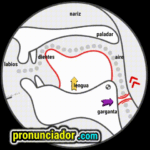
- Keep your tongue tip DOWN (behind your bottom teeth, relaxing).
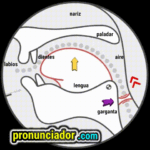
- Lift the BACK of your tongue way up, pressing it against the soft roof of your mouth (like for ‘K’ or ‘G’).
- Turn your voice ON (buzz in throat).
- Let the buzzing air flow out through your NOSE ONLY. “Nnnnnnggggg” (but think of it as one smooth sound!).
The CRUCIAL Difference: /ŋ/ (Thing) vs. /n/ (Thin) – It’s All About the Tongue!
This is maybe the #1 confusion point for many learners! They sound kinda similar because both are voiced nasals. BUT they are made in totally different parts of the mouth!
| Feature | /ŋ/ (Thing, Sing) | /n/ (Thin, Sin) |
| Tongue PART? | BACK of tongue lifts! | TIP of tongue lifts! |
| Tongue TOUCHES? | Soft Palate (Back Roof) | Alveolar Ridge (Behind Top Teeth) |
| Tongue TIP stays? | DOWN! (Relaxed below) | UP! (Touching the ridge) |
| Sound Feeling? | BACK of mouth / Throat | FRONT of mouth |
Think:
- /n/ (‘no’, ‘sun’): Tip Up!
- /ŋ/ (‘song’, ‘long’): Tip Down! Back Up!
Mistake Alert! Using /n/ (tip up) when you need /ŋ/ (back up) makes words sound totally wrong! “Sing” /sɪŋ/ becomes “Sin” /sɪn/. “Going” /ˈɡoʊɪŋ/ becomes “Goin'” /ˈɡoʊɪn/ (very common informal reduction, but technically incorrect and marks accent).
Solution: FEEL where your tongue is! For /ŋ/, actively keep the tip DOWN and lift the BACK. It feels different! Practice “sin”/”sing”, “thin”/”thing”, “win”/”wing”, “ran”/”rang”.

The -NG Puzzle: When is the ‘G’ Silent (Like in Sing)?
Here’s the rule most people miss: When the letters ‘NG’ appear AT THE VERY END of a word or syllable, you ONLY pronounce the /ŋ/ sound. The ‘G’ sound /ɡ/ is SILENT!
- Sing → /sɪŋ / (NOT /sɪŋɡ/)
- Long → /lɔŋ / (NOT /lɔŋɡ/)
- King → /kɪŋ / (NOT /kɪŋɡ/)
- String → /strɪŋ/
- Wrong → /rɔŋ/
- Hang → /hæŋ/
- Being → /ˈbiɪŋ/
- Going → /ˈɡoʊɪŋ/
- Morning → /ˈmɔrnɪŋ/
Super Easy Rule: See NG at the END? Just make the /ŋ/ sound (back of tongue up, nasal buzz). NO hard ‘G’ sound added!
Why the Confusion? Probably because ‘G’ is written there! And because in some other cases (see next section), you DO say the ‘G’.
When DO We Say the ‘G’ After NG? (Like in Finger!)
Okay, if ‘sing’ doesn’t have a ‘G’ sound, why does ‘finger’ have one? /ˈfɪŋɡər/. What’s the deal?
The general pattern (though not 100% perfect, this is English!):
- NG in the MIDDLE of a word: Sometimes you say the /ɡ/ AFTER the /ŋ/ sound, sometimes you don’t!
- Tendency 1: If the ‘NG’ is part of the ORIGINAL root word, and something is ADDED LATER (-er, -est), the /ɡ/ OFTEN does not appear.
- Sing + er → Singer /ˈsɪŋər/ (NO /g/)
- Hang + er → Hanger /ˈhæŋər/ (NO /g/)
- Long + est → Longest /ˈlɔŋɪst/ (NO /g/)
- Strong + est → Strongest /ˈstrɔŋɪst/ (NO /g/)
- Tendency 2: BUT, if the ‘NG’ just HAPPENS to be in the middle of a word that isn’t formed like that, the /ɡ/ OFTEN is pronounced.
- Finger → /ˈfɪŋɡər/ (YES /g/!)
- Anger → /ˈæŋɡər/ (YES /g/!)
- Hungry → /ˈhʌŋɡri/ (YES /g/!)
- English → /ˈɪŋɡlɪʃ/ (YES /g/!)
- Language → /ˈlæŋɡwɪdʒ/ (YES /g/!)
- Single → /ˈsɪŋɡəl/ (YES /g/!)
- Jungle → /ˈdʒʌŋɡəl/ (YES /g/!)
- Comparative/Superlative Exception! Words like ‘longer’ and ‘stronger’ (comparisons of ‘long’, ‘strong’) DO add the /ɡ/ sound: Longer /ˈlɔŋɡər/, Stronger /ˈstrɔŋɡər/. (This contradicts Tendency 1 – welcome to English exceptions!)
Simple Takeaway: NG at the END = NO /g/ sound. NG in the MIDDLE? It’s TRICKY! Listen or check a dictionary. But common words like ‘finger’, ‘English’, ‘language’ DO have the /ŋɡ/ combo.
The N+K and N+C Connection: Why ‘Bank’ Uses the NG Sound!
Remember how /ŋ/ is made with the BACK of the tongue up? And /k/ (cat) and /ɡ/ (go) are ALSO made with the back of the tongue up? They’re neighbors!
Because they’re made in the same place, something cool happens when N (normally tongue TIP up) comes BEFORE a K or hard C sound:
- Your tongue gets “lazy” or efficient! Instead of going TIP UP for N then BACK UP for K, it just goes straight to the BACK for BOTH!
- So, the ‘N’ before ‘K’ or hard ‘C’ (which sounds like /k/) AUTOMATICALLY CHANGES into the NG /ŋ/ sound! It’s called assimilation.
Rule: NK or NC (where C=/k/) is usually pronounced /ŋk/!
- Think → /θɪŋk/
- Thank → /θæŋk/
- Bank → /bæŋk/
- Pink → /pɪŋk/
- Drink → /drɪŋk/
- Ink → /ɪŋk/
- Uncle → /ˈʌŋkəl/
- Zinc → /zɪŋk/
- Junk → /dʒʌŋk/
- Monkey → /ˈmʌŋki/
- Crank → /kræŋk/
- Donkey → /ˈdɑŋki/
Easy Trick: See NK or NC? Make the NG sound /ŋ/ first, then the /k/! Back of tongue up + K sound!

Mouth Ninja Moves: Making the /ŋ/ Sound Perfectly!
Let’s nail the physical steps! It’s easy once you get the feel!
Step 1: Mouth & Lips – Normal & Relaxed
- Open your mouth just slightly, comfortably. [Similar setup to /n/].
- Lips are totally relaxed, doing nothing special. Neutral position.
Step 2: Tongue Tip STAYS DOWN!
- This is different from /n/! Let the tip of your tongue rest gently behind your bottom front teeth. DON’T lift it!
Step 3: BACK of Tongue Goes UP! (Like for K/G)
- Now, lift the BACK part of your tongue way up until it presses firmly against the soft palate (the soft roof way back in your mouth).
- This BLOCKS air from coming out your mouth.
Step 4: AIR Goes Out Your NOSE + VOICE ON!
- While the back of your tongue blocks your mouth, let the buzzing, voiced air flow out through your nose only.
- Make the sound: “Mmmmnnnnngggggg” (like the end of ‘sing’). /ŋ/.
Feeling Check: You should feel the back of your tongue pressing up. You should feel the buzz in your throat AND nose. Your tongue tip should be down and relaxed. The air ONLY escapes nasally.
Try this:
- Say /n/ (“nnnn”). Feel your tongue TIP UP behind top teeth.
- Now say /ɡ/ (“guh”). Feel your tongue BACK UP touching the soft palate.
- Now for /ŋ/: Put tongue BACK UP like for /ɡ/, KEEP IT THERE, and hum through your NOSE. Keep tip DOWN. That’s /ŋ/!
Spelling Summary: NG and N are the Clues!
Let’s recap the spelling patterns for the /ŋ/ sound:
- ‘NG’ Letters:
- At the END: = /ŋ/ sound ONLY (Sing, Long, Thing)
- In the MIDDLE: = Either /ŋɡ/ sound (Finger, English) OR just /ŋ/ sound (Singer, Hanging) → Tricky! Depends on word structure.
- ‘N’ Letter BEFORE ‘K’ or Hard ‘C’ (/k/ sound):
- = /ŋk/ sound combo! (Think, Bank, Uncle, Ink). The N changes to /ŋ/ automatically.
That covers almost all cases!
Mistake Busting! Common /ŋ/ Errors Zapped!
Let’s tackle the typical problems:
- Mistake #1: Adding Extra /ɡ/ or /k/ at the END (-ng)!
- Problem: Saying “Sin-guh”, “Lon-guh”, “Thin-kuh” (for ‘thing’!). Adding a hard stop sound after the nasal /ŋ/.
- Solution: END CLEAN! For final -NG, lift the back of your tongue for /ŋ/, let air flow through nose, then just STOP. Lower your tongue without a hard G/K explosion. Sing -> /sɪŋ/, not /sɪŋɡ/. Thing -> /θɪŋ/, not /θɪŋk/. Feel the difference!
- Mistake #2: Using Tongue TIP /n/ instead of Tongue BACK /ŋ/!
- Problem: “Sing” sounds like “Sin”. Your tongue tip goes up instead of the back.
- Solution: TIP DOWN, BACK UP! Consciously keep your tongue tip relaxed behind your bottom teeth. FOCUS on lifting ONLY the back part against the soft palate. Feel the vibration way back there.
- Mistake #3: Confusion with NK/NC words.
- Problem: Maybe trying to make a normal /n/ (tip up) right before the /k/, which feels awkward. Or just sounding unclear.
- Solution: EMBRACE THE /ŋk/! Realize the N naturally becomes /ŋ/ here. Practice making the /ŋ/ sound and immediately follow with a crisp /k/ explosion: thi[ŋk], ba[ŋk].
NG Ninja Training! Easy /ŋ/ Exercises!
Time to practice that back-tongue nasal!
Exercise 1: Feel the Back! /ŋ/ Alone
- Tip down. Lift BACK of tongue to soft palate. Hum through nose. “Nnnnnnnggggg”. Hold it! Feel the vibration way back.
Exercise 2: Tip UP vs Back UP! (/n/ vs /ŋ/)
Crucial contrast!
- Sin /sɪn/ (TIP UP) — Sing /sɪŋ/ (BACK UP)
- Thin /θɪn/ — Thing /θɪŋ/
- Win /wɪn/ — Wing /wɪŋ/
- Ran /ræn/ — Rang /ræŋ/
- Sun /sʌn/ — Sung /sʌŋ/
- Kin /kɪn/ (pariente) — King /kɪŋ/
Exercise 3: NG at the END! (NO Hard G!)
Practice cutting off cleanly after /ŋ/.
- Long, Strong, Wrong, Hang, Hung, Swing, Bring, Being.
Exercise 4: NG in the MIDDLE! (/ŋ/ or /ŋɡ/?)
Listen carefully!
- Singer /ˈsɪŋər/ (No G) — Finger /ˈfɪŋɡər/ (Yes G!)
- Hanging /ˈhæŋɪŋ/ (No G) — Anger /ˈæŋɡər/ (Yes G!)
- Wrongly /ˈrɔŋli/ (No G) — English /ˈɪŋɡlɪʃ/ (Yes G!)
Exercise 5: The NK/NC Combo → /ŋk/
Feel the /ŋ/ before the /k/!
- Think, Thank, Bank, Pink, Drink, Ink.
- Uncle, Zinc, Junk, Monkey, Crank.
Exercise 6: Mixed Bag Sentences + Recording!
RECORD yourself! Check your N vs NG, final NG, and NK sounds.
- “The king [ŋ] sang [ŋ] a long [ŋ] song [ŋ].” (Final NG focus)
- “Think [ŋk] before you drink [ŋk] the pink [ŋk] ink [ŋk]!” (NK focus)
- “My uncle [ŋk] has strong [ŋ] fingers [ŋɡ].” (Mix)
- “There’s nothing [ŋ] wrong [ŋ] with being [ŋ] hungry [ŋɡ].” (Mix)
- “Bring [ŋ] your thing [ŋ] along [ŋ]!”
Practice Exercises for the /ŋ/ Sound
The best way to master the /ŋ/ sound is through practice. Here are a few exercises you can try:
- Listen and Repeat: Listen carefully to native speakers pronouncing words with the /ŋ/ sound and try to repeat them. Pay attention to how they form the sound. You can use online dictionaries or the provided YouTube video for this.
- Minimal Pairs: Practice pairs of words that differ only by the /ŋ/ sound and other similar sounds, like /n/ and /k/.
- sing – sin
- sing – sink
- long – lawn
- rang – ran
- Word Lists: Practice saying the following words, focusing on the correct /ŋ/ pronunciation:
PHONETICAL PRONUNCIATION
PHONETICAL PRONUNCIATION
FAQs: Your NG /ŋ/ Sound Questions Answered!
Q1: So, the G in words like ‘sing’ or ‘long’ is silent? Really?
YES! At the END of a word or syllable, NG is just the /ŋ/ sound. The ‘G’ is just part of the spelling, it doesn’t make a separate /ɡ/ sound. Sing = /sɪŋ/.
Q2: But why do I hear a ‘G’ sound in ‘finger’ or ‘English’?
Good question! When ‘NG’ is in the MIDDLE of a word, sometimes you DO pronounce the /ɡ/ sound after the /ŋ/ (like in finger /ˈfɪŋɡər/). Sometimes you DON’T (like in singer /ˈsɪŋər/). Unfortunately, there’s no super simple rule, it often depends on the word’s origin and structure. You have to learn which words add the /ɡ/.
Q3: What’s the BIG difference between N /n/ and NG /ŋ/?
Where your TONGUE touches!
- /n/ (Thin): Tongue TIP goes UP behind your top teeth.
- /ŋ/ (Thing): Tongue TIP stays DOWN, while the BACK of your tongue goes UP to touch the soft roof.
It’s a FRONT vs BACK tongue movement!
Q4: Why does ‘N’ sound like NG /ŋ/ in ‘think’ or ‘bank’?
It’s a cool shortcut called assimilation! Because N /n/ (tip up) is followed by K /k/ (back up), your tongue just takes the easy route and makes the N with the BACK up too, turning it into /ŋ/ automatically before the /k/. So, NK = /ŋk/.
Q5: What’s the #1 mistake learners make with NG /ŋ/?
Probably two main ones:
- Adding a hard /ɡ/ sound at the end of words like “sing” or “long”.
- Using the regular /n/ sound (tongue tip up) instead of the /ŋ/ sound (tongue back up).
Mastering the clean /ŋ/ ending and the BACK tongue position fixes these!
Final Thoughts: You’re the KING (or QUEEN!) of /ŋ/!
Awesome work! You’ve now uncovered the secrets of the American NG sound /ŋ/! It’s not just “N+G”. It’s a unique nasal sound made with the BACK of your tongue.
Remember the golden rules:
- /ŋ/ = BACK Tongue UP + Tip DOWN + Nose Air + Voice ON!
- Vs /n/ = BACK vs TIP of tongue!
- Final NG = NO /ɡ/ sound! (Sing, Long). Just /ŋ/.
- Middle NG = SOMETIMES /ŋɡ/! (Finger, English). Tricky, listen up!
- NK / NC = /ŋk/ sound! (Think, Bank). N changes to /ŋ/ naturally.
- Key Mistakes: Adding final G, using /n/ instead.
Focus on feeling the BACK of your tongue working. Keep the tip relaxed and down. Practice the difference between /n/ and /ŋ/, and learn the common patterns for NG and NK/NC words. Record yourself! You’ll be “singing” the praises of your clear NG sound in no time!
👇🔥👇🔥👇🔥👇🔥👇🔥👇🔥
👉 RETURNS in the YEAR 2031 ! WHO? CLICK HERE ! 🔥



👇🔥👇🔥👇🔥👇🔥👇🔥👇🔥
👉 RETURNS in the YEAR 2031 ! WHO? CLICK HERE ! 🔥
👇🔥👇🔥👇🔥👇🔥👇🔥👇🔥
👉 RETURNS in the YEAR 2031 ! WHO? CLICK HERE ! 🔥
👉 RETURNS in the YEAR 2031 ! WHO? CLICK HERE ! 🔥