

Does ‘vision’ sound like ‘mission’? Master the tricky American English ZH /ʒ/ sound. Learn the secret “SH + voice” trick, spelling rules, and simple exercises.
Hey there, future American accent stars! Get ready to unlock one of the coolest, but also one of the rarest and trickiest, sounds in American English: the ZH sound, the one that buzzes in words like “vision”, “measure“, “pleasure“, and even the ‘G’ in “garage”! Its secret IPA symbol looks like a fancy number 3: /ʒ/.
“The ZH sound?” you might ask. “I didn’t even know that was a thing!” And you’re not alone! Because this sound is so rare in English words (less than 1%!) many learners either don’t notice it or replace it with sounds they do know, like SH /ʃ/, J /dʒ/, or Z /z/. Does your “vision” accidentally sound like “mission“? Or does “pleasure” come out sounding like “pressure“? If so, you’re devoicing the /ʒ/ and making it a /ʃ/ (SH). It’s a subtle difference in voicing (that throat buzz!) but makes a HUGE difference in sounding natural. And the SPELLING! How can ‘S’ (vision), ‘G’ (beige), or even ‘Z’ (seizure) ALL make this “buzzing SH” sound? It’s enough to make you want to avoid these words altogether!
But here’s the amazing news: the /ʒ/ (ZH) sound is actually the IDENTICAL TWIN of the /ʃ/ (SH) sound… just with your VOICE TURNED ON! Once you can make SH /ʃ/, making ZH /ʒ/ is a piece of cake! This ultimate, kid-friendly guide will show you how:
- Meet the “Buzzing SH” /ʒ/: What IS this cool, rare sound? (Hint: SH + Throat BUZZ!).
- Mouth Magic Twins: The EXACT SAME easy mouth, lip, and tongue position as the /ʃ/ SH sound!
- The #1 SECRET: Voicing! How to turn ON the buzz for /ʒ/ and OFF for /ʃ/. We’ll nail it!
- Spelling Surprises: Why S, G, Z (and even T!) are the most common ways to write /ʒ/ (NOT ‘ZH’!).
- Zap Those Errors! Fix common mistakes like saying SH, J, or Z instead of the buzzy ZH.
- Practice Power-Up! Simple exercises and key words (“vision”, “measure”, “usual”, “pleasure”, “garage”) to make your /ʒ/ amazing!
Get ready for your “television,” “decision,” “casual,” and “conclusion” to sound sophisticated and spot-on American! Let’s get this buzzing!
What is This Rare /ʒ/ (ZH) Sound? (The “Vision” Buzz!)
Let’s get to know this interesting sound. The /ʒ/, often called the “ZH” sound by learners (even though it’s rarely spelled that way!), is one of the essential nine fricative consonants in American English. Remember, “fricative” just means you squeeze air through a small opening in your mouth to make a continuous rubbing or hissing noise.
It’s considered the voiced counterpart (the twin that buzzes!) of the voiceless /ʃ/ SH sound (like in “show”). This means they are made with the EXACT SAME MOUTH POSITION! The only thing that changes is whether your vocal cords (voice box) are vibrating or not.
You hear /ʒ/ in words like:
- vision /ˈvɪʒən/
- measure /ˈmɛʒɚ/
- pleasure /ˈplɛʒɚ/
- usual /ˈjuʒuəl/
- decision /dɪˈsɪʒən/
- television /ˈtɛləvɪʒən/
- garage /ɡəˈrɑʒ/ (One of the few ‘G’ examples!)
- beige /beɪʒ/
Its Secret Ingredients (Super Easy Version!)
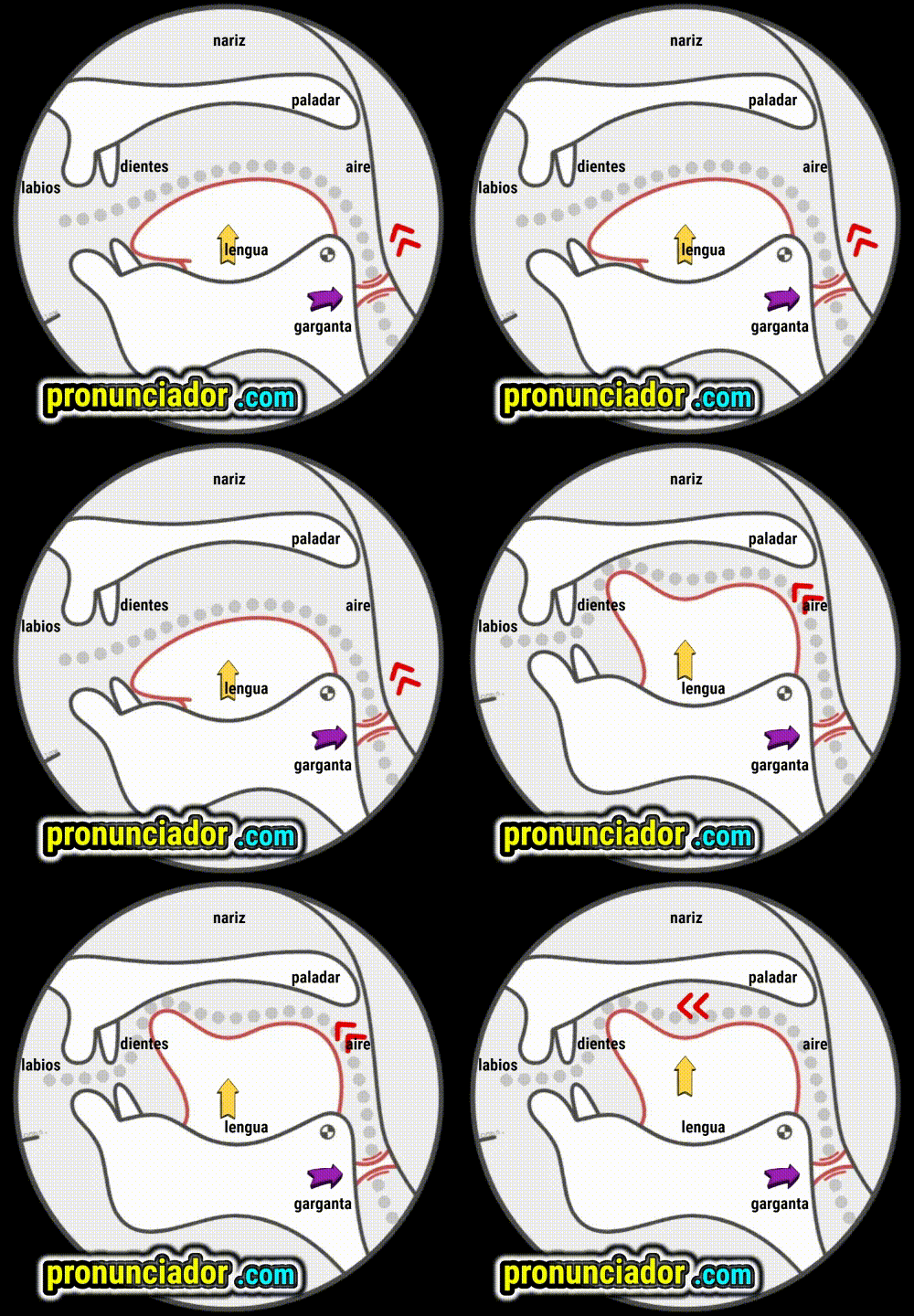
The sound experts describe /ʒ/ as a “palatal (or postalveolar), voiced, fricative consonant.” Let’s translate that for us humans:
- Palatal / Post-Alveolar (Tongue Arches UP!): This is WHERE your tongue goes.
- “Palatal” means near the hard roof of your mouth (palate).
- “Post-alveolar” means just behind that bumpy ridge behind your top teeth (alveolar ridge).
- For /ʒ/, the middle/front part of your tongue makes a big arch or ramp UP towards this area, getting close but NOT TOUCHING! A small gap is needed for the air to make the sound.
- Fricative (Air SQUEEZES & RUBS!): The air you breathe out is squeezed through that narrow tunnel made by your arched tongue and the roof of your mouth, creating a continuous friction or rubbing sound.
- Lips Slightly Rounded (Gentle “O” Shape!): Just like for the SH /ʃ/ sound, your lips should be slightly rounded and maybe pushed out just a tiny bit (puckered/protruded). Like you’re about to say “oooo” very gently.
- VOICED (Voice Box ON – THE BUZZ!): ★★★ THIS IS THE BIG KAHUNA! ★★★ Your vocal cords in your throat MUST be VIBRATING to make /ʒ/! It’s not just air; it’s air + buzz!
Super-Duper Kid Summary: To make the /ʒ/ (ZH in ‘vision’):
- Make your lips into a small, slightly puckered “O”.
- Raise the middle/front of your tongue UP towards the roof of your mouth (like a ramp, but don’t touch!).
- Blow air gently over your tongue.
- AND MOST IMPORTANTLY: Turn ON your voice box and make it BUZZ like a happy bumblebee in your throat! “ZZZZHHHHH”.
It’s literally the SHHH /ʃ/ sound, but you add a throat buzz to it!

The EPIC Twin Battle: Voiceless SH /ʃ/ vs. VOICED ZH /ʒ/
If you get this, you get 90% of the /ʒ/ sound! They share the EXACT SAME mouth, lip, and tongue position!
| Feature | Voiceless SH /ʃ/ (Mission, Pressure) | Voiced ZH /ʒ/ (Vision, Pleasure) |
| Lips Rounded? | YES, slightly puckered. | YES, slightly puckered. |
| Tongue Arched Up? | YES, mid/front towards palate. | YES, mid/front towards palate. |
| Airflow? | YES, continuous friction. | YES, continuous friction. |
| VOICE BOX (Buzz?) | OFF (NO BUZZ! Just air) | ON (YES BUZZ! Throat vibrates) |
| Sound Quality? | Airy “Shhhhh” | Buzzy “Zhhhhh” |
Why is this distinction SO VITAL? English uses it to tell words apart!
- Confusion /kənˈfjuʒən/ (voiced) vs. “Confession” /kənˈfɛʃən/ (voiceless)
- Azure /ˈæʒər/ (voiced, sky blue) vs. Asher* (name, /ˈæʃər/)
- Pleasure /ˈplɛʒər/ (voiced) vs. Pressure /ˈprɛʃər/ (voiceless)
It’s subtle, but crucial for clarity and sounding native.
The Golden Fix: The Throat Buzz Test! Place your fingertips lightly on your Adam’s apple.
- Say “shoe” /ʃu/. No buzz. That’s /ʃ/.
- Now say “zoo” /zu/. Big buzz! That’s /z/ (related to /ʒ/).
- Now, keep your mouth exactly like for /ʃ/ (“shoe”) but TRY to make the “zoo” buzz at the same time: That feeling of SH-mouth + ZOO-buzz is your target /ʒ/!
Your “Buzzing SH” Mouth Moves: Articulating /ʒ/ Easily!
Let’s build that voiced, buzzy friction sound. Remember, it’s IDENTICAL to /ʃ/ SH, but with the voice switched ON!
Step 1: Mouth Slightly Ajar
Just a comfortable, slight opening between your teeth.
Step 2: Lips: Gentle Pucker Forward!
- Round your lips slightly. Don’t make a tight kissing face like for /u/ (blue). Just a gentle rounding.
- Push them out a tiny bit (protrude/pucker). Imagine you’re saying “shhhh” to a baby.
Step 3: Tongue: The “Almost-Touching” Ramp!
- Let your tongue tip rest easily, perhaps behind your lower teeth or just neutrally. It’s not the main actor here.
- The BLADE (the part just behind the tip) and the FRONT/MIDDLE of your tongue make a big ARCH or RAMP upwards.
- It gets very CLOSE to the hard palate (roof of mouth) and the area just behind your top-front tooth ridge (post-alveolar region).
- MEGA IMPORTANT: DO NOT TOUCH! There must be a narrow channel or gap for the air to flow through.
Step 4: Airstream: The Continuous Whoosh!
- Gently and steadily push air from your lungs, forcing it over the ramp of your tongue and through that narrow channel.
- This should create audible friction – that classic “shhh” (or “zhhh”) type of sound.
Step 5: Voice Box: TURN IT ON! Make it BUZZ!
- THIS IS THE /ʒ/ SECRET! As the air flows, make your vocal cords vibrate.
- Feel for that buzzing or humming sensation in your throat. It will transform the airy SH-like friction into a voiced ZZH-like friction.
Putting it All Together: Slightly Puckered Lips + Tongue Arched High (No Touch!) + Air Squeezing Out + THROAT BUZZING = Perfect American /ʒ/!
Quick Try:
- Make a perfect, clear, voiceless SH /ʃ/ sound (“Shhhhhhhhh”).
- Keep everything in your mouth EXACTLY the same, but now, simply turn on your voice and hum through it.
- “Shhhhhh” should become “Zzzzhhhhhh”. That’s your /ʒ/!
Crazy Spelling Alert! How Do You Write the /ʒ/ Sound?
Okay, brace yourselves! The /ʒ/ sound, even though it’s rare, has some WEIRD spellings! The letters ‘ZH’ are almost never used to spell it!
#1 Most Common: Letter ‘S’ in -SION / -SURE (~79%)
YES! The letter ‘S’ is the MOST common way to spell the /ʒ/ sound! This happens primarily in suffixes like:
- -SION (after a vowel): vision /ˈvɪʒən/, decision /dɪˈsɪʒən/, television /ˈtɛləvɪʒən/, conclusion /kənˈkluʒən/, explosion /ɪkˈsploʊʒən/, invasion /ɪnˈveɪʒən/, occasion /əˈkeɪʒən/, confusion /kənˈfjuʒən/.
- -SURE (after a vowel): measure /ˈmɛʒɚ/, pleasure /ˈplɛʒɚ/, treasure /ˈtrɛʒɚ/, leisure /ˈliʒɚ/ (or /ˈlɛʒɚ/), exposure /ɪkˈspoʊʒɚ/, closure /ˈkloʊʒɚ/.
- -SUAL (after a vowel): usual /ˈjuʒuəl/, casual /ˈkæʒuəl/, visual /ˈvɪʒuəl/.
The Pattern: VOWEL + S + I/U + Vowel often leads to /ʒ/.
#2 Player: Letter ‘G’ (Mostly from French!) (~16%)
The letter ‘G’ (before E or I, often from French words) can also be /ʒ/.
- beige /beɪʒ/
- garage /ɡəˈrɑʒ/
- massage /məˈsɑʒ/
- montage /mɑnˈtɑʒ/
- corsage /kɔrˈsɑʒ/
- régime /reɪˈʒim/
- prestige /prɛˈstiʒ/
- genre /ˈʒɑnrə/
- concierge /ˈkɑnsiˌɛrʒ/
- sabotage /ˈsæbətɑʒ/
- camouflage /ˈkæməflɑʒ/
#3 Rarity: Letter ‘Z’ (~4%)
Very few common words use ‘Z’ for /ʒ/, but they exist!
- seizure /ˈsiʒɚ/
- azure /ˈæʒɚ/
#4 Super Rare: Letter ‘T’ (~1% )
This one is mind-bending! The ‘T’ can sometimes be /ʒ/ in specific patterns, usually involving ‘TU’ before a vowel or specific suffix. The SoundsAmerican video for /ʒ/ doesn’t list ‘T’ as a common spelling but mentions ‘equation’ in the video’s on-screen spelling examples when discussing “concierge” and “regime.” This requires cross-checking, as -TION is usually /ʃən/.
Research shows that T as /ʒ/ happens rarely, like in equation /ɪˈkweɪʒən/ by some speakers as a form of palatalization of /zj/ or due to historical shifts. However, standard transcription for ‘equation’ is more commonly /ɪˈkweɪʃən/ with SH /ʃ/. This spelling is extremely minor for /ʒ/ and might be dialectal or very specific to certain phonetic environments.
For our “kid-friendly” purpose, we’ll focus on S, G, and Z as the primary reliable indicators (with S being the tricky champion!).
Spelling Guide for /ʒ/ (The Buzzing SH):
| Spelling | Frequency (Web) | Clue / Typical Context | Key Examples (/ʒ/) |
| S (in -SION, -SURE, -SUAL) | ~79% (KING!) | Usually VOWEL + S + I/U + Vowel | vision, measure, usual, pleasure |
| G (before E/I) | ~16% | Often French loanwords, -AGE, -IGE | garage, beige, massage, prestige |
| Z | ~4% | Specific words to learn | seizure, azure |
| T | Extremely Rare | (equation debated) | (Focus on S, G, Z) |
Main Idea: Be super alert to -SION, -SURE, -SUAL after a vowel. If you see a fancy ‘G’ word from French, suspect /ʒ/. ‘Seizure’ and ‘azure’ are special Z’s.

Oops! Common /ʒ/ Mistakes (And How to Buzz Past Them!)
What trips learners up with this rare-but-important buzzing sound?
- Mistake #1: MAKING IT VOICELESS! (/ʃ/ instead of /ʒ/)
- The Problem: Mouth is perfect, but no throat buzz! “Vision” → “Mission”. “Pleasure” → “Pressure”. The #1 error!
- The Fix: TURN ON THE MOTOR! Consciously vibrate your vocal cords. Feel the buzz. Compare SH /ʃ/ (air only) with ZH /ʒ/ (air + buzz). The VOWEL before /ʒ/ is also usually LONGER than before /ʃ/ (the vowel length rule!).
- Mistake #2: USING /dʒ/ (J like ‘Judge’) instead!
- The Problem: Starting the sound with a ‘D’ stop. “Vision” → “Vih-John”.
- The Fix: /ʒ/ is SMOOTH FRICTION, NO STOP! The air flows continuously from the beginning. /dʒ/ has a quick D-block first (“D-ZH”). For /ʒ/, it’s just “ZZZHHHHHH” right away.
- Mistake #3: Not Enough LIP ROUNDING or TONGUE ARCH.
- The Problem: Sound is weak, too much like /z/ (if voiced) or /s/ (if voiceless by mistake). Lips are flat, tongue not high enough.
- The Fix: Gentle “O” lips, pushed out slightly. And really feel that front/middle tongue making a ramp UP, creating that narrow channel.
- Mistake #4: PRONOUNCING THE WRITTEN ‘S’ or ‘G’ as /s/ or /g/.
- The Problem: Seeing ‘vision’ and saying “vis-see-on”. Seeing ‘garage’ and saying “ga-rag” (with hard G).
- The Fix: SPELLING IS A TRAP! Remember -SION, -SURE, -SUAL after vowel often = /ʒ/. Some -GE endings = /ʒ/. You need to learn these patterns for the sound, not just the letter.
Buzz Bootcamp! Easy Exercises for the /ʒ/ Sound!
Let’s get that voice box humming with the right mouth shape!
Exercise 1: Feel the /ʒ/ Buzz – Isolate It!
- Start with /ʃ/ (SHHH): Round lips slightly, arch tongue, blow air (no voice).
- Now, ADD VOICE: Keep everything the same, but make your throat buzz. SHHHHH → ZZZHHHHH. That’s /ʒ/!
- Hold it: /ʒʒʒʒʒʒʒʒʒʒʒʒʒʒʒʒʒʒ/. Feel the buzz and the airy friction?
Exercise 2: Voicing ON vs. OFF – /ʒ/ (Vision) vs. /ʃ/ (Mission)
THE MOST CRITICAL DRILL! Same mouth, just voice on/off.
- Vision /ˈvɪʒən/ (BUZZ) — Mission /ˈmɪʃən/ (NO BUZZ)
- Pleasure /ˈplɛʒər/ (BUZZ) — Pressure /ˈprɛʃər/ (NO BUZZ)
- Leisure /ˈliʒər/ (BUZZ) — Leh-shure (NO BUZZ, hypothetical)
- Asia /ˈeɪʒə/ (BUZZ) — A-sha (NO BUZZ, hypothetical)
- Rouge /ruʒ/ (BUZZ – makeup) — Rush /rʌʃ/ (NO BUZZ)
Exercise 3: Smooth Friction /ʒ/ vs. Stop+Friction /dʒ/ (Judge)
No ‘D’ block at the start of /ʒ/!
- Vision /ˈvɪʒən/ (SMOOTH) — Vi-djohn (BLOCK – how it might sound if wrong)
- General /dʒ/ comparison: Beige /beɪʒ/ — Judge /dʒʌdʒ/
- Measure /ˈmɛʒɚ/ — Major /ˈmeɪdʒɚ/
- Garage /ɡəˈrɑʒ/ — Jar /dʒɑr/
Exercise 4: Practice Words with Different /ʒ/ Spellings
Get used to ‘S’, ‘G’, ‘Z’ making the SAME BUZZING sound!
- S (-sion, -sure, -sual): decision, pleasure, usual, treasure, television, explosion, vision, measure, occasion, division, conclusion, illusion, visual, invasion, confusion, casualty.
- G (-ge, -gi…): garage, beige, massage, prestige, regime, camouflage, concierge, genre.
- Z: seizure, azure.
Exercise 5: Common Word List Workout
| PHONETICAL PRONUNCIATION |
| PHONETICAL PRONUNCIATION |
Exercise 6: Sentence Buzz Drill + Recording!
RECORD! Can you keep the /ʒ/ buzzing and smooth? Is it distinct from /ʃ/?
- “It’s a pleasure [ʒ] to watch television [ʒ] at my leisure [ʒ].”
- “The usual [ʒ] confusion [ʒ] led to a bad decision [ʒ].”
- “The beige [ʒ] garage [ʒ] holds a treasure [ʒ].”
- “His vision [ʒ] for the division [ʒ] was a precise [s] conclusion [ʒ].” (Precise = /s/! Contrast!).
FAQs: Your American ZH /ʒ/ (Vision) Questions Solved!
Q1: Is the ZH /ʒ/ sound really just a SH /ʃ/ sound with my voice turned on?
YES! That’s the easiest way to think about it! Make a perfect SH /ʃ/ sound (lips rounded, tongue arched up not touching, air flowing). NOW, keep everything in your mouth EXACTLY the same, but simply make your throat buzz (vibrate your vocal cords). SHHHH (air only) will magically turn into ZZZHHH (air + buzz). That’s /ʒ/!
Q2: Why is this sound so RARE if the words it’s in are common?
Good question! While words like “vision”, “usual”, “measure” are very common, the actual number of distinct English words that contain /ʒ/ is quite small compared to sounds like /s/ or /t/. Many of them are related (vision, television, division) or come from specific origins (like French words ending in -age: garage, massage). So, you don’t encounter as many unique words with /ʒ/, but the ones that have it are used a lot!
Q3: My /ʒ/ still sounds like /dʒ/ (like in “judge”). What’s wrong?
You’re probably stopping the air with your tongue for a split second before making the friction sound.
- /dʒ/ (Judge): Starts with a quick D-like BLOCK (tongue tip/blade hits the ridge behind teeth), THEN releases into a ZH-like friction. It’s a “D-ZH!” combo.
- /ʒ/ (Vision): Is PURE, CONTINUOUS friction from the start. The air never stops flowing. “ZZZHHH” all the way.
FIX: Make sure your tongue doesn’t make that initial “stop” contact. Let the air flow freely from the beginning with the buzz.
Q4: The spelling is SO confusing! How do I know S, G, or Z will be /ʒ/?
You’re right, it’s a puzzle!
- ‘S’ is most common (≈79%): Look for -SION, -SURE, -SUAL patterns after a vowel (vision, measure, usual).
- ‘G’ (≈16%): Often in words borrowed from French ending in -AGE, -IGE (garage, beige, prestige).
- ‘Z’ (≈4%): Only in a few words like seizure, azure.
- ZH, T: Almost NEVER.
Best tip: For these spellings, if you’re unsure, LISTEN to a native or check the IPA /ʒ/ in a dictionary!
Q5: Does the vowel before /ʒ/ really get longer, like mentioned with /ʃ/?
Yes! The “vowel length rule” generally applies. Vowels tend to be a bit longer before VOICED consonants (like /ʒ/, /z/, /d/, /b/, /g/) compared to their shorter duration before their VOICELESS counterparts (like /ʃ/, /s/, /t/, /p/, /k/). So, the /ɪ/ in “vision” (before voiced /ʒ/) is naturally a bit longer than the /ɪ/ in “mission” (before voiceless /ʃ/). It’s a subtle detail that adds to natural rhythm!
Key Takeaways: You’ve Got the /ʒ/ Buzz Power!
Fantastic effort! You’ve now explored the rare but impactful American English /ʒ/ (ZH) sound – the “buzzing SH” that makes words like ‘vision’ and ‘pleasure’ sound just right.
Keep these power points in mind:
- /ʒ/ = SH Sound + THROAT BUZZ! (Lips Rounded, Tongue Arched UP – NO TOUCH, Air Flows, VOICE ON!)
- Key vs /ʃ/ (SH) = BUZZ vs. NO BUZZ. Mouth is IDENTICAL.
- Key vs /dʒ/ (Judge) = SMOOTH FRICTION vs. D-STOP + FRICTION.
- SPELLING CLUES: S (in -SION/-SURE/-SUAL after vowel), G (in -AGE/-IGE French words), Z (seizure).
- #1 ERROR: Forgetting the BUZZ (saying /ʃ/ instead). #2: Using /dʒ/.
- FREQUENCY: Rare overall in number of words, but the words are VERY common.
Mastering the /ʒ/ sound, especially its voiced quality, is a fantastic step toward a clearer and more authentic American accent. Practice feeling that buzz while maintaining the SH mouth shape. Listen to native speakers and focus on how they pronounce ‘vision’, ‘measure’, ‘usual’. You’ll get it!
👇🔥👇🔥👇🔥👇🔥👇🔥👇🔥
👉 RETURNS in the YEAR 2031 ! WHO? CLICK HERE ! 🔥



👇🔥👇🔥👇🔥👇🔥👇🔥👇🔥
👉 RETURNS in the YEAR 2031 ! WHO? CLICK HERE ! 🔥
👇🔥👇🔥👇🔥👇🔥👇🔥👇🔥
👉 RETURNS in the YEAR 2031 ! WHO? CLICK HERE ! 🔥
👉 RETURNS in the YEAR 2031 ! WHO? CLICK HERE ! 🔥
👉 RETURNS in the YEAR 2031 ! WHO? CLICK HERE ! 🔥