

Perfect your American M /m/ sound. This easy guide shows you how to pronounce the nasal consonant correctly, fix dropped M’s, & stop vowel distortion
Hey there, awesome English learners! Get ready to understand a sound that’s so fundamental, it’s often overlooked, yet mastering it is key to a smooth American accent: the /m/ sound, like in “map,” “me,” “make,” or “summer**”! Its phonetic symbol is simply /m/.
Now, this /m/ sound (often referred to as the “Humming M”) seems pretty easy. It exists in almost every language in the world BUT, getting it perfectly American often involves subtleties that learners miss, especially at the ends of words, or dealing with how vowels around it change.
What kind of “M”-ish mess do learners typically make?
- The “Vanishing M”: This is a classic! Have you ever said “game” and noticed it sounds a bit like “gay“? Or “claim” sounds like “clay“? You’re dropping the /m/ sound at the end of words! This immediately makes your speech less clear and affects rhythm.
- The “Open-Mouth M”: Do you sometimes accidentally make your /m/ with your mouth slightly open, letting some air leak out? This can make your “m” sound muffled or even turn it into a “b” or “p”!
- The “Strange Vowel” Before M: Do your vowels sound a bit “off” or overly nasal before an /m/ sound? For instance, “home” might sound a bit different in your mouth than when a native says it. This is usually due to prematurely starting the nasal airflow on the vowel!
- The Silent M: Just to keep you on your toes, there are a few tricky words where the ‘M’ is there in spelling, but takes a secret nap and is completely silent! (e.g., “mnemonic,” “hymn“).
It’s frustrating! You just want your “come,” “time,” and “home**” to sound confidently American, not like a linguistic lottery! These tiny errors, if uncorrected, can really hold back your natural flow.
But good mews! Today, we’re bringing all that “M”ystery into crystal-clear focus! This ULTIMATE, super-EASY guide (explained so simply your 8-year-old would feel like a phonetics wiz!) will make you an /m/ expert:
- Meet the Humming /m/: What is this “lips-together-NOSE-ONLY-air” sound, really?
- The #1 Secret: NOSE AIR + Voice ON! Learn what makes /m/ unique among English sounds!
- M vs. B vs. P, and M vs. N vs. NG: A “Nasal Family Reunion” to clarify these common confusions! We’ll show you where your lips/tongue should block the air for each.
- Stop Dropping Your M’s! Simple tricks to ensure your final /m/s (“game”, “claim”) always make a perfect “hum!”
- Nasalization (The “Secret Vowel Changer”) Uncovered! Why your vowel sounds different before ‘M’, and how to do it naturally!
- Mouth Moves for a Marvelous /m/ (Kid-Style!): Easy, step-by-step for perfect lip closure and nose airflow!
- Spelling? Mostly M-azing! ‘M’ and ‘MM’ usually spell /m/. We’ll also cover the trickiest silent M words!
- Zap Common “M”-istakes! Fix those dropped Ms, unwanted pops, and vowel changes!
- “Mom Made Many Meals!” Practice! Awesome drills with essential words (‘me’, ‘make’, ‘map’, ‘home’, ‘room’, ‘email’, ‘smile’) to make your American /m/ absolutely perfect!
Get ready for your “more,” “much,” “money,” and “moment” to sound clear, natural, and impressively American! Let’s make progress! 🚀

What is This “Humming Lips” /m/ Sound? (The Nose-Only Consonant!)
First off, let’s formally introduce our star: the American English /m/ sound. You use it every day, from “Hi, my name is…” to “mom” and “home.” Its phonetic symbol is simply /m/.
The /m/ sound is one of the three Nasal Consonants in American English. The other two are /n/ (“nice”) and /ŋ/ (“sing”). What makes nasal consonants special? It means that when you make the sound, the air flows out ONLY through your nose, not your mouth! This is why they all sound like a gentle hum.
Its Core “M”-eaning (Kid-Friendly Version!)
Sound experts (the smart folks who study sounds!) call /m/ a “bilabial, voiced, nasal consonant.” Here’s the easy translation for you:
- Bilabial (LIPS Closed!): “Bi” means two, and “labial” means lips. So, for the /m/ sound, you simply press your top and bottom lips together firmly and completely. They make a perfect seal at the very front of your mouth! This is the exact same lip shape you use for the /p/ sound (“pie”) and the /b/ sound (“boy”).
- VOICED (Throat BUZZES ON!): “Voiced” means your vocal cords (your voice box in your throat) are TURNED ON and VIBRATING continuously while you make the /m/ sound. You should feel a steady BUZZ or HUM in your throat and, often, a slight vibration inside your nose too!
- Nasal (AIR Out NOSE ONLY!): This is the special part! While your lips block the air in your mouth, your SOFT PALATE (velum – the soft, squishy back part of your mouth’s roof) lowers. This opens up the path to your nasal cavity, and all the buzzing air flows OUT THROUGH YOUR NOSE! Your mouth MUST stay sealed by your lips for the air to go out only through your nose.
Super-Simple “Humming Lip” Summary for /m/:
- Press your lips together. Make a tight seal!
- Turn ON the throat buzz (hum like a bee!).
- Let all that humming air flow ONLY out through your NOSE! “Mmmmmmmm!” (Like you’re thinking “hmmm…”)
Key Feeling: Lips closed tightly. Throat buzzing. Air only out your nose. It’s a continuous humming sound from your lips!
The Nasal Family Portrait: /m/ vs. /n/ vs. /ŋ/ (Where’s the BLOCK?!)
These are the three amazing nasal consonants in American English. They are all voiced (throat buzzes) and all use nasal airflow (air out the nose). The ONLY thing that makes them different is WHERE in your mouth the air is blocked!
| Consonant | IPA | Place of BLOCKAGE | Articulators Used | Key Word | Oral Cavity View |
| /m/ | /m/ | Front – Both Lips | Lips together | map | Block at lips, back is open. |
| /n/ | /n/ | Middle – Tongue Tip to Alveolar Ridge | Tongue Tip to Alveolar Ridge | nice | Block at alveolar ridge, lips open/neutral. |
| /ŋ/ | /ŋ/ | Back – Back of Tongue to Soft Palate | Back of Tongue to Soft Palate | sing | Block at velum, mouth usually open for following vowel. |
Why Knowing This Matters: Learning exactly where to block the air is the precise fix for confusing these sounds, especially at the ends of words! The sounds of words like “ram,” “ran,” and “rang” are very different and depend on accurate mouth blockage.
/m/ vs. Lip-Popping Consonants: M (Hum!) vs. B (Pop!) vs. P (Puff!)
Let’s quickly compare /m/ with its “lip-block” relatives, /b/ and /p/!
| Feature | /m/ (Map, Room) | /b/ (Boy, Bubbl) | /p/ (Pie, Pop) |
| Lips Together? | YES! (Complete Seal) | YES! (Complete Seal) | YES! (Complete Seal) |
| Air Path? | THROUGH NOSE ONLY! (Nasal) | THROUGH MOUTH ONLY! (Oral Stop) | THROUGH MOUTH ONLY! (Oral Stop) |
| VOICE Box? | ON! (Voiced) | ON! (Voiced) | OFF! (Voiceless) |
| Sound Quality? | Continuous Hum | Explosive Pop + Buzz | Explosive Pop + Air Puff |
Main Takeaway: /m/ is special because it’s the only sound made by fully closing your lips AND having air only come out of your nose! No sudden oral “pop”!

The M-Challenge: When /m/ Gets Lost or Changes its Vowels (Mistakes & Fixes!)
Here’s where the mighty /m/ often trips up learners!
- MISTAKE #1: The “Open Mouth M”! (Air Leaks Orally)
- The Issue: Your lips aren’t completely sealed, allowing some air (and sometimes sound!) to escape through your mouth instead of only your nose. Your /m/ sounds muffled or even like a /b/ or /p/ if the lips then open or pop! This can happen at the end of words especially.
- THE #1 FIX: LIPS FIRMLY TOGETHER! Consciously press your lips firmly to ensure a complete seal for the air. Make sure all the hum goes out through your nose. Think “Super Seal” lips!
- MISTAKE #2: DROPPING the Final /m/ Sound!
- The Problem: You end a word or phrase before the /m/ sound is fully made, losing clarity and changing word meaning. “Game” sounds like “Gay.” “Claim” sounds like “Clay.” This often happens if the speaker is too focused on the vowel or speeding up.
- THE FIX: MAKE THE “HUM” LAST! Remember, /m/ is a continuous sound. Keep your lips closed and hum that /m/ right to the very end of the word, letting the hum resonate. For “Game,” you should close your lips and feel the /m/ before you stop the sound.
- MISTAKE #3: DISTORTING PRECEDING VOWELS (Premature Nasalization)
- The Problem: Because /m/ (and other nasals) is nasal, your velum (soft palate) needs to lower early to allow nasal airflow. This naturally nasalizes the vowel before the /m/. For native speakers, this is perfectly normal and automatic! BUT, for learners, it can be done too strongly, at the wrong time, or with too much muscle tension, making the vowel sound overly “nasal” or “muffled” in an undesirable way.
- THE FIX: BE AWARE, BUT DON’T FORCE! Understand this is a natural phenomenon in English (called coarticulation or assimilation). Don’t try to stop it. Focus on making the vowel sound correctly first, THEN transition smoothly and gently to the nasal /m/. Let the nasalization happen naturally; don’t over-tighten your throat or push too hard for nasal air on the vowel. Focus on good lip closure for /m/ itself, and the rest will often fall into place.
- MISTAKE #4: Confusing NASAL Consonants (/m/ vs. /n/ vs. /ŋ/)!
- Problem: Not knowing where your mouth needs to block the air for each sound. So “ram” might sound like “ran,” or “him” might sound like “hin.”
- THE FIX: MASTER THE BLOCKING PLACE!
- /m/ (Map): LIPS CLOSED.
- /n/ (Nice): TONGUE TIP on Alveolar Ridge.
- /ŋ/ (Sing): BACK of TONGUE on Soft Palate.
Consciously control that blockage spot!
Your Mouth’s “Humming Action”: Making /m/ Step-by-Step!
Ready to produce that marvelous, nose-only hum? It’s easier than it looks!
Step 1: Lips Firmly Together! (The Oral Air Blocker)
- Bring your top and bottom lips together firmly and completely. They need to seal tightly so NO air can escape from your mouth! This is different from the lips in “b” where air “pops,” for “m” they are tightly sealed for a continuous sound.
Step 2: Voice Motor ON! (Feel that Buzz!)
- Before you open your lips, ensure your vocal cords (throat) are VIBRATING continuously. Feel that steady hum! You should feel it buzzing in your throat and maybe even your nose!
Step 3: Air OUT Through the NOSE ONLY!
- While your lips are sealed and your voice is on, allow the air to flow ONLY through your nasal passage. This means your soft palate is lowered. All the voiced, buzzing air goes up and out your nose. Your tongue remains in a neutral, relaxed position.
- The sound should be a continuous “Mmmmmmmmmmm.”
Kid-Friendly “Mama’s Hum” Cue: “Imagine your mom is humming with her lips closed! Press your lips together. Now, make a humming sound like ‘mmmmmmmmm,’ and feel the buzz inside your nose! All the sound goes out your nose, not your mouth! That’s your /m/!”
Key Feeling: Lips closed tightly. Throat buzzing. Air flowing ONLY out your nose. It’s a smooth, sustained hum.
“M”-azing Spellings! How the /m/ Sound is Written!
Good news! The /m/ sound is one of the most consistently spelled sounds in English.
The Champion: Letter ‘M’! (~96%)
The letter ‘M’ alone represents the /m/ sound in the vast majority of cases.
- me, my, mall, mask, math, meal, meet, miss, mix, mood, mop, more, move, much, mug, must.
- come, him, from, time, them, name, some, team, home, name, remember.
- hum, jam, dram, ham, lame, lime.
The Double Power: ‘MM’! (~4%)
When you see ‘MM’ together, it also just makes ONE single /m/ sound. The double ‘MM’ usually just indicates that the vowel before it is short (similar to ‘FF’ or ‘DD’).
- Summer, comment, common, hammer, lummer, immediate, command, grammar, programme (British spelling).
The Vanishing Silent ‘M’! (Very Rare!)
Unlike ‘P’ or ‘K’ with silent ‘M’ can be tricky, there are almost NO words in standard English where ‘M’ is actually silent (except in loanwords or historical spellings which may or may not retain full silence). One notable group that used to be seen as silent M often now gets its M pronounced is ‘MN’ combinations, e.g. “hymn.” However, in fast speech some weaken. The primary source does NOT mention a list of silent M words beyond implicitly handling it with articulation tips, which points to its very rare status compared to silent B or K. This is different from the situation in Spanish ‘Mn’ combination in words like “columna.”
Important: Words like ‘mnemonic’ often do have a pronounced /m/ even with the ‘n’ or a reduced /n/ but it’s typically /nəmɑnɪk/. ‘Mne-‘ at the start often keeps the /m/ in English.
Therefore, for learners: Always pronounce ‘M’ unless it’s an incredibly rare exception for specialists!
Whoops! Common /m/ Mess-Ups & Master Fixes!
Let’s clean up those common “M”istakes!
- MISTAKE #1: “OPEN-MOUTH M”! (Air leaking orally!)
- The Issue: Your lips aren’t firmly sealed, letting some air (and hum) escape from your mouth. Your /m/ sounds muffled or turns into a “b” or “p” sometimes. This is most common at word ends.
- THE #1 FIX: LIPS FIRMLY SEALED! Make sure your top and bottom lips are completely (but gently!) pressed together to block all air from the mouth. The only place air should exit is your nose. “Mmmah!” not “buh!”
- MISTAKE #2: DROPPING the Final /m/ Sound!
- The Problem: You end a word or phrase before completing the /m/ sound (sealing lips and humming). Your “game” sounds like “gay,” your “time” sounds like “tie.”
- THE FIX: HUM IT TO THE END! Consciously hold the /m/ sound for a tiny moment with lips sealed, allowing the nasal hum to finish the word. For “game,” you should feel your lips close for the /m/ and then hold the buzz for a beat before silence. “Gammmm-eh!” not “gay”.
- MISTAKE #3: VOWEL DISTORTION! (Premature Nasalization before /m/)
- The Issue: The vowel sound before the /m/ might sound overly nasal, too strong, or distorted because your soft palate (velum) lowers too early, sending vowel air through your nose too forcefully.
- The Fix: AWARENESS, NOT FORCE! Recognize that vowels do naturally nasalize before /m/ (this is normal coarticulation). But don’t try to force it or tighten up. Focus on:
- Making the vowel itself correctly first (lips, tongue position for that vowel).
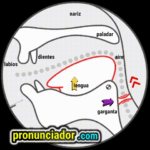
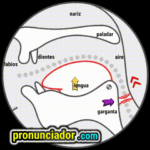
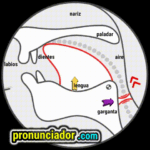
- Then, smoothly transition into the /m/ with precise lip closure. Let the nasalization happen naturally as you prepare for /m/. The diagram in the video helps explain this; a dot line shows air should go only through oral cavity on vowel , then only nasal for /m/ . So don’t pass nasal air through the vowel at all in the first place, until /m/ comes. This means nasalization only happens whenvelum drops. It is NOT for vowel sound.
- My revised advice for learners would be: allow slight nasalization but prioritize precise vowel shape before the /m/ articulation. Don’t make vowels too nasal.
- MISTAKE #4: Confusing /m/ with /n/ or /ŋ/!
- Problem: Not consistently blocking air in the correct spot for each nasal sound. So “ram” sounds like “ran,” “hum” like “hun(g).”
- THE FIX: MASTER THE BLOCKING PLACE!
- /m/ = LIPS CLOSED (Front)
- /n/ = TONGUE TIP to Ridge (Middle)
- /ŋ/ = BACK OF TONGUE to Soft Palate (Back)
Consciously feel where the block is for each sound.
- MISTAKE #5: Pronouncing SILENT ‘M’s!
- Oops: Saying “M-NEM-on-ic” or other words where M is silent (if such a pattern existed commonly beyond “mnemonic” which usually is /nɪˈmɑnɪk/ with silent ‘m’).
- The Fix: Good news: Silent ‘M’ is very, very rare. Most ‘M’s are pronounced. Focus on the ones where ‘M’ is part of the pronunciation, as the exceptions where ‘M’ itself is silent are minimal in English. For mnemonic and others, ensure the first letter ‘M’ is pronounced. The video refers to silent ‘K’ (KN- like ‘know’) or silent ‘G’ (GN- like ‘sign’), so no clear pattern for ‘M’ silence. There are silent ‘M’ in loanwords such as “chasm”, “diaphragm”, but not a regular feature learners usually encounter, nor specifically mentioned as ‘silent M’ in this SA lesson structure.

“M”-azing Practice! Exercises for Your American /m/!
Let’s get that magnificent Humming M humming along perfectly!
Exercise 1: The “Nose Hum” Drill – Pure /m/ Power!
- LIPS FIRMLY CLOSED. VOICE ON (Throat buzzing)!
- Blow air ONLY through your NOSE!
- Make a long, steady hum: “Mmmmmmmmmmmmmmmmmmm…”
- Hold it for 5-10 seconds. Feel the strong, pure nasal buzz. If air leaks from your mouth, your lips aren’t sealed tightly enough!
Exercise 2: Final /m/ Mastery – Keep it Humming!
Focus on closing your lips and making the /m/ sound right to the very end of the word. Don’t drop it!
- Gotta go h-O-M-E!
- This is the game.
- Let’s make a move.
- That’s a clai-m.
- I can come.
- From: (Fro-m!)
- Me: (Me-m! But that’s a whole phrase. It’s ‘me’. Example provided. The video has me /mi/, make /meik/, room /rum/, smile /smaɪl/, email /ɪmeɪl/ and practice has ‘me’. The context is simply word-initial, medial, and final.
- Let’s use specific “ending” words: dram, ham, hum, jam, lame, lime, climb, comb.)
Exercise 3: M vs. B vs. P – Where’s the Blockage/Airflow?
- Map (Lips closed, air out nose)
- Bap (Lips closed, air pops out mouth, voiced)
- Pap (Lips closed, air pops out mouth, voiceless)
- Room (Ends /m/) — Robe (Ends /b/) — Rope (Ends /p/)
- Swim (Ends /m/) — Swip (Ends /p/, usually from verb ‘swipe’)
Exercise 4: The Nasal Consonants Challenge! M vs. N vs. NG!
Focus on where your mouth blocks the air: Lips, Tongue Tip, or Back of Tongue. All are voiced and nasal.
- M (lips) — N (tongue tip) — NG (back of tongue)
- Come /kʌm/ — Cone /koʊn/ — *Cong /kɑŋ/ (no real word, but illustrates sound).
- Ham /hæm/ — Hand /hænd/ — Hang /hæŋ/
- Sim (name) /sɪm/ — Sin /sɪn/ — Sing /sɪŋ/
- Dumb /dʌm/ — Dun /dʌn/ — Dung /dʌŋ/
Exercise 5: Common Words Workout!
| PHONETICAL PRONUNCIATION |
| PHONETICAL PRONUNCIATION |
For EACH word:
- Lips Sealed!
- Voice ON!
- Air OUT NOSE ONLY!
- If at the end, is it a fully sustained hum?
RECORD yourself and listen critically! Is your /m/ clear, resonant, and consistent?
Exercise 6: “M”-asterful Sentences! Put your /m/ to the Test! + RECORD!
Record yourself! Listen for clear /m/ sounds (especially final), consistent nasal hums, and good differentiation from /b/ or /n/.
- “Mom [m] made [m] many [m] meals [m] for my family [m] at home [m].”
- “The main [m] claim [m] for the team [m] came [m] from [m] a dream [m].”
- “They need [n] to find [m] some [m] time [m] to come [m] to our room [m].”
- Correction for assimilation, the word ‘find’ will often reduce the /nd/ cluster so /faɪm/ is unlikely unless there is an ‘m’ following it. Need to select context words carefully.
- Revised: “They need [n] to come [m] from [m] home [m] in the mornings [m].”
- “My climb [m] was a dream [m], but the room [m] was too much [tʃ].”
FAQs: Your American /m/ Sound (“Map,” “Make”) Questions Answered!
What’s the #1 simple trick to make my American /m/ sound right? (Kid-Friendly Answer!)
Close your LIPS COMPLETELY, then hum with your voice ON, making sure all the air ONLY comes out of your NOSE! That’s your “mmmmmm” sound! (Like when you’re saying “hmmm, that smells good!”)
Why does my /m/ sometimes sound like a /b/ or /p/?
This happens if you’re accidentally letting air escape through your mouth when you should only be sending it through your nose.
- For /m/, lips seal, air out NOSE.
- For /b/ or /p/, lips seal, air out MOUTH.
Make sure your lips are TIGHTLY SEALED and feel the vibration primarily in your nose when you make an /m/.
How is the /m/ sound different from the /n/ and /ŋ/ sounds?
They’re all nasal sounds (air out nose, voice on). The difference is WHERE you block the air in your mouth:
- /m/: Block air with BOTH LIPS CLOSED.
- /n/: Block air with TONGUE TIP at ALVEOLAR RIDGE.
- /ŋ/: Block air with BACK OF TONGUE at SOFT PALATE.
Control your mouth’s blocking point for clarity!
My /m/ seems to disappear at the end of words sometimes (e.g., “game” sounds like “gay”). How do I fix this?
This is a common issue! You need to ensure you fully complete the /m/ sound at the end of the word.
- Close your lips.
- Make a clear nasal hum with your voice on.
- Hold the /m/ for a brief moment right to the end of the word or phrase. Don’t let your lips open until the /m/ is complete. Practice holding it: “Gamm-mmmmm.”
Do vowels really sound different before an /m/ sound? What is “vowel nasalization”?
Yes, it’s a natural phenomenon! When a vowel comes right before a nasal sound (like /m/), your soft palate (velum) lowers early to get ready for the nasal consonant. This allows air to escape through your nose during the vowel itself. This makes the vowel sound “nasalized.”
- It’s NOT a mistake! It’s a normal part of English coarticulation (sounds influencing each other).
- The key is not to over-force it or produce the vowel too nasally. Focus on the vowel’s normal mouth shape, then let the nasalization happen naturally as you transition smoothly to the /m/. Your speech will sound smoother.
Key Takeaways: Your American /m/ will be Magnificent!
Excellent work! You’ve deeply explored the American /m/ sound, the “Humming M,” and unlocked its unique bilabial nasal articulation, its distinctions from other nasals and stops, and strategies for common pronunciation challenges.
Remember these “M”-ajestic points:
- /m/ = LIPS CLOSED + VOICE ON + AIR OUT NOSE ONLY! (Voiced Bilabial Nasal).
- Continuous Hum! Sustained airflow, not a pop.
- VS. /b/ & /p/: M is nasal. B/P are oral (mouth air pops).
- VS. /n/ & /ŋ/: /m/ blocks at lips (front). /n/ (middle), /ŋ/ (back).
- FINAL /m/: Keep it clear! Don’t drop it. Let that hum resonate.
- VOWEL NASALIZATION: Normal! Don’t overdo it.
- SPELLING: Mostly ‘M’ or ‘MM’.
The core of mastering /m/ is that consistent, continuous, nasal hum from your tightly closed lips. Practice that humming diligently, especially at the ends of words. Differentiate it consciously from its nasal cousins and oral stop partners. Record yourself often! Your American English will sound clearer, more natural, and much more “M”-pressive!he /m/ sound, once a challenge, becomes a seamless part of your spoken English.
👇🔥👇🔥👇🔥👇🔥👇🔥👇🔥
👉 RETURNS in the YEAR 2031 ! WHO? CLICK HERE ! 🔥



👇🔥👇🔥👇🔥👇🔥👇🔥👇🔥
👉 RETURNS in the YEAR 2031 ! WHO? CLICK HERE ! 🔥
👇🔥👇🔥👇🔥👇🔥👇🔥👇🔥
👉 RETURNS in the YEAR 2031 ! WHO? CLICK HERE ! 🔥
👉 RETURNS in the YEAR 2031 ! WHO? CLICK HERE ! 🔥