

Struggling with the American /ɔr/ sound? This guide reveals the “AW→RRR” glide & the “keep lips rounded” secret. Master words like for, door, & warm
Many learners of American English find the /ɔr/ soundHey pronunciation pros! Get ready to unlock another cornerstone sound of American English – one that shows up in a TON of everyday words, but often trips learners up: the sound in “for**”, “your**”, “door**”, or even “warm“! The secret phonetic code for this sound is /ɔr/ (looks like that backward ‘c’ from “law” joined with an ‘r’). And just like its R-colored vowel buddies, it’s a special kind of DIPHTHONG – a vowel sound that MOVES!
What makes this /ɔr/ sound (think “orange” or “spor**t”) so tricky?
- The Starting “AW” Vowel (/ɔ/)! This isn’t just any ‘O’. The sound starts with the open, back, ROUNDED vowel /ɔ/ – the sound in “law” or “caught.” Many learners don’t get their lips ROUND enough or their tongue LOW/BACK enough for this starting point.
- The “Keep ‘Em Round” R-Glide! Unlike some other diphthongs where lips might spread at the end, for a perfect /ɔr/, those lips need to STAY ROUNDED as you glide from the “AW” /ɔ/ into the American R /r/ sound! This is a HUGE key!
- That Infamous American R! As always with R-colored vowels, getting that smooth, continuous, tense American R (NO taps, NO trills!) is essential.
- The Spelling Jungle! Prepare yourselves! “OR” is common, yes. But what about “OAR” (board), “OOR” (door), “OUR” (four), or even “AR” (warm, war, quarter)?! How can all those spellings make the SAME “OR” sound?! It’s baffling!
You try to ask for “more**” /mɔr/ water and it sounds like “mar” /mɑr/ (like in “MARch”). You talk about the “four**th” /fɔrθ/ floor and the ‘our’ just sounds… weird. It’s frustrating when the R sounds weak, or the vowel before it is off, and you can’t quite get that full, rich American “OR” sound!
But today, we’re opening the door /dɔr/ to perfect /ɔr/ pronunciation! This ultimate, super-EASY guide, (so clear a kiddo could teach it!) will make you an /ɔr/ expert:
- Meet the “Awesome AWW-RRR” /ɔr/: What is this R-Colored Diphthong and its special “AW” starting point?
- Your Mouth’s “OR-bit” (Kid-Style!): Ultra-simple, step-by-step for your jaw, lips (ROUND & STAY ROUND!), and tongue for the “AW → RRR” journey!
- The “Warm Car” vs “War” Mystery! Why ‘AR’ in “warm” & “war” ISN’T like ‘AR’ in “car”!
- Sound Sorter! Stop confusing /ɔr/ (store) with /ɑr/ (star) or /ɜr/ (stir)!
- Crazy Spellings De-Coded! OR, OAR, OOR, OUR, AR (after W/QU)… we’ll make sense of it ALL!
- Zap Common “OR-ful” Blunders! Master lip rounding, the correct R, and the smooth glide!
- “More, More, More!” Practice! Fun drills with essential words (‘for’, ‘or’, ‘more’, ‘door’, ‘your’, ‘four’, ‘sport’) to make your /ɔr/ truly authentic!
Get ready for your “before,” “morning,” “important,” and “story” to sound richer, clearer, and impressively American! Let’s explore /ɪkˈsplɔr/! 🚀

Unpacking the /ɔr/ “OR” Sound: The “Open AW + American R” Fusion!
Let’s get to know this important sound. The /ɔr/ is another one of the seven vital R-Colored Vowel sounds in American English.. Like its R-colored siblings, the American /r/ sound basically “melts into” or “colors” the vowel sound that comes before it, creating one smooth, blended sound.
Specifically for /ɔr/, it’s a diphthongal R-colored vowel – meaning your mouth MOVES from one vowel quality into the R.
The /ɔr/ “OR” Glide: Starting with “AW” /ɔ/ and Moving to “RRR” /r/
This is the magic recipe:
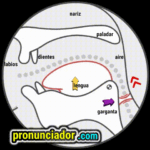
- The Starting Vowel – Open, Back, ROUNDED “AW” /ɔ/: Your mouth starts by making the /ɔ/ vowel sound. This is the sound you hear in words like “law,” “caught,” “thought,” or “dog.” To make it correctly:
- Mouth: Is WIDE open (but maybe not as extremely wide as for /ɑ/ in “father”).
- Lips: Are distinctly ROUNDED. Think of the shape for “aww, how cute!”
- Tongue: Is LOW in your mouth and PULLED BACK towards your throat.
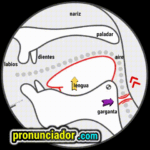
- The Destination – The American R /r/: From that open, rounded “AW” position, your mouth smoothly transitions into the American R /r/ sound.
- Mouth/Jaw: Closes PARTIALLY from the wide /ɔ/ position.
- Lips: STAY ROUNDED! This is super important for /ɔr/! The rounding from /ɔ/ CONTINUES and might even tighten slightly for the /r/.
- Tongue: TENSES and moves into your American R position – either tip curled up and back (Retroflex) OR body bunched up and back (Bunched). Always TENSE and NO TAPPING/TRILLING!
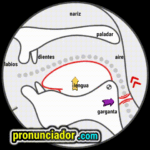
The Winning Formula for the “Door” Sound /ɔr/:
/ɔr/ = Start WIDE-ISH, LIPS ROUND, TONGUE LOW/BACK for “AWW” (/ɔ/) → GLIDE SMOOTHLY as JAW CLOSES SLIGHTLY, LIPS STAY ROUND (maybe tighten), & TONGUE TENSES/MOVES TO “R” for → AMERICAN “RRRR” (/r/)
It’s one continuous, flowing “Awwwwwwwwh-RRRRRRR” sound. The lip rounding throughout is a defining feature!
Crucial Sound Distinctions for a Clear /ɔr/:
- /ɔr/ (For, Door) vs. /ɑr/ (Far, Dark): ROUND LIPS vs. NEUTRAL LIPS at the START!
- /ɔr/ (For): Starts with /ɔ/ (“AW”) – Mouth open, TONGUE BACK, LIPS ROUNDED.
- /ɑr/ (Far): Starts with /ɑ/ (“AH”) – Mouth WIDE open, TONGUE BACK, LIPS NEUTRAL/UNROUNDED.
- The Mix-Up: Using unrounded lips for /ɔr/ makes “more” sound like “mar.” Using rounded lips for /ɑr/ makes “car” sound a bit like “core.”
- FIX: Focus on the LIP SHAPE for the starting vowel. /ɔr/ needs that “AW”-like rounding from the beginning. /ɑr/ needs neutral lips at the start (they only round for the R-part at the end).
- /ɔr/ (North) vs. Stressed ER /ɝ/ (Nurse): “AWW-RRR” vs. Central “ERRRR”!
- /ɔr/ (North): Starts with the BACK, ROUNDED /ɔ/ “AW” vowel before the R.
- /ɝ/ (Nurse): Is a MID, CENTRAL, TENSE R-vowel. Tongue starts more in the middle of the mouth. Lips often rounded but possibly less dramatically than the /ɔ/ starting point.
- The Mix-Up: Using a more central ER-like vowel for /ɔr/, losing the distinct “AW” quality. Your “born” might sound too much like “burn.”
- FIX: Make sure the /ɔr/ sound truly starts with that LOW, BACK, ROUNDED /ɔ/ “AW” flavor before you blend in the R.
- /ɔr/ (Your) vs. the Long O + R (/oʊər/ – as in “Mower”, often reduced to /oʊr/ or /oɚ/):
- /ɔr/ (Your): Starts with the OPEN-MID, BACK, ROUNDED /ɔ/ (“AW”).
- /oʊər/ (Mower /ˈmoʊər/): This is actually the Long O /oʊ/ (GO) diphthong (O→U glide) FOLLOWED BY an R sound (often Schwar /ɚ/ or syllabic /r/). It’s a different, more complex mouth movement.
- The Mix-Up: Confusing “store” /stɔr/ with “stower” (not a common word, but illustrates the sound diff) or “pour” /pɔr/ with “power” /paʊər/ (different vowel!).
- FIX: /ɔr/ has that single “AW”-to-R glide. /oʊər/ has the distinct “OH-OO” glide THEN an R. Focus on the /ɔr/’s single, open, rounded “AW” start.
Key to /ɔr/: That WIDE-ish MOUTH + CONSISTENT LIP ROUNDING from “AW” (/ɔ/) smoothly into the American “RRR” (/r/)!

Your Mouth’s “AWESOME-RRR” Journey: Making /ɔr/ (Kid Simple!)
Let’s get that “OR” sound sailing smoothly! It’s all about the “AW” start and keeping those lips friendly with an R!
Step 1: The Big “AWW, That’s Cool!” Start! (Position for /ɔ/)
- Mouth: Open WIDE! Not quite as wide as for /ɑ/ in “father,” but pretty wide. Imagine you’re about to say “AWESOME!”
- Lips: Make an “O” Shape and KEEP THEM ROUNDED! This is vital. Your lips should form a nice, fairly open circle. Think of the lips for “law” or “saw.” And KEEP them round!
- Tongue: LOW & PULLED BACK! Let the body of your tongue go down low in your mouth and pull it towards the back of your throat. The tip might be down.
This is the “AW” /ɔ/ sound! Make it strong and clear: “AWWWWW.”
Step 2: The Smooth American “RRR” Takeover! (Adding the /r/)
Now, from that “AWW” position, and without stopping the sound or unrounding your lips, you glide into the American R.
- Jaw Closes Up a Bit: Your jaw will naturally come up a little (mouth closes partially) from the wide “AW” position.
- LIPS: STAY ROUNDED! This is the magic key for /ɔr/! Don’t let them spread or relax too much! They stay in that rounded shape, maybe even tightening just a fraction as you make the R.
- Tongue: TENSES & Moves to “R-Mode”! While lips stay round, your tongue does its American R trick (TENSE!):
- Retroflex R (Curled Tip): The tip of your tongue TENSES and CURLS UP and BACK towards the ridge behind your top teeth (or further back), WITHOUT TOUCHING.
- Bunched R (Humped Body): Tip stays down/neutral. Body/middle of tongue TENSES and PULLS/BUNCHES UP and BACK, high. Sides often touch upper back teeth.
- Critical R Reminders: TENSE tongue! NO TAPPING! NO TRILLING! Air flows continuously.
Step 3: The Beautiful Blend! “AWW-RRR!” = /ɔr/ “OR”!
The /ɔr/ sound is ONE smooth, flowing R-colored vowel, where the “AW” quality melts into the “RRR” quality.
- Start by making that strong, open, ROUND-LIPPED “AWWWWWWW” (/ɔ/) sound.
- Keep your voice on and smoothly let your jaw rise slightly, your lips stay rounded (maybe getting a tiny bit smaller/tighter), and your tongue tenses and glides into your American R position.
- The sound should flow like this: “Awwwwwwwwh-RRRRRRRRR” –> /ɔr/ –> The sound in “spORt,” “dOOR“!
- Remember: The starting “AW” /ɔ/ quality is generally a bit louder and longer than the R-coloring it smoothly flows into.
Kid-Friendly “Roaring Lion” Cue: “Imagine you’re a friendly lion about to give a little roar! First, open your mouth for a big ‘AWW’ like you just saw something cool (lips round!). Then, keep those lips round and make your tongue strong and pull it back to let out a gentle American ‘RRRRR’! Put it together: AWW-RRRR! Like the ‘or’ in ‘roar‘!”
Feeling Check: Mouth starts open with LIPS ROUND for “AW”? Then, do lips STAY ROUND as your jaw closes a bit and your tongue tenses and makes that American R sound? Is it all one smooth flow? Perfect! That’s your /ɔr/!
The “OR” /ɔr/ Spelling Puzzle: OR, OAR, OOR, OUR, AR (W+AR), RR!
Phew! Like other R-colored vowels, the /ɔr/ sound loves to play hide-and-seek with spelling! But the good news is, ‘OR’ is the main player, and the others have some patterns.
Here are the Most Common Spellings for /ɔr/, with data from the Sounds American web page chart:
#1: The BIG BOSS – ‘OR’! (~79%)
Yes! The vast majority of the time (almost 8 out of 10 words!), if you see ‘OR’ in a stressed syllable, it’s our /ɔr/ “sport” sound!
- for, or, north, sport, short, cord, corn, horse, storm, fork, form, forget, important, record (noun), report, support, order, morning.
- Absorb, adore, forehead, foreign, forest.
- (Heads Up: In UNSTRESSED syllables at the END of words, -OR often becomes weak Schwar /ɚ/ like in “doctor,” “actor.” We’re focusing on STRESSED /ɔr/ here!)
#2: The “Warm AR” – ‘AR’ (After W, WH, QU)! (~7%)
This is a CRUCIAL pattern we also saw can sometimes lead to /ɑr/ (car) being misapplied. When ‘AR’ follows a ‘W’ sound (spelled W, WH, QU which has /kw/), it very often makes the /ɔr/ “sport” sound, NOT the /ɑr/ “car” sound!
- war /wɔr/ (sounds like “wore”)
- warm /wɔrm/
- warn /wɔrn/
- ward /wɔrd/
- quarter /ˈkwɔrtər/
- quarrel /ˈkwɔrəl/
- dwarf /dwɔrf/
- wharf /wɔrf/
- (This is a very strong pattern! W+AR = usually “OR” sound).
#3: The “Board” Meeting – ‘OAR’! (~4%)
When you see ‘OAR’, it’s almost always the /ɔr/ sound! Pretty reliable.
- board /bɔrd/
- roar /rɔr/
- soar /sɔr/ (to fly high)
- oar /ɔr/ (a paddle)
- coarse /kɔrs/ (rough)
- hoarse /hɔrs/ (raspy voice – sounds like “horse”!)
#4: The “Four/Source” Group – ‘OUR’! (~3%)
‘OUR’ is a tricky one because it can be /aʊər/ (our, hour) or /jʊr/ (your in some contexts). But in a specific set of common words, it IS the /ɔr/ sound.
- four /fɔr/ (sounds like “for”!)
- your* /jɔr/ (common pronunciation, though /jʊr/ or /jɚ/ also exist). The video specifically uses “your” as an /ɔr/ example word.
- source /sɔrs/
- course /kɔrs/ (sounds like “coarse”!)
- court /kɔrt/
- pour /pɔr/
- (You’ll need to learn these specific ‘OUR’=/ɔr/ words).
#5: The “Door on the Floor” – ‘OOR’! (~2%)
‘OOR’ is another good clue for /ɔr/, especially in these common words.
- door /dɔr/
- floor /flɔr/
- poor* /pɔr/ or /pʊr/ – This one has dialectal variation! Many Americans do say /pɔr/, but /pʊr/ (with the “book” vowel + R) is also very common and sometimes considered more standard for “poor.” Be aware of this one! Sounds American list for /ɔr/ has “poor.”
#6: The Ultra-Rare Double ‘RR’ Exceptions! (‘etc.’ ~1% – but this spelling type within ‘etc.’)
Very few words! Usually older words or specific contexts where ‘RR’ followed by certain vowels might get this /ɔr/ treatment rather than just a strong /r/ or /ɛr/ as in ‘marry’. The source lists these as exceptions.
- horrible /ˈhɔrəbəl/ (or /ˈhɑrəbəl/ – first ‘o’ might lean /ɑ/ then /ɔr/ quality).
- warranty /ˈwɔrənti/ (or /ˈwɑrənti/)
- sorry* /ˈsɔri/ or /ˈsɑri/ – Again, this can be /ɑr/ or /ɔr/ based on region/speaker for the first vowel. The video uses it for /ɔr/, and for the R-colored overview, but not its specific /ɔr/ sound example words in the ‘How to pronounce’ section, but does in the long list. It’s a variable one.
- tomorrow /təˈmɔroʊ/ or /təˈmɑroʊ/
- borrow /ˈbɔroʊ/ or /ˈbɑroʊ/
- These are tricky due to vowel variation before the RR. Best to listen carefully for words with RR.
“OR” /ɔr/ Spelling – Main Takeaways:
| Spelling | Freq. | Main Clue? | Key Examples for /ɔr/ | Watch Out For! |
| OR | ~79% (KING!) | STRESSED Syllable! | for, sport, north, more, door | Unstressed -or = /ɚ/ (doctor) |
| AR (after W/QU) | ~7% | W/QU + AR | war, warm, quarter | AR alone = /ɑr/ (car) or /ɛr/ (care)! |
| OAR | ~4% | Very Reliable for /ɔr/! | board, roar, soar, oar | (Few, if any, other sounds) |
| OUR | ~3% | Specific Common Words to MEMORIZE! | four, your, source, course | OUR = /aʊər/(our), /ɝ/(journey) |
| OOR | ~2% | Mostly “Door” & “Floor” (+ “Poor” sometimes) | door, floor (poor can be /pʊr/) | |
| RR (exceptions) | Low/’etc.’ | Specific Words (often ‘o’ or ‘a’ before) | horrible, warranty, sorry | RR often means different things |
Golden Rule for /ɔr/ Spelling: ‘OR’ is your best bet by far! ‘OAR’ and ‘OOR’ are pretty solid. W+AR = /ɔr/ is a vital pattern. ‘OUR’ needs memorization for key words.

Oops! Common “OR” Sound /ɔr/ Blunders & Super Fixes!
Where do learners go “off course” /kɔrs/ with this “AWW-RRR” sound?
- MISTAKE #1: THE WRONG “R”! (The Usual Suspect: Tapped/Trilled/Weak/Missing R!)
- The Glitch: Using any R that isn’t the smooth, continuous, tense American /r/. “For” sounds like “fo-[ɾ]” or completely like “foh” (if R is dropped).
- THE #1 FIX: Solidify Your AMERICAN R! Lips GENTLY ROUNDED, Tongue TENSE & CURLED or BUNCHED (NO taps/trills!), air flows continuously. This R quality must blend into the “AW” from the start.
- MISTAKE #2: Wrong STARTING VOWEL “AW” /ɔ/ (Not Open Enough, Not Back Enough, OR Lips Not Rounded!)
- The Problem A (Lips NOT ROUNDED or Open Too Wide like /ɑ/ “ah”): Your “more” sounds like “mar” (/mɑr/). You started with neutral lips or a very wide “AH”.
- The Problem B (Too Closed or Too Front, like /oʊ/ “go” or /ʊ/ “book”): Your “for” sounds more like “fur” (/fɝr/ or /fʊr/). You didn’t get that open, back “AW” quality with rounded lips.
- THE FIX: Get That “AW” /ɔ/ Right!
- MOUTH: Open fairly WIDE.
- LIPS: ROUNDED from the START! Think “AWESOME!”
- TONGUE: LOW and PULLED BACK.
Then, KEEP LIPS ROUNDED as you glide to the R.
- MISTAKE #3: LIPS UNROUNDING DURING THE GLIDE! (The “Stay Round” Rule Broken!)
- What Happens: You start with nice round lips for “AW”, but then they spread or relax before you finish the R, so the R part loses its deep /ɔr/ color and sounds more like /ɑr/ or a weaker R.
- The Fix: LIPS STAY ROUND & TENSE(ish) for the WHOLE /ɔr/! This is unique to /ɔr/ compared to /ɑr/ or /ɛr/ where lips only round for the R part. For /ɔr/, the /ɔ/ rounding carries through and helps color the R. Feel them actively stay in that circle.
- MISTAKE #4: CHOPPY “AW… …RRR” – No Smooth Blend!
- Problem: Two separate sounds, not one flowing R-colored vowel.
- Fix: ONE FLUID MOVEMENT! The “AW” should melt into the “RRR” quality seamlessly. Your mouth parts are moving as the sound is produced.
- MISTAKE #5: SPELLING TRAPS! (“car” for “war,” “heart” for “horde”)
- Problem: Seeing ‘AR’ in “war” and thinking /ɑr/. Seeing ‘OAR’ and being unsure.
- Fix: LEARN THE PATTERNS & EXCEPTIONS! Especially W+AR = /wɔr/ (not /wɑr/). And ‘OAR’ is a good friend for /ɔr/.
“Roar Like a Lion!” /ɔr/ Sound Practice Workout!
Let’s get that mouth making the rich American “OR”!
Exercise 1: Target the Glide: “AWW” (/ɔ/) → “RRR” (/r/) – Slow & Steady
- Part 1 (Just /ɔ/ “AWW”): Mouth WIDE-ish. Lips ROUND & slightly tense. Tongue LOW & BACK. Make a clear “AWWWWWW.” (Like in “law“).
- Part 2 (Just American R /r/): Lips GENTLY ROUNDED & slightly tense. Tongue TENSE (curled or bunched). Continuous “RRRRRRR.”
- NOW, SLOWLY GLIDE, KEEPING LIPS ROUND: Start the “AWWW,” and while keeping voice and ROUND LIPS, smoothly tense and move your tongue to the R position. “Awwwwwwwwh-RRRRRRRRR.”
- Speed it up: /ɔ/-/r/… /ɔ/-/r/… /ɔr/! /ɔr/! The “OR” sound!
Exercise 2: The “Keep Lips Round” Challenge!
Say these, focusing on ensuring your lips DON’T unround between the /ɔ/ and the /r/:
- More… More… More…
- Door… Door… Door…
- Four… Four… Four…
- Sport… Sport… Sport…
(If your lips spread, it will sound like /mɑr/, /dɑr/, etc.)
Exercise 3: Critical Contrast: /ɔr/ (Store) vs. /ɑr/ (Star)
This is ALL about the STARTING MOUTH (Lips & Tongue) for the vowel before R!
- Store /stɔr/ (Lips ROUND for /ɔ/ start) — Star /stɑr/ (Lips NEUTRAL for /ɑ/ start)
- Cord /kɔrd/ — Card /kɑrd/
- For /fɔr/ — Far /fɑr/
- Born /bɔrn/ — Barn /bɑrn/
- Warm /wɔrm/ (W+AR!) — Arm /ɑrm/
RECORD yourself. Do they sound clearly different based on your lip rounding at the START?
Exercise 4: Conquer All the “OR” Spellings for /ɔr/!
Practice making the SAME “AWW→RRR” /ɔr/ sound with these varied spellings:
- OR: for, or, north, sport, short, horse, storm, more, before, order, important, normal, born, absorb.
- AR (after W/QU): war, warm, warn, ward, quarter, dwarf, wharf.
- OAR: board, roar, soar, oar, coarse, hoarse.
- OUR: four, your, source, course, court, pour.
- OOR: door, floor, (poor* – remember variation /pʊr/).
- RR (rare exceptions): horrible, warranty, sorry*, tomorrow*, borrow*. (* for ‘sorry’, ‘tomorrow’, ‘borrow’ the /ɔr/ is mainly if first O is /ɔ/. Some say /sɑri/, /təmɑroʊ/ which would not fit this group’s targeted /ɔr/*). Focus on horrible, warranty as clear /ɔr/ examples.
Exercise 5: Source Top 30 “OR” /ɔr/ Workout
| PHONETICAL PRONUNCIATION |
| PHONETICAL PRONUNCIATION |
- Strong “AW” /ɔ/ start: Mouth open, LIPS ROUND, tongue low/back.
- Smooth GLIDE to TENSE American R /r/, keeping lips ROUNDED.
- One fluid “AWW-RRR” sound.
RECORD & COMPARE!
Exercise 6: “Four More Doors on the North Shore!” – /ɔr/ Sentences!
Put it into action. Record and check for smooth glides and consistent lip rounding!
- “There are [ɑr!] four [ɔr] doors [ɔr] on the north [ɔr] shore [ɔr].” (Trap! “are” is /ɑr/!)
- Revised: “Of course [ɔr], there are four [ɔr] more [ɔr] doors [ɔr] before [ɔr] the north [ɔr] shore [ɔr].” (Ensuring focus on /ɔr/)
- “This important [ɔr] report [ɔr] is for [ɔr] your [ɔr] record [ɔr].”
- “The storm [ɔr] in the forest [ɔr] was horrible [ɔr].”
- “He was born [ɔr] before [ɔr] the war [ɔr], of course [ɔr].”
- “This sport [ɔr] requires more [ɔr] force [ɔr] and support [ɔr].”
Practice these words slowly, focusing on how the /ɔ/ blends with the R. Gradually increase your speed while ensuring the clarity of the sound remains intact.
FAQs: Your American “OR” /ɔr/ (Sport/Door) Questions Solved!
Q1: What IS the /ɔr/ “OR” sound, simply put? (Kid-Style Answer!)
It’s like you start to say “AWWW, how cute!” (mouth open, lips nicely ROUNDED, like /ɔ/ in “law“). Then, without stopping or changing your round lips, you smoothly make an American “RRRR” sound with a tense tongue. AWW → RRR (lips stay round!) = OR!
Q2: What’s the BIGGEST secret to making /ɔr/ (for, door) sound different from /ɑr/ (far, car)?
LIP ROUNDING from the VERY START and THROUGHOUT!
- /ɔr/ (for, door): Your lips are ROUNDED when you make the starting “AW” /ɔ/ sound, and they STAY ROUNDED (maybe tighten a bit) as you glide into the R.
- /ɑr/ (far, car): Your lips are NEUTRAL/UNROUNDED when you make the starting “AH” /ɑ/ sound. They only round a bit at the very end for the R.
This initial lip rounding is the game-changer for /ɔr/!
Q3: Why does ‘AR’ in “war” or “warm” sound like /ɔr/ (“OR”) instead of /ɑr/ (“AR” in car)?
That ‘W’ sound before the ‘AR’ is like a magic wand! It usually changes the ‘AR’ to sound like /ɔr/. So, “war” sounds like “wore,” and “warm” has that “OR” vowel sound in it. It’s a common English pattern to learn! (QU+AR in “quarter” does the same!).
Q4: Do ‘OAR’ (board) and ‘OOR’ (door) and ‘OUR’ (four) ALL really sound the SAME as ‘OR’ (for)?
Yes, in American English, they generally do! They all make that /ɔr/ “AWW-RRR” sound.
- board /bɔrd/
- door /dɔr/
- four /fɔr/
- sport /spɔrt/
It’s another case where different spellings lead to the same awesome sound!
Q5: I still struggle with the American “R” part. Any quick tip for /ɔr/?
For the R in /ɔr/: Keep lips round. Then, TENSE your tongue and either:
- CURL the tip UP & BACK (not touching anything!). OR
- BUNCH the tongue body UP & BACK (tip down).
And make a continuous “RRRR” sound blended with the “AWW”. No tongue tip tapping or trilling! Smooth and strong!
Final Thoughts: Your American “OR” /ɔr/ Sound is “More” Than Awesome!
Fantastic effort! You’ve navigated the round-lipped, gliding world of the American /ɔr/ R-Colored Diphthong! This “AWW-RRR” of “sport” and “door” is a huge part of the native sound.
Pin these “OR-some” truths to your brain:
- /ɔr/ = “AWW” (/ɔ/) smoothly gliding into AMERICAN “RRR” (/r/)! (One sound!).
- MOUTH MOVES: Jaw WIDE-ish (LIPS ROUND/TENSE for /ɔ/) → Jaw CLOSES Slightly, LIPS STAY ROUND & TENSE, TONGUE TENSES for /r/.
- LIP ROUNDING THROUGHOUT IS KEY! Start round, stay round!
- AMERICAN R IS NON-NEGOTIABLE! No taps, no trills! Tense, continuous.
- SPELLING = ‘OR’ Dominates! W+AR is /ɔr/. OAR/OOR/OUR (key words) also common.
- #1 MISTAKE = WRONG STARTING VOWEL / LIPS NOT ROUND! #2 = Wrong R!
Keep focusing on that initial ROUNDED “AWW” /ɔ/ and the smooth glide into a TENSE American R, keeping those LIPS ROUNDED. Listen to native speakers say “more,” “for,” “door,” “your,” “important.” Record yourself! Your /ɔr/ is going to sound better and better before you know it! You’re on your way to “OR-dinary” to “extra-OR-dinary”!
👇🔥👇🔥👇🔥👇🔥👇🔥👇🔥
👉 RETURNS in the YEAR 2031 ! WHO? CLICK HERE ! 🔥



👇🔥👇🔥👇🔥👇🔥👇🔥👇🔥
👉 RETURNS in the YEAR 2031 ! WHO? CLICK HERE ! 🔥
👇🔥👇🔥👇🔥👇🔥👇🔥👇🔥
👉 RETURNS in the YEAR 2031 ! WHO? CLICK HERE ! 🔥
👉 RETURNS in the YEAR 2031 ! WHO? CLICK HERE ! 🔥
👉 RETURNS in the YEAR 2031 ! WHO? CLICK HERE ! 🔥