

Confused by the J /dʒ/ sound in “job” or “age”? This guide explains the voiced D+ZH combo, fixing common mistakes with the CH /tʃ/ sound. Learn to pronounce it perfectly!
Hey there, American English enthusiasts! Today, we’re diving deep into a sound that packs a punch and is ALL over English: the J sound, like in “job”, “judge”, “change”, or “age”! Its secret IPA code is /dʒ/ (looks like a ‘d’ married a fancy ‘3’ or ‘z’!).
Now, this sound might seem straightforward, but many non-native speakers find it surprisingly tricky! Do you ever say “jam” and it comes out a bit like “yam”? Or you try for “juice” and it’s closer to “zhuice” (like the ‘s’ in ‘vision’)? Perhaps you see the letter ‘G’ in “page” or “ginger” and aren’t sure if it should be a hard /ɡ/ (like ‘go’) or this J /dʒ/ sound. And then there’s the confusion with its voiceless twin, the CH /tʃ/ sound (“chair”)! It’s a recipe for feeling unsure and for your accent to stand out. You want to sound clear and confident, but this D+ZH combo can feel like a tongue twister!
But guess what? The American J /dʒ/ sound is simply the CH /tʃ/ sound WITH YOUR VOICE TURNED ON! If you can whisper CH, you can thunder J! This ultimate, kid-friendly guide will transform your J sound:
- Meet the “Jumping J” /dʒ/: It’s a secret agent sound made of TWO parts: D-stop + ZH-friction!
- Mouth & Tongue Power Moves: Simple, step-by-step directions to nail that D-block → ZH-release like a pro!
- The BUZZ is BOSS! How to turn ON your voice for /dʒ/ and OFF for CH /tʃ/. It’s game-changing!
- Sound-Alike Showdowns: No more mixing up J /dʒ/ with SH /ʃ/ (vision-like sound), Y /j/ (yes), or Z /z/!
- Spelling UNLOCKED! When J, G, DG, D… make the /dʒ/ sound! We’ve got the cheat sheet!
- Zap Those Errors! Fixing common mistakes (like a soft J or saying CH) for a crisp, strong /dʒ/.
- J-Sound Gym! Fun exercises and essential words (‘just’, ‘job’, ‘age’, ‘change’, ‘large’, ‘soldier’) to get you buzzing!
Get ready for your “judge,” “major,” “education,” and “huge” to sound undeniably American and full of energy! Let’s jump right in! 😉

What IS This /dʒ/ J Sound? The “D-plus-ZH” Combo!
Let’s properly introduce the /dʒ/ sound. You hear it constantly:
- job /dʒɑb/
- judge /dʒʌdʒ/
- age /eɪdʒ/
- change /tʃeɪndʒ/ (wait, CH + /dʒ/?) → Correction: ‘change’ is /tʃeɪndʒ/. This sound often ends words after CH for example. → ‘Change’ uses /tʃ/ then /eɪ/ then /ndʒ/ in final cluster if looking closely, but root /dʒ/ often in mind. Let’s use clearer examples for /dʒ/ at different positions for introduction:
- Initial: jam /dʒæm/, joke /dʒoʊk/, German /ˈdʒɜrmən/
- Medial: major /ˈmeɪdʒər/, educate* /ˈɛdʒəkeɪt/, suggest /səɡˈdʒɛst/ (or /səˈdʒɛst/).
- Final: age /eɪdʒ/, large /lɑrdʒ/, bridge /brɪdʒ/
This sound is one of only two affricate consonants in American English (the other is its voiceless twin, CH /tʃ/). “Affricate” sounds like a complicated coffee order, but it just means it’s a special combo sound!
Think of it as a lightning-fast 1-2 punch:
- PUNCH 1 (The D-STOP): You start by very briefly making a sound similar to /d/. Your tongue tip (or blade) goes up behind your top teeth and quickly STOPS the air. D-
- PUNCH 2 (The ZH-FRICTION): THEN, instantly, you release that D-stop into a sound just like the /ʒ/ ZH sound (the buzzy ‘s’ in “vision” or “measure”). The air whooshes out with that buzzy “zhhhh” friction, with lips slightly rounded. -ZH!
So, /dʒ/ = a quick /d/-like stop + an immediate /ʒ/ ZH-release! All blended into ONE smooth, sharp, BUZZING sound: “J!”
Its Secret Code (Explained Like You’re a Spy!)
Experts call /dʒ/ a “palato-alveolar, voiced, affricate consonant.” Let’s decode that for normal humans:
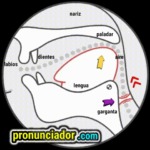
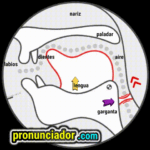
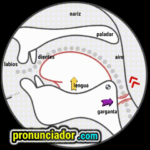
- Palato-Alveolar (Tongue Action Zone!): This tells you WHERE the main “rubbing” or “whooshing” part happens (the /ʒ/ part). The blade (flat part just behind the tip) and front of your tongue arch up and get close to the area just behind the bumpy ridge (alveolar ridge) and the hard roof of your mouth (palate). The /d/ part starts with the tongue tip/blade at the alveolar ridge.
- VOICED (Voice Box ON – It BUZZES!): This is KEY! Your vocal cords VIBRATE throughout the entire sound, for both the D-stop and the ZH-release! Put your fingers on your throat – you should feel a strong BUZZ!
- Affricate (Stop Air + Rub Air!): As we said, it starts like a STOP (air totally blocked for the D-part) and then immediately releases into a FRICATIVE (air squeezed out with rubbing for the ZH-part). A perfect 2-in-1 sound!
Super Simple Kid-Friendly Summary: To make the /dʒ/ (J sound in ‘job’):
- Get your lips ready for a “choo-choo” sound (slightly rounded and pushed out).
- Quickly touch your tongue tip/blade behind your top teeth (like for ‘D’).
- Release that ‘D’ and right away let the air “whoosh” out with a BUZZ, like the ‘S’ in “vision” (keep your tongue arched up but not touching the roof for this ZH part).
- Make sure your voice box is BUZZING the whole time! “D-ZHHHH!”
It’s like a CH sound (/tʃ/), but with your voice motor turned ON!

The Ultimate Twin Battle: J /dʒ/ (Voiced) vs. CH /tʃ/ (Voiceless)
These two are perfect mirror images! They use the EXACT SAME mouth and tongue movements. The ONLY difference is the throat buzz!
| Feature | J /dʒ/ (Job, Judge) | CH /tʃ/ (Chop, Church) |
| Mouth/Tongue Moves? | SAME! D-stop → ZH-release | SAME! T-stop → SH-release |
| Airflow Type? | SAME! Stop + Friction | SAME! Stop + Friction |
| VOICE BOX (Buzz?) | ON (BUZZING!) | OFF (NO BUZZ!) |
| Resulting Sound? | Sharp, Buzzy “DZH!” | Sharp, Airy “TSH!” |
Why is this so CRITICAL? Voicing changes word meanings in English!
- Joke /dʒoʊk/ (broma) vs. Choke /tʃoʊk/ (asfixiar)
- Badge /bædʒ/ (insignia) vs. Batch /bætʃ/ (lote)
- Ridge /rɪdʒ/ (cresta) vs. Rich /rɪtʃ/ (rico)
- Gin /dʒɪn/ (ginebra) vs. Chin /tʃɪn/ (barbilla)
The Fix: MASTER THE BUZZ! Hand on throat.
- “Church” = No buzz.
- “Judge” = BUZZ!
Feel that voice turn ON for J /dʒ/ and OFF for CH /tʃ/!
Your Mouth’s J-Jump! Making the /dʒ/ Sound Step-by-Step!
Let’s get that buzzy “D-ZH” combo perfect! It’s a fast action.
Step 1: Mouth & Lips Ready!
- Open your mouth just a little bit.
- Round your lips slightly and you can even push them out a tiny bit (protrude). Like making a very gentle “oo” or “shh” face.
Step 2: Tongue Part 1 – The “D” STOP!
- This is the first part of the combo.
- Bring the TIP and BLADE (flat part behind the tip) of your tongue UP to touch the bumpy ridge just behind your top front teeth (the alveolar ridge). Some part of the tongue just behind the tip might also touch the back of the top teeth.
- For a split second, press your tongue there to STOP the airflow completely. Build up a tiny bit of air pressure.
Step 3: Tongue Part 2 & Airstream – The “ZH” RELEASE (with BUZZ!)
- This happens IMMEDIATELY and very quickly after the D-stop!
- Pull your tongue tip SLIGHTLY back and down from that ridge.
- Simultaneously, the main body/front of your tongue stays ARCHED UP, close to the roof of your mouth (hard palate, post-alveolar area) but NOT touching it. This creates a narrow channel for the /ʒ/ ZH sound.
- Release the blocked air from the D-stop and let it flow out THROUGH this ZH-channel and your rounded lips, WITH audible friction.
- CRUCIALLY: Your VOICE BOX must be BUZZING through this ENTIRE D-stop and ZH-release process!
Putting It All Together (D → ZH → J!):
- Lips slightly rounded/pushed out.
- Tongue tip/blade quickly up to alveolar ridge (D-stop, BLOCK air, VOICE ON).
- Instantly pull tip back a bit, keep tongue body arched up (ZH-shape).
- Release air from D-stop straight into the ZH-friction-BUZZ.
- VOICE BUZZES THE WHOLE TIME!
The result is ONE quick, sharp, BUZZING sound: J! /dʒ/.
Practice the Feel:
Now try to “squish” them: Quick D-stop, and release right into the ZH-friction, keeping the buzz ON: “D-ZH… DZH… J!”ike learning to ride a bike, it might feel awkward at first, but with time, it will become natural.
Say /d/ (dog). Feel the tip stop and the buzz.
Say /ʒ/ (vision). Feel the rounded lips, arched tongue, friction, and buzz.
Crazy Spelling, Strong Sound! How is /dʒ/ Written?
The /dʒ/ sound has a few main ways it shows up in spelling. Luckily, two of them are very common!
The Co-Champions: Letter ‘G’ & Letter ‘J’!
These two are the main spellings for /dʒ/!
- Letter ‘G’ (Soft G): YES! The letter ‘G’ is the MOST frequent speller of /dʒ/ (about 63% of the time!), BUT only when it’s a “soft G”.
- Rule of Thumb for Soft G (/dʒ/): ‘G’ often sounds like /dʒ/ when it comes BEFORE the letters E, I, or Y.
- Ginger /ˈdʒɪndʒər/, Page /peɪdʒ/, Age /eɪdʒ/, Huge /hjudʒ/, Large /lɑrdʒ/.
- Gem /dʒɛm/, General /ˈdʒɛnərəl/, Strange /streɪndʒ/, Energy /ˈɛnərdʒi/.
- Logic /ˈlɑdʒɪk/, Religion /rɪˈlɪdʒən/, Magic /ˈmædʒɪk/.
- WARNING: This “G before E/I/Y” rule has MANY important exceptions where ‘G’ is HARD /ɡ/ (like ‘get’, ‘give’, ‘girl’, ‘begin’, ‘target’!). You HAVE to learn these!
- Rule of Thumb for Soft G (/dʒ/): ‘G’ often sounds like /dʒ/ when it comes BEFORE the letters E, I, or Y.
- Letter ‘J’: The “obvious” one! ‘J’ ALMOST ALWAYS sounds like /dʒ/ (about 26% of /dʒ/ words). This is reliable!
- Job /dʒɑb/, Judge /dʒʌdʒ/, Juice /dʒus/, June /dʒun/, Just /dʒʌst/, Joy /dʒɔɪ/, Joke /dʒoʊk/, Major /ˈmeɪdʒər/, Object* /ˈɑbdʒɛkt/ (noun).
- (Very rare foreign words like ‘Raj’ can vary).
The Bridge Builder: ‘DG’
When you see ‘DG’ together, it almost always makes the /dʒ/ sound. The ‘D’ is part of making the J sound sharp.
- Bridge /brɪdʒ/, Edge /ɛdʒ/, Judge /dʒʌdʒ/, Badge /bædʒ/, Fridge /frɪdʒ/, Lodge /lɑdʒ/, Porridge /ˈpɔrɪdʒ/.
The Sneaky ‘D’: Before -URE, -UAL, -IER
Yes, ‘D’ can make a /dʒ/ sound, usually through palatalization before certain suffixes with a /j/-like quality!
- Soldier /ˈsoʊldʒər/
- Procedure /prəˈsidʒər/
- Gradual /ˈɡrædʒuəl/
- Educate /ˈɛdʒəkeɪt/ (The DU can become /dʒə/)
- Schedule* (US: /ˈskɛdʒʊl/)
- (These are a bit more advanced and depend on a /j/ Yod sound merging with /d/).
The Super Rare Double ‘GG’:
In a few specific words (often from Italian):
- Suggest /səgˈdʒɛst/ or /səˈdʒɛst/ (second G often /dʒ/).
- Veggie /ˈvɛdʒi/.
- (Exaggerate has /dʒ/ but from the G after ‘a’).*
Main Spelling Clues for /dʒ/:
- G (before E, I, Y – BUT watch for hard G exceptions!) = Most Common.
- J (almost always /dʒ/!) = Very Common.
- DG (usually /dʒ/!).
- D (in specific -DIER, -DURE, -DUAL patterns) = Less common but exists.
The RULE: If it looks like G/J/DG and it’s not a hard /ɡ/ (for G), it’s probably /dʒ/!

Oops! Common /dʒ/ J Sound Blunders (& Easy Fixes!)
Let’s fix those common ways the J sound goes wrong!
- Mistake #1: MAKING IT VOICELESS! (Using CH /tʃ/ instead of J /dʒ/)!
- What’s Up: No throat buzz! Your “Job” sounds like “Chop”. This is super common if your native language doesn’t have a voiced /dʒ/.
- The Fix: BUZZ IT UP! Turn that voice box ON! Feel the vibration for the whole D-stop + ZH-release. Practice /tʃ/ (CHurch – NO BUZZ) vs. /dʒ/ (JuDGe – YES BUZZ!).
- Mistake #2: Just Saying ZH /ʒ/ (Losing the “D” Stop)!
- What’s Up: Your /dʒ/ sounds too soft, like just a ZH (“Vision” sound). “Job” becomes “Zhob”. “Age” becomes “A-zhe”. You miss the sharp “attack” of the D-stop.
- The Fix: FEEL THAT D-STOP! Briefly touch your tongue tip/blade to the ridge behind top teeth to BLOCK the air before you make the ZH whoosh. It needs that tiny, quick block. Practice: D…ZH… D-ZH… J!
- Mistake #3: Using a Y /j/ Sound (Like “Yes”)!
- What Happens: Your tongue doesn’t make the D-stop or the ZH-friction. “Jam” sounds like “Yam”.
- The Fix: NOT a Y! /dʒ/ needs that tongue tip/blade block AND the specific palato-alveolar friction with rounded lips. /j/ is just tongue body high and front, different feel.
- Mistake #4: Lips Not Rounded Enough.
- What Happens: The ZH part of /dʒ/ sounds weak or too much like a Z.
- The Fix: Gentle “Choo-Choo” lips! Slightly round and push them out for the ZH-release part.
- Mistake #5: Getting TRICKED by G-spellings for HARD G /ɡ/!
- What Happens: Seeing ‘G’ before E/I/Y and ALWAYS saying /dʒ/, even in ‘get’, ‘give’, ‘girl’.
- The Fix: MEMORIZE THE EXCEPTIONS! The G+E/I/Y = /dʒ/ rule is strong but get, give, girl, begin, target, tiger, gear, geese, gift, giggle and more are HARD /ɡ/! When in doubt, check!
J-Sound Workout! Fun Exercises for a Perfect /dʒ/!
Time to get that American J sound buzzing sharply!
Exercise 1: The D+ZH Combo Slow-Mo!
- Slowly: Say a clear /d/ (tip up, block air, BUZZ!). Then say a clear /ʒ/ (lips round, tongue arch, whoosh air, BUZZ!).
- D….. ZH….. D….. ZH…..
- Faster: D-ZH… D-ZH… D-ZH…
- Even Faster & Smoother: J! J! J! /dʒ/ /dʒ/ /dʒ/!
- Feel the two parts blend into ONE sharp, buzzy sound.
Exercise 2: Voicing ON /dʒ/ vs Voicing OFF /tʃ/ (The Big Twins!)
Hand on throat! BUZZ vs NO BUZZ!
- Joke /dʒoʊk/ (BUZZ) — Choke /tʃoʊk/ (NO BUZZ)
- Gin /dʒɪn/ (BUZZ) — Chin /tʃɪn/ (NO BUZZ)
- Badge /bædʒ/ (BUZZ) — Batch /bætʃ/ (NO BUZZ)
- Ridge /rɪdʒ/ (BUZZ) — Rich /rɪtʃ/ (NO BUZZ)
- Major /ˈmeɪdʒər/ (BUZZ) — Ma-cher (No buzz, if existed)
Exercise 3: J /dʒ/ (Stop+Friction) vs ZH /ʒ/ (Smooth Friction)
No D-block for ZH!
- Age /eɪdʒ/ (D-stop + ZH) — Asia* /ˈeɪʒə/ (Smooth ZH)
- Jump /dʒʌmp/ — Zhum-p (If ZH was first – not a word)
- Bridge /brɪdʒ/ — Beige /beɪʒ/
Exercise 4: Practice ALL the Spellings for /dʒ/!
Same BUZZY sound, different letters!
- J: job, just, joke, juice, jump, enjoy, major, subject, object, project.
- G (soft): age, page, huge, large, change, manage, energy, ginger, general, logic, suggest.
- DG: judge, bridge, edge, badge, fridge, knowledge, budget.
- D (rare): soldier, procedure, gradual, educate.
Exercise 5: Common Words Drill (Source App List)
(Go through list of common words shown in Video for Part 1, 2, and 3: Gel, Gym, Jar… through to… Stage). Pay CLOSE attention to starting with the D-stop AND keeping the voice ON!
Exercise 6: Real Sentences with /dʒ/ + Recording!
Record! Is your J /dʒ/ sharp AND buzzy? Distinguishing from CH?
- “The judge [dʒ][dʒ] had a huge [dʒ] job [dʒ] in June [dʒ].”
- “Major [dʒ] John [dʒ] Bridges [dʒ] gently [dʒ] changed [dʒ] the engine [dʒ].” (Tongue Twister!)
- “The large [dʒ] page [dʒ] had a magic [dʒ] image [dʒ].”
- “Education [dʒ][ʃ] is a major [dʒ] challenge [dʒ][dʒ].” (Mix J and CH!)
- “What an agenda [dʒ]! Pack your baggage [dʒ][dʒ] for college [dʒ].”
| PHONETICAL PRONUNCIATION |
| PHONETICAL PRONUNCIATION |
FAQs: Your American J /dʒ/ Sound Questions Answered!
Q1: Is the J sound /dʒ/ just ONE sound or a COMBO? (Easy explanation!)
It’s a super-fast combo! Like a 1-2 punch:
- Starts with a tiny, quick ‘D’ sound (tongue taps behind top teeth).
- Instantly slides into a ‘ZH’ sound (like ‘S’ in ‘vision’, with rounded lips and throat buzzing!).
D + ZH = J! (/dʒ/). All done in a flash!
Q2: What’s the #1 difference between CH /tʃ/ (“chair”) and J /dʒ/ (“jar”)?
THE BUZZ! (Voicing!)
- CH /tʃ/ (“chair”): Voice Box OFF. No throat buzz. Purely airy “T-SH!”.
- J /dʒ/ (“jar”): Voice Box ON. YES throat buzz! Buzzy “D-ZH!”.
The mouth and tongue movements are exactly the same for both! Just turn the voice ON for J!
Q3: Why does my J sound soft, like SH /ʃ/ or ZH /ʒ/?
You’re likely missing the first “D-stop” part! The J /dʒ/ needs that very quick block of air with your tongue tip before the buzzy ZH friction. Without the D-stop, “job” might sound like “zhob” (if voiced) or “shob” (if voiceless). Make sure to get that D-tap in there!
Q4: If I see ‘G’ before E, I, or Y, is it ALWAYS the J /dʒ/ sound?
USUALLY, but NOT always! This is a strong pattern (G + E/I/Y → /dʒ/, like ‘ginger’, ‘page’, ‘gym’). BUT, English loves exceptions! Important words like ‘get’, ‘give’, ‘girl’, ‘begin’, ‘target’, ‘finger’ all have a HARD /ɡ/ sound (like ‘go’) despite the G+E/I. You HAVE to learn these exceptions!
Q5: The video mentioned vowel length with “batch” vs “badge”. What’s that?
It’s a cool (but subtle) rule! Vowels are often a tiny bit LONGER before VOICED consonants (like /dʒ/ in ‘badge’) than before their VOICELESS twin consonants (like /tʃ/ in ‘batch’). So, the ‘a’ /æ/ in “badge” is a fraction longer than in “batch”. It helps distinguish them!
Final Thoughts: Your J /dʒ/ is Now a GEM!
Fantastic work! You’ve demystified the American J /dʒ/ sound. You know it’s that dynamic D-stop + ZH-release with a constant buzz!
Keep these J-sound jewels:
- /dʒ/ = Quick /d/-STOP + IMMEDIATE /ʒ/-RELEASE (ZH-friction)! Voice ON the whole time!
- KEY MOUTH MOVE: Tongue TIP/BLADE taps for D, then pulls back slightly as tongue BODY arches for ZH. Lips slightly rounded/pushed out.
- Vs CH /tʃ/ (Chair): J /dʒ/ is BUZZING, CH /tʃ/ is AIR ONLY. (Same mouth moves!)
- Vs ZH /ʒ/ (Vision): J /dʒ/ has D-STOP first, ZH /ʒ/ is smooth friction only.
- SPELLING: G (soft G rule!), J (usually always J!), DG are main ones. D for ‘soldier’.
- COMMON ERRORS: No D-stop (sounds like ZH), no buzz (sounds like CH), wrong tongue spot (sounds like Y).
The secret is truly feeling that sharp D-block quickly flowing into the buzzy ZH-friction. Practice those contrasts, especially J vs CH. Record yourself saying “job,” “judge,” “age,” “change,” and “major.” Your American J /dʒ/ will sound powerful and precise!
👇🔥👇🔥👇🔥👇🔥👇🔥👇🔥
👉 RETURNS in the YEAR 2031 ! WHO? CLICK HERE ! 🔥



👇🔥👇🔥👇🔥👇🔥👇🔥👇🔥
👉 RETURNS in the YEAR 2031 ! WHO? CLICK HERE ! 🔥
👇🔥👇🔥👇🔥👇🔥👇🔥👇🔥
👉 RETURNS in the YEAR 2031 ! WHO? CLICK HERE ! 🔥
👉 RETURNS in the YEAR 2031 ! WHO? CLICK HERE ! 🔥