

Confused by the Hard G sound? Learn why your “big” sounds like “bik”! This guide masters /ɡ/ vs. /k/, decodes all spelling rules (get, give), & fixes your pronunciation
Hey, American English adventurers! Get ready to tackle a consonant that looks innocent but is famous for having a split personality: the letter ‘G’! We’re focusing today on its most common sound, the “Hard G” /ɡ/ sound, like in “go,” “gift,” “good,” “big,” or “dog.” Its secret phonetic code is /ɡ/.
Now, you might think, “A ‘G’ is a ‘G’!” But in English, the letter ‘G’ is a bit of a shapeshifter.
- Sometimes it’s HARD /ɡ/ like in “game.”
- Sometimes it’s SOFT /dʒ/ (like a ‘J’ sound) as in “gym”!
This Hard G /ɡ/ vs. Soft G /dʒ/ confusion is a MASSIVE headache for learners.
Beyond that, making the Hard G /ɡ/ sound itself can be tricky:
- The “K” Confusion: Does your “big” sometimes slip out sounding like “bik“? That means your voice box (vocal cords) wasn’t buzzing! The Hard G /ɡ/ needs that throat vibration!
- The “Mushy G”: In some languages, ‘g’ between vowels gets soft and “rubbed.” American English Hard G /ɡ/ is usually a clear “pop,” even in “again” or “suggest.”
- The Tiny Air Puff? Just like /b/ and /d/, the /ɡ/ sometimes has a tiny puff of air, and sometimes it doesn’t! When?!
- Silent G’s! And then there are words like “sign” or “foreign” where the ‘G’ just vanishes! Poof!
You’re trying to sound great /ɡreɪt/, but this tricky ‘G’ makes you feel like you’re guessing /ˈɡɛsɪŋ/ all the time! It’s frustrating when common words don’t sound right and your accent stands out because of this one letter.
But guess what? We’re about to give you the Golden Key to the Great American G! This ULTIMATE, super-EASY guide (explained so simply your 8-year-old cousin could get it!) will make you a Hard G /ɡ/ guru AND a Soft G /dʒ/ spotter:
- Meet the “Back-of-Tongue BUZZ POP” /ɡ/: What is this “Hard G” sound, really?
- The #1 Hard G Secret: THROAT BUZZ ON! This is how you’ll instantly nail /ɡ/ vs. /k/ (its quiet twin!).
- The Gentle G-Puff [ɡʰ]: The super-simple truth about the Hard G’s tiny puff of air.
- Mouth Moves for a Grand /ɡ/ (Kid-Style!): Easy, step-by-step instructions for that perfect back-of-tongue “pop”!
- HARD G vs. SOFT G (/dʒ/) Spelling DECODED! The famous “G+EIY = Soft” rule… AND ALL ITS NAUGHTY EXCEPTIONS (get, give, girl, begin… we’ve got you!). This is HUGE!
- GG, X as /gz/, and Silent G Secrets! We cover all the G-spellings!
- Zap Common “G”-rief! Fix devoicing, mushy G’s, and spelling slip-ups!
- “Go Get ‘Em!” G-Practice Power! Awesome drills with tons of essential words (‘go’, ‘get’, ‘good’, ‘big’, ‘dog’, ‘egg’, ‘language’, ‘guess’) to make your Hard G /ɡ/ totally great!
Get ready for your “game,” “girl,” “glad,” and “guest” to sound genuine and grand! Let’s go!
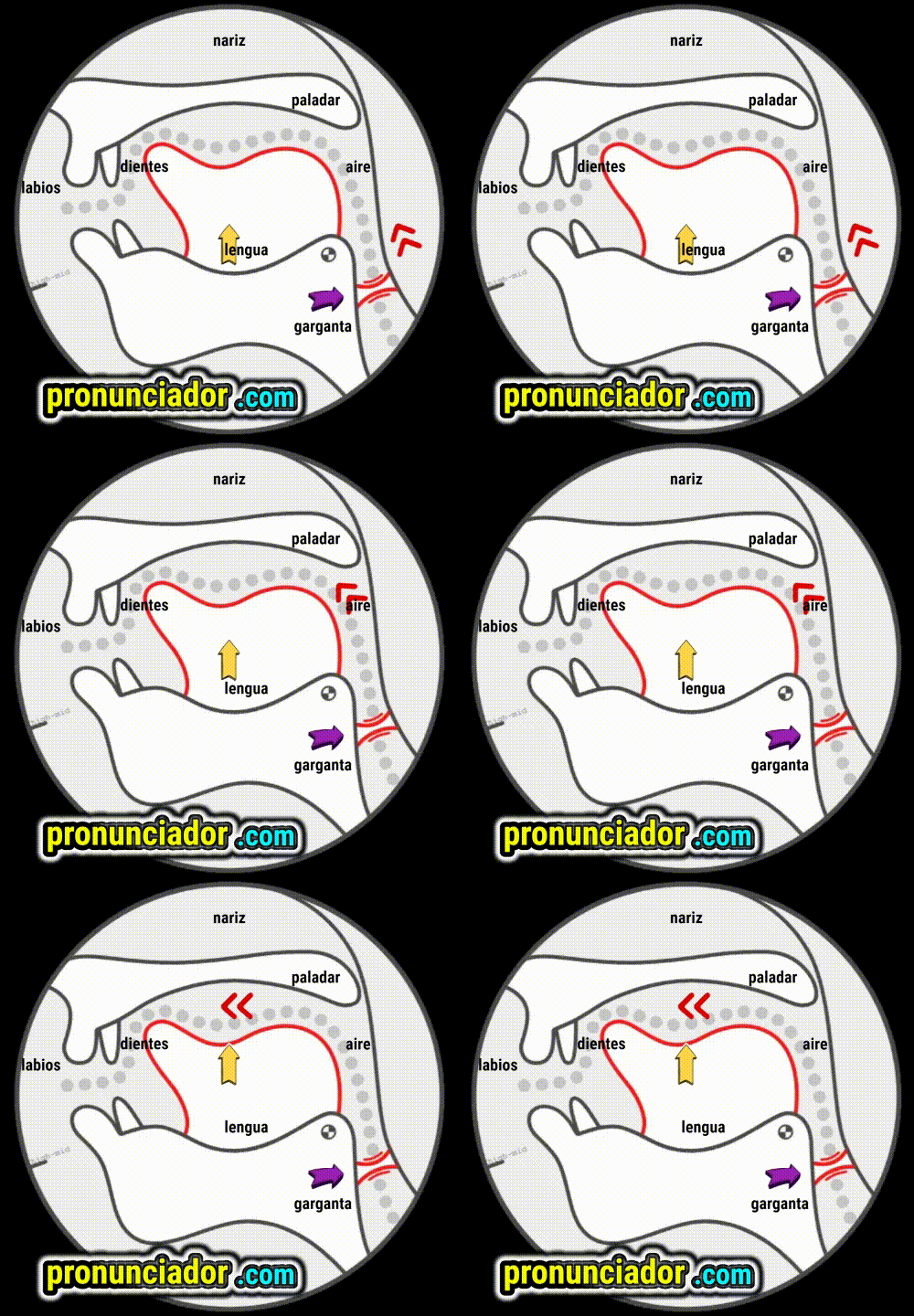
Unpacking the American HARD G /ɡ/ Sound: The “Back-Tongue Pop + Voice ON!” Star!
Alright, let’s properly introduce the main sound we’re focusing on today: the Hard G /ɡ/ sound. You hear it clearly in words like “gift,” “go,” “good,” “dog,” “big,” and “agree.” This Hard G /ɡ/ is a consonant, and it’s one of the “Super Six” Stop Consonants in American English – sounds where we momentarily block the air in our mouth and then release it with a little burst or “pop.” The others are /p, b, t, d, k/.
Its Core “G”-nius Features (Explained Super Simply!)
Sound scientists call /ɡ/ a “velar, voiced, stop consonant.” That sounds complex, but it’s easy when you break it down:
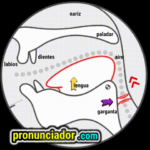
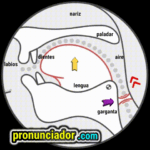
- Velar (BACK of Tongue Touches Soft Roof!): “Velar” tells us where the sound is made. For /ɡ/, it’s all the way at the BACK of your mouth. The BACK part of your tongue (not the tip!) rises up high and presses firmly against your SOFT PALATE (the velum – that soft, squishy part of the roof of your mouth way in the back, behind the hard bony part). This makes a complete seal, stopping the air for a moment. This is the exact same place you make the /k/ sound (“key”) and the NG /ŋ/ sound (“sing”)!
- VOICED (Throat BUZZES ON – The #1 Clue!): This is the SUPERPOWER of /ɡ/ and what makes it different from /k/! “Voiced” means your vocal cords (your voice box) are TURNED ON and VIBRATING when you make the /ɡ/ sound. If you gently touch your throat while saying “guh-guh-guh,” you MUST feel a definite BUZZ or HUM. It’s like a little engine running in your throat!
- Stop (Air BLOCKS, then POPS Out!): Just like a tiny, voiced explosion! First, your back-of-tongue and soft palate stop the airflow completely. Then, when you quickly lower the back of your tongue, the trapped, buzzing air bursts out with a “guh!” sound.
Kid-Friendly “Giggle Pop” Summary for Hard G /ɡ/:
- Open your mouth just a little, lips relaxed.
- Lift the very BACK of your tongue up high like it’s trying to give the back roof of your mouth a little “high-five.” Seal it tight back there!
- Turn ON the BUZZING motor in your throat (make it hum!).
- Then, quickly drop the back of your tongue and let that buzzing air POP out! “Guh!” Like a happy little giggle starting!
The Ultimate G vs. K Grudge Match: BUZZ vs. NO BUZZ + AIR!
The Hard G /ɡ/ (“go”) and the K /k/ (“key”) are like twin brothers who live in the same house (back of the mouth, velar stop!) but have totally different personalities (voiced vs. voiceless) and one uses more “air freshener” (aspiration!).
The ONLY Two Key Differences: VOICING (Throat Buzz) & STRENGTH of Air Puff!
| Feature | Hard G /ɡ/ (Go, Bag, Goat) | K Sound /k/ (Key, Back, Coat) |
| Back-of-Tongue Stop? | YES! | YES! |
| THROAT BUZZING (VOICE)? | ON! (VOICED – Must Vibrate!) | OFF! (VOICELESS – Just Air!) |
| AIR PUFF (Initial/Stressed)? | GENTLE/Slight Puff [ɡʰ] (if any) | STRONG PUFF! [kʰ] (Big burst of air!) |
The #1 Learner Blunder:
- Turning OFF the voice for Hard G /ɡ/, making it sound like K /k/. So, “go” becomes “ko,” “big” becomes “bik.” This is especially common at the end of words.
- (Less common for G/K, but possible) Turning ON the voice for K /k/, making it sound like G /ɡ/.
The Golden Fix: THE THROAT CHECK + THE AIR CHECK! - Voice First: Fingers on throat. Hard G /ɡ/ = MUST BUZZ! K /k/ = NO BUZZ! Drill “ga-ga-ga” (BUZZ) vs. “ka-ka-ka” (NO BUZZ).
- Air Puff (Initial/Stressed words): Use the Paper Test (details below). K /k/ makes the paper DANCE with a strong puff! Hard G /ɡ/ makes it flutter only a tiny bit, if at all, with the voice.
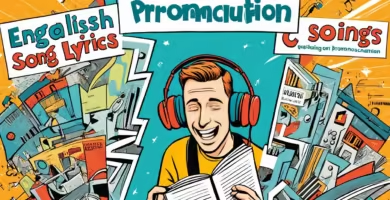
The Gentle G-Puff: Aspiration for Hard G /ɡ/ ([ɡʰ] vs. [ɡ])
Just like its voiced stop buddies /b/ and /d/, our Hard G /ɡ/ can have a tiny bit of aspiration (a small puff of voiced air) when it’s released, but it’s way more subtle than for /k, p, t/.
The Easy “G-Air” Rules (Same as for /b/ and /d/):
- SLIGHTLY Aspirated Hard G [ɡʰ] (Tiny Voiced Puff): The /ɡ/ usually has a gentle release of voiced air when it’s:
- A) At the VERY BEGINNING of a word:
- Go /ɡoʊ/ → [ɡ̊ʰoʊ] or [ɡʰoʊ] (a little breathy voiced start)
- Game /ɡeɪm/ → [ɡ̊ʰeɪm]
- Give /ɡɪv/ → [ɡ̊ʰɪv]
- Good /ɡʊd/ → [ɡ̊ʰʊd]
- B) At the BEGINNING of a STRESSED (Strong) Syllable:
- Again /əˈɡɛn/ → /əˈɡ̊ʰɛn/ (stress on ‘gain’)
- Forget /fərˈɡɛt/ → /fərˈɡ̊ʰɛt/ (stress on ‘get’)
- Begin /bɪˈɡɪn/ → /bɪˈɡ̊ʰɪn/ (stress on ‘gin’)
- (The little circle under [ɡ̊ʰ] means it’s slightly devoiced by the aspiration, common for voiced stops.)
- A) At the VERY BEGINNING of a word:
- UNASPIRATED Hard G [ɡ] (or Unreleased [ɡ̚]) (Clean Voiced Pop, NO Puff!): The /ɡ/ has NO extra puff of air (just a clear voiced pop, or it might even be “held” or “unreleased”) when it’s:
- A) At the VERY END of a word: This is the “Final Stop Rule.” The back of your tongue makes the /ɡ/ closure, voice is on, but you release it cleanly without an extra puff. Sometimes, especially before a pause, the tongue might stay in the G-position briefly, stopping the sound sharply (unreleased [ɡ̚]). [1:34 (Video /ɡ/) “Unaspirated /g/” diagram with ‘dog’ /dɔg/ (NO puff icon)].
- Dog /dɔɡ/ → /dɔ[ɡ]/ or /dɔ[ɡ̚]/
- Big /bɪɡ/ → /bɪ[ɡ]/ or /bɪ[ɡ̚]/
- Flag /flæɡ/ → /flæ[ɡ]/ or /flæ[ɡ̚]/
- Egg /ɛɡ/ → /ɛ[ɡ]/ or /ɛ[ɡ̚]/
- B) Generally AFTER an /s/ sound (like in the non-existent cluster “SG-” initially). While SG- isn’t a standard English initial cluster like SK-, SP-, ST-, if it did occur, the G would likely be unaspirated, similar to K, P, T after S. This is more theoretical for G.
- C) Often when it’s part of a consonant cluster NOT at the start of a stressed syllable. (e.g., “signal” /ˈsɪɡnəl/ – G is before N, unaspirated).
- A) At the VERY END of a word: This is the “Final Stop Rule.” The back of your tongue makes the /ɡ/ closure, voice is on, but you release it cleanly without an extra puff. Sometimes, especially before a pause, the tongue might stay in the G-position briefly, stopping the sound sharply (unreleased [ɡ̚]). [1:34 (Video /ɡ/) “Unaspirated /g/” diagram with ‘dog’ /dɔg/ (NO puff icon)].
Why Aspiration for /ɡ/ Matters (Subtly!):
- That slight initial/stressed puff [ɡʰ] helps the Hard G /ɡ/ sound clear, fully voiced, and distinct from a weak /k/.
- CRITICALLY, NOT puffing a final Hard G /ɡ/ (and keeping the VOICE ON!) is essential to avoid it sounding like a K /k/. “Do[ɡ]” not “do[k]-huh”.
Main Focus for /ɡ/: Make sure it’s VOICED! The slight aspiration is secondary. If your G is buzzy and pops, you’re 90% there!
Your Mouth’s “Guh-Guh-Go!” Action: Making the Hard G /ɡ/!
Let’s nail that back-of-tongue, voiced pop!
Step 1: Mouth Slightly Open, Lips Just Being Lips.
Keep it natural! Your mouth is only slightly open. Your lips are in a relaxed, neutral position. They don’t do much for this sound.
Step 2: BACK of Tongue HITS THE ROOF (Soft Spot)!
This is the /ɡ/ sweet spot!
- Let the TIP of your tongue chill out, maybe down behind your bottom teeth.
- Raise the very BACK part of your tongue (the thick part, called the dorsum) way UP and BACK.
- PRESS it firmly against your SOFT PALATE (the velum – that soft, fleshy part of the roof of your mouth at the very back, beyond the hard part). It needs to make a complete SEAL to STOP all air for a tiny moment.
Step 3: THROAT BUZZER = ON! (Voiced!)
This is what makes G different from K! As your tongue is making that seal (or just before you release it), TURN ON YOUR VOICE MOTOR! Your vocal cords in your throat need to be VIBRATING. Feel the buzz!
Step 4: The “Guh!” POP! (Voiced Air Release!)
Now, quickly drop the back of your tongue away from your soft palate, letting that BUZZING, trapped air EXPLODE out!
- If Aspirated [ɡʰ] (Start of word/stressed syllable like “Game”): Let a GENTLE puff of that voiced air escape with the “guh!” pop. It’s very light!
- If Unaspirated [ɡ]/[ɡ̚] (End of word like “Dog”): Release the voiced “guh!” pop cleanly with NO extra puff of air. Or, even better for a natural end, just make the voiced closure and “hold” it (unreleased [ɡ̚]), stopping the sound right there.
Kid-Friendly “Gargle-Pop” Cue: “Imagine you’re about to gargle, and you lift the back of your tongue up high in your throat and make a ‘gggggg’ buzz. Now, from that buzzing ‘ggggg’, quickly let it POP out with a ‘guh!’ If it’s at the start of a word, make that ‘guh!’ a tiny bit breathy!”
Feel the Back-Mouth BUZZY Stop & Pop! Practice “guh-guh-guh” with voice, trying both the slightly airy [ɡʰ] start and the clean [ɡ] end.
G-Whiz! Spelling Hard G /ɡ/: G, GG, X… and Hard vs. Soft G Rules!
The Hard G /ɡ/ sound has a few spelling tricks up its sleeve, especially the infamous “Hard G vs. Soft G” rule!
#1: Letter ‘G’ – The Main Player (BUT with Rules!) (~92%)
The letter ‘G’ is, of course, the MOST common way to spell the Hard G /ɡ/ sound.
BUT, and this is a HUGE BUT, ‘G’ doesn’t always sound like Hard G /ɡ/! It depends on the letter that comes AFTER it!
The Hard G /ɡ/ Rule (Usually!):
The letter ‘G’ usually sounds like HARD G /ɡ/ when it’s followed by:
- Vowels A, O, U:
- Game /ɡeɪm/, garden /ˈɡɑrdən/, gap /ɡæp/.
- Go /ɡoʊ/, got /ɡɑt/, gold /ɡoʊld/, good /ɡʊd/.
- Gun /ɡʌn/, guy /ɡaɪ/, guess /ɡɛs/.
- A CONSONANT (L, R, etc.):
- Glad /ɡlæd/, glass /ɡlæs/, glow /ɡloʊ/.
- Great /ɡreɪt/, green /ɡrin/, ground /ɡraʊnd/.
- At the END of a word:
- Dog /dɔɡ/, big /bɪɡ/, bag /bæɡ/, flag /flæɡ/, leg /lɛɡ/, hug /hʌɡ/, drug /drʌɡ/.
The Soft G /dʒ/ (“J” sound) Rule (Usually!):
The letter ‘G’ often sounds like SOFT G /dʒ/ (like the ‘J’ in “jam” or “judge“) when it’s followed by:
- Vowels E, I, Y:
- Gem /dʒɛm/, general /ˈdʒɛnərəl/, age /eɪdʒ/, page /peɪdʒ/, huge /hjudʒ/.
- Giant /ˈdʒaɪənt/, magic /ˈmædʒɪk/, origin /ˈɔrədʒɪn/, religion /rɪˈlɪdʒən/.
- Gym /dʒɪm/, energy /ˈɛnərdʒi/, apology /əˈpɑlədʒi/.
BUT WAIT! THE EXCEPTIONS TO SOFT G! (These G+E/I ARE HARD /ɡ/!)
This is where it gets TRICKY! There are many common, important words where ‘G’ IS followed by E or I, but it STAYS HARD G /ɡ/! You mostly have to MEMORIZE these high-frequency rebels!
- GE = /ɡɛ/: get, together, forget, target, tiger, finger, anger, hunger.
- GI = /ɡɪ/: give, girl, begin, gift, giggle, gill (fish).
- (These exceptions are usually Germanic root words, while the Soft G /dʒ/ often comes from Latin/French roots).
Think of it this way: ‘G’ LIKES to be Hard /ɡ/. It ONLY becomes Soft /dʒ/ when it’s “tickled” by an E, I, or Y, UNLESS it’s one of those tough Germanic words that refuses to soften up!
#2: Double ‘GG’ – Usually Just ONE Hard G /ɡ/! (~4%)
When you see ‘GG’, it almost always makes one single HARD G /ɡ/ sound.
- Egg /ɛɡ/
- Struggle /ˈstrʌɡəl/
- Bigger /ˈbɪɡər/
- Trigger /ˈtrɪɡər/
- Suggest* /səɡˈdʒɛst/ or /səˈɡɛst/ (The FIRST G is Hard /ɡ/. The second ‘G’ here can be Soft /dʒ/ due to ‘-gest’ or even another hard G /ɡ/ depending on how assimilated it is! This word is complex). A clearer one for learners is digging /ˈdɪɡɪŋ/.
- Froggy /ˈfrɑɡi/ or /ˈfrɔɡi/.
#3: Letter ‘X’ Making a /ɡz/ Sound (Includes Hard G!) (~4%)
Sometimes the letter ‘X’ doesn’t say /ks/ (box). When it’s between vowels, and the second vowel is stressed, ‘X’ often makes the VOICED sounds /ɡz/. The /ɡ/ part is our Hard G!
- Exact /ɪɡˈzækt/ (Sounds like “ig-ZAKT”)
- Exam /ɪɡˈzæm/ (“ig-ZAM”)
- Exist /ɪɡˈzɪst/ (“ig-ZIST”)
- Example /ɪɡˈzæmpəl/ (“ig-ZAMPLE”)
- Executive /ɪɡˈzɛkjətɪv/ (“ig-ZEK-utive”)
The Mysterious SILENT ‘G’ (Usually Before ‘N’)
Just like ‘K’ can be silent before ‘N’, ‘G’ also has its vanishing act, most famously in the ‘GN’ combination, often at the beginning or end of words.
- GN- at Start: Gnat /næt/ (insect – G is SILENT, sounds like “nat”). Gnaw /nɔ/ (to chew – G is SILENT). Gnome /noʊm/ (G silent).
- -GN at End: Sign /saɪn/ (G silent). Reign /reɪn/ (G silent). Foreign /ˈfɔrən/ (G silent). Design /dɪˈzaɪn/ (G silent). Campaign /kæmˈpeɪn/ (G silent).
- -GM at End (rarely, sometimes ‘g’ weakens or is silent): Phlegm /flɛm/ (G is silent). Diaphragm /ˈdaɪəfræm/ (G silent). More complex, not for beginner focus.
- -GHT (GH is always silent, T is heard): Thought, Brought, Caught, Night, Light, Right, Fight. (The ‘G’ here doesn’t make a /ɡ/ or /dʒ/ sound).
Hard G /ɡ/ Spelling – Your Smart Summary:
- G + A/O/U/Consonant/End: Mostly Hard /ɡ/ (Game, Dog, Glad).
- G + E/I/Y: Mostly Soft /dʒ/ (Gem, Gym, Giant)…
- …EXCEPT Key Hard G words: Get, Give, Girl, Begin, Finger, Tiger etc. (MEMORIZE!).
- GG: One Hard G /ɡ/ (Egg, Bigger).
- X (Medial, Stressed Vowel After): Often /ɡz/ (Exact, Exam).
- SILENT G: Mostly with GN- (Gnat) or -GN (Sign).
This Hard G/Soft G thing is tricky! Your best bet is to learn the rule, learn the BIG exceptions (get, give, girl), and then use your ears and a dictionary for new words!

OOPS! Common Hard G /ɡ/ Goofs & How to Fix ‘Em!
What are the typical trip-ups with this “buzzy back-pop”?
- MISTAKE #1: “K” for “G” – THE VOICE IS OFF! (Devoicing)
- Problem: This is HUGE, especially at the END of words. Your “big” sounds like “biK.” Your “dog” becomes “doK.” You’re not vibrating your vocal cords enough, or at all.
- THE #1 FIX: TURN ON THE THROAT BUZZ! For Hard G /ɡ/, your vocal cords MUST be vibrating. Touch your throat – “guh-guh-guh” should feel buzzy. Contrast with “kuh-kuh-kuh” (no buzz). Drill “baG / baCK,” “piG / piCK,” “doG / doCK” focusing on keeping voice ON for G right to the very end.
- MISTAKE #2: “HARD G” vs “SOFT G” Spelling SNAFU!
- The Nightmare: Saying “G” in “gem” like the “G” in “get.” Or “G” in “give” like the “J” in “giraffe.” It all comes from not knowing or applying the “G+EIY=Soft /dʒ/” rule and ITS EXCEPTIONS.
- The Rescue:
- MEMORIZE THE BASIC RULE: G+E/I/Y = often Soft G /dʒ/ (Gentle, Giant, Gym). G+A/O/U/Consonant = Hard G /ɡ/ (Game, Go, Gun, Glad).
- MEMORIZE THE HARD G EXCEPTIONS: “Get, give, girl, begin, forgive, finger, tiger, gear, geese, giddy…” These are KEY! They break the “soft G” pattern and stay HARD /ɡ/.
- When in doubt, LISTEN or look up the word!
- MISTAKE #3: Wrong “G-Puff” (Aspiration)!
- Uh-Oh: Adding a STRONG puff to initial Hard G (making it sound K-like if voicing is also weak), or puffing a final G (like “doG-HUH”).
- The Fix: Hard G /ɡ/ aspiration is VERY SLIGHT initially [ɡʰ] (if at all), mostly it’s about the voiced release. Final /ɡ/ has NO puff [ɡ]/[ɡ̚]. Focus on strong VOICE, not strong air, for /ɡ/.
- MISTAKE #4: Using a “G” Sound From Your Native Language (if it’s different, e.g., a fricative).
- The Glitch: Some languages have a ‘g’ between vowels that’s a “rubbing” sound [ɣ] (like Spanish “agua”). American Hard G /ɡ/ is always a clear “POP” (stop sound), even between vowels (“ago,” “bigger”).
- The Fix: Make sure the back of your tongue fully BLOCKS the air against the soft palate, then POPS open with voice. No “leaky” air for Hard G /ɡ/.
- MISTAKE #5: Pronouncing SILENT ‘G’s!
- Oops! Saying “siGN” with a /ɡ/ or “GNAT” starting with /ɡ/.
- Solution: Learn the SILENT G patterns! Especially GN- (Gnat) and -GN (Sign) where G is usually just for show.
“Go Get It!” Hard G /ɡ/ Sound Workout Time!
Let’s get that back-of-tongue, buzzy pop sounding great!
Exercise 1: The “Throat Motor” Drill – Pure VOICING for /ɡ/!
- Place fingers lightly on your throat (Adam’s apple area).
- Lift the back of your tongue to your soft palate.
- Now, make a BUZZING sound, “GGGGGGGGGG,” feeling the vibration. Then quickly release the tongue into a “guh!” pop, keeping the buzz. “Guh! Guh! Guh!”
- If you don’t feel a buzz, it’s a K! Buzz ON = G!
Exercise 2: The K vs. G Knockout Round! (No Buzz + STRONG Air vs. Buzz + GENTLE Air)
This is where the magic happens for clarity! Hand on throat AND paper test for initial sounds!
- Kate [kʰeɪt] (No Buzz, Big Puff) — Gate [ɡ̊ʰeɪt] (BUZZ, Slight Puff)
- Coat [kʰoʊt] (No Buzz, Big Puff) — Goat [ɡ̊ʰoʊt] (BUZZ, Slight Puff)
- Back [bæk̚] (No Buzz, No Puff) — Bag [bæɡ] (BUZZ, No Puff)
- Pick [pɪk̚] (No Buzz, No Puff) — Pig [pɪɡ] (BUZZ, No Puff)
- Think /θɪŋk/ (ends /k/) — Thing /θɪŋ/ (ends /ŋ/, not /ɡ/! Careful with example choice)
- Better end pair: Lock [lɑk̚] — Log [lɔɡ] (or /lɑɡ/ for some AmE speakers)
Exercise 3: The “Always a Pop” Hard G /ɡ/ Challenge (No Mushy G’s!)
Practice these, ensuring a clear back-of-tongue voiced POP for every Hard G, even between vowels.
- Ago, Again, Agree, Bigger, Suggest (/səɡˈdʒɛst/ or /səˈɡɛst/), Tagged, Figure, Legal, Regular, Dragon.
- (Make sure that back tongue fully STOPS and POPS with VOICE!)
Exercise 4: Final Hard G /ɡ/ Focus – Keep that BUZZ ALIVE!
Make the final /ɡ/ clearly voiced and avoid a puff.
- Dog, Big, Egg, Flag, Leg, Hug, Drug, Blog, Rag, Vague.
- (Say “doGGG” then cut the end short, keeping the buzz in the G stop).
Exercise 5: Hard G /ɡ/ vs Soft G /dʒ/ – Spelling Rules & EXCEPTIONS!
Read these, applying the G+EIY=Soft G /dʒ/ rule OR the Hard G /ɡ/ exception:
- Hard /ɡ/: Game, Got, Gum, Glad, Green, Get, Give, Girl, Begin, Forget, Finger, Tiger.
- Soft /dʒ/: Gem, General, Gentle, Giant, Logic, Energy, Age, Page, Bridge, Judge.
This needs LOTS of listening and memorization for exceptions!
Exercise 6: Silent G Showdown! (Don’t Say It!)
- Sign, Reign, Foreign, Design, Campaign.
- Gnat, Gnaw, Gnome.
Exercise 7: Top 30 Hard G Workout (Sounds American List) + RECORD!
| PHONETICAL PRONUNCIATION |
| PHONETICAL PRONUNCIATION |
- Is the G initial/stressed (slight aspiration [ɡʰ] with STRONG VOICE)?
- Is it final (unaspirated [ɡ]/[ɡ̚] but VOICED)?
- Is it GG (single /ɡ/ sound)?
- Is it ‘X’ as /ɡz/ (like “exactly”)?
RECORD yourself! Is your G buzzing? Is it a pop? Does it sound like K?
FAQs: Your American Hard G /ɡ/ (“Go,” “Gift”) Questions Answered!
Q1: What’s the #1 ABSOLUTE KEY to making my English Hard G /ɡ/ sound different from K /k/?
VOICING! Your throat MUST BUZZ! Put your hand on your throat:
- For Hard G /ɡ/ (like in “go,” “big“): Feel that VIBRATION. Voice ON!
- For K /k/ (like in “key,” “back“): NO VIBRATION. Voice OFF, just air.
This voicing difference is even more critical than the slight air puff G might have.
Q2: What’s the Hard G /ɡ/ vs. Soft G /dʒ/ (“gym”) rule again, simply?
Super simply:
- G + A, O, U, or another Consonant → Usually HARD G /ɡ/ (Game, Go, Gun, Glad).
- G + E, I, Y → Usually SOFT G /dʒ/ (Gem, Giant, Gym).
BUT!!! There are SUPER important exceptions to the G+E/I rule where it STAYS HARD /ɡ/! You MUST learn words like get, give, girl, begin, finger, tiger. They are very common!
Q3: Does the Hard G /ɡ/ have that puff of air (aspiration) like K /k/ does?
Yes, a little bit, but it’s much GENTLER and often with a bit of voice mixed in [ɡ̊ʰ].
- It usually gets a slight voiced puff when it’s at the beginning of a word (“Game”) or starts a stressed syllable (“aGain”).
- It has NO puff (or is “unreleased”) at the end of a word (“doG“).
Don’t focus on a strong puff like for K; focus on the strong voice for G!
Q4: What about “GG” like in “egg” or “bigger”?
‘GG’ usually just makes ONE single Hard G /ɡ/ sound. Don’t say it twice! So, egg is /ɛɡ/, bigger is /ˈbɪɡər/.
Q5: When is ‘G’ SILENT? It’s confusing!
The most common time ‘G’ is silent is in the combination ‘GN’:
- At the START of a word: gnat (sounds like “nat”), gnaw.
- At the END of a word: sign (sounds like “sine”), reign, foreign.
(Also, GH in words like “thought,” “light” is silent, but that’s not just G alone).
Key Takeaways: Your “Great” American Hard G /ɡ/ is Good to Go!
You’ve done some grande /ɡrænd/ work today unpacking the American Hard G /ɡ/! You now know its true power comes from that VOICED, back-of-tongue POP, how its tiny puff of air works, and the all-important rules (and exceptions!) for Hard vs. Soft G spellings!
Your “G”-olden Nuggets:
- /ɡ/ (Hard G) = BACK-OF-TONGUE Pop + THROAT BUZZ ON! (Voiced Velar Stop).
- VS. /k/ (Key) = BUZZ ON (G) vs. BUZZ OFF (K)! #1 Difference! Initial G also has much less air puff than K.
- HARD G vs. SOFT G /dʒ/: G+AOU/Consonant = /ɡ/. G+EIY = mostly /dʒ/ (Gym) EXCEPT for common words like Get, Give, Girl!
- ASPIRATION (Air Puff): Very slight voiced puff [ɡ̊ʰ] at start of words/stressed syllables. NO puff [ɡ]/[ɡ̚] at word ends (but keep VOICE ON!).
- SPELLING: ‘G’ (rules apply!), ‘GG’ (/ɡ/), ‘X’ (can be /ɡz/).
- SILENT ‘G’: Usually in ‘GN’ (Sign, Gnat).
The ultimate keys are feeling that throat BUZZ for Hard G /ɡ/ and mastering the “G before E, I, Y” spelling rule along with its vital exceptions. Keep practicing those minimal K/G pairs (“coat”/”goat,” “back”/”bag”). Record yourself on the Hard/Soft G words (“gem” vs “get”). Your American English will sound stronger and more authentic with every great /ɡreɪt/ “G”!
👇🔥👇🔥👇🔥👇🔥👇🔥👇🔥
👉 RETURNS in the YEAR 2031 ! WHO? CLICK HERE ! 🔥



👇🔥👇🔥👇🔥👇🔥👇🔥👇🔥
👉 RETURNS in the YEAR 2031 ! WHO? CLICK HERE ! 🔥
👇🔥👇🔥👇🔥👇🔥👇🔥👇🔥
👉 RETURNS in the YEAR 2031 ! WHO? CLICK HERE ! 🔥
👉 RETURNS in the YEAR 2031 ! WHO? CLICK HERE ! 🔥