
Do ‘cup’ & ‘love’ sound wrong? Master the American /ʌ/ vowel! This easy guide shows you the relaxed mouth position & secrets to fix common pronunciation errors.
HHey there, future American accent pros! Today, we’re tackling a super common, yet super sneaky, vowel sound in American English. It’s the sound you hear in everyday words like “us”, “cup”, “but”, “love“, and “come! The secret code for this sound is /ʌ/ (it kinda looks like a little pointed roof without the bottom line!). Mastering this little guy is HUGE for sounding clear and natural.
So, why is it “sneaky”? Because this exact sound isn’t found in many other languages around the world , so learners often replace it with something close, but not quite right! You might try to say “cut” /kʌt/ (to slice), but it accidentally comes out sounding more like “cat” /kæt/ (the furry pet) or even “cot” /kɑt/ (a small bed)!. Maybe you say “some” /sʌm/ but use a sound closer to the ‘o’ in “song” /sɔŋ/. It gets confusing! You see the letter ‘U’ and think it should sound like “put” /pʊt/ or “blue**” /blu/, but then “cup” /kʌp/ comes along. You see the letter ‘O’ and expect “go**” /ɡoʊ/, but then “come” /kʌm/ uses this different “uh” sound! And don’t even get started on “blood” /blʌd/! Plus, there’s that other super common “uh” sound, the Schwa /ə/ (like the ‘a’ in ‘ago’)… are they the same? AAAH!. You feel stuck, your pronunciation feels a bit stiff, and you can’t quite get that effortless, relaxed American vibe.
But NO MORE confusion! Today, we’re unlocking the mystery of the /ʌ/ UH vowel together! This MEGA guide makes it crazy easy (seriously, 8-year-old easy!) to finally nail it:
- Meet the Sound: What IS this /ʌ/ sound, really? (Secret: Think RELAXED and MIDDLE MOUTH!).
- The Big Showdown: We’ll finally understand the KEY difference between /ʌ/ (in strong syllables like ‘cup’) and its famous cousin Schwa /ə/ (in weak syllables like ‘ago’). Think loud cousin vs. quiet cousin!
- Mouth Moves Made Simple: Step-by-step, super easy instructions on how your mouth, lips, and tongue just CHILL OUT to make this sound. (Hint: Doing LESS is better!).
- Crazy Spelling Cracked: Why U, O, OU, OO can ALL make the /ʌ/ sound – we have the cheat codes!
- Zap Common Mistakes: We’ll identify the #1 errors learners make (too much effort! using ‘A’!) and fix them instantly!
- Practice Time! Fun, easy exercises with common words (‘up’, ‘but’, ‘come’, ‘money’, ‘fun’…) so your /ʌ/ sounds amazing without even trying!
Get ready to stop saying “cap” when you mean “cup”! Your path to a clearer, more natural American accent starts NOW! Let’s run! 😉

What IS This /ʌ/ Sound? The Relaxed “Uh” of Cup!
Let’s get friendly with this sound. The /ʌ/ (you can call it the STRUT vowel, or just the “UH-as-in-CUP” sound) is one of the basic building blocks of American English vowels. And even though it’s rare in other languages, it’s super common in English! You use it constantly:
- up /ʌp/
- but /bʌt/
- cup /kʌp/
- lunch /lʌntʃ/
- much /mʌtʃ/
- study /ˈstʌdi/
- And sneaky ones! –> some /sʌm/, come /kʌm/, love /lʌv/, money /ˈmʌni/, enough /ɪˈnʌf/, blood /blʌd/!
Its Secret Features (Kid-Friendly Version!)
Experts use fancy words: “Low-mid, relaxed, central vowel”. Let’s translate that into plain English:
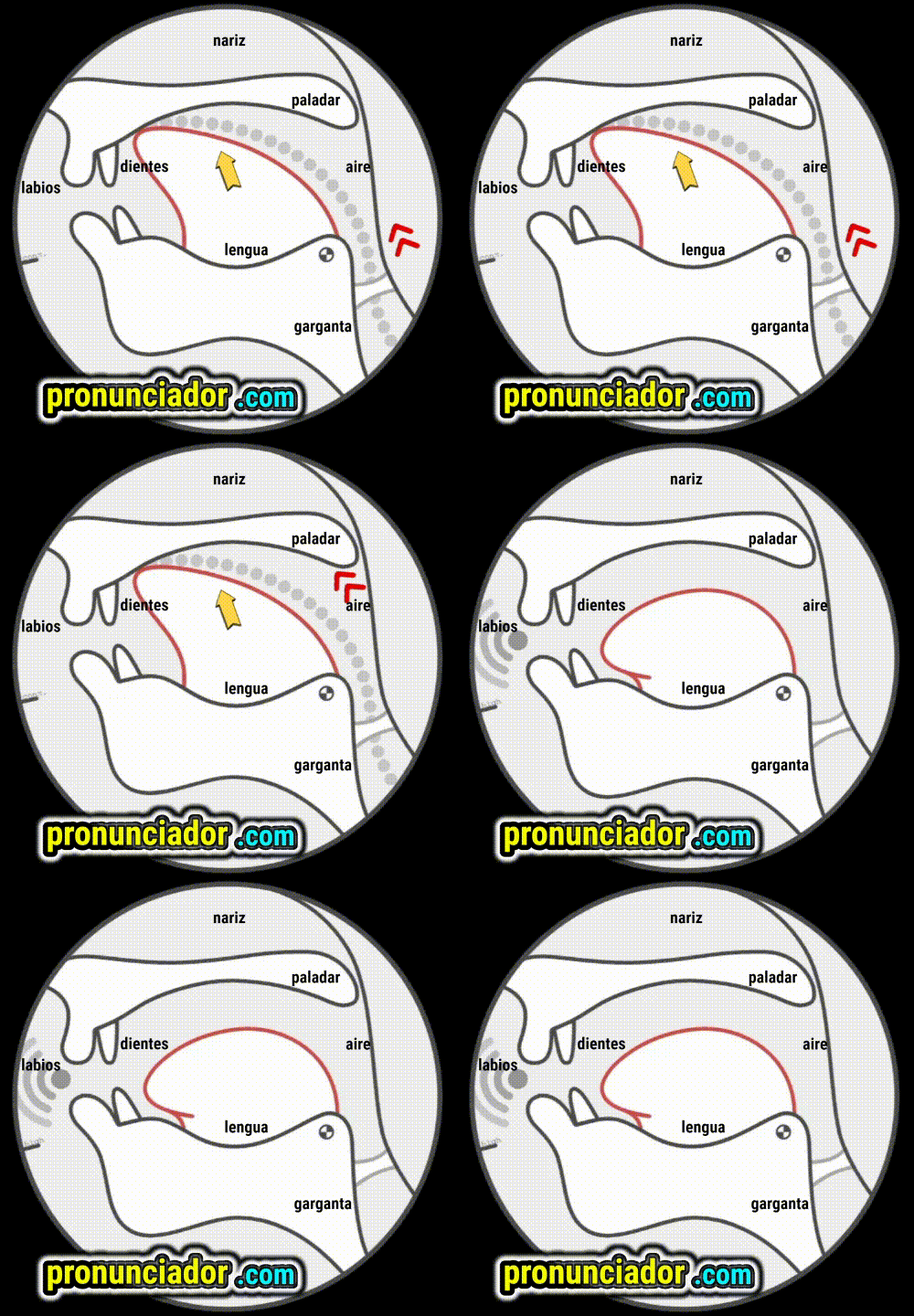
- Central (Middle-of-the-Mouth): Imagine your mouth is a room. For “eeee” (/i/), your tongue goes to the FRONT window. For “oooo” (/u/), it goes to the BACK wall. But for /ʌ/? Your tongue just hangs out RIGHT IN THE MIDDLE of the room! Super easy, right?
- Low-Mid (Tongue Kinda Low): Is your tongue way up high touching the ceiling? Nope! Is it flat on the floor? Not quite! It’s chilling out somewhere between the middle and the floor. Kinda low down, very casual. This means your JAW is only open A LITTLE BIT. Not wide, not shut tight.
- RELAXED!!! (Lazy Sound!): This is the NUMBER ONE MOST IMPORTANT SECRET! 🌟 Forget flexing! For /ʌ/, your TONGUE and LIPS are completely loosey-goosey, floppy, chilled out. Like right after a nap. Zero muscle tension needed!
- Lips? Do Nothing! (Neutral/Unrounded): Seriously. No smile, no kissy face. Your lips just are. Totally relaxed in their normal resting position.
Super Duper Easy Summary: Making the /ʌ/ (cup sound) is about not doing much! Open your mouth just a tiny bit, leave your lips totally relaxed, let your tongue relax in the middle-low part of your mouth, and make a short, quick “uh” sound. The magic trick? Maximum RELAXATION!
The Ultimate Showdown: /ʌ/ (Cup – STRESSED Uh) vs. /ə/ Schwa (Ago – UNSTRESSED Uh)
Okay, THIS is HUGE for sounding American! English has two main “uh” sounds. They sound super similar, but they have different jobs!
| Feature | /ʌ/ (CUP, BUT, LOVE) | /ə/ Schwa (AgO, SofA, About) |
| JOB (Stress)? | STRONG syllables ONLY! | WEAK syllables ONLY! |
| Clarity? | A clearer “uh” sound | Super blurry, fast “uh” |
| Effort Level? | RELAXED | SUPER-DUPER LAZY! |
| Mouth Opening? | Slightly open | Often even more closed |
Think of it like family members:
- /ʌ/ is the cousin who speaks up clearly (but still relaxed!) when it’s their turn in the important, stressed part of the word (like ‘cup’, love’).
- /ə/ Schwa is the super quiet cousin who just murmurs quickly when the word part isn’t important (like ‘about’ /əˈbaʊt/ – the ‘a’ is weak /ə/; ‘but’ /bʌt/ – the ‘u’ is strong /ʌ/).
Why does this matter? If you use the clear /ʌ/ in weak spots, or the blurry /ə/ in strong spots, the music and rhythm of your English will sound really off. Nailing this difference is like getting the secret handshake to sounding more natural!

Your Mouth on Vacation Mode: Making the Easy /ʌ/ Sound!
Ready to make the easiest (if you relax!) sound in English? Let’s do it step-by-step!
Step 1: Mouth – Just a Tiny Gap!
Relax your jaw completely. Let your mouth hang open just a little bit. Don’t force it wide or keep it shut. Just… neutral.
Step 2: Lips – Be Lazy! (Neutral & Relaxed)
Seriously, do nothing with your lips. Let them be soft and natural. No smile, no rounding, no tension. Just… lips.
Step 3: Tongue – Nap Time! (Relaxed & Centered)
This is the secret sauce!
- Let your tongue completely relax. Floppy like a cooked noodle.
- Have it rest right in the MIDDLE of your mouth floor. Not forward, not back. Centered.
- Make sure it’s pretty low down, but not flat-flat. Just chilling in that middle-low space.
- The tip can lightly touch behind your bottom teeth, or just float. Don’t overthink the tip, focus on the middle being relaxed and centered.
Step 4: The Sound – “Uh” (Quick & Effortless)
- Okay, easy mouth, lazy lips, sleepy tongue… now just breathe out with your voice on: “uh”.
- It should be short and neutral. Not an “ah”, not an “oh”, not an “eh”. Just a simple, middle-of-the-road “uh”. That’s /ʌ/!
How it Feels: Everything should feel totally relaxed. Barely any mouth movement. The sound comes from the center of your mouth without effort. It’s the “whatever” sound of English vowels! 😄
Crazy Letters, Same Sound! How is /ʌ/ Spelled? (U, O, OU, OO!)
Okay, now for the tricky part! How do you know when to make this /ʌ/ sound when the spelling is all over the place? Let’s look at the main clues.
The #1 Most Common: Letter ‘U’! (~78% – 83%)
Good news! Most often, if you see a ‘U’ in a stressed syllable that ends with a consonant (or two), it’s likely the /ʌ/ “UH” sound! This is your best bet!
- Up, us, under, ugly, uncle, until (stress on ‘til’, ‘un’ is schwa /ən/) -> Correcting: Focus on STRESSED U, like under.
- But, cup, cut, run, fun, sun, bus, gun, numb, drug.
- Just, must, trust, study, husband, summer, number, plus.
- Stuff, club, mud, such, lunch, jump, bunch.
Top Tip: Stressed ‘U’ + Consonant? → Probably /ʌ/! (But watch out for exceptions like ‘put’ /pʊt/ and ‘rule’ /rul/!).
The Surprise Visitor: Letter ‘O’! (~18% – 13%)
Yes, the letter ‘O’! There’s a key group of very common words you MUST learn where ‘O’ makes the /ʌ/ “UH” sound!
- come /kʌm/
- some /sʌm/
- love /lʌv/
- glove /ɡlʌv/
- above /əˈbʌv/ (strong ‘o’=/ʌ/)
- mother /ˈmʌðər/
- brother /ˈbrʌðər/
- other /ˈʌðər/
- another /əˈnʌðər/
- nothing /ˈnʌθɪŋ/
- done /dʌn/
- won /wʌn/ (sounds like ‘one’ /wʌn/!)
- one /wʌn/
- money /ˈmʌni/
- month /mʌnθ/
- front /frʌnt/
- (Remember: Most ‘O’s are NOT /ʌ/! ‘Go’ is /oʊ/, ‘hot’ is /ɑ/, ‘off’ is /ɔ/. These are SPECIAL words!)
The ‘OU’ Rebels: Not Many, But Important! (~3%)
‘OU’ usually sounds like /aʊ/ (out) or /oʊ/ (though), or others! But sometimes… /ʌ/!
- enough /ɪˈnʌf/ (gh=/f/)
- tough /tʌf/ (gh=/f/)
- rough /rʌf/ (gh=/f/)
- young /jʌŋ/
- country /ˈkʌntri/
- couple /ˈkʌpəl/
- cousin /ˈkʌzən/
- trouble /ˈtrʌbəl/
- double /ˈdʌbəl/
- touch /tʌtʃ/
The Super Rare ‘OO’ Twins! (<1%)
Normally OO is /u/ (food) or /ʊ/ (book). BUT just two very common words use /ʌ/:
- blood /blʌd/
- flood /flʌd/
- (Maybe related: ‘does’ /dʌz/, usually pronounced /dʌz/ which has the /ʌ/!)
Spelling Cheat Sheet for /ʌ/ (“UH” Cup):
| Spelling | Frequency (Approx. Web) | Best Clue? | Key Examples (/ʌ/) | WARNING! Usually Sounds Like… |
| U | ~83% (By Far!) | STRESSED syllable, ends in Consonant | cup, up, but, run | /ʊ/(put), /u/(rule) |
| O | ~13% | KEY WORDS to MEMORIZE! | come, love, son, money | /oʊ/(go), /ɔ/(off), /ɑ/(hot)… |
| OU | ~3% | Specific group (‘ough’, ‘oung’, etc.) | enough, young, country | /aʊ/(out), /oʊ/(though)… |
| OO | <1% | Blood & Flood ONLY! | blood, flood | /u/(food), /ʊ/(book)!! |
Big Idea: ‘U’ is your main guy for /ʌ/. ‘O’ needs memorization. OU/OO are super rare for /ʌ/. Best tool? Your ears + IPA /ʌ/ check!

Zap Those Errors! Common /ʌ/ Mistakes & Easy Fixes!
Let’s fix the ways we often mess up this “UH” sound!
- Mistake #1: Using an ‘A’ sound ([a] or /æ/ ‘cat’)!
- What Happens: Mouth too open, tongue forward. “Cup” becomes “Cap/Cat”.
- The Fix: RELAX! Close mouth slightly. Tongue MIDDLE, lazy, neutral lips. Think “uh”, not “aaah”.
- Mistake #2: Using an ‘O’ sound ([o] or /ɔ/ ‘caught’)!
- What Happens: Lips get rounded! Tongue might go back. “Come” sounds like “Comb” (or the start of it).
- The Fix: NEUTRAL LIPS! No rounding at all. Relax them. Tongue MIDDLE.
- Mistake #3: Too Much Muscle! (Tension) [Key issue implied by ‘relaxed’ descriptor].
- What Happens: Trying too hard! Mouth tense, tongue stiff. Doesn’t sound lazy/natural.
- The Fix: CHILL OUT! Let jaw drop slightly, relax cheeks, lips, tongue. /ʌ/ = Zero effort sound!
- Mistake #4: Mixing Up /ʌ/ (Stressed) with Schwa /ə/ (Unstressed)!
- What Happens: Using the clear /ʌ/ in weak spots (like ‘a’ in ‘about’), messing up rhythm. Or using weak /ə/ where /ʌ/ needs clarity (‘c’p’ not ‘cup’).
- The Fix: FEEL THE BEAT! Strong syllable = /ʌ/. Weak syllable = /ə/. A–BOVE (/əˈbʌv/). CUP (/kʌp/).
- Mistake #5: Spelling Traps! (U/O ≠ Always /ʌ/)
- What Happens: Seeing ‘U’ -> saying /ʊ/ or /u/. Seeing ‘O’ -> saying /oʊ/ or /ɔ/.
- The Fix: LEARN THE PATTERNS & EXCEPTIONS! Know when U/O can be /ʌ/ (cup, come…). Spelling lies in English!
Easy Tip: Just slightly open your mouth and make the shortest, vaguest “uh” you can, right from the middle. That’s super close!
Let’s Practice! Easy Exercises for the /ʌ/ Sound!
Ready to get that relaxed American “UH”? Let’s go!
Exercise 1: The Lazy “Uh” – Just /ʌ/
- Tiny mouth opening. Lips 100% relaxed. Tongue asleep in the middle-low center.
- Short, soft “uh”. → /ʌ/, /ʌ/, /ʌ/. No effort!
Exercise 2: Strong /ʌ/ vs. Weak /ə/ (Feel the Difference!)
- Say Loud & Clear (/ʌ/): Up! Cup! But! Love!
- Say Soft & Quick (/ə/): ago, sofa, about, teach**er* (/ɚ/ is schwa+r).
- Feel the difference in energy and clarity!
Exercise 3: The BIG Contrasts! /ʌ/ vs /ɑ/ vs /æ/
This REALLY helps tune your ear and mouth!
- Hut /hʌt/ (Relaxed, Mid) — Hot /hɑt/ (Open, Back) — Hat /hæt/ (Open, Front, Spread Lips)
- Cup /kʌp/ — Cop /kɑp/ — Cap /kæp/
- Bug /bʌɡ/ — Bog /bɑɡ/ (swamp) — Bag /bæɡ/
- Luck /lʌk/ — Lock /lɑk/ — Lack /læk/ (lack)
- Run /rʌn/ — R(o)n* (name) /rɑn/ — Ran /ræn/ (ran)
Exercise 4: Crazy Spelling Practice for /ʌ/!
Get used to seeing different letters for the SAME “UH” sound!
- U: but, cut, run, sun, must, fun, study, husband, number, stuff, up, us, under.
- O: come, some, love, done, won, money, month, mother, brother, other, front.
- OU: enough, young, country, couple, cousin, trouble, touch.
- OO: blood, flood.
Exercise 5: Common Words Workout (Source List)
(Go through the list from the source: some, love, because, much… husband, trust). Focus on that short, relaxed /ʌ/ sound!*
*Again, ‘because’ is complex /bɪˈkʌz/ or /bɪˈkɔz/, be careful with using it for basic /ʌ/ practice.
Exercise 6: Put it in Sentences + Recording!
RECORD YOURSELF! Does your /ʌ/ sound right? Is it different from your /ə/?
- “My mother [ʌ][ɚ] loves [ʌ] her other [ʌ][ɚ] son [ʌ].” (Lots of /ʌ/ and /ɚ/!)
- “Come [ʌ] up [ʌ] front [ʌ], it’s fun [ʌ]!”
- “I trust [ʌ] my young [ʌ] husband [ʌ] with [ɪ] much [ʌ] money [ʌ].” (More mix!)
- “Such [ʌ] luck [ʌ]! The flood [ʌ] doesn’t* [ʌ] touch [ʌ] us [ʌ].” (*’Doesn’t’ uses /ʌ/!)

Vocales Abiertas vs. Vocales Relajadas (El Sonido No Enfatizado)

El secreto de la ‘N’ que se convierte en ‘NG’ /ŋ/ Y porque tu paladar es la clave, Guía visual
Common Spellings of the /ʌ/ Sound
One of the challenges of English pronunciation is that the same sound can be spelled in different ways. Here are the most common spellings for the /ʌ/ sound:
- “u”: This is the most frequent spelling. Think of words like:
| but | |
| sun | |
| cup | |
| run | |
| under | |
| husband |
- “o”: Surprisingly, the letter “o” can also represent the /ʌ/ sound in certain words:
| come | |
| some | |
| love | |
| money | |
| none | |
| won |
- “ou”: This combination of letters can also produce the /ʌ/ sound:
| enough | |
| young | |
| tough | |
| rough |
- “oo”: Less commonly, the double “o” can sound like /ʌ/:
| flood | |
| blood |
1. Listen and Repeat: Listen carefully to the following words and try to repeat them, focusing on the /ʌ/ sound:
| PHONETICAL PRONUNCIATION |
| PHONETICAL PRONUNCIATION |
FAQs: Your /ʌ/ (“Uh”) Questions Answered!
Q1: Is the /ʌ/ sound (‘cup’) the same as Schwa /ə/ (‘ago’)? They sound like “uh”!
Almost, but NO! Key difference: STRESS!
- /ʌ/ (‘cup’) lives in STRONG, stressed syllables. It’s a clearer, slightly lower “uh”.
- /ə/ (Schwa) lives in WEAK, unstressed syllables. It’s the laziest, fastest, blurriest “uh”.
Getting stress right = Getting /ʌ/ vs /ə/ right!
Q2: Why doesn’t my regular ‘A’ or ‘O’ sound work for /ʌ/?
Because they’re made in different parts of your mouth with different lip shapes!
- ‘A’ [a] is too far forward & open. /ʌ/ is central & less open.
- ‘O’ [o] is too far back & has ROUND lips. /ʌ/ is central & has NEUTRAL lips.
/ʌ/ needs its own special relaxed, central spot!
Q3: How do I really know if a ‘U’ or ‘O’ word uses the /ʌ/ sound?
That’s the million-dollar question!
- For ‘U’: STRONG syllable + ends in consonant? → HIGH CHANCE it’s /ʌ/ (cup, bus). Check common exceptions (‘put’ /ʊ/, ‘rule’ /u/).
- For ‘O’: You MUST MEMORIZE the common ones (‘come’, ‘love’, ‘son’, ‘mother’, ‘done’…). Most ‘O’s are NOT /ʌ/!
- Best way? Always LISTEN to native speakers or check the word’s IPA symbol /ʌ/ in a dictionary.
Q4: I try to relax for /ʌ/, but it sounds tense! Help!
REALLY focus on doing less.
- Drop your jaw only slightly.
- Let lips hang naturally.
- Think of your tongue as a wet noodle resting in the middle floor.
- Make the sound SHORT and QUIET initially. “uh”.
Maybe even practice after a real yawn! That ultra-relaxed state is close.
Q5: You said /ʌ/ is only in STRESSED syllables. Really?
Yes, according to standard phonetics and the source material. That’s its main job description, distinguishing it from the weak Schwa /ə/. When you hear that clear “UH” sound in a word like ‘come’ or ‘under’, that part of the word IS carrying stress. Weak syllables use Schwa /ə/ (like the ‘a’ in ‘about’).
Final Thoughts: Unlock Your Relaxed American /ʌ/!
Way to go! You’ve tackled the super common, often confusing, American UH /ʌ/ vowel! Now you know it’s all about RELAXING, staying CENTRAL, and understanding its connection to STRESS.
Keep these gold nuggets:
- /ʌ/ = RELAXED UH! Short, central, low-mid, neutral lips. Think ‘cup’, ‘love’.
- STRESSED Syllables Only! (Weak ones use Schwa /ə/).
- RELAXATION is EVERYTHING! Mouth, lips, tongue – chill mode ON.
- NOT ‘A’ or ‘O’! It’s its own unique sound.
- SPELLING ALERT! ‘U’ is common; ‘O’ has key exceptions; OU/OO are rare. LISTEN!
- KEY MISTAKE: Using another vowel (A, O, /æ/, /ɑ/) OR being too tense!
The magic trick is truly minimal effort. Feel that lazy, central “uh”. Practice contrasting it with Schwa and other vowels (/æ/, /ɑ/). Listen for it in words like ‘but’, ‘come’, ‘money’. Record yourself! Master the /ʌ/, and you’ve mastered a huge piece of the American accent puzzle!’ll be well on your way to speaking clearer and more natural-sounding English. Keep practicing, and don’t be afraid to make mistakes – they are a natural part of the learning process! You’ve got this!
👇🔥👇🔥👇🔥👇🔥👇🔥👇🔥
👉 RETURNS in the YEAR 2031 ! WHO? CLICK HERE ! 🔥




👇🔥👇🔥👇🔥👇🔥👇🔥👇🔥
👉 RETURNS in the YEAR 2031 ! WHO? CLICK HERE ! 🔥
👇🔥👇🔥👇🔥👇🔥👇🔥👇🔥
👉 RETURNS in the YEAR 2031 ! WHO? CLICK HERE ! 🔥
👉 RETURNS in the YEAR 2031 ! WHO? CLICK HERE ! 🔥