

Struggling to pronounce the American K sound? Learn the #1 secret to a crisp /k/: the puff of air (aspiration)! Master K vs. G, tricky spellings & more. Speak clearly!
Hey there, American accent champions! Get ready to “kick” your pronunciation up a notch by mastering one of the most frequent, yet surprisingly tricky, sounds in American English: the /k/ sound, as in “key,” “can,” “cat,” “back,” or even “ache”! Its official phonetic symbol is just /k/ – which looks pretty straightforward, right? You probably think, “The K sound? I use it all the time!” And that’s partly true!
But here’s the kicker (pun intended!): the American /k/ is a bit of a shapeshifter, especially when it comes to how much AIR you use when you say it! This “puff of air,” or aspiration, is the #1 secret that separates a native-sounding /k/ from one that sounds a bit flat or, even worse, like its voiced cousin, the /ɡ/ sound (as in “go”)!
Have you ever felt like your “come” /kʌm/ just doesn’t have that crisp American “kick-off”? Or maybe your “back” /bæk/ sounds a little too much like “bag” /bæɡ/? What about the ‘K’ in “sky” – do you puff air there? (Hint: Americans usually don’t!). And the SPELLING! Oh, the glorious spelling chaos! Why do ‘C’ (cat), ‘K’ (key), ‘CK’ (back), ‘CH’ (school), ‘CC’ (occur), ‘QUE’ (unique), AND ‘X’ (box) ALL sometimes make the SAME /k/ sound?! It’s enough to make anyone’s brain ache! You’re trying to sound clear, but this “simple” /k/ is causing pronunciation chaos!
But don’t you fret! Today, we are CRACKING the K-CODE! This ULTIMATE, super-duper-easy guide will turn you into an American /k/ King or Queen:
- Meet the “Back-of-Tongue POP” /k/: What IS this Velar, Voiceless Stop sound, really?
- The #1 AMERICAN K SECRET – The “Air Puff” ([kʰ]) & Its 3 GOLDEN RULES! This is IT! When to use a BIG puff, when to use NO puff (often a “Held K” [k̚]), and when it’s just a clean, quiet [k] pop!
- K vs. G Smackdown! Finally master how to keep your /k/ (NO throat buzz!) totally distinct from the /ɡ/ (WITH throat buzz!).
- Mouth Magic for a Killer /k/ (Kid-Style!): Easy step-by-step, how to get your tongue in the perfect “back-pop” position!
- Conquer K-Spelling CHAOS! C, K, CK, CH, X, CC, QUE – we’ll decode them ALL with simple patterns and key words!
- The Curious Case of the SILENT K! (Yes, ‘K’ sometimes ghosts us, like in “know”!).
- Kick Out Common K-Errors! Stop that flat K, the K/G mix-up, and wrong air puffs!
- “Keep Practicing!” Power Drills! Fun, targeted exercises with tons of common words (‘can’, ‘like’, ‘back’, ‘school’, ‘because’, ‘ask’) to make your American /k/ kickin’!
Get ready for your “kind,” “come,” “look,” “thank,” and even your “architect” to sound incredibly clear, crisp, and American! Let’s get kracking!

The American /k/ Sound: A “Back-of-the-Tongue Pop” (No Voice!)
First, let’s get properly acquainted. The /k/ sound is a super common and important consonant in American English. It’s the sound that kicks off words like “key” and “kind,” is hidden in the ‘C’ of “cat” and “come,” makes up the ‘CK’ in “back” and “rock,” and even appears in ‘CH’ for “school” or ‘QUE’ in “unique.”
It belongs to the group of six Stop Consonants – these are the sounds where we briefly stop the air in our mouth and then release it in a small burst. The other stops are /p, b, t, d, ɡ/. And fun fact: it’s one of the top five most frequently used consonants in American English!
Its Core Features (The /k/ Personality – Kid Version!)
Sound experts have fancy terms for /k/: “velar, voiceless, stop consonant.” Let’s make that easy:
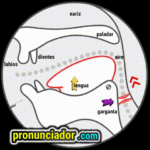
- Velar (Back-of-Tongue Action!): “Velar” tells us where in the mouth the sound is made. Forget your lips or tongue tip for this one! For /k/, you use the BACK part of your tongue. You raise this back part UP until it presses firmly against the soft palate (also called the velum) – that’s the soft, squishy part on the roof of your mouth way at the back. This is the SAME spot where you make the /ɡ/ sound (as in “go”).
- Voiceless (No Throat Tickle! Shhh!): This is CRUCIAL! “Voiceless” means your vocal cords (your voice box in your throat) are WIDE OPEN and NOT VIBRATING. The /k/ sound is made entirely with air. If you put your hand on your throat and try to say “kuh-kuh-kuh” (like you’re coughing very quietly), you should feel NO buzzing or tickling. It’s the “quiet twin” of the buzzy /ɡ/ sound.
- Stop (Air Blocks, then… K-POW!): Like all stops, you first completely BLOCK the airflow (with the back of your tongue against your soft palate). For a tiny moment, air builds up. Then, you quickly pull your tongue down and away, and the trapped air POPS out! “K!”
Super-Simple “Quiet Cough” Summary for /k/:
- Open your mouth just a little, lips relaxed and neutral.
- Raise the BACK of your tongue up high until it touches the soft roof at the back of your mouth, making a seal.
- Keep your voice box totally QUIET (no hum or buzz).
- Then, quickly drop the back of your tongue and let a puff of air POP out! “K!”
It’s like a very small, sharp, quiet cough, but without the throat clearing!
The Ultimate K vs. G Showdown: AIR vs. BUZZ!
The /k/ (“key”) and /ɡ/ (“go”) sounds are made with the exact same back-of-tongue-to-soft-palate action. They are identical twins in where and how they stop the air.
The ONLY Difference is VOICING (the Throat Buzz)!
| Feature | /k/ (Key, Back, Like) | /ɡ/ (Go, Bag, Log) |
| Back of Tongue to Roof? | YES! (Velar Stop) | YES! (Velar Stop) |
| Air Stops & Pops? | YES! | YES! |
| THROAT BUZZING? | OFF! (VOICELESS – Pure Air) | ON! (VOICED – With Buzz!) |
| AIR PUFF (Initial/Stressed)? | STRONG PUFF! [kʰ] | Gentle/Slight Puff [ɡʰ] (if any) |
The BIG Mistake for Learners:
- Accidentally turning ON the voice for /k/, making it sound like /ɡ/ (“key” → “gey”).
- Or, more commonly, turning OFF the voice for /ɡ/ (especially at word ends), making it sound like /k/ (“bag” → “back“).
The Instant Fix: The Throat Touch Test & Air Check! - Throat: Fingers on throat. /k/ = SILENT. /ɡ/ = BUZZ. Practice “ka-ka-ka” (no buzz) then “ga-ga-ga” (BUZZ!).
- Air (Initial/Stressed): The puff of air for /k/ ([kʰ]) is MUCH STRONGER than for /ɡ/ ([ɡʰ]). The [kʰ] puff clearly marks it as voiceless.
The American /k/’s Superpower: The “Puff of Air” (Aspiration!) [kʰ], [k̚], [k]
This is it! ASPIRATION is the magical ingredient that makes the American /k/ (and /p/, /t/) sound so distinct and energetic!
What IS Aspiration, Simply Put?
It’s that extra burst or puff of air that escapes your mouth right after you release voiceless stop sounds like /k/, /p/, or /t/ in certain situations. It’s like a tiny, unvoiced “h” tagging along: [kʰ]. For /k/, this puff is often quite strong and audible!
The 3 Golden Rules for the American /k/ Air Show:
Rule #1: ASPIRATED /k/ [kʰ] – BIG PUFF OF AIR! (Think “Key!” or “Cat!”) 💨💥
Your /k/ gets a STRONG, clear puff of air when it’s:
- A) At the VERY BEGINNING of a word:
- Key /ki/ → [kʰi] (Sounds like “K-HEE”)
- Can /kæn/ → [kʰæn]
- Come /kʌm/ → [kʰʌm]
- Kind /kaɪnd/ → [kʰaɪnd]
- Cold /koʊld/ → [kʰoʊld]
- B) At the BEGINNING of a STRESSED (Strong) Syllable inside a word:
- Across /əˈkrɔs/ → /əˈkʰrɔs/ (stress on ‘cross’)
- Occur /əˈkɜr/ → /əˈkʰɜr/ (stress on ‘cur’)
- Account /əˈkaʊnt/ → /əˈkʰaʊnt/ (stress on ‘count’)
- Because /bɪˈkɔz/ → /bɪˈkʰɔz/ (stress on ‘cause’)
- (For ‘CC’ words like “occur,” only the first ‘C’ makes the /k/ that begins the stressed syllable and thus gets aspirated).
Feel the [kʰ] Puff! Hold a thin piece of paper (or your hand) close to your mouth. Say “Key!” with energy. The paper should JUMP with that puff! No jump? You need more [kʰ]!
Rule #2: UNASPIRATED /k/ [k] or HELD/UNRELEASED /k/ [k̚] – NO BIG PUFF! (Think “Look!”) 🤫
Your /k/ has NO strong puff of air (or a very minimal, often inaudible release) when it’s:
- A) At the VERY END of a word (before a pause, or often before another consonant in the next word): This is the classic “Final Stop Rule.”
- Your back-tongue goes to the /k/ position, STOPS the air, but then you don’t really pop it out with a strong puff.
- Often UNRELEASED [k̚]: The back of your tongue makes contact and just STAYS there for a split second, cutting the sound off sharply. No big “kuh” explosion. This is very typical.
- Look /lʊk/ → /lʊ[k̚]/ (Back-tongue up, sound STOPS. No “kuh” at the end).
- Back /bæk/ → /bæ[k̚]/
- Book /bʊk/ → /bʊ[k̚]/
- Take /teɪk/ → /teɪ[k̚]/
- Like /laɪk/ → /laɪ[k̚]/
- Sometimes, a very soft, unaspirated release [k] occurs if linking smoothly to a following vowel (“Look‿at…”), but still NO STRONG PUFF.
Rule #3: UNASPIRATED /k/ [k] – Clean Release, NO Puff! (Think “Sky!”) 🐍
Your /k/ has NO strong puff, but often a CLEAR (though softer) release when it is:
- IMMEDIATELY AFTER an /s/ sound (in an SK-, SC- consonant cluster): The /s/ magically “absorbs” the puff of the /k/!
- Sky /skaɪ/ → (The /k/ is a clean pop, NOT [skʰaɪ]!)
- Skate /skeɪt/
- Skill /skɪl/
- Scool /skul/ (CH = /k/ here, after S)
- Ask /æsk/
- Task /tæsk/
- Mask /mæsk/
- Excuse (noun)* /ɪkˈskjus/ (XC=/ks/, so k after s = no puff). *The verb is /ɪkˈskjuz/ with /ɡz/!
Quick “K-Air” Reference:
| /k/ Position | AIR PUFF? | IPA-ish | Example |
| BEGINNING of Word | YES! STRONG PUFF! | [kʰ] | Key |
| BEGINNING of STRESSED Syllable | YES! STRONG PUFF! | [kʰ] | Account |
| END of Word (before pause/stop) | NO PUFF! (Often Held) | [k̚] or soft [k] | Look |
| AFTER ‘S’ (SK-, SC-, -SK, etc.) | NO PUFF! (Clean pop) | [k] | Sky, Ask |
Why This is a Game-Changer:
- No [kʰ] Puff Initially/Stressed: Your /k/ sounds flat, weak, easily mistaken for /ɡ/. “Coat” could become “Goat.”
- Puffing [kʰ] Finally or After /s/: Sounds super foreign and like you’re trying too hard (“bac-KUH!”, “s-KUH-ool!”).
Mastering these 3 “air states” for /k/ will instantly elevate your American accent!
Your Mouth’s “K-Pop” Action: Making the /k/ Sound (Kid-Style!)
Let’s get that back-of-the-tongue pop perfect!
Step 1: Mouth Slightly Open, Lips Relaxed & Ready.
Easy start! Your mouth is just slightly open. Your lips are neutral – not spread, not rounded. Just chillin’.
Step 2: Back-of-Tongue LIFTOFF! (The Velar Seal)
This is where the /k/ is truly born!
- Keep the tip of your tongue down, resting behind your bottom front teeth.
- Now, lift the BACK part of your tongue UP and BACK until it presses firmly against your soft palate (that soft, fleshy part on the roof of your mouth, way at the back). This creates a complete seal, stopping the air. Imagine the back of your tongue is giving the roof of your mouth a little high-five!
Step 3: Voice Box = SUPER QUIET! (Voiceless!)
This is non-negotiable for a /k/! Your throat (vocal cords) must be 100% OFF. No buzzing, no humming. Only air!
Step 4: The “Kuh!” POP Release! (Air Power!)
Now, quickly pull the back of your tongue DOWN and away from your soft palate. This breaks the seal, and the trapped air bursts out!
This is where the Aspiration Rules dictate how much air comes out:
- For Aspirated [kʰ] (“Key”): As you drop your tongue, let a STRONG, SHARP PUFF of air explode out with the “k” pop! “K-HUH!” Make the paper fly!
- For Unaspirated/Held Final [k̚]/[k] (“Look”): Drop your tongue slightly for a very soft, quiet release, or simply cut the sound off by keeping the back-tongue briefly sealed. NO big puff.
- For Unaspirated After /s/ [k] (“Sky”): Drop your tongue for a CLEAN, QUIET “k” pop with NO extra puff of air.
Kid-Friendly “Kicking K” Cue: “Imagine the back of your tongue is a little kicker foot. Lift it UP high in the BACK of your mouth and give the roof a gentle kick, ‘kuh!’ Keep your voice turned OFF. If ‘K’ is at the start of a word like ‘Kick!’, make that kick send a little puff of air forward!”
Feel the BACK Stop & Pop! It’s very different from the front-of-mouth /t/ or lip-based /p/. All the action is in the back!
The Crazy K-Spelling Code: C, K, CK, CH, X, CC, QUE?!
Get ready for the spelling party! The /k/ sound is famous for having MANY different letter disguises! But there are patterns!
#1 The SURPRISE King: Letter ‘C’! (~69% – 62%)
Believe it or not, ‘C’ is the MOST COMMON spelling for the /k/ sound!
- ‘C’ BEFORE A, O, U: Cat, come, cut, call, cold, cup.
- ‘C’ BEFORE Consonants L, R: Club, clean, crab, cry, class, cross.
- ‘C’ at the END of a word (often after short vowels or in specific words): Music, logic, public, comic, basic, panic, traffic.
- (REMEMBER: ‘C’ before E, I, Y usually sounds like /s/ – “cent,” “city,” “cycle”! That’s why we need ‘K’ for those contexts!)
#2 The Obvious One: Letter ‘K’! (~16%)
‘K’ reliably makes the /k/ sound.
- ‘K’ BEFORE E, I, Y (when ‘C’ would be /s/): Key, keep, kind, kiss, king, kid, kitten, sky, ask.
- ‘K’ at the END of a word (often after long vowels, diphthongs, or other consonants): Look, book, seek, speak, park, drink, thank, milk, bank, week.
- ‘K’ is also used in many borrowed words: kangaroo, karma, kayak.
#3 The Dynamic Duo: ‘-CK’ (After Short Vowels!) (~7% – 8%)
This is a SUPER RELIABLE pattern! When you see ‘-CK’ at the end of a word or syllable, it ALWAYS makes one /k/ sound, and it usually comes after a short, simple vowel sound.
- Back, lack, rock, pick, duck, lock, neck, sock, sick, check, truck, brick, clock.
#4 The Greek ‘CH’ = /k/! (~3%-6%)
Remember ‘CH’ from the /tʃ/ “church” sound? Well, in words that come from Greek origin, ‘CH’ often makes the /k/ sound! You’ll have to learn these as a special group.
- School /skul/ (SC also /sk/)
- Ache /eɪk/
- Christmas /ˈkrɪsməs/
- Character /ˈkærəktər/
- Technology /tɛkˈnɑlədʒi/
- Mechanic /məˈkænɪk/
- Psychology /saɪˈkɑlədʒi/
- Chemistry /ˈkɛmɪstri/
- Chaos /ˈkeɪɑs/
- Echo /ˈɛkoʊ/
- Stomach /ˈstʌmək/
- Architect /ˈɑrkəˌtɛkt/
- Orchestra /ˈɔrkəstrə/
#5 The Double ‘CC’ – Sometimes /k/, Sometimes /ks/! (~1% – other small %s in chart for ‘hiccup, occur’)
This one can be tricky!
- ‘CC’ BEFORE A, O, U, or a Consonant (other than H) → usually ONE /k/ sound:
- Occur /əˈkɜr/
- Account /əˈkaʊnt/
- According /əˈkɔrdɪŋ/
- Accuse /əˈkjuz/
- Hiccup* /ˈhɪkʌp/ (Often treated as single /k/)
- ‘CC’ BEFORE E or I → usually the /ks/ sound! (Because the second ‘C’ becomes soft /s/):
- Accent /ˈæksɛnt/
- Success /səkˈsɛs/
- Accept /ækˈsɛpt/
- Accident /ˈæksədənt/
#6 The Fancy French ‘-QUE’ = /k/! (~1% – “unique, technique” in charts)
Usually at the end of words borrowed from French. The ‘-QUE’ just sounds like /k/.
- Unique /juˈnik/
- Technique /tɛkˈnik/
- Mosque /mɑsk/
- Antique /ænˈtik/
- Boutique /buˈtik/
- Cheque (UK) /tʃɛk/ (AmE usually “check”)
- Opaque /oʊˈpeɪk/
#7 The Tricky ‘X’ often has /k/ (as /ks/)! (“Etc: next, six” in web chart)
The letter ‘X’ is most often pronounced as a /ks/ cluster – which includes our /k/ sound!
- Box /bɑks/
- Fox /fɑks/
- Six /sɪks/
- Next /nɛkst/
- Text /tɛkst/
- Extra /ˈɛkstrə/
- Flexible /ˈflɛksəbəl/
- (But remember ‘X’ can also be /ɡz/ as in “exam”!)
“K” Spelling Kick-Starters – Key Patterns:
| Spelling(s) | Frequency | Common Context | Key /k/ Examples | Watch Out For… |
| C | ~62% (#1) | Before A,O,U,L,R; End of word | Cat, club, music | C before E,I,Y = /s/ (cent)! |
| K | ~16% | Before E,I,Y; End of word | Key, ask, book | (Usually very reliable for /k/) |
| CK | ~8% | AFTER Short Vowel (often end) | Back, rock, pick | (ALWAYS /k/, never /s/k/) |
| CH | ~6% | GREEK Origin words! | School, ache, Christmas | CH usually /tʃ/ (church)! |
| CC (+ A,O,U…) | Low % | Before A,O,U, Consonant | Occur, account | CC + E,I = /ks/ (accent)! |
| QUE (final) | Low % | FRENCH Origin words | Unique, technique, mosque | |
| X (as /ks/) | Low % | Common clusters | Box, next, text | X can be /gz/ (exam)! |
The Big Secret: “C” is king, but know its rules! “K” helps where “C” would be soft. “CK” is a trusty friend after short vowels. CH/CC/QUE/X are special agents!
Don’t Forget the SILENT ‘K’! (KN- at the Start!)
Just like ‘P’ can be silent, ‘K’ has one major disappearing act:
- ‘KN-‘ at the BEGINNING of a word: The ‘K’ is ALWAYS SILENT! You just pronounce the /n/.
- Know /noʊ/ (Sounds like “no”)
- Knife /naɪf/
- Knee /ni/
- Knight /naɪt/ (Sounds like “night”)
- Knock /nɑk/
- Knot /nɑt/
- Knowledge /ˈnɑlədʒ/
Always ignore the K in KN- words!

Whoops! Common “K” Catastrophes & Quick Fixes!
What are the usual K-sound stumbles for learners?
- MISTAKE #1: THE “FLAT K” – MISSING THE [kʰ] AIR PUFF! (The Most Common!)
- The Problem: Your “Key” or “Cat” lacks that American explosive start. It sounds weak, too much like /ɡ/, or just not “crisp.”
- THE #1 FIX: POWER PUFF! Get that paper fluttering! Consciously release that strong burst of air [kʰ] when /k/ is at the beginning of a word OR a stressed syllable. “K-HUH-ey!”
- MISTAKE #2: WRONG AIR PUFF! (Aspirating Final /k/ or /k/ After ‘S’)
- The Glitch: You’re puffing air where Americans don’t. “LooK-HUH!” or “S-K-HUH-y!” Sounds unnatural.
- THE FIX: FOLLOW THE 3 ASPIRATION RULES!
- End of word = NO PUFF (often Unreleased/Held [k̚]). Clean stop.
- After ‘S’ (SK/SC-) = NO PUFF (clean, quiet [k] pop after the /s/ hiss).
- MISTAKE #3: “G” FOR “K”! (Accidentally Voicing it)
- The Trouble: Your throat buzzes, turning /k/ into /ɡ/. “Back” becomes “Bag.” “Coat” becomes “Goat.” Often happens if aspiration is also weak.
- Solution: THROAT CHECK! For /k/, ZERO vibration. It’s all air. Practice whispering “K” loudly. Then drill K/G minimal pairs (“Kate/gate,” “class/glass”).
- MISTAKE #4: SPELLING OVERLOAD! (C? K? CK? CH? X? CC? QUE? AAAH!)
- The Headache: Just not knowing which letters make the /k/ sound, especially the tricky ‘C’ or ‘CH’.
- Solution: LEARN THE PATTERNS! (From the spelling section above).
- C + A/O/U = /k/. K + E/I/Y = /k/. Short Vowel + CK = /k/.
- Memorize key CH=/k/ words (school, ache).
- Learn specific QUE=/k/ (unique) and X=/ks/ (box) words.
- When in doubt, a dictionary with IPA is your best friend!
- MISTAKE #5: Pronouncing the Silent ‘K’ in KN- Words!
- The Faux Pas: Saying “KUH-now” for “know.”
- Easy Fix: K is a GHOST in KN-! Just say the /n/ sound. “Knife” = “Nife.”
“Kickstart Your K!” Practice Drills for the American /k/ Sound!
Time to make that back-of-the-tongue POP perfectly!
Exercise 1: The “Air Cannon” vs. “Quiet Click” – Aspirated [kʰ] vs. Unreleased [k̚]
Feel that puff, then feel it stop! (Use the paper test!)
- Aspirated [kʰ] (Initial/Stressed):
- Key! Can! Come! Kick! Cold! Car! Chaos!
- Account! Because! Occur! Across!
- Unreleased/Held [k̚] (Final – No Puff!):
- Look. Back. Book. Take. Like. Rock. Duck. Music. Speak. Unique.
Practice ending these words with a SHARP cut-off by the back of your tongue, very little air escaping.
- Look. Back. Book. Take. Like. Rock. Duck. Music. Speak. Unique.
Exercise 2: The “Smooth SK/SC” – Unaspirated [k] after /s/
Flow from the /s/ hiss into a CLEAN, non-puffy /k/ pop.
- Sky, skate, skill, scool, scarf, scoop, ask, task, mask, desk.
- Excuse (noun) /ɪkˈskjus/, exclaim /ɪkˈskleɪm/ (X = /ks/).
Exercise 3: The K vs. G Rumble! (Voiceless AIR vs. Voiced BUZZ)
This is essential! Hand on throat: NO BUZZ for /k/, definite BUZZ for /ɡ/.
- Coat [kʰoʊt] — Goat [ɡʰoʊt]
- Class [kʰlæs] — Glass [ɡʰlæs]
- Back [bæk̚] — Bag [bæɡ]
- Pick [pʰɪk] — Pig [pʰɪɡ] (If “pick” is initial in a phrase and stressed, it’s aspirated! Otherwise, ‘ck’ final means unreleased). For the sake of this exercise, we will assume a final position of pick to match bag ending for an unreleased [k̚] to make it comparable. Pick [pɪk̚].
- Lock [lɑk̚] — Log [lɔɡ]
- Ankle [ˈæŋkəl] (/k/ is part of KL cluster) — Angle [ˈæŋɡəl] (/g/ is part of GL cluster)
Record yourself – can you clearly differentiate them?
Exercise 4: The K-Spelling Maze Runner!
Practice words with all the different /k/ spellings. Focus on making the SAME crisp /k/ sound (with correct aspiration!).
- C: Cat, call, cold, club, class, cross, panic, public.
- K: Key, keep, kind, look, ask, milk, week, park, think.
- CK: Back, rock, pick, neck, duck, black, sick, clock, luck.
- CH (Greek): School, ache, character, chemistry, stomach, architect, echo, chaos.
- CC (+AOU…): Occur, account, acclaim, hiccup. (vs. /ks/: Accept, success).
- QUE (Final): Unique, technique, mosque, antique, opaque.
- X (as /ks/): Box, fox, six, next, text, extra, complex.
Exercise 5: Silent K Stealth Drill! (KN- = /n/!)
Say these words correctly, making the K a total ghost!
- Know (no), knife (nife), knee (nee), knight (night), knock (nock), knot (not), knowledge (NOL-edge).
Exercise 6: Top 30 K-Word Challenge!
| PHONETICAL PRONUNCIATION |
| PHONETICAL PRONUNCIATION |
- How is /k/ spelled (C, K, CK, CH, X etc.)?
- Does the /k/ need Aspiration [kʰ] (Initial/Stressed)?
- Is it Unaspirated/Held [k̚]/[k] (Final)?
- Is it Unaspirated [k] after /s/ (SK, SC, X=/ks/)?
Example analysis of source list words for aspiration:
- aspirated [kʰ]: can, come, could, keep, kid, kind, course, came, care.
- unaspirated/held [k̚]/[k] (final): like, think, look, take, okay (k is final in first syllable), back, make, thank, talk, work, ask, pick, took, drink.
- unaspirated [k] after /s/: speak (has /k/ after /s/ if we break ‘speak’ as /spik/, C sound in sC combos behaves like K) -> speak is a direct /k/ at end, it should be [spik̚]. Actually “next” /nɛkst/ and “close” (if referring to ‘kl’ as starting /k/ then not SK), or “actually” /ækʃuəli/->/æktʃuəli/ or “ask” /æsk/. Best is to use actual SK/SC examples for this specific unaspirated group rather than force-fit the general list.
It is best to generate unique lists for each type of K:
- Aspirated [kʰ]: Key, cat, call, kite, across, occur, complain, because, kind, keep, care.
- Unaspirated/Held Final [k̚]/[k]: Look, lack, lake, back, bake, black, luck, music, park, rock, sack, smoke, snake, stomach, strike, mistake.
- Unaspirated [k] after /s/: Skate, skill, scrabble, scale, scar, school, scream, screen, squad, squat, squeeze, prescribe, transcript, corkscrew, describe, discuss, escape, excuse. (For X=/ks/: box, six, next).
Exercise 7: “The Cool Cat Keeps Kicking Cans!” – /k/ Sentences! + RECORD!
Time for the real test! Record yourself. Are your [kʰ]s puffing? Your [k̚]s held? Your [k]s after /s/ clean?
- “Can [kʰ] you come [kʰ] to the class [kʰ] to check [k̚] the clock [k̚]?” (Initial [kʰ] vs Final CK [k̚]).
- “Ask [k] the skeptical [k] architect [kʰ] about the technique [k̚].” (SK [k] vs CH [k] vs QUE [k]).
- “The unique [k̚] black [k̚] kitten [kʰ] likes [k̚] milk [k̚].”
- “He knows (silent K!) a lot about Korean (aspirated K!) psychology (silent P, CH=/k/).”
- “I accept (CC=/ks/ -> /k/ here after /s/-like part!) the excellent (X=/ks/) excuse (X=/ks/) for the caos [kʰ].”
FAQs: Your American /k/ (“Key,” “Cat”) Questions Cracked!
Q1: What’s THE absolute #1 secret for making the American K /k/ sound correct?
ASPIRATION (the puff of air)! Understanding when to make a STRONG PUFF [kʰ] (at the start of words like “Key” or stressed syllables like “aCCount”) and when to make NO PUFF (at the end of words like “looK” [k̚], or after ‘S’ like in “SKy” [k]) is what makes it sound American.
Q2: How can I really feel that [kʰ] “puff of air” for words like “key” or “cat”?
The Paper Test! Hold a very thin piece of paper (or even just your hand) a few inches in front of your mouth.
- When you say an aspirated [kʰ] word like “Key!” or “Cat!”, the paper should JUMP or you should feel a definite burst of air on your hand.
- For an unaspirated final [k̚] (“looK“) or after /s/ (“SKy”), the paper should barely move or not at all.
Q3: My “K” often sounds like “G”! (“Back” sounds like “Bag”). Why, and how do I fix it?
This usually means you’re accidentally turning your voice ON (vibrating your vocal cords) when you make the /k/. Or, you’re not aspirating initial/stressed /k/ enough, which makes it sound less distinct from /ɡ/.
- THE FIX: VOICE BOX OFF + AIR POWER! Put your fingers on your throat. For /k/, it MUST be still (NO buzz). For /ɡ/, it BUZZES. Practice “ka-ka-ka” (no buzz) vs. “ga-ga-ga” (buzz). Then, for initial/stressed /k/, make sure you release that STRONG [kʰ] puff of air.
Q4: “C” “K” “CK” “CH” “CC” “QUE” “X” – SO MANY SPELLINGS for /k/! Any simple rules?
It’s a jungle, but here are your main survival tools:
- C: Usually /k/ before A, O, U, L, R (“cat,” “club”). (BUT C + E,I,Y = /s/ “cent”!).
- K: Usually /k/ before E, I, Y (“key,” “kind”) or at word ends (“look,” “ask”).
- CK: ALWAYS /k/ after a short vowel (“back,” “rock”). Very reliable!
- CH: Sometimes /k/ in GREEK words (“school,” “ache,” “character”). Usually /tʃ/ (“church”).
- QUE (End): Often /k/ in FRENCH words (“unique,” “technique”).
- X: Often /ks/, so it HAS a /k/ sound in it (“box,” “next”).
Strategy: Learn ‘C’ rules well. ‘K’ and ‘CK’ are good friends. CH/QUE/X are special groups to memorize!
Q5: What’s the deal with SILENT ‘K’ in words like “know” or “knife”?
It’s a leftover from Old English! Hundreds of years ago, that ‘K’ in “KN-” words was pronounced (like “kuh-NOW”). But over time, the ‘k’ sound dropped off in pronunciation, but the spelling stuck around. So today, for ALL words starting with KN-, the K is completely SILENT. Just say the /n/ sound! (“know” = /noʊ/, “knife” = /naɪf/).
Wrapping It Up: Your “KICKIN'” American /k/ is Unlocked!
Congratulations! You’ve journeyed through the surprisingly complex world of the American /k/ sound! You now know it’s not just one simple “kuh,” but a dynamic consonant with critical aspiration rules ([kʰ], [k̚], [k]) and a mind-boggling array of spellings.
Remember these “K”-ool Keys to Success:
- /k/ = BACK-OF-TONGUE POP + NO VOICE! (Voiceless Velar Stop).
- ASPIRATION IS KING!
- STRONG PUFF [kʰ]: Start of words & stressed syllables (Key, aCcount).
- NO PUFF (Held/Clean) [k̚]/[k]: End of words (looK) & after ‘S’ (SKy).
- K vs G = VOICE OFF vs VOICE ON! Zero buzz for /k/!
- SPELLING = C, K, CK rule! CH, CC, QUE, X are special! Master the patterns.
- SILENT K = KN- words are just /n/-words! (Know, Knife).
- #1 ERROR = WRONG AIR PUFF! (No [kʰ] puff when needed OR puffing when you shouldn’t).
The “paper test” is your most valuable tool for practicing [kʰ]! Drill those 3 Aspiration Rules. Pound those K vs G minimal pairs. Become a spelling pattern detective. Record yourself constantly. Very soon, your “keys,” “cats,” “backs,” and “schools” will sound absolutely kickin’ and authentically American! Keep up the great work!
👇🔥👇🔥👇🔥👇🔥👇🔥👇🔥
👉 RETURNS in the YEAR 2031 ! WHO? CLICK HERE ! 🔥



👇🔥👇🔥👇🔥👇🔥👇🔥👇🔥
👉 RETURNS in the YEAR 2031 ! WHO? CLICK HERE ! 🔥
👇🔥👇🔥👇🔥👇🔥👇🔥👇🔥
👉 RETURNS in the YEAR 2031 ! WHO? CLICK HERE ! 🔥
👉 RETURNS in the YEAR 2031 ! WHO? CLICK HERE ! 🔥
👉 RETURNS in the YEAR 2031 ! WHO? CLICK HERE ! 🔥