

Does your “make” sound like “meck”? You’re likely missing the secret glide of the Long A /eɪ/ sound. Learn the simple mouth moves & spelling patterns to fix it!
Hey there, future American English pronunciation stars! Today, we’re diving into a sound that’s absolutely EVERYWHERE in English – it’s even the name of a letter! We’re talking about the Long A sound, as in “make“, “take“, “day**”, “say**”, or “wait“! Its secret IPA code is /eɪ/ (looks like an ‘e’ chilling with an ‘ɪ’ – and that’s a BIG clue!).
Now, you might think, “The letter A? I know how to say A!” But hold your horses! This American Long A is a bit of a shapeshifter! The BIGGEST mistake learners make is pronouncing it as a single, flat “eh” sound, similar to the ‘e’ in “met” /mɛt/ or maybe like how we might just say the letter “A” in some other languages. If your “late” /leɪt/ sounds a lot like “let” /lɛt/, or if your “rain” /reɪn/ is missing a little “finish,” then this guide is for you! And oh, the SPELLING! How can A_E (make), AI (rain), AY (day), EI (eight), EA (great), and EY (they) ALL represent this exact same /eɪ/ sound?! It’s wild! You might feel lost in a spelling maze, unsure how to make your “A” words sound genuinely American!
But guess what? The American Long A /eɪ/ is actually a DIPHTHONG – a fancy word for a gliding vowel sound, or simply, a sound that MOVES! It starts with one vowel sound and smoothly slides into another, all in one syllable! For /eɪ/, it’s like starting with an “EH” sound (like in “met”, but a bit higher and tenser) and gliding quickly into an “IH” sound (like in “kid”). EH → IH = /eɪ/!
This ultimate, super-easy guide will unlock the Long A /eɪ/ mystery for you, step-by-step:
- Meet the “Sliding A” /eɪ/: What IS this “Eeeh-to-Iiih” diphthong really? (Hint: It’s a two-part journey!).
- Mouth & Tongue Adventure: SIMPLE instructions for the E → I glide: tongue front, jaw closing, lips spreading slightly & tensing!
- The “Tension” Secret: Why this sound needs a little muscle to shine.
- Vowel Battle Royale! No more confusing /eɪ/ (lake) with Short E /ɛ/ (let) or Short A /æ/ (lack)!
- Crazy Spelling CONQUERED! A_E, AI, AY, EI, EA, EY – We’ve got the main patterns and lots of examples!
- Zap Common Mistakes! Stop saying a flat “Eh”! Get that “ih” glide in there!
- “A” Team Practice! Fun exercises with everyday words (‘make’, ‘day’, ‘say’, ‘great’, ‘they’) to perfect your /eɪ/!
Get ready for your “name,” “game,” “rain,” “play,” and “break” to sound absolutely amazing and unmistakably American! Let’s say /seɪ/ hello to the Long A! 😉
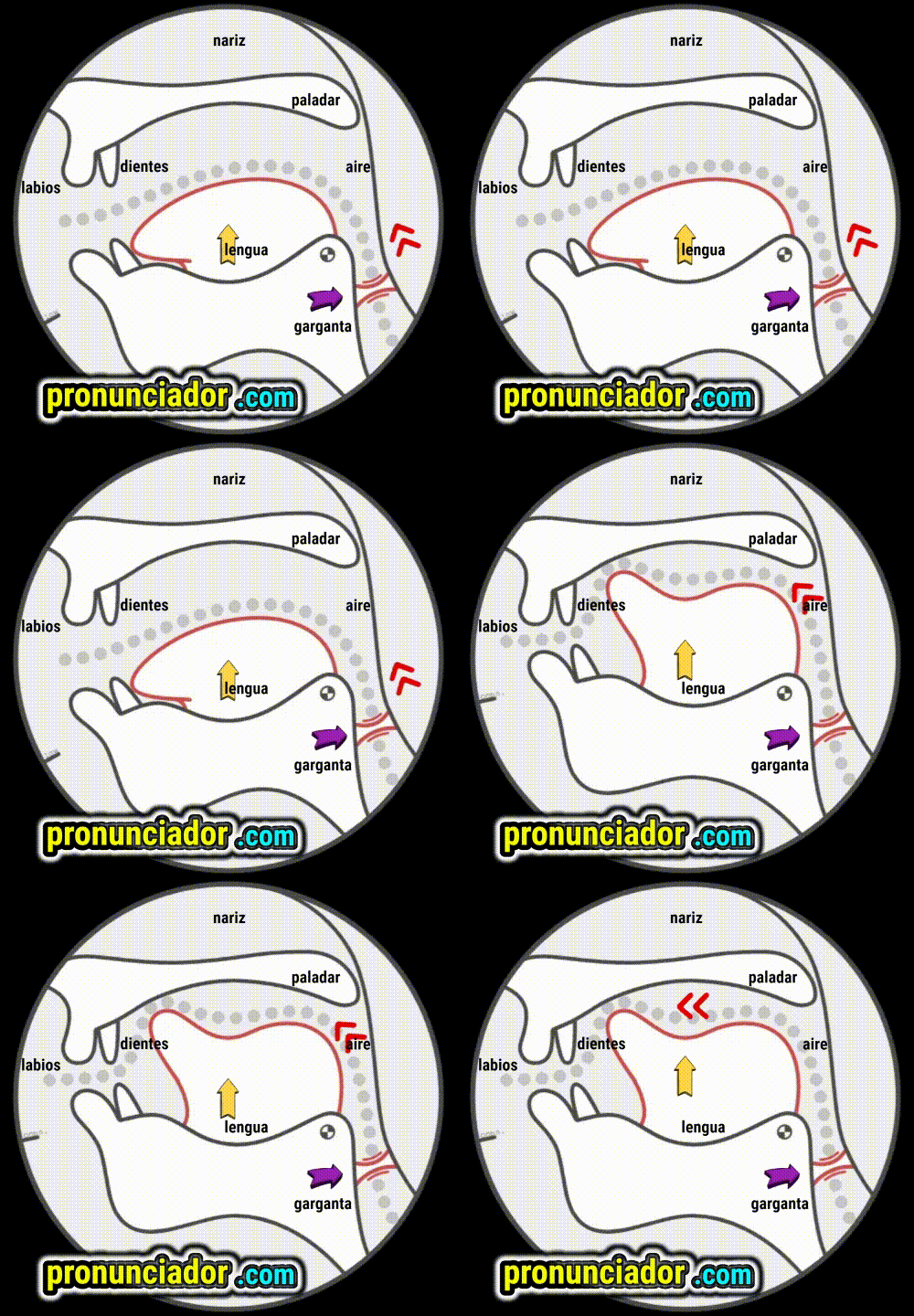
What’s This “Long A” /eɪ/ Sound Really? (The “Eeeh-to-Iiih” Glide!)
Let’s properly introduce the Long A /eɪ/ sound. You hear it in the name of the letter “A” itself when you say the alphabet! And in tons of super common words:
- make /meɪk/
- take /teɪk/
- say /seɪ/
- day /deɪ/
- wait /weɪt/
- rain /reɪn/
- great /ɡreɪt/
- eight /eɪt/
- they /ðeɪ/
- name /neɪm/
- place /pleɪs/
As mentioned, the key to understanding /eɪ/ is knowing it’s a DIPHTHONG. Remember, that just means it’s a vowel sound that GLIDES or changes from one position to another within a single syllable. It’s not just one fixed sound.
The /eɪ/ Journey: Start with /e/, Glide to /ɪ/
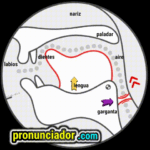
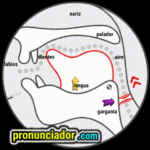
- Starting Sound /e/: It begins with a vowel sound very similar to the /e/ sound found in many languages (like a clear, tense “eh”). Your tongue is in the front of your mouth and at a mid to high-mid height. Your lips are somewhat spread (like a slight, tense smile).
- Ending Sound /ɪ/: From that starting /e/ position, your tongue and jaw then move slightly upward and closer together to a position similar to the Short I /ɪ/ sound (the “ih” in “kid” or “sit”).
So, /eɪ/ = Start at /e/ (mid-high front, tense, lips spread) → GLIDE QUICKLY UP to → /ɪ/ (high front, lips still spread, jaw higher).
It’s a smooth, quick “Eeeeehhhhh-ih” all in one motion.
Key Distinctions: /eɪ/ vs. Flat “E” and Other Sounds
- /eɪ/ (Make) vs. Monophthongal “E”:
- The Mistake: Pronouncing /eɪ/ as just the starting /e/ sound without the glide up to /ɪ/. This makes it sound flat and often shorter, more like the Short E /ɛ/ (bed). “Make” /meɪk/ sounds like “Mek” /mɛk/.
- The Fix: You MUST have that upward glide towards /ɪ/. Feel your jaw close slightly and your tongue rise for the “ih” ending.
- /eɪ/ (Lake) vs. Short E /ɛ/ (Let) – Tension & Glide vs. Relaxed & Static:
- /eɪ/ (Lake): TENSE start (/e/), glides up to /ɪ/. Jaw starts mid, closes slightly. Lips spread and tense.
- /ɛ/ (Let): RELAXED, single sound. Jaw is MORE OPEN (low-mid). Lips slightly spread but relaxed.
- Huge Difference: “Wait” /weɪt/ vs. “Wet” /wɛt/. “Pain” /peɪn/ vs. “Pen” /pɛn/.
- /eɪ/ (Main) vs. Short A /æ/ (Man) – Completely Different Worlds!
- /eɪ/ (Main): Tongue MID-HIGH FRONT, jaw mid-closing, lips spread, GLIDES to /ɪ/.
- /æ/ (Man): Tongue LOW FRONT, jaw WIDE OPEN, lips spread. Single sound.
- Night and Day: “Late” /leɪt/ vs. “Lack” (if mispronounced) /læk/. “Sale” /seɪl/ vs. “Sal” (short for Salvatore) /sæl/.
Understanding that /eɪ/ is a MOVEMENT (E→I) and that it starts TENSE and relatively HIGH is critical!
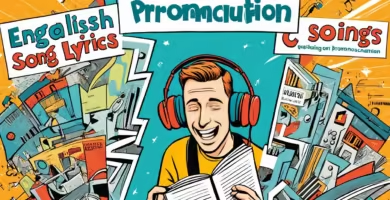
Your Mouth’s “Long A” Adventure: Making the /eɪ/ Glide! (Kid-Friendly!)
Ready to teach your mouth the Long A /eɪ/ dance? It’s just two easy steps blended smoothly!
Step 1: Starting Position – The “Tense EH” (/e/)
- Mouth – Just a Bit Open: Let your mouth open partially, not too wide, not too closed.
- Lips – Slight, TENSE Smile!: Stretch the corners of your lips slightly to the sides, like you’re beginning a smile. And importantly, make those lips TENSE. Not a floppy smile, but an active one!
- Tongue – FORWARD & MID-HIGH & TENSE!:
- TENSE your tongue! Make it strong.
- Push the front part of your tongue FORWARD in your mouth.
- Keep it just above the middle line (midline) of your mouth height – not super high like for /i/ (see), but not low either.
- The tip can gently touch behind your bottom front teeth.
Step 2: The Quick Glide UP – Towards “IH” (/ɪ/)
This happens fast and smoothly FROM the /e/ position!
- Mouth/Jaw CLOSES a Little: From the partial opening, your jaw moves up a little, so your mouth closes slightly more.
- Lips (Slight Shift/Relax?): The video/web description says “then relax them [lips]” after the tense start. However, for the /ɪ/ end-point, lips are usually still somewhat spread (though perhaps less tense than the initial /e/). EASY WAY: Focus on the jaw/tongue closing movement, and let your lips follow naturally from the initial spread; don’t over-relax or round them.
- Tongue RAISES a Little Higher: As your jaw closes, the front of your tongue that was mid-high for /e/ now goes a little HIGHER for the /ɪ/ end of the glide. It’s moving towards the Long E /i/ position but doesn’t quite get there and isn’t as tense.
Step 3: Blend it! E→I = /eɪ/! The Diphthong Action!
The magic is the smooth, quick, uninterrupted slide from /e/ to /ɪ/.
- Start making the tense /e/ sound (lips spread, tongue mid-high front and tense).
- While your voice is ON, smoothly and quickly raise your jaw and the front of your tongue a bit more, letting the sound change towards /ɪ/.
- It should be one continuous sound: “Eeeeehhhhh-ih!” –> /eɪ/.
- Crucial Note from Video/Web: The first part (/e/) is pronounced louder and longer than the second part (/ɪ/). The “ih” at the end is quick and light, but it MUST be there!
Feeling Check: Start with a tense “eh” smile, then feel your jaw close slightly and tongue rise slightly towards an “ih”, all in one fluid motion. It should feel like you’re aiming for an “ih” but starting from a strong “eh”.
The Long A /eɪ/ Spelling Puzzle: A_E, AI, AY, EA, EI, EY?!
Hold on tight! The Long A /eɪ/ sound is spelled in a TON of different ways! It’s probably one of the most varied vowel spellings. BUT, there are very common patterns!
The #1 Champion: ‘A’ (Usually as A + Consonant + E) (~73%!)
This is the MOST COMMON way to spell /eɪ/! This includes the “Magic E” or “Silent E” pattern: A + Consonant + E (at the end, where E is silent).
- make, take, name, late, same, game, face, case, date, place, state, shape, came, blame, grade.
- Also words where ‘A’ is in an open syllable (ends the syllable): able /ˈeɪbəl/, baby /ˈbeɪbi/, lady /ˈleɪdi/, April /ˈeɪprəl/, apron /ˈeɪprən/, basic /ˈbeɪsɪk/.
The Dynamic Duo: ‘AI’ (~14%)
Very common, usually found in the middle of a word (or sometimes the beginning).
- wait, rain, pain, mail, train, brain, aim, aid, afraid, explain, sail, fail, again* /əˈɡeɪn/ or /əˈɡɛn/, saint /seɪnt/.
The Reliable Finisher: ‘AY’ (~8%)
Almost always appears at the END of a word or syllable!
- day, say, way, play, stay, may, pay, today, away, okay, gray/grey.
The Sophisticated Pair: ‘EI’ & ‘EIGH’ (~small %, ‘EI’ shown as 4% in video ‘eight’)
Less common overall, but appear in very familiar words!
- EI: eight /eɪt/, weight /weɪt/, neighbor (AmE) /ˈneɪbər/, vein /veɪn/, veil /veɪl/, rein /reɪn/ (bridle).
- EIGH: All the above (eight, weight, neighbor) PLUS sleigh /sleɪ/, freight /freɪt/. (GH is silent!)
- (Careful! ‘EI’ can also be /i/ (‘receive’) or /aɪ/ (‘height’)!)
The Surprise Guest: ‘EA’ (~small %, shown as 3% ‘break’ in video)
‘EA’ is usually Long E /i/ (eat) or Short E /ɛ/ (head). BUT, in a few important words, it’s Long A /eɪ/!
- great /ɡreɪt/!
- break /breɪk/!
- steak /steɪk/!
- (Yeah* /jeɪ/ – very informal)
The Very Rare Crew: ‘EY’, ‘ET’, ‘AU’, ‘AO’, ‘E+acute’ (all in ‘etc.’ category ~1-2%)
These are rare but exist!
- EY: they /ðeɪ/, obey /oʊˈbeɪ/, grey/gray (AY version more common for color), survey /sərˈveɪ/.
- ET (French loanwords, final): ballet /bæˈleɪ/, cachet /kæˈʃeɪ/, buffet /bəˈfeɪ/ (food) or /ˈbʌfɪt/ (hit).
- AU: gauge /ɡeɪdʒ/. (Very rare for /eɪ/).
- AO: jaol* /dʒeɪl/ (British spelling of ‘jail’).
- É (with acute accent, French loanwords): café /kæˈfeɪ/, resumé /ˌrɛzʊˈmeɪ/, fiancé /ˌfiɑnˈseɪ/.
Long A /eɪ/ Spelling Cheat Sheet (Key Patterns):
| Spelling Pattern | Main Clue / Position | KEY Examples for /eɪ/ | Danger! Can Also Be… |
| A_E (Magic E) | ‘A’ + Consonant + Silent ‘e’ | make, name, take, place | /æ/ if no silent e (mat) |
| AI | Usually Middle/Start | rain, wait, pain**, explain** | /ɛ/ (said – rare) |
| AY | Usually at the END | day, say, play, stay | |
| EI / EIGH | ‘Eight’ words, ‘neighbor’ | eight, weight**, neighbor**, rein | /i/ (receive), /aɪ/ (height) |
| EA | MEMORIZE: Great, Break, Steak | great, break, steak | /i/ (eat)!!, /ɛ/ (head)!! |
| EY | ‘They’, ‘obey’ | they, grey, obey | /i/ (key), /ɪ/ (money) |
| ET/É (French) | Final position | ballet, café, resumé |
Bottom Line for /eɪ/ Spelling: A_E is your biggest clue! AI and AY are strong contenders. For the rest (EA, EI, EY, ET, etc.), it’s usually specific words or smaller patterns you need to learn. When in doubt, listen to a native or check an IPA dictionary for /eɪ/!

Oops! Common Long A /eɪ/ Blunders & How to Fix ‘Em!
Where do non-native speakers typically stumble with this E→I glide?
- Mistake #1: THE BIG ONE! NO GLIDE! (Saying a Flat “EH” /e/ or /ɛ/)
- What’s Happening: You’re only making the first part of the diphthong, the /e/-like sound, and completely missing the upward glide to /ɪ/. “Make” sounds like “Mek”. “Say” sounds like “Seh”.
- The Fix: THINK “Eee-to-Iiih”! You MUST make that slight upward movement with your jaw and tongue at the end to add the /ɪ/ sound. Exaggerate it at first: “Maaaayyy-ke”, “Saaaayyyy”. Feel your jaw close a little and your tongue rise for the “eeh” at the very end.
- Mistake #2: MOUTH TOO OPEN (Drifting to /æ/ ‘cat’)
- What’s Happening: Your jaw is dropped too low, making the starting sound too open, more like /æ/. “Lake” sounds like “Lack”.
- The Fix: Start with your jaw only partially open (mid-high tongue). The /eɪ/ sound is much higher and fronter than /æ/.
- Mistake #3: LIPS NOT SPREAD or NOT TENSE ENOUGH at Start.
- What’s Happening: If your lips are too relaxed or neutral, the initial /e/ part loses its brightness and tension, making the whole diphthong sound muddy.
- The Fix: Slight, TENSE smile for the /e/ part! Feel the corners of your mouth pull a bit and engage those muscles.
- Mistake #4: TONGUE NOT FAR ENOUGH FORWARD or NOT TENSE ENOUGH.
- What’s Happening: If your tongue is too far back or too relaxed, it won’t have that clear, front /e/ starting point, and the glide won’t be distinct.
- The Fix: Push the front of your TENSE tongue forward and keep it mid-high for the start of the /eɪ/.
- Mistake #5: CONFUSING SPELLING PATTERNS (Especially ‘A’ and ‘EA’)
- What’s Happening: Seeing ‘A’ and thinking /æ/ (cat) or /ɑ/ (car). Seeing ‘EA’ and thinking only /i/ (eat) or /ɛ/ (head).
- The Fix: MEMORIZE! A_E, AI, AY are strong /eɪ/ clues. Learn the EA=/eɪ/ words (great, break, steak) as special friends! Don’t let letters trick your ears!
Long A /eɪ/ Glide Practice! “Make” it Perfect!
Let’s train that E→I slide!
Exercise 1: Isolate the Glide – Slow Motion “Eee-to-Iih”
- Start with your mouth in the “tense EH” /e/ position: Jaw mid, lips slight tense smile, tongue front/mid-high/tense. Make a sustained “Ehhhhhhh”.
- Now, WHILE STILL MAKING SOUND, slowly raise your jaw a bit and let your tongue rise a bit higher to the “relaxed IH” /ɪ/ position. “Eeeeeehhhhh-ih.”
- Speed it up: /e/-/ɪ/ … /e/-/ɪ/ … /eɪ/! /eɪ/! /eɪ/!
- It’s the sound of saying the letter “A” in English!
Exercise 2: NO GLIDE vs. WITH GLIDE! (Flat E vs. /eɪ/)
- Record yourself:
- Say “Mek” (like a flat Spanish ‘e’). THEN say “Make” /meɪk/ (with the E→I glide).
- Say “Let” (flat /ɛ/). THEN say “Late” /leɪt/ (with glide).
- Say “Pen” (flat /ɛ/). THEN say “Pain” /peɪn/ (with glide).
- Can you HEAR and FEEL the difference? The /eɪ/ is longer and has that upward mouth movement.
Exercise 3: Key Contrasts: /eɪ/ (Wait) vs /ɛ/ (Wet) vs /æ/ (Wat* not ideal pair -> Wax)
Focus on JAW OPENING and the GLIDE!
- Wait /weɪt/ (Mid-Jaw closing, GLIDE E→I)
- Wet /wɛt/ (Mid-Jaw open, STATIC, more relaxed)
- Wax /wæks/ (WIDE Jaw open, STATIC, tongue low front)
- Lake /leɪk/ — Let /lɛt/ — Lack /læk/
- Sale /seɪl/ — Sell /sɛl/ — Sal* /sæl/ (nickname)
- Tape /teɪp/ — Test /tɛst/ — Tap /tæp/
Exercise 4: Conquer the Crazy Spellings of /eɪ/!
Practice each spelling group, focusing on the SAME /eɪ/ (E→I) glide sound!
- A_E: make, take, name, late, game, face, date, same, blame, brave, shape, age.
- AI: wait, rain, pain, mail, train, brain, aim, paid, main, claim, paint.
- AY: day, say, way, play, stay, may, pay, today, away, gray, clay.
- EI/EIGH: eight, weight, neighbor, vein, freight, sleigh, veil, rein.
- EA: great, break, steak, yea (old yes).
- EY/ET/É: they, grey, obey, survey, ballet, café, résumé.
Exercise 5: Top 30 Word Workout
| PHONETICAL PRONUNCIATION |
| PHONETICAL PRONUNCIATION |
FAQs: Your American Long A /eɪ/ (Make) Questions Answered!
Q1: Is the Long A /eɪ/ sound (“make”) just like saying the English letter “A”?
YES! Exactly! When you say the name of the letter “A” in the alphabet song, you’re making the perfect /eɪ/ diphthong sound! So, think “A for Apple, the SOUND of A is /eɪ/.”
Q2: My “A” words still sound flat (“mek” for “make”). What’s the #1 fix?
You’re likely missing the second half of the diphthong – the glide up to the /ɪ/ (“ih”) sound!
Remember, /eɪ/ is a JOURNEY from /e/ → /ɪ/. Make sure your jaw closes a bit and your tongue rises a bit higher and more forward AT THE END of the sound. It’s a quick “ih” tagged onto your “eh”. Exaggerate “Maaaayyy-kuh” with a tiny “ih” at the end when you practice.
Q3: Why does English use SO MANY different spellings for the SAME Long A /eɪ/ sound?!
It’s a long story involving history, language borrowing, and how sounds changed over centuries! The main ones to master are:
- A_E (make, late)
- AI (rain, wait)
- AY (day, say)
- And key exceptions: EA (great, break), EI/EIGH (eight, weight), EY (they).
It’s less about “why” and more about “which ones” – learn the common patterns!
Q4: Is the Long A /eɪ/ very different from the Short E /ɛ/ (“bed”)?
YES, very different!
- Long A /eɪ/ (make): Is a DIPHTHONG (E→I glide). Starts TENSE. Jaw starts mid and CLOSES slightly. Tongue starts mid-high front and RISES.
- Short E /ɛ/ (bed): Is a SINGLE vowel. Is RELAXED. Jaw is MORE OPEN (low-mid). Tongue is lower-mid front.
They should sound clearly different! “Late” /leɪt/ vs “Let” /lɛt/.
Q5: I feel tension when I make the /eɪ/ sound. Is that right?
Yes, for the STARTING /e/ part! The Sounds American video and article specifically mention “TENSE your lips” and “TENSE your tongue” for the initial /e/ position of the /eɪ/ diphthong. While the ending /ɪ/ part is generally more relaxed, the /eɪ/ diphthong as a whole is considered one of the “tense” vowels because its starting point involves more muscular effort and a more defined (less floppy) tongue shape than truly lax vowels like /ɛ/ or /ɪ/ in isolation.
Key Takeaways: Your Long A /eɪ/ GLIDES to Perfection!
Fantastic! You’ve now navigated the E-to-I rollercoaster of the American Long A /eɪ/ diphthong! You know it’s not just a flat sound, but a dynamic glide.
Remember your /eɪ/ superpowers:
- /eɪ/ = A DIPHTHONG (E→I GLIDE): Starts like tense “Eh” (/e/), slides QUICKLY UP to “Ih” (/ɪ/).
- MOUTH MOVEMENT: Jaw starts mid-open, CLOSES slightly. Tongue starts mid-high front, RISES slightly. Lips start SPREAD & TENSE.
- TENSION at the START: Feel the muscles in your lips and tongue for the initial /e/.
- VS. SHORT E /ɛ/ (bed): /eɪ/ is higher, tenser, and GLIDES. /ɛ/ is lower, relaxed, and STATIC.
- CRAZY SPELLING? YOU GOT THIS! A_E, AI, AY are champs. Learn the EA/EI/EY exceptions.
- #1 MISTAKE: No E→I glide! (Sounding like a flat “eh”).
Keep practicing that smooth E→I slide. Feel your jaw and tongue make that slight upward movement. Listen to native speakers saying “make,” “day,” “wait,” “name,” “great.” Record yourself! Your Long A /eɪ/ will soon be a “great” success!
👇🔥👇🔥👇🔥👇🔥👇🔥👇🔥
👉 RETURNS in the YEAR 2031 ! WHO? CLICK HERE ! 🔥



👇🔥👇🔥👇🔥👇🔥👇🔥👇🔥
👉 RETURNS in the YEAR 2031 ! WHO? CLICK HERE ! 🔥
👇🔥👇🔥👇🔥👇🔥👇🔥👇🔥
👉 RETURNS in the YEAR 2031 ! WHO? CLICK HERE ! 🔥
👉 RETURNS in the YEAR 2031 ! WHO? CLICK HERE ! 🔥