

Struggle with the ‘T’ in “button” or “mountain”? Learn the American glottal stop (ʔ), the “throat-catch” secret to sounding native. Your easy guide is here
Hey, English pronunciation detectives! Get ready to uncover one of the coolest, most common, but often “invisible” sound tricks that native speakers use all the time: the Glottal T sound, especially in words like “button,” “certain,” “important,” or “kitten”! The secret phonetic symbol for this little throat-catch is /ʔ/ (it looks like a question mark without the dot!).
Have you ever listened to an American say “button” and thought, “Wait a minute… where did the ‘T’ sound go?! It sounds more like ‘buh-uhn’!” Or you try to say “mountain” very clearly, with a sharp “T” sound, and it just doesn’t sound quite as smooth or natural as when a native speaker says it? This “disappearing T” or “T stuck in the throat” feeling is usually because Americans are using a Glottal T in a very specific place!
The PROBLEM for many learners is either:
- You don’t know this T-variation exists, so you always pronounce a full, clear /t/ (often with a puff of air [tʰ]), making words like “button” sound too “crisp” or “choppy.”
- You hear it, but can’t figure out HOW Americans make that T sound so “soft” or “eaten.” You try to drop the T, but it just sounds wrong.
- You might think using a Glottal T is “lazy” or “bad” English. (Spoiler: It’s NOT! It’s a super common feature of everyday American speech!).
This all leads to frustration! You want your English to flow, to sound natural and connected, but these little T-ending words keep tripping you up, making your accent more noticeable.
But what if I told you that mastering this “throat-catch T” is actually MUCH easier than you think and will make you sound instantly more American? This ULTIMATE, super-EASY guide (explained so simply your little cousin could nail it!) will make you a Glottal T guru:
- Meet the Secret Agent /ʔ/: What is this Glottal Stop, and why is it a “positional variant” of /t/?
- The GOLDEN RULE for “Button T”: We’ll reveal the #1, super-simple context where /t/ becomes /ʔ/ (Hint: It involves the letter ‘N’!).
- Mouth… or Throat? The “Uh-Oh!” Trick! Step-by-step, ridiculously easy instructions on how to make this “throat stop” (plus the Sounds American 3-Step Method!).
- Glottal T vs. Flap T vs. True T: How is “button” different from “butter” or “bat”? Crystal clear!
- Spelling Made Simple (for /ʔn/): T-EN, T-ON, T-AIN, T-ANT… the common letter combos that shout “Glottal T time!”
- Zap Common “Throat-Ache” Errors! Stop over-T-ing and learn the smooth N-link!
- “Button Up!” Practice Time! Easy drills with HIGH-FREQUENCY words (‘button’, ‘important’, ‘certain’, ‘written’, ‘mountain’) to make your Glottal T perfect!
Get ready for your “gotten,” “eaten,” and “Manhattan” to sound smoother and more connected than ever! Let’s stop that T in its tracks… the American way! 😉

What is This “Throat-Catch T” /ʔ/ Anyway? (The Glottal Stop!)
Alright, let’s meet our star of the show: the Glottal Stop, which has the cool IPA symbol /ʔ/. In American English, this isn’t usually a sound that changes the meaning of a word all by itself (it’s not a separate “letter-sound” or phoneme like /p/ or /k/). Instead, it’s most often a “positional variant” or “allophone” of the /t/ sound. That just means the regular /t/ sound changes its costume and becomes a /ʔ/ in certain specific word environments!
So, what does a Glottal Stop /ʔ/ feel and sound like?
Imagine you’re about to say something, and then you suddenly stop yourself right in the middle of a vowel, like when you say: “Uh-oh!” That tiny little PAUSE or CATCH in your throat between “Uh” and “Oh” – that’s a perfect Glottal Stop /ʔ/!
Here are its secret features (Super Simple!):
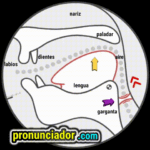
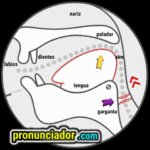
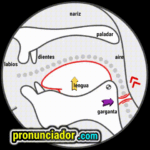
- Glottal (Made in your THROAT!): This is the BIGGIE! Unlike /t/ (tongue tip behind teeth), /p/ (lips), or /k/ (back of tongue), the Glottal Stop /ʔ/ is made much lower down, right in your glottis. The glottis is simply the opening between your vocal cords (your voice box in your throat, often called the Adam’s apple). You make the /ʔ/ by quickly and firmly closing your vocal cords together for a tiny moment, completely stopping the airflow from your lungs right there at the throat.
- Voiceless (NO Throat BUZZ during the stop!): When your vocal cords snap shut for the /ʔ/, they are NOT vibrating. It’s a silent closure of air. (Of course, the sounds around the /ʔ/, like a vowel before it or an /n/ after it, WILL be voiced!).
- Stop (Air STOPS completely!): Just like other stop sounds, the air is completely blocked for a brief instant. But for /ʔ/, the block happens in the throat, not the mouth. There’s usually no audible “pop” or release of air from the mouth for the /ʔ/ itself, especially when it’s replacing a /t/ before an /n/.
Kid-Friendly “Hiccup Stop” Summary:
Imagine you have a tiny, silent hiccup! Your throat closes for a split second and stops the air. That little “catch” in your throat, without any pop from your mouth or tongue, is very much like the Glottal T /ʔ/ we’re talking about!
The Golden Rule: WHEN Does ‘T’ Become a Glottal Stop /ʔ/ in “Button”?
This is crucial! Americans don’t just randomly replace ‘T’ with a throat catch. For the most common and recognizable Glottal T (the “Button T”), there’s a very specific rule:
The American /t/ often becomes a Glottal Stop /ʔ/ when it occurs just BEFORE an UNSTRESSED (weak) syllable that ENDS WITH AN /n/ SOUND.
Let’s break that rule down, piece by piece:
- It’s a ‘T’ sound: We’re talking about a written ‘T’ or ‘TT’.
- BEFORE an /n/ sound: The ‘T’ is immediately followed by an ‘N’.
- That ‘-ən’ Syllable is UNSTRESSED: The syllable containing the ‘N’ (like -en, -on, -ain, -ant) is WEAK. It doesn’t get the main beat or emphasis of the word. If that syllable were stressed, the ‘T’ would usually be an aspirated [tʰ] (“con-TAIN”).
- The Vowel Often Disappears (Syllabic N – /n̩/): What usually happens is the weak vowel (often Schwa /ə/) before the /n/ in that unstressed syllable almost disappears or gets “swallowed.” The /n/ sound itself then becomes syllabic (shown as /n̩/ with a little line underneath). This means the /n/ basically forms the syllable all by itself. The Glottal Stop /ʔ/ happens right before this syllabic N /n̩/.
Phonetically, the pattern is often: …Vowel + /t/ + /ən/ (unstressed) → …Vowel + /ʔ/ + /n̩/
Classic “Button T” Examples (All follow the T + Unstressed Syllabic N Rule):
- button /ˈbʌtən/ → /ˈbʌʔn̩/
- kitten /ˈkɪtən/ → /ˈkɪʔn̩/
- cotton /ˈkɑtən/ → /ˈkɑʔn̩/ [AmE often /kɑ:tən/ with /ɑ:/]
- certain /ˈsɜrtən/ → /ˈsɜrʔn̩/
- mountain /ˈmaʊntən/ → /ˈmaʊnʔn̩/
- important* /ɪmˈpɔrtənt/ → /ɪmˈpɔrʔn̩t/ (The final ‘t’ is still there and often unreleased [t̚], but the ‘t’ before the “-ant” /ənt/ becomes /ʔn̩/).
- written /ˈrɪtən/ → /ˈrɪʔn̩/
- eaten /ˈitən/ → /ˈiʔn̩/
- gotten /ˈɡɑtən/ → /ˈɡɑʔn̩/ (AmE for “got”)
- Manhattan /mænˈhætən/ → /mænˈhæʔn̩/
Why does English DO this? EASE & SPEED!
It’s simply quicker and uses less mouth acrobatics for a native speaker to make that “throat stop /ʔ/” and then go directly to the nasal /n/ sound (which is made with the tongue tip in a similar alveolar place as /t/!) rather than making a full popped /t/ and then an /n/ in a fast, weak syllable. It helps the words flow smoothly.
Is it “Lazy” or “Incorrect”? NOPE!
While using a clearly pronounced [t] in “button” isn’t wrong, it will sound more like careful speech, a British English pronunciation, or a non-native speaker. The Glottal T [ʔn̩] in these “-ton,” “-ten,” “-tain” endings is a very standard and natural feature of everyday American English.

How to Make that “Button” /ʔn̩/ Sound: The 3 Easy Steps!
Ready to try the “throat-catch T + N” combo? Sounds American has a fantastic 3-step method that makes it surprisingly simple!
Step 1: The “T+N” Link-Up (NO Vowel in Between!)
- The Goal: First, practice saying the /t/ sound immediately followed by the /n/ sound, but try to squeeze out or swallow any little “uh” vowel (Schwa /ə/) that might want to sneak in between them. You’re aiming for a quick “[tn̩]” sound where the /n/ becomes “syllabic” (makes its own syllable beat).
- How To:
- Say the first part of a word, like “bu-” from “button.”
- Put your tongue tip on the alveolar ridge (behind top teeth) to make the /t/ stop. Hold the air.
- NOW, without moving your tongue tip from that spot, change the airflow from your mouth to your NOSE and make the /n/ sound (which is voiced!). Because your tongue tip is already in the /t/ and /n/ spot, it should link smoothly.
- Practice words (SLOWLY, just linking T+N first):
- “But-[tn̩]”
- “Kit-[tn̩]”
- “Cot-[tn̩]” (for cotton)
- “Cer-[tn̩]”
- “Moun-[tn̩]”
- Why this step? It helps you get the feel for that tight, quick transition to the syllabic N, which is what happens after the Glottal Stop. It trains your ear and mouth for that final /n̩/ sound without a helping vowel.
Step 2: Master the Glottal Stop /ʔ/ with “Uh-Oh!”
- The Goal: Learn to feel and control that throat catch /ʔ/ independently.
- How To (The “Uh-Oh!” Trick!):
- Say the common American expression: “Uh-oh!” (/ˈʌʔoʊ/).
- Notice that tiny PAUSE or “catch” in your breath or sound right between “Uh” and “Oh.” THAT catch is a Glottal Stop /ʔ/!
- Now, try to make just that throat-catch part by itself. Gently contract your throat muscles (vocal cords) to stop the air for a tiny moment, then release. “Uh-[ʔ]-oh.” Then just: [ʔ]… [ʔ]… [ʔ]. It’s a silent stop, but you should feel it in your throat. You’re essentially holding your breath using your throat muscles, not your diaphragm.
Step 3: THE MAGIC SWAP! Replace Regular /t/ with Glottal /ʔ/ → for the /ʔn̩/ ending!
This is where it all comes together! You take the “-[tn̩]” ending idea from Step 1, but instead of making the /t/ with your TONGUE, you make the STOP in your THROAT (/ʔ/) like in Step 2, and then go straight to the /n/ sound (with your tongue tip now up for the /n/).
- How To (Using “button” /ˈbʌʔn̩/ as example):
- Start saying “button”: “buh-” (with the /ʌ/ ‘cup’ vowel).
- As you get to where the ‘TT’ should be: DO NOT make a /t/ sound with your tongue tip on the ridge!
- Instead, make that “Uh-oh!” THROAT CATCH /ʔ/. Stop the air in your glottis. Your tongue tip, meanwhile, can start moving towards or even be at the alveolar ridge, ready for the /n/ that’s coming.
- IMMEDIATELY after you make that [ʔ] throat stop, release the air through your NOSE and make the /n/ sound. Your tongue tip is now firmly on the alveolar ridge, and your voice is ON for the /n/. This /n/ is syllabic: /n̩/.
- The Result: “buh-[THROAT CATCH /ʔ/]-[N sound /n̩/]” –> “button” /ˈbʌʔn̩/!
- The “T” sound you hear isn’t from your tongue popping on the ridge; it’s the effect of the air being stopped sharply in your throat before the nasal /n/!
Practice These! (Focus on Throat Stop + N):
- Kitten: /ˈkɪʔn̩/
- Cotton: /ˈkɑʔn̩/
- Certain: /ˈsɜrʔn̩/
- Mountain: /ˈmaʊnʔn̩/
- Important: /ɪmˈpɔrʔn̩t/ (final /t/ might still be there and unreleased)
- Written: /ˈrɪʔn̩/
- Forgotten: /fərˈɡɑʔn̩/
Feeling Check: Vowel sound → Throat catches/stops air → Tongue tip at ridge, air flows out nose for ‘N’ sound. Is it smooth and quick? Awesome!
Glottal T /ʔ/ vs. Other American T’s: What’s the Difference?
It’s super important to know that this Glottal T is just ONE way the /t/ sound can change. Don’t confuse it with:
- True Aspirated T [tʰ] (“Time”): Big puff of air, tongue tip on alveolar ridge. Glottal T /ʔ/ = Throat stop, no mouth puff.
- True Unreleased/Held T [t̚] (“Cat”): Tongue tip on ridge, air stopped, no puff, sound cuts off. Glottal T /ʔ/ = Throat stop, not primarily tongue tip stop (though tongue moves for /n/).
- Flap T [ɾ] (“Water,” “City”): Super-fast, VOICED D-like tap of tongue on ridge. Glottal T /ʔ/ = Voiceless throat stop, not a tap, and a different context (before /n̩/).
They all come from the letter ‘T’, but they are different sounds for different situations! Using a hard, puffy [tʰ] in “button” will sound very un-American (or very British!).
Spotting Glottal T (-TN): The Spelling Clues!
While the rule is about the sound (/t/ before unstressed /ən/), certain spellings are very common triggers for the Glottal T + Syllabic N (/ʔn̩/) pattern. The main spellings are ‘T’ or ‘TT’ followed by these unstressed endings:
- -EN / -TEN / -TTEN: Often become /ən/ → /ʔn̩/
- Written /ˈrɪʔn̩/, Eaten /ˈiʔn̩/, Gotten /ˈɡɑʔn̩/, Beaten /ˈbiʔn̩/, Threaten /ˈθrɛʔn̩/, Frighten /ˈfraɪʔn̩/, Kitten /ˈkɪʔn̩/, Smitten /ˈsmɪʔn̩/, Mittens /ˈmɪʔn̩z/ (plural often keeps it).
- -ON / -TON / -TTON: Often become /ən/ → /ʔn̩/
- Button /ˈbʌʔn̩/, Cotton /ˈkɑʔn̩/, Mutton /ˈmʌʔn̩/, Rotten /ˈrɑʔn̩/.
- -AIN / -TAIN: Often become /ən/ → /ʔn̩/
- Certain /ˈsɜrʔn̩/, Mountain /ˈmaʊnʔn̩/, Fountain /ˈfaʊnʔn̩/, Curtain /ˈkɜrʔn̩/.
- -ANT / -TANT (unstressed): Often /ənt/ → /ʔn̩t/ (The final /t/ after /n/ IS usually still there, often unreleased)
- Important /ɪmˈpɔrʔn̩t/, Accountant /əˈkaʊnʔn̩t/, Mutant /ˈmjuʔn̩t/.
- -ENT (unstressed – rare to be pure /ʔn̩/, more often /ənt/ or just very reduced /t/)
- Client /ˈklaɪənt/ (final T more likely released) – Better not to overgeneralize -ent without strong evidence it patterns robustly with -ʔn̩.
- -IN (when pronounced /ən/ unstressed)
- Latin /ˈlæʔn̩/ (Source video includes this one).
The Key Pattern to Spot: Written ‘T’ or ‘TT’ + a vowel letter (like E, O, A, I) + ‘N’ at the end of an UNSTRESSED syllable. That’s your Glottal T alarm bell!

“Buttoning Up” Errors: Common Glottal T Goofs & Fixes!
- MISTAKE #1: USING A FULLY POPPED/ASPIRATED ‘T’! (The “But-TON!” error).
- Problem: You’re making a clear [t] or [tʰ] with your tongue tip before the ‘N’. Sounds too choppy and over-pronounced for casual American English.
- FIX: THE THROAT STOP! Remember, the “T-ness” comes from the glottal closure /ʔ/, NOT an alveolar T-pop. The tongue tip moves to the N-position as or after the throat stops the air. (3-Step method helps).
- MISTAKE #2: SWALLOWING THE ‘T’ SOUND COMPLETELY (No Glottal Stop).
- Problem: You might say “buh-uhn” or “moun’-in” with no stop at all. It can sound a bit mushy or unclear.
- Solution: FEEL THE “UH-OH!” CATCH! That little glottal closure /ʔ/ is important. It creates a clean break before the /n/, giving the word its characteristic rhythm. It’s subtle, but it’s there.
- MISTAKE #3: Inserting a Strong Vowel BEFORE the ‘N’ (Not making /n̩/ Syllabic).
- Problem: Saying “Butt-ON” or “Kitt-EN” with a full vowel in the last syllable, making it sound like two clear syllables instead of “…[ʔ]-N” (where N carries the syllable beat).
- Solution: LINK ‘T’ (now /ʔ/) directly to ‘N’. The vowel before the ‘N’ in the spelling (o, e, ai) almost disappears or becomes a super-quick Schwa /ə/ that immediately blends into the /n̩/. Think of the final syllable as just “[ʔN!]”
- MISTAKE #4: Making the Glottal Stop /ʔ/ too LONG or HARD.
- Problem: If the throat catch is too forceful or held too long, it can sound like a cough or very unnatural.
- Solution: QUICK & GENTLE! The /ʔ/ is a very fast, light closure. Like a tiny blip in your throat. It shouldn’t be a big effort.
- MISTAKE #5: Not Getting a Clean NASAL Release for the /n/.
- Problem: After the glottal stop, the /n/ might sound muffled or not fully nasal.
- Solution: Ensure your tongue tip IS making good contact on the alveolar ridge for the /n/, and that air IS flowing out your nose. The glottal stop stops air in throat; the /n/ releases voiced air through the nose.
“Hit the Button!” Glottal T /ʔn̩/ Practice Drills!
Let’s get that throat-catch T + N combo down pat!
Exercise 1: The “Uh-Oh!” Throat Squeeze
This is your foundation for feeling the /ʔ/!
- Say “Uh — Oh!” with a clear pause and stop of air in your throat between “Uh” and “Oh.”
- Now speed it up: “Uh-Oh! Uh-Oh! Uh-Oh!” Feel that little glottal muscle contracting?
- Try to make just the catch: (Breathe in) …[ʔ]… (Release breath). (Breathe in) …[ʔ]…
It’s a silent “hold” of air in your throat.
Exercise 2: Glottal Stop + “N” (The /ʔn̩/ Combo!)
Now, right after you make that throat-catch /ʔ/, immediately make an ‘N’ sound (tongue tip to alveolar ridge, voice on, air through nose).
- [ʔ]….nnnnnn → [ʔn̩]
- [ʔ]….nnnnnn → [ʔn̩]
- It should be very quick: like “unh” but with a throat stop before the ‘n’. Think: “Ki[ʔn̩]”, “Bu[ʔn̩]”.
Exercise 3: Words with T/TT + EN, ON, AIN (Your /ʔn̩/ Playground!)
Practice the source video’s method: First, link “T” + “N” with NO vowel (Step 1). Then, make the “uh-oh” glottal stop (Step 2). FINALLY, replace the “T” with the “uh-oh” glottal stop for the full word (Step 3).
- Button: (but-tn → uh-oh → /ˈbʌʔn̩/)
- Kitten: (kit-tn → uh-oh → /ˈkɪʔn̩/)
- Cotton: (cot-tn → uh-oh → /ˈkɑʔn̩/)
- Certain: (cer-tn → uh-oh → /ˈsɜrʔn̩/)
- Mountain: (moun-tn → uh-oh → /ˈmaʊnʔn̩/)
- Written: (writ-tn → uh-oh → /ˈrɪʔn̩/)
- Eaten: (eat-tn → uh-oh → /ˈiʔn̩/)
- Forgotten: (forgot-tn → uh-oh → /fərˈɡɑʔn̩/)
- Fountain: (foun-tn → uh-oh → /ˈfaʊnʔn̩/)
- Curtain: (cur-tn → uh-oh → /ˈkɜrʔn̩/)
- Threaten: (threat-tn → uh-oh → /ˈθrɛʔn̩/)
- Straighten: (straight-tn → uh-oh → /ˈstreɪʔn̩/)
- Flatten: (flat-tn → uh-oh → /ˈflæʔn̩/)
| PHONETICAL PRONUNCIATION |
| PHONETICAL PRONUNCIATION |
Exercise 4: Minimal-ish Contrast: Glottal T /ʔn̩/ vs. Fully Released T [tən] (If you CAN manage it)
This helps you hear the difference. Say it both ways:
- “Button”:
- Too Clear/Non-Native like: /ˈbʌt.tʰən/ or /ˈbʌt.ən/
- Natural American: /ˈbʌʔn̩/
- “Important”:
- Too Clear: /ɪmˈpɔr.tʰənt/
- Natural American: /ɪmˈpɔrʔn̩t/
The Glottal T version should sound smoother and quicker.
Exercise 5: “The Kitten in Mittens” – Glottal T Sentences + Recording!
Record yourself! Is your Glottal T just a quick throat catch before the N?
- “The kitten [ʔn̩] has bitten [ʔn̩] my cotton [ʔn̩] mitten [ʔn̩].”
- “It is certain [ʔn̩] that the mountain [ʔn̩] has a fountain [ʔn̩].”
- “Have you forgotten [ʔn̩] what was written [ʔn̩] about the mutton** [ʔn̩]?”
- “Straighten [ʔn̩] the curt**ain [ʔn̩]; it’s important [ʔn̩t]!”
- “I’ve eaten [ʔn̩] the rotten [ʔn̩] apple.”
FAQs: Your American Glottal T /ʔ/ (Button) Questions Answered!
Q1: What IS a Glottal Stop /ʔ/ in REALLY simple terms? (Kid-Style!)
Imagine you’re about to talk, but you suddenly stop the air in your throat with a tiny little “catch” before any sound comes out of your mouth – like the little pause in “Uh**-**oh!” That throat-catch is a glottal stop! For words like “button,” you do that throat-catch instead of making a “T” sound with your tongue, right before the “N” sound.
Q2: So, the “T” in “button” or “mountain” really DISAPPEARS?
It feels like it disappears from your tongue, yes! You’re not making the usual “T-pop” with your tongue tip on the ridge behind your teeth. Instead, you make that quick stop in your throat (/ʔ/) just before you make the ‘N’ sound with your tongue tip on the ridge. So, the effect of a stop is there, but it’s made in your throat.
Q3: Is it “lazy” or “bad” English to use the Glottal T in “button” or “important”?
NO, not at all in these specific contexts! It’s a very normal, natural, and common feature of everyday spoken American English (and some other English dialects). Using a very clear, popped [t] in these “-ton,” “-ten,” “-tain” endings can actually sound a bit too formal, over-pronounced, or even British for casual American speech. So, using the Glottal T /ʔn̩/ will often make you sound more native!
Q4: When EXACTLY should I use this Glottal T /ʔ/ before ‘N’?
The main, super-clear rule is: When a ‘T’ (or ‘TT’) comes RIGHT BEFORE an ‘N’ that starts an UNSTRESSED (weak) syllable, especially at the end of words.
- Like in: butt<u>on</u> (ON is weak), cert<u>ain</u> (AIN is weak), mount<u>ain</u> (AIN is weak), import<u>ant</u> (ANT is weak for the ‘t’ before it). The vowel before the N in these endings (like O, AI, A) often gets swallowed, and the N becomes “syllabic” (/n̩/).
Q5: How is this Glottal T /ʔ/ different from the Flap T /ɾ/ (in “water”)? They both replace ‘T’!
Great question! They are BOTH common ways the ‘T’ can change, but in different situations and they sound different:
- Glottal T /ʔ/ (“button” /ˈbʌʔn̩/):
- Sound: A stop in the THROAT. Voiceless.
- Context: Usually ‘T’ before an UNSTRESSED /ən/ or syllabic /n̩/.
- Flap T /ɾ/ (“water” /ˈwɔɾɚ/):
- Sound: A super-fast, D-LIKE TAP of the TONGUE on the ridge. VOICED.
- Context: Usually ‘T’ BETWEEN VOICED sounds, before an UNSTRESSED vowel.
So, different mouth actions, different voice, different rules!
Key Takeaways: Your American Glottal T /ʔn̩/ Will Be “Suddenly” Perfect!
Amazing work! You’ve now unlocked the “secret” of the American Glottal T in words like “button” and “important”! It’s not a missing T, but a T transformed into a quick throat stop /ʔ/ smoothly linked to a syllabic N /n̩/.
Your “Button” Points to Remember:
- Glottal T /ʔ/ in -TN endings = THROAT CATCH + N! (Stop air in glottis → release nasally for /n/).
- RULE: For ‘T’ or ‘TT’ just BEFORE an UNSTRESSED syllable ending in /n/ (buTTon, cerTAIN, imporTANT). The vowel before ‘N’ usually vanishes.
- NOT “Lazy” – It’s NATIVE! Standard for American English rhythm.
- PRACTICE with “Uh-Oh!” This helps you find and control that throat stop.
- Then use the 3-STEP METHOD: (Link T-N no vowel) → (Isolate /ʔ/) → (REPLACE T with /ʔ/ → /ʔn̩/).
- VS. FLAP T /ɾ/ (“water”): Glottal T is a throat stop before /n̩/. Flap T is a tongue tap between voiced sounds. Totally different!
- SPELLING: Watch for T/TT before -EN, -ON, -AIN, -ANT endings.
Keep practicing that little throat catch before ‘N’ in these common words. Focus on a smooth, quick transition. Listen carefully to how Americans say “button,” “mountain,” “certain.” Record yourself! You’ll be amazed how much more natural and connected your American English will sound!T’ sound becomes a refined part of your pronunciation.
👇🔥👇🔥👇🔥👇🔥👇🔥👇🔥
👉 RETURNS in the YEAR 2031 ! WHO? CLICK HERE ! 🔥




👇🔥👇🔥👇🔥👇🔥👇🔥👇🔥
👉 RETURNS in the YEAR 2031 ! WHO? CLICK HERE ! 🔥
👇🔥👇🔥👇🔥👇🔥👇🔥👇🔥
👉 RETURNS in the YEAR 2031 ! WHO? CLICK HERE ! 🔥
👉 RETURNS in the YEAR 2031 ! WHO? CLICK HERE ! 🔥