

Does your “thank you” sound like “tank you”? Discover the simple tongue & air trick to finally master the voiceless TH /θ/ sound & fix common pronunciation mistakes
Hey there, future pronunciation superstars! Get ready to tackle one of the most feared, yet most crucial, sounds in American English: the voiceless TH sound, like in “think”, “three”, or “bath“! Its secret IPA code is /θ/ (looks like a little ‘o’ with a line through it, or a Greek ‘theta’). Why “feared”? Because this sound doesn’t exist in many other languages, so learners often twist it into something else!
Does this sound familiar? You try to say “thank you” but it comes out like “tank you” or “sank you”. Or you want to say “three” but it sounds more like “free” or even “tree“! You might even try to say “truth” /truθ/ and just drop the TH completely, making it sound like “true” /tru/. Ah, the TH frustration! You feel your accent sticking out like a sore thumb, potential misunderstandings creep in, and you’re just not sure what your tongue is supposed to be doing! Is it between the teeth? Behind the teeth? Does it vibrate? It’s one of those sounds that screams “non-native” if you don’t nail it.
But guess what? The voiceless TH /θ/ is much easier than you think once you know the simple trick! This ULTIMATE guide, explained so clearly an 8-year-old could get it, will turn you into a TH-master:
- Meet the Sound: What IS this “airy TH” /θ/? (Hint: Tongue-tip PEEKING OUT + AIR!).
- The HUGE Difference: We’ll clearly distinguish it from its voiced twin, the /ð/ sound (like in “this” or “that”). No more guessing if it buzzes!
- Mouth Magic Simplified: Super easy, step-by-step instructions on where to put your tongue and how to let the air flow. (NO vibrating!).
- Spelling Made Easy: Good news! The /θ/ sound is almost always spelled ONE way! (Can you guess? 😉)
- Common Mistake Crusher: We’ll zap those common errors (replacing with /t/, /s/, /f/) with practical solutions.
- Practice Powerhouse: Awesome exercises with everyday words (‘think’, ‘three’, ‘month’, ‘bath’, ‘health’) to make your /θ/ sound sharp and natural!
Get ready for your “think”, “three”, “truth”, and “healthy” to sound incredibly clear and genuinely American! Let’s do this!

What IS This Voiceless TH /θ/ Sound Anyway? The “Airy Tongue-Tip”
Alright, let’s properly introduce the /θ/ sound. This is one of the two “TH” sounds in English. It’s the voiceless one, meaning it’s made ONLY with air, no vibration from your vocal cords (your voice box). You hear it clearly in:
- think /θɪŋk/
- three /θri/
- bath /bæθ/
- mouth /maʊθ/
- healthy /ˈhɛlθi/
- thank /θæŋk/
- through /θru/
- truth /truθ/
It’s part of a family of sounds called fricatives, which are sounds where air is squeezed through a narrow opening, making a hissy or breathy noise.
Its Secret Code (Easy Peasy Breakdown!)
Experts call /θ/ an “interdental, voiceless, fricative consonant.” Woah, big words! Let’s make it kid-simple:
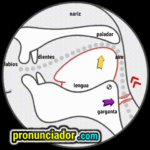
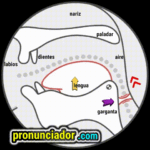
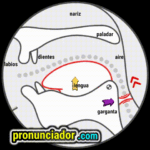
- Interdental (Tongue PEEKS OUT!): “Inter” means between, “dental” means teeth. So, guess what? Your TONGUE TIP peeks out a tiny bit BETWEEN your upper and lower front teeth! Not too much, just a little peek-a-boo!
- Voiceless (No BUZZ!): This is SUPER important. Your voice box (vocal cords in your throat) is OFF. Asleep. Quiet. You do NOT make any humming or buzzing sound from your throat. It’s all air.
- Fricative (Air SQUEEZES Through!): Remember “friction”? This sound is made by air squeezing and rubbing as it passes between your tongue tip and your upper teeth (or just behind them). It should make a soft, hissy, airy sound.
Kid-Friendly Summary: To make the /θ/ (TH in ‘think’):
- Let your tongue tip peek out a little between your top and bottom front teeth.
- Gently rest your top teeth on your tongue tip (or let your tongue tip just touch the back of your top teeth).
- BLOW AIR softly over your tongue, between your tongue and teeth.
- Make sure your voice box is OFF (no humming!).
It should sound like a soft “thhhhhhh”, like air escaping.
The ULTIMATE TH Showdown: Voiceless /θ/ (Think) vs. Voiced /ð/ (This)
This is where MANY learners stumble! English has TWO TH sounds! They are made with the EXACT SAME MOUTH POSITION! The ONLY difference? Your voice box!
| Feature | Voiceless TH /θ/ (Think, Bath) | Voiced TH /ð/ (This, Mother) |
| Mouth/Tongue Position? | IDENTICAL! Tongue peeks out. | IDENTICAL! Tongue peeks out. |
| Airflow? | YES, squeezes through. | YES, squeezes through. |
| VOICE BOX (Vocal Cords)? | OFF! (Voiceless – NO buzz) | ON! (Voiced – BUZZING!) |
| How it Sounds? | Soft, airy “thhhhh” | Buzzy, vibrating “thvvvvv” |
Common Error: Using /θ/ for /ð/ or vice-versa, or using some other sound (like /d/ or /z/) for /ð/.
Result: “They” /ðeɪ/ might sound like “they-sssss” or “day”. “Mother” /ˈmʌðər/ might sound like “motter” or “mosser”.
Solution: THE THROAT BUZZ TEST! Put your fingers gently on your throat.
- Say “think” /θɪŋk/. Feel anything? NO buzz. That’s /θ/ voiceless!
- Now say “this” /ðɪs/. Feel anything? YES! A definite BUZZ! That’s /ð/ voiced!
Practice feeling that on/off switch in your throat while keeping your tongue in the SAME “peeking out” position. This is a GAME CHANGER!

Your Mouth’s TH Mission: Easy Steps to the Perfect /θ/
Ready to make that perfect, airy voiceless TH? It’s simpler than you imagine!
Step 1: Mouth – Just a Little Bit Open!
Relax your jaw. Let your mouth open naturally, just slightly. Not wide like for “AH”, just enough for your tongue to peek.
Step 2: Tongue – The Star of the Show! (Peek-a-Boo!)
This is THE most important part!
- Take the very tip of your tongue and let it peek out a tiny bit BETWEEN your upper and lower front teeth.
- It should gently touch both rows of teeth, or at least the bottom of your upper teeth and the top of your lower teeth.
- CRUCIAL: Don’t stick your whole tongue way out! Just the tip, very delicately. And don’t bite down hard! It’s a gentle touch.
Alternative Tongue Tip (if ‘between’ feels weird): Some people find it easier to place the tongue tip just behind the upper front teeth, very lightly touching them, and then blow air. This can also work for many and sometimes sounds more natural if the ‘between teeth’ method makes you lisp too much. However, the primary instruction from Sounds American is “between teeth”.
Step 3: Air Stream – Let it Squeeze & Flow!
- Now, with your tongue tip peeking out and gently touching your teeth, blow air steadily out of your mouth.
- The air has to squeeze through that tiny gap created between your tongue and your upper teeth (or upper teeth ridge if using the alternative tip position).
- You should hear (and feel) a soft, continuous, hissy/airy friction sound. “Thhhhhhh.”
Step 4: Voice Box – Shhh! Keep it OFF!
- Remember, for /θ/, your vocal cords do NOT vibrate.
- It’s purely an airy sound. If you feel a buzz in your throat, you’re accidentally making the voiced TH /ð/! Stop the buzz for /θ/.
Putting It All Together: Slightly open mouth + Tongue tip peeks & touches teeth + Blow air smoothly + NO throat buzz = Perfect /θ/!
Feel it!
- Exaggerate sticking your tongue tip WAY out and blow. Now bring it back in bit by bit while still blowing, until it’s just BARELY peeking. Find that sweet spot where the air flows with that gentle “thhhh” friction.
- Can you hold the “thhhhhhhhh” sound for a few seconds like a leaky tire? Good! That’s the fricative quality.
TH Spells TH! (Mostly!) – Spelling the /θ/ Sound
Guess what? Spelling the voiceless TH /θ/ sound is… actually SUPER EASY!
The ONE and ONLY (Almost!): ‘TH’ (~100%)
That’s right! The /θ/ sound is almost always, always, always spelled with the letters ‘TH’ together!
- think, three, thanks, thin, theme, theater, theory, throat.
- author, healthy, birthday, something, anything, everything.
- bath, mouth, truth, health, strength, earth, north, south.
Simple Rule: See ‘TH’? Very high chance it’s one of the TH sounds (/θ/ or /ð/).
The only tiny “exception” is sometimes in very old place names or a few loanwords where ‘TH’ might sound like /t/ (e.g., Thomas, Thames, Thailand), but these are extremely rare and specific. For everyday English, TH = /θ/ or /ð/.
TH Trouble! Common Mistakes & How to Zap Them!
What are the usual trip-ups with the airy /θ/ sound? Let’s fix ‘em!
- Mistake #1: The “T” Takeover! (/t/ for /θ/)
- What’s Happening: Instead of letting the tongue tip peek between teeth, you press the tongue tip hard against the alveolar ridge (behind top teeth) and stop the air, like for /t/. “Think” becomes “Tink”. “Three” becomes “Tree”.
- The Fix: TONGUE PEEK-A-BOO! Get that tongue tip between your teeth. It needs to be INTERDENTAL (between teeth) or DENTAL (touching back of top teeth) for friction, NOT Alveolar (behind teeth ridge) for a stop. And don’t press hard; it’s a gentle touch allowing air to flow. RELAX the tongue tip.
- Mistake #2: The “S” Sneak-In! (/s/ for /θ/)
- What’s Happening: Tongue tip stays behind the teeth and too close to the alveolar ridge, making an /s/ “ssss” sound instead of the airy “thhhh”. “Think” becomes “Sink”. “Mouth” becomes “Mouse”.
- The Fix: TONGUE TIP FORWARD! Again, it must come between or very close to the front teeth for /θ/. The /s/ sound is made with the tongue tip near the alveolar ridge but not between the teeth, and with a different groove in the tongue. For /θ/, the airflow is flatter over the tongue tip.
- Mistake #3: The “F” Fake-Out! (/f/ for /θ/)
- What’s Happening: Instead of tongue-tip-and-teeth, you use your bottom lip and upper teeth to make an /f/ sound. “Three” becomes “Free”. “Thought” becomes “Fought”.
- The Fix: LIPS DO NOTHING! For /θ/, your lips should be relaxed and slightly open to let the tongue do its work. It’s a TONGUE sound, not a LIP sound. Keep that bottom lip out of the way!
- Mistake #4: No Air, Just Stop! (Stopping the Air)
- What’s Happening: You place the tongue tip correctly, but instead of letting air flow continuously for friction, you block it completely and then release, almost like a /t/ or /d/ but with the tongue out.
- The Fix: KEEP THE AIR FLOWING! /θ/ is a fricative (friction sound), which means air needs to keep escaping. Think of it like a slow tire leak “thhhhhhhhhh”. Don’t dam up the air.
- Mistake #5: Oops, I’m Buzzing! (Accidentally making /ð/)
- What’s Happening: Your tongue position is perfect, but your voice box is ON!
- The Fix: VOICE OFF! Remember the throat buzz test. For “think”, “three”, “bath” – NO buzz. For “this”, “they”, “mother” – BUZZ! Practice turning that motor on and off while keeping the tongue placement the same.

TH Training Time! Exercises for a Perfect Voiceless /θ/
Ready to make that airy TH your new best friend? Let’s practice!
Exercise 1: Tongue Peek-a-Boo + Air
- Look in a mirror. Let your tongue tip just PEEK out between your front teeth. Not too much!
- Gently rest your top teeth on it (or let tongue touch back of top teeth).
- Now, blow air softly and continuously: “Thhhhhhhhhh…”
- Is it airy? Good! Is your voice box OFF (no buzz)? Perfect!
- Try holding it for 3-5 seconds.
Exercise 2: The Voiceless /θ/ vs. Voiced /ð/ Switch
THE MOST IMPORTANT EXERCISE for TH sounds!
- Tongue in TH position (peeking out).
- Alternate:
- /θ θ θ θ/ (AIR ONLY – “thhh thhh thhh”)
- /ð ð ð ð/ (AIR + THROAT BUZZ – “thvv thvv thvv”)
- Feel the ON/OFF in your throat, but the TONGUE STAYS PUT!
- Now with minimal pairs:
- Thigh /θaɪ/ (voiceless) — Thy /ðaɪ/ (voiced – archaic word)
- Bath /bæθ/ (voiceless) — Bathe /beɪð/ (voiced – verb)
- Tooth /tuθ/ (voiceless) — Teethe /tið/ (voiced – verb, baby teething)
- Wreath /riθ/ (voiceless – corona de flores) — Wreathe /rið/ (voiced – serpentear, envolver)
Exercise 3: Bye-Bye T/S/F! /θ/ vs. The Impostors!
Force your tongue to do the RIGHT thing for /θ/!
- θink (tongue out, air) — Tink (tongue behind teeth, stop) — Sink (tongue behind teeth, hiss) — Fink (bottom lip + top teeth)
- Thin /θɪn/ — Tin /tɪn/ — Sin /sɪn/ — Fin /fɪn/
- Mouth /maʊθ/ — Mout /maʊt/ (not a word) — Mouse /maʊs/ — Mouf (not a word)
- Path /pæθ/ — Pat /pæt/ — Pass /pæs/ — Paf (not a word)
Exercise 4: Initial /θ/ Power!
Exaggerate the tongue peek and airy release at first.
- Thank, thick, thin, thing, think, theme.
- Three, throw, through, throat, thrill, thread.
- Thunder, Thursday, thousand, thirsty.
Exercise 5: Final /θ/ Finesse!
End with that soft airy release.
- Bath, path, math, both, cloth, tooth.
- Earth, north, south, fourth, fifth, ninth, tenth.
- Truth, youth, health, wealth, strength, length, breadth.
- Growth, death, breath (noun – careful! ‘breathe’ verb is /ð/).
Exercise 6: Medial /θ/ Workout! (In the Middle)
Keep that airy TH clear.
- Author, method, brother*, nothing*, something, anything. (Oops, brother & nothing are /ð/!)
- Corrected: Author, ethics, athlete, catholic, mathematics, pathetic, anthem, orthodox.
- Healthy, wealthy. Birthday. Toothbrush. Bathtub. Plaything.
Exercise 7: Top 30 Word Drill (From Source) + Recording!
| PHONETICAL PRONUNCIATION |
| PHONETICAL PRONUNCIATION |
FAQs: Your Voiceless TH /θ/ Questions Answered!
Q1: What’s the absolute EASIEST way to remember how to make the voiceless TH /θ/?
Think: “Tongue Tip PEEKS, Air SQUEAKS (softly), Voice SLEEPS!”
- Tongue tip just barely peeks between your teeth.
- Blow air gently over it.
- NO buzzing in your throat!
Q2: I still sound like I’m saying S or T! Help!
- For S problem: Your tongue is likely too far back and making a groove. Push tongue tip more forward, flatter, truly between or lightly on upper teeth.
- For T problem: You’re stopping the air with your tongue then releasing. For TH, the air must flow continuously with friction. Don’t let your tongue block the air completely against the tooth ridge. Think “hiss” not “hit.” And a gentle touch, not a hard press.
Q3: Is the voiceless TH /θ/ (“think”) different from voiced TH /ð/ (“this”)? They both use TH!
YES! MASSIVELY DIFFERENT in sound, same in mouth position!
- /θ/ (think): NO vocal cord vibration (VOICELESS). Just air.
- /ð/ (this): YES vocal cord vibration (VOICED). Buzzing sound from throat.
Put your hand on your throat. “Think” = no buzz. “This” = BUZZ! Master this, and you’ve mastered TH!
Q4: Does it matter how MUCH tongue I stick out?
Yes! Too much, and it’s exaggerated and might block air. Too little (behind teeth), and it becomes /s/ or /t/. Just the very tip should be visible or lightly making contact. Experiment in a mirror to find your sweet spot for that airy “thhhh”.
Q5: The spelling is ALWAYS ‘TH’ for /θ/, right?
Pretty much, yes! It’s one of the most reliable spellings in English for a specific sound (or pair of sounds /θ/-/ð/). Very rare exceptions are usually very old names or obscure words you won’t use much. So, ‘TH’ is your big clue!
Final Takeaways: Your Airy, Voiceless /θ/ is Within Reach!
You’ve done it! You’ve journeyed into the land of the voiceless TH /θ/ and come out a champion! You now know it’s not some impossible monster, but a sound made with a gentle tongue tip peek and a soft, continuous, unvoiced airflow.
Your TH /θ/ Superpowers to Remember:
- /θ/ = Tongue Tip PEEKS + AIR Flows + VOICE OFF!
- KEY MOUTH MOVE: Tip of tongue GENTLY between or just touching upper teeth.
- KEY AIR MOVE: Continuous, soft friction. “Thhhhhhhhhh”.
- KEY VOICE MOVE: ABSOLUTELY NO THROAT BUZZ! (That’s /ð/).
- SPELLING = ‘TH’. Easy peasy.
- WATCH OUT FOR: Trying to make /t/, /s/, or /f/ instead! TONGUE TIP FORWARD!
The most crucial part is distinguishing it from its voiced twin /ð/ by controlling your vocal cords. Keep practicing with the mirror, the throat buzz test, and by recording yourself. Words like “think”, “three”, “bath”, “truth” will soon sound perfectly American, light and airy! Good luck, and keep practicing!
👇🔥👇🔥👇🔥👇🔥👇🔥👇🔥
👉 RETURNS in the YEAR 2031 ! WHO? CLICK HERE ! 🔥




👇🔥👇🔥👇🔥👇🔥👇🔥👇🔥
👉 RETURNS in the YEAR 2031 ! WHO? CLICK HERE ! 🔥
👇🔥👇🔥👇🔥👇🔥👇🔥👇🔥
👉 RETURNS in the YEAR 2031 ! WHO? CLICK HERE ! 🔥
👉 RETURNS in the YEAR 2031 ! WHO? CLICK HERE ! 🔥