

Rolling your English R or confusing it with L? Learn the ‘no-touch’ rule to fix your American R pronunciation. Master 2 simple ways to sound clear. Get started!

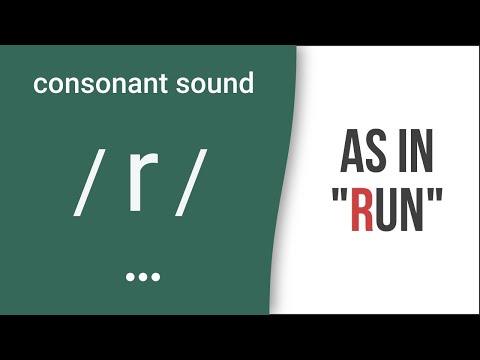
Hey there, awesome American accent architects! Get ready to build your English confidence with one of the most famous, challenging, yet rewarding sounds: the /r/ sound, like in “run,” “read,” “right,” or “really”! Its phonetic symbol is just /r/.
Now, you might think, “The ‘R’ sound? Easy!” Many of you have an ‘R’ sound in your native language. BUT… does your English ‘R’ always sound quite right?
What makes this “R” so notorious for learners?
- The “Rolling R” (Trilled R /r̄/) or “Tapped R” (/ɾ/) Problem: Many languages (like Spanish, Italian, Russian) have ‘R’ sounds made by quickly vibrating or tapping the tongue against the roof of the mouth. American English /r/ is different – it’s a smooth, continuous sound, NOT a trill or a tap!
- The “L vs. R” Conundrum: This is a classic challenge for many learners, leading to “right” sounding like “light,” or “grass” sounding like “glass.” Your tongue position for /r/ is VERY different from /l/!
- The “Hidden R” or “R-Colored” Mystery: Have you noticed how the vowels before an ‘R’ in American English (like in “bird,” “car,” “door“) often sound a bit “different” or “darker”? That’s because the American /r/ influences the vowel, creating what we call R-Colored vowels! The ‘R’ itself is also part of these vowel sounds.
- Spelling Simplicity (But It Hides All The Tricks!): The letter ‘R’ spells the /r/ sound about 98% of the time! Easy! But knowing how to say that /r/ (especially if it colors a vowel) is the real puzzle!
You try to express yourself clearly, but your R’s keep tripping you up, making your speech sound unnatural or even causing confusion. You want that fluid, authentic American “R” sound, but it feels like the toughest sound to master!
But don’t give up! Today, we’re giving you the Roadmap to the American R! This ULTIMATE, kid-simple guide will make you an /r/ rockstar:
- Meet the Resonant /r/: What is this unique, continuous “lip-rounded-tense-tongue-NO-touch” sound?
- The #1 Game-Changer: The “NO-ROLL, NO-TAP” Rule! We’ll show you exactly how to make the American R that doesn’t vibrate like a foreign ‘R’!
- Your Tongue’s Two Superpowers (Pick Your R-Style!): Learn both easy ways to make the American R: The “Curled Tip” (Retroflex R) and the “Humped Body” (Bunched R)!
- Mouth Moves for a Ripping /r/ (EASY-PEASY!): Step-by-step for the perfect lip rounding, tongue tension, and central airflow!
- R vs. L Duel! Crystal-clear differences and amazing tricks so you NEVER confuse them again!
- R-Colored Vowels UNLOCKED! Understand why /r/ makes vowels sound special and how to produce them correctly!
- Spelling? ‘R’ is Your Guy! (Good news: Mostly consistent!).
- Zap Common “R”-iffic Errors! Fix rolls, taps, “L” confusions, and more!
- “Read and Roll!” Practice Power! Awesome drills with essential words (‘run’, ‘read’, ‘right’, ‘really’, ‘try’, ‘great’, ‘room’, ‘around’) to make your American /r/ perfect!
Get ready for your “rain,” “race,” “remember,” and “reason” to sound confident, clear, and perfectly American! Let’s run with it! 🏃♀️💨

What IS This Resonant /r/ Sound, Anyway? (The “No-Roll, No-Tap” Sound!)
First, let’s properly introduce our star for today: the American English /r/ sound. You use it everywhere: at the beginning of “run,” “red,” “ready,” or “really.” It’s one of the two Liquid Consonants in American English (the other is /l/).
The /r/ sound is a true chameleon! And for many learners, it’s THE HARDEST SOUND to master.
Its Core “R”-markable Features (Kid-Friendly Version!)
Sound experts call /r/ an “alveolar approximant, voiced, liquid consonant.” Sounds complicated, right? Let’s make that totally easy for you:
- Alveolar Approximant (Tongue Nears, But DOESN’T Touch!): This is the key differentiator!
- “Alveolar” tells you the general area: that bumpy ridge behind your upper front teeth.
- “Approximant” means your tongue gets VERY CLOSE to the roof of your mouth (or teeth), but it NEVER actually touches to make a full block, tap, or trill! It just approximates (gets near). Air flows continuously over it.
- NO Tongue-Tip Tapping/Trilling: This is the most crucial part! Unlike some languages (e.g., Spanish, Italian, Arabic, some varieties of German or French), the American /r/ is NEVER made by rapidly vibrating your tongue tip against the ridge (a trill [r̄]) or tapping it once (a tap [ɾ], which is the Flap T!). It’s a smooth, continuous sound.
- Voiced (Throat BUZZES ON!): Your vocal cords (voice box) are TURNED ON and VIBRATING continuously as you make the /r/ sound. You should feel a steady BUZZ in your throat.
- Liquid (Smooth & Flowy): Means it’s a smooth, flowing sound that can be stretched out: “Rrrrrrrrr!”
Your Tongue’s Two “R”-illiant Tricks (Pick Your Style!): Retroflex R vs. Bunched R!
The amazing thing about the American /r/ is that there are two main, equally common, and equally valid ways native speakers make it! You can choose the one that feels easiest for you! Both achieve the same sound:
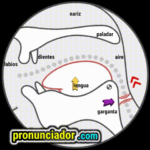
- The “Retroflex R” (Tongue Tip Curled UP & BACK):
- How: The TIP of your tongue CURSLS UP and BACK (like an old-fashioned telephone receiver going back), aiming towards the back of your alveolar ridge or slightly past it.
- CRITICAL: It DOES NOT TOUCH the roof of your mouth.
- The middle of your tongue might dip down slightly.
- Feeling: Like your tongue is “pointing” back and up, without touching.
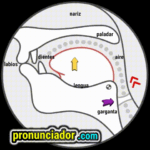
- The “Bunched R” (Tongue Body Humped UP & BACK):
- How: The TIP of your tongue stays DOWN (or just floats neutrally). Instead, the MIDDLE/BODY of your tongue BUNCHES UP into a “hump” and PULLS BACK high towards the roof of your mouth.
- CRITICAL: Sides of tongue may lightly touch your upper back teeth (molars) but again, NO FIRM, AIR-BLOCKING contact in the center with the alveolar ridge from the tip.
And Your Lips? They Get in on the Act Too!
For both R-types, your lips usually round slightly and push forward a little! Think of making a little “Ooooh” shape with your lips. This also contributes to the unique sound.
Super-Simple “R” Summary:
- Open your mouth slightly, lips round.
- TENSE your tongue! (Like a strong arm).
- Choose your favorite: CURL the tip UP & BACK (Retroflex R) OR BUNCH the middle of your tongue UP & BACK (Bunched R).
- REMEMBER: Tongue MUST NOT TOUCH or VIBRATE the roof of your mouth.
- Turn ON your throat buzz!
- Let the voiced air flow CONTINUOUSLY out the center of your mouth. “Rrrrrrr!”
It’s a strong, smooth, non-trilled, non-tapped hum/growl!
R-Colored Vowels: When ‘R’ Colors the Vowel!
This is where the magic happens!
In American English, when the /r/ sound comes immediately after a vowel, it doesn’t just sit there. It BLENDS with and “colors” the vowel sound, forming special R-Colored vowels like in:
- Bird /bɝd/ (stressed ER)
- Car /kɑr/ (AR sound)
- Door /dɔr/ (OR sound)
- Hair /hɛr/ (AIR sound)
- Here /hɪr/ (EAR sound)
- Fire /faɪr/ (IRE sound)
When you make these, your tongue goes into that /r/ position (Retroflex or Bunched) as you make the vowel sound itself, making it one continuous, blended unit! The vowels themselves actually change their quality in anticipation of the R.

Your “R” Journey: Making the /r/ Step-by-Step (Kid-Friendly!)
Let’s make that “RRRR” resonate clearly!
Step 1: Mouth Slightly Open, Lips Rounded (Gently).
Relax your jaw, letting your mouth open slightly. Your lips should be gently rounded and pushed forward a little, like a very soft “ooh” shape.
Step 2: TENSE Your Tongue! (Get it Ready!)
This is important! Make your tongue muscles tense and firm, like you’re getting ready to lift something heavy. It needs to be active for the R sound.
Step 3: Tongue in “R” Position (Curled OR Bunched) – NO TOUCHING!
Now, choose your preferred method for the R sound (either is fine!):
- Method A: The “Curled Tip” (Retroflex) R:
- Curl the TIP of your tongue UP and BACK (pointing towards the very back of your upper teeth/front part of roof).
- Crucial: It must NOT TOUCH the roof of your mouth. There should be a small gap.
- Method B: The “Humped Body” (Bunched) R:
- Keep your tongue tip DOWN, resting behind your bottom teeth.
- Raise the MIDDLE/BACK of your tongue up high into a “hump” and PULL it BACK towards your throat.
- The sides of your tongue may gently press against your upper back teeth. Again, the center should NOT TOUCH.
Step 4: Voice Motor ON! & Air Flow!
- Make sure your vocal cords (throat) are BUZZING! “Vrrrrr…”
- Release the voiced air over your tongue (through that central passage). The tension in your tongue and lips (rounded) helps shape this sound.
Kid-Friendly “Roar” Cue: “Imagine you’re a happy tiger! First, make a small ‘Ooooh’ shape with your lips, but tense them up. Then, make your tongue strong! Either point the tip back without touching (Retroflex) or pull the whole middle of your tongue back (Bunched). Turn your voice ON (GRRR!), and let the sound out, like a gentle, happy ‘Rrrrrrr!’ It should never ‘roll’ or ‘tap’ like drums!”
Key Feeling: Lips slightly roun
The American ‘R’ vs. ‘L’ Ultimate Showdown! (Block vs. No Block!)
This is probably THE biggest hurdle for many English learners! These two liquid sounds are often confused, but they’re made very differently.
| Feature | /r/ (American R) | /l/ (American L: Light or Dark) |
| Oral Obstruction? | NO FIRM CONTACT with alveolar ridge (approximant!) | TONGUE TIP FIRMLY TOUCHES alveolar ridge (lateral!) |
| Airflow Path? | OUT CENTER of Mouth (Central) | OUT SIDES of Tongue (Lateral) |
| Tongue Tip? | Curled up/back OR Down | Presses UP on Ridge |
| Tongue Body? | Often Bunched Up/Back (TENSE) | Light L: Flat/Forward; Dark L: Pulled UP/BACK |
| Lips? | Slightly Rounded | Neutral or slightly spread |
| Sound Quality? | Resonant, Continuous “Rrr” | Clear, Liquid “Lll” |
The Golden Rule: CONTACT for L, NO CONTACT for R!
- To make /l/: Your tongue tip TOUCHES that bumpy ridge.
- To make /r/: Your tongue tip DOES NOT TOUCH the bumpy ridge. It’s close, but there’s a gap!
This is what you MUST focus on!
The /r/ Spelling Story: Mostly ‘R’ & ‘RR’!
Good news again! The spelling for the /r/ sound is wonderfully consistent!
- Letter ‘R’ (The Overwhelming Champion!): About 98% of the time, the /r/ sound is spelled with a single ‘R’.
- run, read, right, really, room, reason, remember.
- from, try, great, friend, bring, brother, drink, dram, dry.
- (Also in blends: Cr, Dr, Fr, Gr, Pr, Tr, Shr, Thr, etc.)
- Double ‘RR’: Still just ONE /r/ Sound!
- When you see ‘RR’ together, it makes one single /r/ sound. The double letters are a spelling convention, usually signaling a short vowel before them, or a compound word.
- arrive /əˈraɪv/, correct /kəˈrɛkt/, hurry /ˈhɜri/, terrible /ˈtɛrəbəl/, cherry /ˈtʃɛri/, marry /ˈmɛri/.
Spelling Caveats for /r/:
- ‘WR’ (Silent W): Often sounds just like ‘R’ because ‘W’ is silent (write, wrong).
- ‘RH’ (Silent H): (rhyme, rhythm) – sounds just like ‘R’.
- Final ‘R’ (Silent in some non-American accents): Remember, in American English, ‘R’ is always pronounced where it’s spelled (e.g., in “car,” “brother,” “first”). This is called rhoticity. Some accents (like standard British) are non-rhotic and don’t pronounce ‘R’ after a vowel, so don’t get confused! Your /r/ needs to be there in American English!
Oops! Common “R”-elated Errors & Fixes!
Let’s clear up those frequent ‘R’ road-bumps!
- MISTAKE #1: THE ROLLING R / TAP R! (Making your /r/ vibrate or tap!)
- Problem: Instead of a smooth, continuous sound, your tongue tip rapidly taps/vibrates (trill [r̄]) or flicks once (tap [ɾ]) against the alveolar ridge. Sounds very non-native.
- THE #1 FIX: NO CONTACT! Remember, for American /r/, your tongue must NEVER touch or tap the roof of your mouth. Practice holding a soft, continuous “Rrrrrr” in isolation, making sure your tongue isn’t tapping. Focus on TENSION and not contact!
- MISTAKE #2: CONFUSING R AND L! (Using an L sound for R, or vice-versa!)
- The Glitch: Saying “light” for “right,” or “clean” for “cream.” Tongue tip often touching where it shouldn’t for R, or airflow path is wrong.
- THE #1 FIX: FOCUS ON TONGUE CONTACT (or LACK OF)!
- For R: Tongue NEVER touches ridge.
- For L: Tongue tip ALWAYS TOUCHES ridge (air flows laterally).
This is the most direct physical difference.
- MISTAKE #3: NO LIP ROUNDING FOR R (Making the /r/ too flat).
- Problem: Lips stay spread (like for ‘ee’ or ‘eh’) instead of rounding slightly. Your /r/ might sound dull or weak.
- The Fix: ROUND THOSE LIPS! Consciously engage your lips to gently round and push forward slightly as you make the /r/ sound. It helps give /r/ its characteristic resonance.
- MISTAKE #4: NO TENSION IN THE TONGUE! (A Weak or “Mushy” R).
- Problem: Your tongue muscles are too relaxed. The sound lacks clarity and strength.
- The Fix: TENSE IT UP! Whether you’re doing Retroflex or Bunched R, feel your tongue working actively. It should be firm, not floppy.
- MISTAKE #5: OVER-ARTICULATING ‘R’ IN CLUSTERS (e.g., in TR, DR, CR).
- Problem: Putting too much “umph” into the R sound in blends like “tree” or “dry,” causing it to sound choppy.
- The Fix: Make sure the R blends smoothly with the preceding consonant (T, D, C, etc.). The tension for the R is there, but the sound transitions without a break or too much separate puff/pop for the ‘R’ part. It should be one smooth, tight cluster: “Trrrr” (not “Tuh-rrrrr”).

Your “R”-Revolution! Practice Exercises for the American /r/!
Let’s run through these drills to make your “R” sounds absolutely rock!
Exercise 1: “The Rrrr” – Pure /r/ Power!
- Mouth slightly open, lips gently rounded/pushed. Tongue tense (curled tip OR bunched body), aiming up/back, but NO TOUCHING ridge! Voice ON.
- Make a long, steady, resonant hum: “Rrrrrrrrrrrrrrrrrrr…”
- Hold it for 5-10 seconds. Feel the tension in your tongue and lips. No vibrations!
Exercise 2: Light L vs. American R Showdown! (Block vs. No Block!)
This is your #1 battle! Feel the tongue tip!
- Light /laɪt/ (Tongue TOUCHES ridge!) — Right /raɪt/ (Tongue DOESN’T TOUCH ridge!)
- Lip /lɪp/ — Rip /rɪp/
- Glass /ɡlæs/ — Grass /ɡræs/
- Collect /kəˈlɛkt/ — Correct /kəˈrɛkt/
- Clean /klin/ — Cream /krim/
- Play /pleɪ/ — Pray /preɪ/
- Flow /floʊ/ — From /frʌm/ (or /frɑm/)
RECORD YOURSELF and LISTEN! Can you clearly hear your /l/s where your tongue touches, and your /r/s where it doesn’t?
Exercise 3: Consonant Cluster Coordination! (R-Blends)
Practice these tight, smooth clusters:
- TR-: Try, tree, truth, train, trip.
- DR-: Drive, drink, drum, draw, dream.
- CR-: Crab, crow, cry, crazy, crop.
- FR-: From, free, friend, frog, fright.
- GR-: Great, green, grow, grab, Greg (name).
- PR-: Problem, pretty, pray, print, proud.
RECORD YOURSELF to hear the smooth blend. No extra vowels between the consonants!
Exercise 4: R-Colored Vowel Spotlight! (Context for the /r/)
Recall the vowel sounds that blend with R. Practice them smoothly.
- AR: car, park, start, hard, far, arm, artist.
- ER: her, work, first, learn, bird, turn.
- AIR: hair, care, there, where, chair, share.
- EAR: hear, near, clear, year, beer.
- OR: for, door, sport, more, store, horse.
- IRE: fire, hire, tire, wire, desire, retire.
Exercise 5: Top 30 R-Word Workout!
| PHONETICAL PRONUNCIATION |
| PHONETICAL PRONUNCIATION |
For EACH word:
- Lips Round!
- Tongue Tense! (Curled OR Bunched).
- NO TOUCHING the roof!
- Voice ON!
- If it’s an R-Colored Vowel, make sure the vowel blends smoothly.
RECORD yourself and listen carefully for these key points!
Exercise 6: “Rainy Rides” Sentences! Put your /r/ to the Test! + RECORD!
Record yourself! Listen for your consistent American ‘R’, correct differentiation from ‘L’, and smooth blends!
- “A rat [r] rides [r] a train [tr] in the rain [r].” (Classic American R sentence from video!).
- “Really [r] rare [r] red [r] roses [r] grow in this room [r].”
- “I’ll run [r] around [r] to grab [gr] drink [dr] from [fr] my friend [fr].”
- “They promise [pr] to bring [br] their brother [br][r].”
- “Try [tr] to remember [m][br] the problem [pr][b]. It’s a great [gr] reason [r].”
FAQs: Your American R Sound (/r/) Questions Answered!
What’s the main secret to making the American R /r/ sound? (Kid-Friendly Answer!)
It’s a “NO-TOUCH, TENSE-TONGUE, HUMMING” sound!
- Your TONGUE gets TENSE, and either curls up/back (like an old phone cord) OR humps up/back (like a camel’s hump).
- Crucially, it DOES NOT TOUCH or TAP the roof of your mouth.
- Your lips round a bit.
- Your voice is ON, making a hum.
All the sound comes out through the middle of your mouth. “Rrrrrr!” (No rolls, no taps!).
How can I make my R /r/ sound different from my native language’s rolling or tapped ‘R’?
The key is to break the “touching” habit!
- Your native R: Likely involves your tongue tip quickly hitting or vibrating the roof of your mouth.
- American R /r/: Your tongue tip (if curled) or tongue body (if bunched) gets very close to the roof of your mouth, but NEVER touches or taps it! It’s an approximant, a sound where the articulators (tongue/palate) approach each other but don’t quite touch. Focus on feeling the tension in your tongue pulling back/up, not any contact point.
What’s the fastest way to stop confusing ‘R’ and ‘L’ sounds?
Focus on tongue placement for blocking airflow!
- For L /l/: Your tongue TIP ALWAYS touches the alveolar ridge, and air flows OUT THE SIDES of your tongue.
- For R /r/: Your tongue NEVER touches the alveolar ridge (it floats close, or bunches back), and air flows OUT THE CENTER of your mouth.
Practice this physical difference deliberately (e.g., ‘right’ vs ‘light’ with a mirror).
My tongue feels very tense when I try to make the American R. Is that normal?
Yes, absolutely! The American /r/ is classified as a “tense” consonant (compared to “lax” or relaxed sounds). You should feel muscle activity in your tongue (and often in your lips). If it feels relaxed, you might be making a different sound or an unclear ‘R’. This tension is crucial for creating the correct sound quality and distinguishing it from other sounds.
Does the /r/ sound make the vowels before it different? What are “R-colored vowels”?
Yes! This is a unique feature of American English! When the /r/ sound follows a vowel in the same syllable, the ‘R’ actually changes or “colors” the sound of that vowel. Your tongue (especially the back part) starts to move into the ‘R’ position as you say the vowel. This creates unique, blended R-colored vowels like:
- /ɑr/ in “car**”
- /ɝ/ in “bird“
- /ɔr/ in “for**”
- /ɛr/ in “hair**”
- /ɪr/ in “here**”
This means the vowels often don’t sound like their “plain” versions anymore before the ‘R’. You learn them as new, blended sounds.
Key Takeaways: Your American /r/ is “Right” On Track!
Fantastic work! You’ve successfully embarked on the “R”-evolution for your American accent! You now know that the American /r/ sound is a complex but conquerable non-trilled, non-tapped, continuous, voiced approximant, with its unique Retroflex and Bunched methods, and its power to color vowels.
Your “R”-esounding reminders:
- /r/ = TENSE Tongue + NO TOUCHING (Alveolar Ridge!) + Lips ROUNDED + Voice ON + Continuous AIRFLOW! (Approximant).
- STOP THE ROLL/TAP! This is the #1 mistake. Practice feeling tension, not contact.
- TWO WAYS to make /r/: Retroflex (tip curled) or Bunched (body humped). Pick your favorite!
- R vs. L = BLOCK vs. NO BLOCK! Tongue touches for L (air out sides), Tongue never touches for R (air out center).
- R-COLORED VOWELS: The /r/ influences and blends with the vowel before it. Learn them as fused sounds.
- SPELLING: Mostly ‘R’ or ‘RR’.
The core of mastering /r/ is unwavering tension in your tongue, consistent lip rounding, and strict avoidance of any tongue-tip contact or vibration. Keep practicing with a mirror, doing the minimal pair drills, and immersing yourself in native speech. Record yourself! Your “ready,” “run,” “right,” and “really” will soon sound perfectly, beautifully, and authentically American! You’re making real /rɪl/ progress!
👇🔥👇🔥👇🔥👇🔥👇🔥👇🔥
👉 RETURNS in the YEAR 2031 ! WHO? CLICK HERE ! 🔥



👇🔥👇🔥👇🔥👇🔥👇🔥👇🔥
👉 RETURNS in the YEAR 2031 ! WHO? CLICK HERE ! 🔥
👇🔥👇🔥👇🔥👇🔥👇🔥👇🔥


👉 RETURNS in the YEAR 2031 ! WHO? CLICK HERE ! 🔥

👉 RETURNS in the YEAR 2031 ! WHO? CLICK HERE ! 🔥
