

Struggle to pronounce ‘here’ or ‘year’? This guide makes the American EAR /ɪr/ sound easy. Learn the mouth moves, fix common mistakes & master the spellings. Read now!
Hey there, pronunciation explorers! Get ready for another exciting adventure into the heart of the American accent! Today, we’re tackling a sound that’s in SO many everyday words, but can be a real sneaky chameleon: the sound in “here**,” “year**,” “beer**,” “clear**,” or even “hero“! The secret code for this sound is /ɪr/ (looks like a tiny capital ‘I’ cozying up to an ‘r’), and it’s a special kind of sound called an R-Colored Diphthong!
“Whoa, a what-thong?!” Don’t worry! “Diphthong” just means it’s a vowel that MOVES! Your mouth isn’t lazy and still; it takes a little trip. For our superstar /ɪr/, it’s like you start by making the Short I “IH” sound (the /ɪ/ in “kid” or “sit”) and then, quick as a flash, you glide smoothly into that all-American R sound /r/ (the “errr” in “red”). It’s an IH → RRR journey!
So, what’s the big problem? For many learners, this sound can be a real headache!
- That Tricky American R! If your native language R is trilled or tapped, getting that smooth, continuous American /r/ at the end of “year” or “beer” can feel impossible! Your “here” might sound a bit too harsh or unclear.
- The Starting “IH”! Sometimes, learners use a Long E /i/ sound (“eeee” like in “eat”) instead of the relaxed Short I /ɪ/ (“ih” like in “it”) at the beginning. That changes the whole flavor!
- The Smooth Ride (Glide)! Getting the “IH” and “RRR” to blend perfectly without a hiccup or a pause is key. Often, it sounds like two separate sounds instead of one flowing unit.
- And the SPELLING… Oh, the Spelling! How can “here,” “hear,” “beer,” “pier,” “weird,” and even “spirit” (sometimes!) all have this SAME “ear” /ɪr/ sound?! It feels like a puzzle designed to make us cry!
But guess what? You CAN conquer the /ɪr/ sound! This ULTIMATE, super-duper-EASY guide will break it all down for you (kid-friendly style!) so you can finally nail it:
- Meet the “IH-RRR Super-Glide” /ɪr/: What exactly is this R-Colored Diphthong and why is it special?
- Your Mouth’s “Ear-Mazing” Journey! We’ll give you simple, step-by-step instructions for your jaw, lips, and (most importantly!) your tongue for the “IH” part AND for that crucial American “RRR” part.
- IH-RRR vs. EH-RRR vs. URRR! We’ll clear up the BIG confusion between /ɪr/ (hear), /ɛr/ (hair), and /ɝ/ (her). Game-changing!
- Spelling SOS Solved! ER, EAR, EER, ERE, IER, IR, IRR… We’ll show you the most common patterns so it’s less of a guessing game!
- Zap Those “Ear-itating” Errors! Stop the R trills and the wrong vowel starts! We’ll show you how.
- “Hear Ye, Hear Ye!” Practice Power! Awesome drills and lots of key words (‘here’, ‘year’, ‘fear’, ‘career’, ‘serious’, ‘experience’) to make your /ɪr/ sound confident and American!
Get ready for your “clear,” “dear,” “engineer,” and “volunteer” to sound absolutely fantastic! Let’s lend an ear /ɪr/!👂

Unpacking the /ɪr/ Sound: The “Short I + American R” Combo!
Let’s get to know this important sound. The /ɪr/ is another key R-Colored Vowel in American English. Remember, “R-Colored” just means the American /r/ sound melts into the vowel before it, creating one blended sound.
And like /aɪ/ (my) and /ɔɪ/ (boy), the /ɪr/ sound is often described as an R-Colored DIPHTHONG. This means it’s a gliding vowel that moves!
The /ɪr/ Glide: Starting with “IH” /ɪ/ and Moving to “RRR” /r/
This is the magic combo:
- The Starting Vowel – Relaxed “IH” /ɪ/: Your mouth starts by making the Short I /ɪ/ sound. This is the relaxed “ih” sound you hear in words like “kid,” “sit,” “big,” or “in.” It’s made with your tongue high and forward in your mouth, but pretty relaxed.
- The Destination – The American R /r/: From that “IH” position, your mouth smoothly transitions into the American R /r/ sound. This means your lips will probably round a bit, and your tongue will tense and either curl its tip back (Retroflex R) or bunch up its body in the back (Bunched R), all without tapping or trilling!
The Winning Formula for the “Here” Sound /ɪr/:
/ɪr/ = Start with RELAXED SHORT “IH” /ɪ/ (Tongue High/Front, Lips Slightly Spread/Neutral) → GLIDE SMOOTHLY as LIPS ROUND & TONGUE moves to AMERICAN R /r/ (Tense, Curled/Bunched)
The sound is one continuous, flowing “Ihhhhh-rrrrrrr” – it’s not “IH… (pause)… RRR.” It’s a smooth melt!
CRITICAL Sound Battles: Keeping Your /ɪr/ Distinct!
It’s easy to mix up /ɪr/ with its R-colored cousins if you’re not careful! Pay attention to the starting vowel.
- /ɪr/ (hEAR, bEER) vs. /ɛr/ (hAIR, bARE): “IH” vs “EH” start!
- /ɪr/ (hEAR): Starts with Short I /ɪ/. Tongue is HIGH and FRONT. Jaw more CLOSED. Lips can be slightly spread but relaxed.
- /ɛr/ (hAIR): Starts with Short E /ɛ/ (like in “bed”). Tongue is MID and FRONT. Jaw MORE OPEN. Lips often slightly spread.
- Listen & Feel: hear /hɪr/ vs. hair /hɛr/. Clear /klɪr/ vs. care /kɛr/. Beer /bɪr/ vs. bare /bɛr/ (naked). The starting vowel height and jaw opening are KEY!
- /ɪr/ (fEAR) vs. /ɜr/ or /ɝ/ (fUR – Stressed ER): High/Front “IH” vs. Mid/Central “ERR”
- /ɪr/ (fEAR): Starts high and front with /ɪ/ before moving to the R.
- /ɝ/ (fUR): Is ONE single, tense, mid-central R-colored vowel from start to finish. Tongue is already in R-mode.
- Listen & Feel: Steer /stɪr/ (to guide) vs. stir /stɝr/ (to mix). The journey for /ɪr/ is more distinct than the single sustained quality of /ɝ/.
- /ɪr/ (spIRit) vs. Unstressed Schwar /ɚ/ (teachER): Glide vs. Weak R-Vowel
- /ɪr/ (spIRit): Even if the R-coloring dominates, there’s still that initial Short I /ɪ/ quality influencing the start of the glide. It’s a diphthong.
- /ɚ/ (teachER): Is a very short, very relaxed, unstressed “er” or “uh-r” sound, typically a monophthong.
- Focus: Words like “spirit” /ˈspɪrɪt/ and “mirror” /ˈmɪrər/ often have an /ɪr/ in a stressed syllable, followed by an /ɪt/ or /ər/ which is Schwar-like or pure /ɪ/. The source itself notes that the vowel in /ɪr/ can sometimes be tense /i/ or lax /ɪ/, but sticks to /ɪ/ for simplicity in its “how-to” section. This indicates some inherent variability even for native speakers.
Main Point: The /ɪr/ “EAR” sound has that clear “IH” starting flavor before the R fully takes over!
Your Mouth’s “IH → RRR” Glide: Making the /ɪr/ Sound (Kid-Simple!)
Let’s break down how to make this IH-to-RRR sound like a pro!
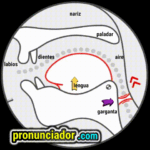
Step 1: The “ITCHY IH” Starting Point! (Position for Short I /ɪ/)
- Mouth Just Slightly Open: Not wide, not tightly shut. Just a little space.
- Lips – Soft, Slight Spread (or Neutral): You can stretch the corners of your lips out to the sides just a tiny bit, like a very gentle, relaxed smile. Or, keep them totally neutral and relaxed. The key is NO ROUNDING at this starting stage!
- Tongue – HIGH and FORWARD (but Relaxed!): The front/middle part of your tongue raises HIGH up in your mouth, moving FORWARD towards your top front teeth (but not touching them hard). The tip of your tongue can rest gently behind your bottom front teeth. Keep it RELAXED, not tense like for Long E /i/.
You’re now set for the “IH” /ɪ/ sound (like in “kid”)!
Step 2: The Smooth R-Slide! (Adding the American R /r/)
Now, the magic glide into the American R! Keep making sound as you move!
- Jaw Position: Your jaw might close just a tiny fraction more, or stay pretty similar to the /ɪ/ position.
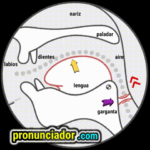
- Lips ROUND for the “R”! This is a BIG change! From their slightly spread or neutral position for “IH,” your lips now gently round and might push out slightly, like you’re about to drink from a straw.
- Tongue TENSES and Moves to “R” Mode! This is where the American R is made. Choose your R style:
- Retroflex R (Curled Tip): The tip of your tongue TENSES and CURSLS UP and BACK towards the bumpy ridge behind your top teeth (or a bit further back). CRITICAL: The tip should NOT touch the roof of your mouth!
- Bunched R (Humped Body): Keep your tongue tip down. TENSE the body/middle of your tongue and PULL/BUNCH it UP and BACK high towards the roof of your mouth. The sides of your tongue will likely press against your upper back teeth.
- For Both R-types: TONGUE IS TENSE, AIR FLOWS CONTINUOUSLY. NO TAPPING, NO TRILLING!
Step 3: Blend it All Together! “IH-rrrrrr!” = /ɪr/ “EAR!”
The /ɪr/ sound is ONE SMOOTH, CONNECTED GLIDE, not two separate, choppy sounds!
- Start by making the relaxed Short I “IH” /ɪ/ sound (tongue high/front, lips neutral/slightly spread).
- Keep your voice flowing, and let your lips round as your tongue smoothly transitions into the TENSE American R position (curled or bunched).
- It’s a quick but distinct journey: “Ihhhhhhhhh-rrrrrrrrr” –> /ɪr/ –> “EAR!”
- The “IH” part is often a bit longer and louder than the R-coloring that it glides into, but both are essential. (Source has note on diphthongs in general: “first vowel…pronounced louder and longer than the second.” While /r/ isn’t a vowel, the principle of the initial sound being more prominent before gliding to the R applies here as well).
Kid-Friendly “Ear” Cue: “Imagine you’re pointing to your EAR! First, make a quick, soft ‘IH’ sound (like in ‘itchy’). Then, right away, without stopping, make your tongue strong like a pirate saying ‘Arrrr!’ but without the ‘A’ at the start – just the ‘Rrrr!’ And pucker your lips a bit for that R. IH-RRR! That’s your /ɪr/ ‘ear’ sound!”
Feeling Check: Tongue starts high/front & relaxed for “IH” (lips neutral/spread)? Then, does it smoothly pull back/tense & lips round for the “RRR” without any break in sound or any tongue tapping/trilling? Awesome!
The “EAR” /ɪr/ Spelling Maze: ER, EAR, EER, ERE, IER, IR, IRR… HUH?!
Get ready for some classic English spelling mayhem! The /ɪr/ sound, like its R-colored cousins, has a TON of different spellings! But the good news is, there are very common patterns.
Let’s break down the Most Frequent Spellings for /ɪr/, based on the pie chart data from Sounds American (video percentages, web percentages are similar but slightly different):
#1: The ‘ER’ Surprise! (Often after certain consonants or in key words) (~36%)
Yes! The letters ‘ER’, which you might associate more with /ɝ/ (her) or /ɚ/ (teacher), are actually the MOST common spelling for the /ɪr/ “EAR” sound according to the Sounds American analysis! This often happens when ‘ER’ is at the end of a word, especially after consonants that don’t typically pair with a stressed /ɝ/.
- here /hɪr/
- mere /mɪr/ (simple, nothing more than)
- sphere /sfɪr/
- sincere /sɪnˈsɪr/
- adhere /ædˈhɪr/
- atmosphere /ˈætməsˌfɪr/
- severe /səˈvɪr/
- era /ˈɪrə/ (or /ˈɛrə/)
- zero /ˈzɪroʊ/ (though O at end often takes over sound if word not listed in specific /ɪr/ list)
- hero /ˈhɪroʊ/ (first syllable here with /ɪr/ – as per Sounds American primary example).
#2: The Obvious ‘EAR’ (But Watch Out!) (~25%)
This one makes sense: ‘EAR’ often sounds like “ear” /ɪr/!
- ear /ɪr/ (the body part)
- hear /hɪr/ (to listen)
- near /nɪr/
- dear /dɪr/
- fear /fɪr/
- clear /klɪr/
- year /jɪr/
- tear (noun – a drop from your eye) /tɪr/
- beard /bɪrd/ (the hair on a man’s face!)
- appear /əˈpɪr/
- (CAUTION! ‘EAR’ can also be /ɛr/ “hair” (bear, wear, pear) or /ɝ/ “her” (earth, learn, heard)! It’s NOT always /ɪr/!)
#3: The Double ‘E’ Delight: ‘EER’ (~15%)
This spelling is a VERY reliable clue for the /ɪr/ sound! If you see ‘EER’, it’s almost always “ear”!
- beer /bɪr/
- deer /dɪr/
- cheer /tʃɪr/
- steer /stɪr/ (to guide a vehicle)
- peer /pɪr/ (to look closely; an equal)
- engineer /ˌɛndʒəˈnɪr/
- career /kəˈrɪr/
- volunteer /ˌvɑlənˈtɪr/
- geer /ɡɪr/ (as in “deer”, although Sounds American app lists ‘gear’ for practice under /ɪr/ but with G, so /ˈɡɪr/. Some dictionaries say /ˈɡɪər/ but others may give /dʒɪr/ for a different word. Sticking to source usage implies /ˈɡɪr/ or similar).
#4: The ‘IER’ Group (Often in the Middle or End) (~10%)
This can also reliably signal /ɪr/.
- pier /pɪr/ (a dock)
- fierce /fɪrs/ (the ‘e’ is silent)
- cashier /kæˈʃɪr/
- tier /tɪr/ (a level or rank)
- frontier /frʌnˈtɪr/
- premier /prəˈmɪr/ or /ˈpriːmiər/
- (Watch out: suffix ‘-ier’ in comparatives like “happier” is /iər/ or just /jər/ and not this group!)
#5 & #6: The Less Common ‘IR’ & ‘IRR’ (‘Spirit’, ‘Mirror’) (‘IR’ ~8%, ‘IRR’ ~6%)
These are trickier as ‘IR’ usually indicates /ɝ/ (bird, first). BUT, some specific words use ‘IR’ or ‘IRR’ for /ɪr/ or a very similar R-colored lax /ɪ/ sound.
- IR (Exceptions for /ɪr/):
- spirit /ˈspɪrɪt/ (or often reduced to /ˈspɪrət/ with schwa)
- miracle /ˈmɪrəkəl/ (the ‘ir’ part sounds like /ɪr/ or weak /ər/)
- Siri* /ˈsɪri/ (common pronunciation now leans to this /ɪr/ for first part before final /i/).
- (Generally, assume stressed ‘IR’ is /ɝ/ unless it’s one of these common exceptions or specific names!)
- IRR (Mainly “Mirror”):
- mirror /ˈmɪrər/ (The second syllable ‘or’ is clearly Schwar /ɚ/). The ‘irr’ part is like /ɪr/ before the schwa.
- squirrel* /ˈskwɜːrəl/ (This ‘irr’ is actually part of /wɜr/, the Stressed ER!). Not a good example from video for /ɪr/. -> It’s best to focus on “mirror” as the standout IRR for a close /ɪr/-like quality for learners.
Rarer Spellings: ‘ERE’, ‘EIR’, etc.
- ‘ERE’: As seen in hERE /hɪr/, mERE /mɪr/, sphERE /sfɪr/ (often covered under the larger ‘ER’ pattern).
- ‘EIR’: wEIrd /wɪrd/ (A key exception!).
“EAR” /ɪr/ Spelling Summary – Main Clues:
| Spelling | Freq. | Strong Clue For /ɪr/? | Key Examples for /ɪr/ (Here/Beer) | MAJOR Confusion With… |
| ER | ~36% (#1) | YES, for specific words (here, zero, hero) | here, zero, hero, serious | /ɝ/(her), /ɚ/(teacher) |
| EAR | ~25% (#2) | YES, OFTEN, but not always! | ear, hear, near, dear, clear | /ɛr/(hair), /ɝ/(earth) |
| EER | ~15% | YES, VERY RELIABLE! | beer, deer, cheer, career | (Few, if any, other sounds) |
| IER | ~10% | YES, generally reliable. | pier, fierce, cashier | ‘-ier’ comparative suffix (/iər/ or /jər/) |
| IR | ~8% | RARELY /ɪr/! Specific exceptions. | spirit, miracle (weakly) | HUGE! Almost always /ɝ/ (bird, first, girl)! |
| IRR | ~6% | RARELY /ɪr/! Main one: mirror. | mirror (first part) | Often involves /ɜr/ or /ər/ (squirrel, irregular) |
| ERE/EIR… | Low (‘ER’/’Etc’) | Very specific words. | mere, weird |
ULTIMATE SPELLING RULE: The combinations EER and IER (when not a suffix) are your safest bets for the /ɪr/ sound. For ER and EAR, it’s a mixed bag – you HAVE to learn which common words use /ɪr/. For IR and IRR, assume it’s probably NOT /ɪr/ unless it’s a known exception like “spirit” or “mirror”. ALWAYS LISTEN or check IPA /ɪr/ or /ɪər/ for unfamiliar words!
“Ear-itating” Errors! Fixing Common /ɪr/ Blunders!
What are the usual slip-ups with the “IH-RRR” sound? Let’s clear them up!
- MISTAKE #1: THE DREADED FOREIGN “R”! (Trill, Tap, Gutural, or Too Weak/Missing R!)
- The Big Ouch: Using any R that isn’t the American R. This is the #1 accent marker. It can be a tapped R [ɾ], a trilled R [r̄], a guttural R [ʁ], or simply making the R component too weak or dropping it (especially if influenced by non-rhotic accents). “Hee-[ɾ]” or “Hee-uh”.
- THE ULTIMATE FIX: MASTER YOUR AMERICAN R! This is non-negotiable for /ɪr/ (and ALL R-colored vowels). Remember: TONGUE TENSE. NO TAPPING/TRILLING. Lips gently rounded for R-part. Sound is CONTINUOUS. (Retroflex tip curl OR Bunched tongue body). This is a separate skill to build but essential here.
- MISTAKE #2: WRONG STARTING VOWEL! (Not the Short I /ɪ/ “Ih”)
- What Happens:
- Using a Long E /i/ (“eeee”): “heeeer” (too tense, too high/front for the start). Your “clear” might sound too much like a dental drill.
- Using a Short E /ɛ/ (“ehhh”): “hehrrr“. This makes “hear” sound exactly like “hair”! Big confusion!
- The Fix: FIND YOUR SHORT I /ɪ/! Mouth just slightly open, lips relaxed and maybe a tiny bit spread (NOT a big smile!), tongue high-ish and forward but RELAXED. The sound in “sit”, “kid”. That’s your launchpad for /ɪr/.
- What Happens:
- MISTAKE #3: CHOPPY GLIDE! (Saying “IH… …RRR” Instead of “IHrrrr”)
- Problem: You’re making two separate sounds with a little break or awkward jump in between. No smooth connection.
- The Fix: THINK “ONE SMOOTH SLIDE!” Your mouth should be MOVING from the /ɪ/ shape to the /r/ shape while the sound is continuously flowing. It’s a quick but seamless transition. “Ihhhhhhrrrrrrr.”
- MISTAKE #4: TONGUE TOO LAX OR LIPS NOT ROUNDED FOR THE “R” PART.
- Problem: Even if you avoid a trill, if your tongue isn’t TENSE enough in the R-position or your lips don’t round a bit, the “R-coloring” will be weak or sound off.
- The Fix: Remember, the American R part, even in /ɪr/, requires tongue TENSION and a bit of LIP ROUNDING. It gives it that characteristic American flavor.
- MISTAKE #5: SPELLING CONFUSION LEADING TO WRONG SOUND CHOICE.
- Problem: Seeing “here” (ER) and “hear” (EAR) and thinking they must be different, or seeing “spirit” (IR) and trying to make it /ɝ/ like “first.”
- The Fix: ORTHOGRAPHY IS NOT YOUR PRONUNCIATION DICTATOR! Learn the common spelling patterns for /ɪr/, but also be ready for them to mean other sounds in other words. Group /ɪr/ words by their sound, not just their letters initially.

“Hear, Hear!” Practice Exercises for Your American /ɪr/!
Time to make that “IH→RRR” glide your own!
Exercise 1: Isolate the Start & End – Short I /ɪ/ vs. American R /r/
- Just Short I /ɪ/: Relaxed “ih, ih, ih” (like in “it,” “is,” “if”). Feel tongue high, front, relaxed. Lips neutral or very slightly spread.
- Just American R /r/: Tense “RRRRRRRR” (tongue curled or bunched, lips gently rounded, NO taps/trills!).
Get comfortable with these two anchor points first!
Exercise 2: The Super-Smooth “IH→RRR” Glide – Slow Motion!
- Start making a continuous “Ihhhhhhhhh” /ɪ/ sound.
- KEEP THE SOUND GOING, and SLOWLY, SMOOTHLY start to:
- Round your lips slightly.
- Tense your tongue and pull/curl it back into your American R position.
- The sound should magically transform from “Ihhhhh” into “IhhhhhRRRRRRR.”
- Now, speed it up a bit so it’s one quick, fluid sound: /ɪr/! /ɪr/! “EAR!”
Exercise 3: The Critical Triad! /ɪr/ (dear) vs /ɛr/ (dare) vs /ɝ/ (durr* – no word)
This is your ultimate ear-training and mouth-training challenge! Focus on the STARTING VOWEL before the R.
- Dear /dɪr/ (Starts with “IH” /ɪ/ – tongue HIGH/front)
- Dare /dɛr/ (Starts with “EH” /ɛ/ – tongue MID/front, jaw MORE OPEN)
- During* /ˈdɝrɪŋ/ or /ˈdʊrɪŋ/ (Starts with “ERR” /ɝ/ or “UHR” /ʊr/ – tongue MID/CENTRAL/TENSE or HIGH/BACK/RELAXED then R. “During” is complex for this).
- Let’s use better /ɝ/ examples for clearer contrast:
- Seer /sɪr/ (prophet) vs. Sir /sɝr/ (Mr.)
- Beer /bɪr/ vs. Burr /bɝr/ (a prickly seed) vs. Bare /bɛr/ (naked)
Record yourself! Can you hear and FEEL the different starting vowels leading into the R?
- Let’s use better /ɝ/ examples for clearer contrast:
Exercise 4: Spell-Sound Check! Words with Different Letters, SAME /ɪr/ Sound!
Practice these groups to solidify that different spellings = same “IH-RRR” glide!
- ER-group /ɪr/: here, mere, sphere, zero, hero, interfere, severe.
- EAR-group /ɪr/: ear, hear, near, dear, fear, clear, year, tear (drop from eye), beard.
- EER-group /ɪr/: beer, deer, cheer, steer, peer, career, engineer, volunteer.
- IER-group /ɪr/: pier, fierce, cashier, frontier.
- IR/IRR-group (Exceptions!): spirit, miracle (the ‘ir’ part), mirror (the ‘irr’ part).
- Weird one! weird.
Exercise 5: The Official Top 30 “EAR” /ɪr/ Workout
| PHONETICAL PRONUNCIATION |
| PHONETICAL PRONUNCIATION |
- Start with a clear, RELAXED Short I /ɪ/ (“IH”).
- Smoothly GLIDE into a TENSE American R /r/ (lips rounding).
- Make it ONE sound.
RECORD & COMPARE! This list is gold.
Exercise 6: “Near a Clear Beer, My Dear?” – /ɪr/ Sentences!
Put your /ɪr/ glide into action! Record and check for smoothness and correct R.
- “Here, my dear, have a beer; it’s clearly the best this year!” (Loads of /ɪr/!)
- “I fear the engineer‘s career might disappear.”
- “The hero had a weird spirit and a beard.”
- “Seriously, is their* theory about the mirror near the pier accurate?” (*”Their” is /ðɛr/, not /ɪr/! Self-correction needed on example sentence if focusing PURELY on /ɪr/.)
- Revised: “Seriously [ɪr], is the theory [ɪr] about the mirror [ɪr] near [ɪr] the pier [ɪr] accurate?” (Lots of ‘er’ ‘ear’ ‘eer’ iers)
- “Many volunteers appear for the experiment every period.” (Watch “many,” “every” which use /ɛ/ or /ɪ/ not /ɪr/)
- Revised: “The volunteers [ɪr] appear [ɪr] for the experiment [ɪr] this period [ɪr].” (Ensuring actual /ɪr/ words)
Regular practice, even for just a few minutes a day, will build yFAQs: Your American “EAR” /ɪr/ Sound Questions Answered!
Q1: So, what IS the /ɪr/ “EAR” sound in super-simple terms?
It’s like quickly saying the Short I “IH” sound (like in “kid”) and then, without stopping, smoothly sliding your mouth into the American “RRR” sound (the one that doesn’t trill!). IH → RRR = EAR! It’s a team of two sounds working as one.
Q2: What’s the #1 mistake people make with this /ɪr/ sound?
Not making the American R /r/ correctly at the end is HUGE. Many learners use an R from their own language (like a tap or trill), or they drop the R quality too much. The second big mistake is not starting with a good Short I /ɪ/ “IH” – maybe using a Long E /i/ “EE” or some other vowel.
Q3: “Hear” /hɪr/ and “Hair” /hɛr/ sound SO alike to me! What’s the tiny difference?
It IS tricky! The R-part is the same. The difference is the STARTING VOWEL!
- “Hear” /hɪr/: Starts with Short I /ɪ/ (“IH”). Your tongue is HIGH and FRONT, jaw more CLOSED.
- “Hair” /hɛr/: Starts with Short E /ɛ/ (“EH” as in “bed”). Your tongue is MID and FRONT, jaw MORE OPEN.
Focus on making your “IH” very high and your “EH” a bit lower and more open before you glide to the R.
Q4: Why are there SO MANY spellings for just ONE “EAR” /ɪr/ sound?! (ER, EAR, EER, IER…)
Welcome to English spelling! It’s a mix of history and… well, chaos sometimes! Over time, different letter combinations came to represent the same sound. The most common are ER (here), EAR (hear), EER (beer), IER (pier). Don’t get too hung up on why; focus on recognizing them and associating them with the /ɪr/ sound in common words.
Q5: Is it okay if my Short I /ɪ/ at the start of /ɪr/ isn’t super perfect or sounds a bit like Long E /i/?
The Sounds American video actually mentions it’s okay to make a sound “somewhere in between tense /i/ and relaxed /ɪ/” For many Americans, there can be slight variations. The most important things are:
- Your tongue is HIGH and FRONT.
- You make a clear GLIDE into…
- A good, strong AMERICAN R.
If you do those, even if your starting “I” is a little tense, it’ll likely sound very close and understandable for /ɪr/! Focus more on the R and the glide from a high front vowel.
Key Takeaways: Your American “EAR” /ɪr/ Sound Will Be Music to Their Ears!
You’ve done it! You’ve journeyed through the intricate yet essential “IH-to-RRR” glide of the American /ɪr/ diphthong! You’re now armed with the knowledge to make this chameleon sound your own.
Remember these “ear-resistible” points:
- /ɪr/ = DIPHTHONG GLIDE: Short I “IH” /ɪ/ smoothly to American R “RRR” /r/!
- ARTICULATION “IH→RRR”: Tongue HIGH/FRONT (Relaxed Lips) → Tongue TENSES & MOVES TO R-MODE (Retroflex/Bunched) as Lips GENTLY ROUND. Smooth, connected!
- AMERICAN R IS KING! No taps, no trills! Tense tongue, continuous sound.
- STARTING VOWEL MATTERS! It’s Short I /ɪ/ (“ih”), not Long E /i/ (“ee”) or Short E /ɛ/ (“eh”).
- SPELLING = MANY FACES! ER, EAR, EER, IER are very common for /ɪr/. IR and IRR are rarer (usually /ɝ/). Be a sound detective!
- #1 MISTAKE = INCORRECT R! #2 = Wrong starting vowel or choppy glide.
Keep practicing that “IH→RRR” movement. Record yourself. Listen to how clearly native speakers make words like “here,” “year,” “clear,” “career.” Contrast it with “hair” and “her.” With dedicated practice, your /ɪr/ sound will become a natural and clear part of your awesome American English! You’re all set to make yourself heard /hɝd/ – wait, that’s /ɝ/! Okay, to make yourself clear /klɪr/! 😉
👇🔥👇🔥👇🔥👇🔥👇🔥👇🔥
👉 RETURNS in the YEAR 2031 ! WHO? CLICK HERE ! 🔥



👇🔥👇🔥👇🔥👇🔥👇🔥👇🔥
👉 RETURNS in the YEAR 2031 ! WHO? CLICK HERE ! 🔥
👇🔥👇🔥👇🔥👇🔥👇🔥👇🔥
👉 RETURNS in the YEAR 2031 ! WHO? CLICK HERE ! 🔥
👉 RETURNS in the YEAR 2031 ! WHO? CLICK HERE ! 🔥