
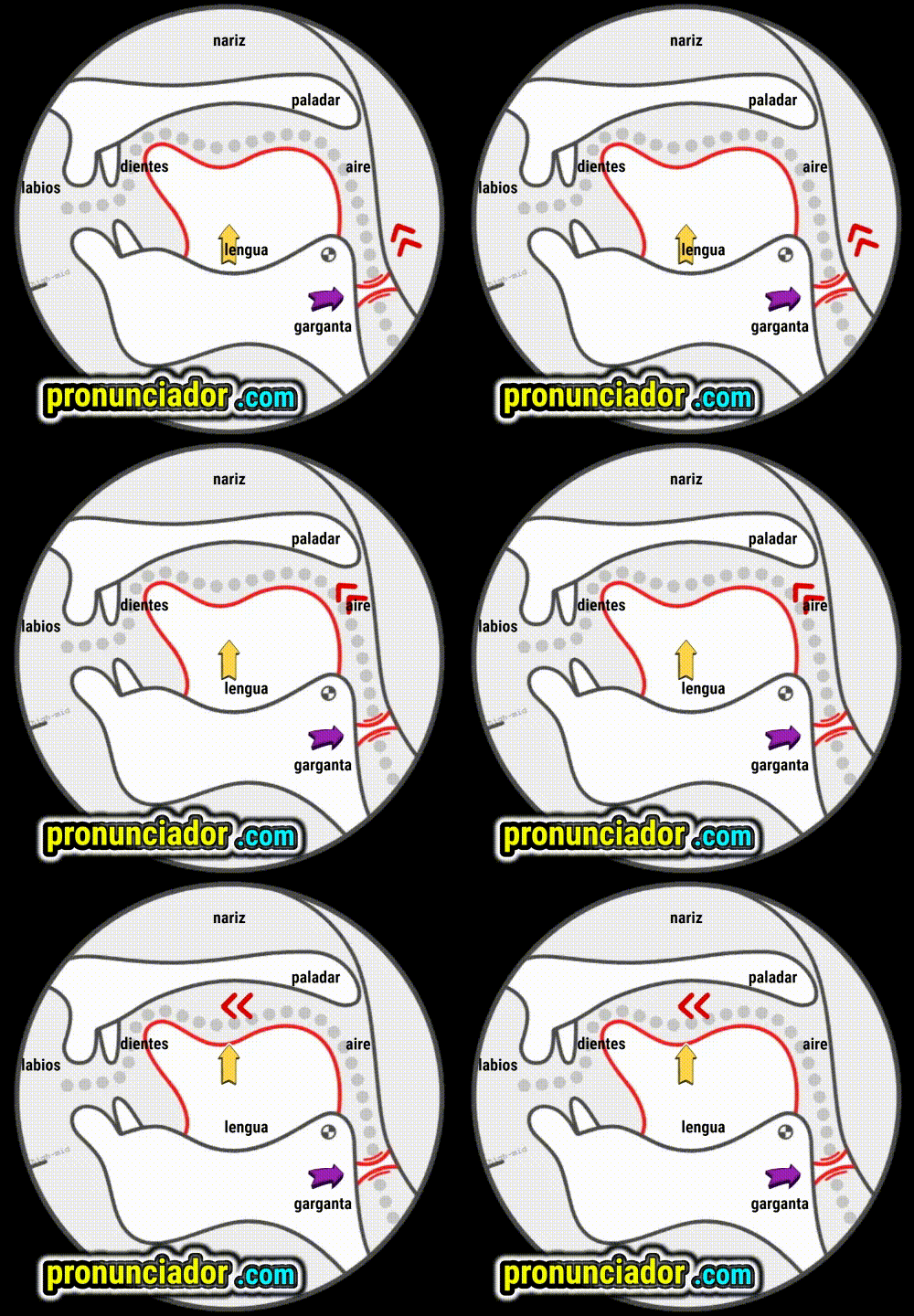
Master American T pronunciation! This guide covers the puff of air [tʰ], the T vs D sound, Flap T (water), & Glottal T (button). Learn the rules & speak clearly!
Hey there, future American accent icons! Get ready to transform one of the MOST frequent and fundamental sounds in English: the /t/ sound, as in “toy,” “time,” “get,” or “cat“! Its official phonetic symbol is just /t/ – looks easy, right? You use ‘T’ all the time! But here’s a little secret: the American /t/ is a master of disguise! It has different “moods” depending on where it is in a word, especially concerning a tiny (or big!) PUFF OF AIR! Getting this “air game” right is a massive step to sounding authentically American.
What’s the usual “T” trouble for learners?
- The “Flat T” Attack: Your “top” lacks that explosive “pop!” It sounds a bit dull, or even like a /d/ (“dop”). This happens when the essential puff of air is missing where Americans expect it.
- The “Too Much T” Trouble: You might be releasing a hard ‘T’ sound at the end of words like “cat-HUH!” when Americans often “hold” or soften it.
- The “S-T-eak” vs “S-Puff-Teak” Puzzle: Do you puff air after ‘S’ in “stop”? (Hint: Americans usually don’t!).
- The “Water” & “Button” Mystery: And then there are words like “water” where the ‘T’ magically sounds like a fast ‘D’ (that’s a Flap T!), or “button” where the ‘T’ seems to vanish into a little throat catch (a Glottal T!). Mind-boggling!
- Spelling Sneaks: ‘T’, ‘TT’, the tricky ‘-ED’ ending (did he “walkt” or “walkd“?), and what about ‘TH’ – is that ever a /t/? Aaargh!
You feel it, right? That one little letter ‘T’ can be a pronunciation minefield, making your English sound less fluent and a bit “off.” You want that crisp, clear, dynamic American sound, but the ‘T’ just isn’t cooperating!
But guess what? We’re about to give you the Official American T-Code Handbook! This ultimate, super-duper-EASY guide will turn you into a /t/ titan:
- Meet the Amazing Alveolar /t/: What is this “tongue-tip-tap-no-voice” sound, really?
- The #1 Game-Changer – The “PUFF OF AIR” (Aspiration! [tʰ]): The ULTIMATE secret! We’ll teach you the 3 Golden Rules for when to use a BIG puff, when to use NO puff (Held T [t̚]), and when it’s just a clean, quiet [t]!
- T vs. D – The EPIC Showdown! Finally, learn how to make your /t/ (NO throat buzz!) undeniably different from /d/ (WITH buzz!).
- Mouth Moves for a Terrific /t/ (Kid-Friendly!): Easy, step-by-step guide to perfect tongue placement and air release.
- Flap T (“Water”) & Glottal T (“Button”) Demystified! We’ll briefly introduce these common /t/ variations so you know what they are (full guides coming soon!).
- Spelling Sorted! T, TT, -ED, and rare TH exceptions. We’ve got you covered.
- Zap Common “T”-errible Mistakes! Stop flat T’s, D-confusion, and wrong puffs!
- “Take Ten!” Practice Power! Awesome drills and tons of common words (‘time’, ‘get’, ‘stop’, ‘what’, ‘about’) to train your terrific T!
Get ready for your “to,” “it,” “that,” “want,” and “light” to sound top-tier American! Let’s talk T!
What is This American /t/ Sound? (The “Tongue-Tap-No-Buzz” Pop!)
First up, let’s get formal with the American /t/ sound. You hear it at the start of “toy” and “time,” in the middle of “attend,” and at the end of “get” or “liked” (past tense -ed can be /t/!).
It’s a consonant, and it’s part of the “Super Six” Stop Consonants in American English, which are sounds where we block the air for a tiny moment and then let it out in a little burst. The others are /p, b, d, k, g/. It’s also the second most common consonant sound in American English, right after /n/! So, it’s a big deal!
Its Secret Identity Code (Explained Super Simply!)
The sound scientists call /t/ an “alveolar, voiceless, stop consonant.”. Let’s make that totally easy:
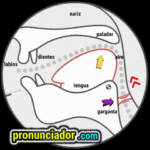
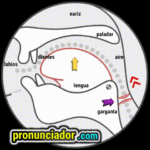
- Alveolar (Tongue Taps Behind Top Teeth!): “Alveolar” just means it’s made on the alveolar ridge. That’s the bumpy bit on the roof of your mouth right behind your upper front teeth. For /t/, the very TIP of your tongue (or the flat part just behind the tip, called the blade) taps or presses firmly against this ridge to make the block. This is the same spot as for the /d/, /n/, /l/, /s/, and /z/ sounds!
- Voiceless (NO Throat Buzz – Shhh!): This is super important! Your vocal cords (your voice box in your throat) are OFF. They DO NOT vibrate. The /t/ sound is made only with a puff or pop of air. If you touch your throat while saying “t-t-t-t,” you should feel absolutely no buzzing. It’s the quiet twin of the buzzy /d/ sound.
- Stop (Air BLOCKS, then POPS Out!): Like a tiny explosion! First, your tongue tip pressing on the alveolar ridge completely stops the airflow from your lungs for a micro-second. Then, when you quickly pull your tongue tip away, the trapped air bursts out. “T!”
Kid-Friendly “Tick-Tock” Summary for /t/:
- Open your mouth just a little, lips relaxed.
- Tap the tip of your tongue just on that bumpy part behind your top front teeth, like a little door closing.
- Keep your voice box quiet (no throat hum!).
- Then, quickly pull your tongue tip down and let a little puff or pop of air escape! “T!” Like a clock going “tick-tock”!
The Crucial “T vs. D” Sound Battle: AIR vs. BUZZ!
The /t/ sound (“time”) and the /d/ sound (“dime”) are like brother and sister. They are both made with the tongue tip in the exact same spot (alveolar ridge) and are both stop sounds (air pops).
The ONE HUGE Difference = VOICING (Throat Buzz) & The TYPE OF AIR PUFF!
| Feature | /t/ (Time, Bet, Light) | /d/ (Dime, Bed, Lied) |
| Tongue on Ridge? | YES! | YES! |
| Air Stops & Pops? | YES! | YES! |
| THROAT BUZZING? | OFF! (VOICELESS – Just Air) | ON! (VOICED – With Buzz!) |
| PUFF OF AIR (Initial/Stressed)? | STRONG PUFF! [tʰ] | Gentle/Slight Puff [dʰ] (if any) |
Super Common Mistake for Learners:
- Not making initial/stressed /t/ airy enough [tʰ], so it sounds like /d/. “Time” sounds like “Dime.”
- Making final /d/ voiceless, so it sounds like /t/. “Bed” sounds like “Bet.”
The Instant Fix (Again!): THROAT CHECK & AIR CHECK! - For Voice: Fingers on throat. /t/ = NO VIBRATION. /d/ = VIBRATION. Practice “ta-ta-ta” (no buzz) then “da-da-da” (buzz!).
- For Air (initial/stressed): Paper test (see next section!). /t/ = BIG puff. /d/ = little or no puff.

The American T’s Secret Weapon: The “Puff of Air” (ASPIRATION!) [tʰ], [t̚], [t]
This is it, folks! ASPIRATION is THE key to making your /t/ (and /p/ and /k/) sound truly American and not flat or misunderstood.
What IS Aspiration, Super Simply?
It’s that extra puff of air that comes out with voiceless stops /t/, /p/, /k/ when they are in certain positions. It’s like a tiny, silent “h” attached: [tʰ]. For /t/, this puff can be quite strong!
The 3 Golden Rules for the American /t/ Air Game:
Rule #1: ASPIRATED /t/ [tʰ] – BIG PUFF OF AIR! (Think “Time!”) 💨
Your /t/ gets a STRONG, noticeable puff of air when it is:
- A) At the VERY BEGINNING of a word:
- Time /taɪm/ → [tʰaɪm] (Sounds like “T-HIME”)
- Take /teɪk/ → [tʰeɪk]
- Toy /tɔɪ/ → [tʰɔɪ]
- Tell /tɛl/ → [tʰɛl]
- Top /tɑp/ → [tʰɑp]
- B) At the BEGINNING of a STRESSED (Strong) Syllable in a word:
- Contain /kənˈteɪn/ → /kənˈtʰeɪn/ (stress on ‘tain’)
- Attend /əˈtɛnd/ → /əˈtʰɛnd/ (stress on ‘tend’)
- Return /rɪˈtɜrn/ → /rɪˈtʰɜrn/ (stress on ‘turn’)
- Until /ʌnˈtɪl/ → /ʌnˈtʰɪl/ (stress on ‘til’)
- Tomorrow* /təˈmɑroʊ/ → (/təˈmɑroʊ/, T is often Flap T /ɾ/ here if preceded by vowel/voiced and before unstressed vowel. Better example for stressed syllable from video: con-TAIN) The video’s “contain” is a perfect example for aspirated /t/ starting a stressed syllable.
Easy Paper Test for Aspirated [tʰ]: Hold a thin piece of paper or your hand a couple of inches from your mouth. Say “Time!” with feeling. The paper should JUMP with the puff of air! If it barely moves, you need more [tʰ]!
Rule #2: UNASPIRATED /t/ [t] or HELD/UNRELEASED /t/ [t̚] – NO BIG PUFF! (Think “Light!”) 🤫
Your /t/ has NO strong puff of air (or very little release) when it is:
- A) At the VERY END of a word (before a pause, or often before another consonant in the next word): This is often called the “Final Stop Rule” or “Unreleased T” or “Held T”.
- Your tongue goes to the /t/ position (tip on the ridge), STOPS the air, but then you don’t really pop it out strongly.
- Often, it’s UNRELEASED [t̚]: The tongue makes contact and just STAYS there for a moment, cutting off the sound sharply without any audible “tuh” release. This is very common!
- Light /laɪt/ → /laɪ[t̚]/ (Tongue goes up, sound stops, no “tuh” pop).
- Cat /kæt/ → /kæ[t̚]/
- Boat /boʊt/ → /boʊ[t̚]/
- Get /ɡɛt/ → /ɡɛ[t̚]/
- What /wɑt/ or /wʌt/ → /wʌ[t̚]/
- Sometimes, there’s a very soft, unaspirated release [t] if linking to a vowel in the next word (“What‿is it?”), but still NO STRONG PUFF.
Rule #3: UNASPIRATED /t/ [t] – Clean Release, NO Puff! (Think “Stop!”) 🐍
Your /t/ has NO strong puff, but a CLEAR (though softer) release when it is:
- IMMEDIATELY AFTER an /s/ sound (in an ST-, STR-, SCR- consonant cluster): The /s/ does something magic and “eats” the aspiration of the /t/!
- Stop /stɑp/ → (The /t/ is a clean, quiet pop, NOT [stʰɑp]!).
- Still /stɪl/
- Street /strit/
- Study /ˈstʌdi/
- Stable /ˈsteɪbəl/
- List /lɪst/ (final ST still means /t/ is unaspirated if released)
- Faster /ˈfæstər/ (medial ST)
Quick Aspirated /t/ Recap – The Air Game:
| ‘T’ Position | AIR PUFF? | IPA-ish | Example |
| BEGINNING of Word | YES! Strong Puff! | [tʰ] | Time |
| BEGINNING of STRESSED Syllable | YES! Strong Puff! | [tʰ] | Attend |
| END of Word (before pause/stop) | NO PUFF! (Often Held) | [t̚] or soft [t] | Cat |
| AFTER ‘S’ (in ST- cluster etc.) | NO PUFF! (Clean pop) | [t] | Stop |
Why this MATTERS SO MUCH:
- No puff [tʰ] for initial/stressed /t/ → Sounds like /d/ or very flat and unclear. “Time” can be “dime.”
- Puffing [tʰ] for final /t/ or after /s/ → Sounds very foreign and over-enunciated (“cat-HUH!”, “s-t-HUH-op!”).
Nailing these three “air states” of /t/ is like finding the secret keys to an American accent!
Your Mouth’s “T-Pop” Action: Making the /t/ (Kid-Friendly Steps!)
Let’s get that tongue tapping perfectly!
Step 1: Mouth Just Slightly Open, Lips Chillin’.
Keep it simple! Your mouth is just slightly open, relaxed. Your lips are in a neutral, natural position – not smiling, not rounding. They’re just… there.
Step 2: Tongue Tip – Quick TAP Behind Top Teeth!
This is where the /t/ is born!
- Take the very tip of your tongue (or the flat part just behind it, called the tongue blade).
- Quickly TAP or PRESS it firmly against that bumpy part right behind your upper front teeth (the alveolar ridge). It should make a good seal to stop the air for a tiny moment.
Step 3: Voice Box = SILENT MODE! (No Buzzing!)
Crucial for /t/! Your throat (vocal cords) should be completely OFF. No vibration, no hum. Purely an air sound.
Step 4: The “Pop” Release! (Air Control is Key!)
Now, pull your tongue tip quickly down and away from the ridge, letting the trapped air escape. This is where the Aspiration Rules dictate how that air comes out!
- For Aspirated [tʰ] (“Time”): As you pull your tongue down, let out a SHARP, STRONG PUFF of air with the “t” pop! “T-HUH!” Feel it on your hand!
- For Unaspirated/Held Final [t̚]/[t] (“Cat”): As you pull your tongue down (or even as it’s still touching), cut the sound off sharply. NO big puff. The air stops, or is released very, very gently. Often, Americans just make the tongue contact and don’t fully release the “t” audibly before a pause – that’s the “Held T” [t̚].
- For Unaspirated After /s/ [t] (“Stop”): Pull the tongue down and release a CLEAN, QUIET “t” pop with NO extra puff.
Kid-Friendly “Tiny Tapper” Cue: “Imagine your tongue tip is a tiny hammer. Tap it quickly on the bumpy roof just behind your top teeth! ‘T-T-T!’ Keep your voice quiet, just let a little puff of air sneak out if it’s at the start of a word, like a tiny ‘tick!’ from a clock!”
Feel the Stop & Pop! Practice “t-t-t” trying all three air releases: Strong Puff [tʰ] / No Puff (Held) [t̚] / Clean No-Puff [t].you the correct technique but also allow you to compare your pronunciation with that of native speakers.

The American T’s Other Faces: Flap T & Glottal T (Quick Intro!)
The American T is a true shapeshifter! Besides the three “air versions” we just learned ([tʰ], [t̚]/[t]), it has TWO MORE common ways it can sound in fast, natural speech. These are called Positional Variations or Allophones. We have full guides on these, but here’s a super quick peek so you know they exist:
- The Flap T [ɾ] (Sounds like a fast ‘D’!):
- When? When ‘T’ or ‘TT’ is between two voiced sounds (usually vowels or vowel + voiced consonant like L/R/N/M) AND the syllable AFTER the T is UNSTRESSED (weak).
- What is it? A super-fast, VOICED tap of the tongue tip on the alveolar ridge. It sounds almost exactly like a quick American D, or the ‘r’ in Spanish “pero.”
- Examples: water (sounds like “wader”), city (“cidy”), better (“bedder”), little (“liddle”), party (“pardy”).
- If you say a clear, hard [tʰ] here, it sounds very British or over-enunciated for American English.
- The Glottal T [ʔ] (The “Throat Catch T”!):
- When? Most clearly and consistently when ‘T’ or ‘TT’ is BEFORE an UNSTRESSED syllable ending with an /n/ sound. Usually at the end of words like “-tain,” “-ton,” “-ten.”
- What is it? Instead of your tongue making the /t/ sound, the sound is stopped way down in your throat (glottis) by your vocal cords snapping shut for a moment. It’s like the tiny pause in “uh-oh!” ([ʌʔoʊ]). The tongue might go to the /t/ position but no air is released from there.
- Examples: button (sounds like “buʔ-uhn” where the -on is a syllabic N), kitten (“kiʔ-uhn”), certain (“cerʔ-uhn”), mountain (“mounʔ-uhn”), important (the T before -ant is often /ʔ/).
- If you say a clear, popped [t] here, it also sounds less typical of casual American speech.
Why know these? Because if you try to apply the 3 “air rules” for [tʰ]/[t̚]/[t] in Flap T or Glottal T situations, it will sound very unnatural! You need to use the Flap T or Glottal T sound instead in those specific contexts to sound truly American. (Check out our full guides on those two awesome T-variations!)
Spelling the Basic /t/ Sound: Mostly Easy, with -ED & TH Twists!
For our “normal” /t/ sounds ([tʰ], [t̚], [t]), the spelling is thankfully quite simple!
The #1 Champion: Letter ‘T’! (~98%!)
Yes! The overwhelming majority of the time you see the letter ‘T’, it will represent one of our /t/ sound variations (aspirated, unaspirated, or held)!
- time, to, it, what, get, out, tell, cat, light, left.
The Double Act: ‘TT’! (Can be /t/ or Flap T/Glottal T)
When you see ‘TT’, it still just makes ONE /t/ sound. The double letters usually mean the vowel before it is short.
- Context for Aspirated/Unaspirated /t/:
- Attach /əˈtætʃ/ (The ‘TT’ here is actually for the /tʃ/ “CH” sound!) -> Self-correction! This is a BAD example for plain /t/ from the source!
- Better: Attic /ˈætɪk/ (First T part of Flap /ɾ/ here, or aspirated if stressed very carefully /ˈæt.tɪk/). Matter /ˈmæɾɚ/ (Flap T). Butter /ˈbʌɾɚ/ (Flap T).
- Letter /ˈlɛɾɚ/ (Flap T).
- The challenge with “TT” examples for the basic /t/ is that SO MANY fall into Flap T [ɾ] or Glottal T [ʔ] contexts when they are between vowels or before unstressed /n/!
- Words where TT might be a clearer plosive /t/ are rarer, e.g., at syllable boundaries where stress blocks flapping, or in very careful speech: “outtake” (if not flapped), “cattail” (if first T isn’t fully flapped before second syllable T). This needs careful example selection for an 8-year-old understanding.
For Simplicity: When ‘TT’ ISN’T making a Flap T or Glottal T, treat it like a single ‘T’ for aspiration rules (e.g., if it started a stressed syllable and wasn’t flappable, it would be aspirated [tʰ]).
The “-ED” Past Tense Ending = /t/! (SUPER Important!)
This is a HUGE one for learners! When regular verbs end in a VOICELESS consonant sound (other than /t/ itself), the “-ED” ending is pronounced as a clear /t/ sound (usually unaspirated [t]).
- Voiceless sounds include: /p, k, f, θ, s, ʃ, tʃ/.
- Look + ed → Looked /lʊkt/
- Help + ed → Helped /hɛlpt/
- Wash + ed → Washed /wɑʃt/
- Watch + ed → Watched /wɑtʃt/
- Ask + ed → Asked /æskt/
- Laugh + ed → Laughed /læft/ (GH=/f/ is voiceless!)
- Dance + ed → Danced /dænst/ (CE=/s/ is voiceless!)
- Fix + ed → Fixed /fɪkst/ (X=/ks/, S is voiceless!)
(This contrasts with -ED = /d/ after voiced sounds, and -ED = /ɪd/ or /əd/ after T/D sounds).
“TH” as /t/ – RARE Exceptions! (Not the TH Sound!)
Normally, ‘TH’ spells the /θ/ (“think”) or /ð/ (“this”) sounds. BUT, in a tiny handful of proper names or very old words (often of Germanic/Greek origin that didn’t fully shift), ‘TH’ CAN sound like /t/. These are true EXCEPTIONS.
- Thomas /ˈtɑməs/
- Thames /tɛmz/ (the river in London, though AmE often says /θeɪmz/ now too)
- Thyme /taɪm/ (the herb)
- Neanderthal /niˈændərˌtɔl/ or /niˈændərˌθɔl/ (can be /t/ or /θ/)
- Posthumous /ˈpɑstʃəməs/ (h is silent, ‘t’ follows?) -> No, this is /pɑs.tʃə.məs/, the T is part of CH. Better to stick to Thomas/Thames/Thyme.
Don’t worry much about these. 99.9% of the time, TH is /θ/ or /ð/.
Silent ‘T’ Words – When ‘T’ Goes Ghost! 👻
Just like silent ‘P’, ‘T’ also has its disappearing acts!
- Often in -STEN, -FTEN, -STLE endings:
- Listen /ˈlɪsən/ (T is GONE! Sounds like “LISS-uhn”)
- Castle /ˈkæsəl/ (“CASS-uhl”)
- Whistle /ˈ(h)wɪsəl/ (“WHISS-uhl”)
- Often /ˈɔfən/ or /ˈɑfən/ (T is OFTEN silent! “OFF-uhn”)
- Soften /ˈsɔfən/ (“SOFF-uhn”)
- Christmas: /ˈkrɪsməs/ (T is silent! “KRISS-muss”)
- Specific French Loanwords (final T often silent before linking):
- Ballet /bæˈleɪ/ (T sounds in French but often silent or very light in English use) -> Usually the T is heard in American English.
- Buffet /bəˈfeɪ/ (If stress on -fet) or /ˈbʌfɪt/ (if stress on bu-). -> The /eɪ/ ending usually means the T is silent as in French.
- Gourmet /ɡɔrˈmeɪ/ (Silent T).
- Debut /deɪˈbju/ or /ˈdɛbju/ (Silent T).
- Rapport /ræˈpɔr/ (Silent T).
- In -TCH- (like “watch,” “kitchen”): The T here is part of the /tʃ/ “CH” sound, not a separate /t/.
Again, these are specific words/patterns to learn. Most T’s make a sound!
Uh-Oh! Common /t/ Blunders & Their Instant Fixes!
Let’s zap those typical T troubles!
- MISTAKE #1: “FLAT T” – MISSING THE [tʰ] AIR PUFF! (The BIGGEST One!)
- Problem: Your initial/stressed “T”s lack that American explosion of air. “Time” sounds weak or even like “dime.” This is the #1 issue!
- THE FIX: PRACTICE THE PUFF! Hold paper to your lips. For “Top,” “Take,” “Today,” MAKE THE PAPER DANCE! Exaggerate that “T-HUH!”
- MISTAKE #2: PUFFING EVERYWHERE! (Aspirating Final /t/ or /t/ in ST-)
- The Glitch: You put the [tʰ] puff at the end (“caT-HUH!”) or after ‘S’ (“sTop-HUH!”). Sounds very unnatural.
- THE FIX: OBEY THE 3 AIR RULES!
- END of word = NO PUFF (often Unreleased/Held [t̚]).
- AFTER ‘S’ (ST-) = NO PUFF (clean, quiet [t] pop).
- MISTAKE #3: “D” FOR “T” (Final /t/ Becomes /d/ or Final /d/ becomes /t/)
- Problem: Confusing voiceless /t/ with voiced /d/ at word endings. “Light” sounds like “Lied.” “Bed” sounds like “Bet.”
- Solution: THROAT BUZZ CHECK! /t/ final = Tongue tap + NO BUZZ + NO PUFF. /d/ final = Tongue tap + BUZZ ON + NO PUFF. Critical difference!
- MISTAKE #4: USING A HARD /t/ in “WATER” or “BUTTON” (Not Using Flap/Glottal T).
- Problem: Saying “waTer” with an aspirated [tʰ] or “buTTon” with a popped [t] sounds too precise or foreign for typical American speech.
- Solution: LEARN THE FLAP T & GLOTTAL T! Recognize those contexts (“T between vowels before weak vowel” → Flap /ɾ/; “T before unstressed -N ending” → Glottal /ʔ/). These need their own full lessons, but awareness is key!
- MISTAKE #5: PRONOUNCING SILENT ‘T’s!
- **Oops!: ** Saying the ‘T’ in “listen” or “castle.”
- Easy Fix: MEMORIZE those silent ‘T’ words/patterns! When you see -sten, -stle, -ften, the ‘T’ is usually taking a break!
“Tick-Tock, Time to Talk!” /t/ Practice Power-Up!
Let’s make that American /t/ terrific!
Exercise 1: The “Air Puff” Power Drill! ASPIRATED /t/ [tʰ]
Grab your paper! Make it flutter! Focus on that SHARP puff!
- Time! Take! Toy! Tell! Top! Ten! Tea! Team!
- (Stressed Syllables): Attend! Contain! Return! Until! Hotel! Tomorrow! (If T is first in stressed syllable).
Exercise 2: The “Quiet End” Drill! UNRELEASED/HELD FINAL /t/ [t̚] or Unaspirated [t]
Tongue tip up to the ridge, cut off the sound cleanly. NO PUFF!
- Light. Cat. Boat. Get. What. Not. But. Out. Right. Night.
- (Try saying “cat” and then immediately close your mouth, holding the T tongue position. That’s the held T!).
Exercise 3: The “Smooth ST-” Drill! UNASPIRATED /t/ [t] after /s/
Flow the /s/ right into a clean, non-puffy /t/.
- Stop. Still. Street. Study. Star. Stay. Stand. Story. Stage.
- List. Best. Most. Fast. Test. Last.
Exercise 4: The T vs. D Showdown! (NO BUZZ vs. BUZZ; STRONG PUFF vs. SLIGHT/NO PUFF)
Focus on the voice for D and the strong AIR for initial T.
- Tie [tʰaɪ] — Die [dʰaɪ]
- Train [tʰreɪn] — Drain [dʰreɪn]
- Bet [bɛt̚] — Bed [bɛd]
- Heart [hɑrt̚] — Hard [hɑrd]
- Sent [sɛnt̚] — Send [sɛnd]
- Plight [plaɪt̚] (predicament) — Blighted* [ˈblaɪdɪd] (using -ED as /d/ here) – Not perfect, try: Wright (artisan) /raɪt/ — Ride /raɪd/
Exercise 5: Silent T Stealth Mode! (Don’t Say It!)
Practice these, letting the T disappear!
- Listen (LISS-uhn)
- Castle (CASS-uhl)
- Often (OFF-uhn)
- Christmas (KRISS-muss)
- Soften (SOFF-uhn)
- Whistle (WHISS-uhl)
Exercise 6: -ED Endings as /t/! (After Voiceless Sounds)
Feel that crisp /t/ sound (no strong puff) for these past tenses:
- Looked /lʊkt/, Asked /æskt/, Helped /hɛlpt/, Laughed /læft/, Washed /wɑʃt/, Watched /wɑtʃt/, Danced /dænst/.
Exercise 7: Top 30 Word /t/ Analysis + RECORD!
| PHONETICAL PRONUNCIATION |
| PHONETICAL PRONUNCIATION |
- Is the T Aspirated [tʰ] (Initial/Stressed Syllable)?
- Is it Unaspirated/Held [t̚]/[t] (Final)?
- Is it Unaspirated [t] after /s/?
- OR is it a Flap T [ɾ] (like ‘what about’) or Glottal T [ʔn̩] (like ‘gotten’)?
This requires careful thought for each word!)
RECORD yourself and listen for those critical air/no-air distinctions!
Remember, every minute you spend practicing brings you closer to mastering the sound. The more you incorporate these tips into your daily routine, the more natural your pronunciation will become.
FAQs: Your American /t/ Sound (“Time,” “Toy”) Questions Answered!
Q1: What is THE most important thing to remember for the American /t/ sound?
ASPIRATION (the puff of air)! Knowing WHEN to use a strong puff [tʰ] (start of words/stressed syllables) and when NOT to (end of words [t̚], after ‘s’ [t]) is the #1 game-changer for sounding American and clear.
Q2: How can I really FEEL that [tʰ] “puff of air”?
The Paper/Hand Trick! Hold a thin piece of paper or your hand close to your lips. Say “Time!” You should see the paper flutter strongly or feel a definite puff of air on your hand. For “cat” (final T) or “stop” (T after S), there should be very little or no flutter/puff.
Q3: My “T” sometimes sounds like a “D.” Why is that, and how do I stop it?
Usually, it’s because you’re NOT aspirating your initial or stressed /t/ enough. That strong [tʰ] puff clearly marks it as voiceless and different from /d/. For final /t/ vs /d/, the key is: /t/ has NO throat buzz ([t̚]), while /d/ KEEPS the throat buzz ON ([d]) even though neither gets a strong puff. Practice with minimal pairs like “time/dime” and “bet/bed,” focusing on air for /t/ and throat buzz for /d/.
Q4: What are the “Flap T” and “Glottal T”? Are they the same as this regular /t/?
No, they’re special VARIATIONS of /t/ used in specific situations:
- Flap T [ɾ]: Makes ‘T’ sound like a fast ‘D’. Used when ‘T’ (or ‘TT’) is BETWEEN voiced sounds and BEFORE an unstressed vowel (e.g., water, city, better).
- Glottal T [ʔ]: Replaces ‘T’ with a “throat catch.” Mainly used when ‘T’ (or ‘TT’) is BEFORE an unstressed syllable ending in ‘N’ (e.g., button, kitten, certain).
These are different from the three main “air rules” of /t/ ([tʰ], [t̚], [t]) and usually need their own dedicated practice!
Q5: Is ‘TH’ (like in “think” or “the”) ever pronounced as a /t/ sound?
Almost NEVER in standard American English. ‘TH’ makes two different sounds: /θ/ (voiceless “think”) and /ð/ (voiced “the”). These are made with the tongue tip between or touching the teeth and letting air rub through (fricatives). The /t/ sound STOPS the air behind the teeth. The only exceptions are a few rare proper names like Thomas or Thames, or the word thyme (herb). Don’t get trapped!
Key Takeaways: Your American /t/ Will Be Top-Notch!
You’ve successfully explored the dynamic world of the American /t/ sound! You now know it’s not just one ‘T’, but a clever consonant with different “air modes” – the aspirated [tʰ], the unreleased/held [t̚], and the clean unaspirated [t] after /s/. Plus, you’re aware of its super-fast alter egos, Flap T [ɾ] and Glottal T [ʔ]!
Lock in these “T”-rrific truths:
- /t/ = Tongue-Tip TAP Behind Teeth + NO VOICE + POP! (Voiceless Alveolar Stop).
- ASPIRATION is the AMERICAN SECRET!
- STRONG PUFF [tʰ]: Beginning of Words & Stressed Syllables (Time, aTTend).
- NO PUFF (Often Held/Unreleased [t̚]): End of Words (caT, lighT).
- NO PUFF (Clean Pop [t]): After ‘S’ (STop, STill).
- T vs. D = NO THROAT BUZZ (for T) + STRONG AIR (for initial T) vs. THROAT BUZZ (for D).
- OTHER T’s: Flap T [ɾ] (water) and Glottal T [ʔ] (button) are common variants with their OWN rules.
- SPELLING: ‘T’, ‘TT’ are main. Crucial ‘-ED’ ending rule (licked = /lɪkt/). TH is almost never /t/. Watch for silent ‘T’s (listen, castle).
The “paper puff test” will be your best friend for mastering [tʰ]. Practice those three aspiration rules religiously. Drill the T vs. D contrast. Become aware of when Flap and Glottal T take over. Record yourself and listen critically. Your “time,” “take,” “get,” and “stop” will sound sharper, clearer, and totally American in no time! Keep practicing!
👇🔥👇🔥👇🔥👇🔥👇🔥👇🔥
👉 RETURNS in the YEAR 2031 ! WHO? CLICK HERE ! 🔥



👇🔥👇🔥👇🔥👇🔥👇🔥👇🔥
👉 RETURNS in the YEAR 2031 ! WHO? CLICK HERE ! 🔥
👇🔥👇🔥👇🔥👇🔥👇🔥👇🔥
👉 RETURNS in the YEAR 2031 ! WHO? CLICK HERE ! 🔥
👉 RETURNS in the YEAR 2031 ! WHO? CLICK HERE ! 🔥