

Is your English H silent (“appy”) or too harsh? Fix common errors like h-dropping and learn the secret to a soft, breathy /h/. Master pronunciation with our easy guide
Understanding the /H/ SHey there, aspiring American accent masters! Ever noticed how some sounds in English are so tiny, they’re almost like a whisper, but getting them wrong makes a HUGE difference? We’re talking about the /h/ sound, like in “home,” “happy,” “how,” or “head”! Its phonetic symbol is /h/.
Now, this /h/ sound seems innocent enough. But for many learners, it’s either an “invisible” ninja sound that disappears when it shouldn’t, or it turns into a rough, harsh sound from another language (like the ‘ch’ in German ‘Bach’ or the ‘j’ in Spanish ‘caja’).
What’s the hustle?
- The H-Dropping Habit: This is super common. You try to say “have” and it comes out sounding like “ave.” Or “he” and it becomes “ee.” In some languages, ‘h’ is always silent, so our brain just defaults to that! This instantly makes your accent stand out.
- The “Harsh H” Heavy-Handedness: You try to say “home” or “hot,” but instead of a soft puff of air, it comes out sounding very strong and guttural, like a rough clearing of the throat (that harsh sound is sometimes written as /x/). This isn’t how Americans do it!
- The “H” Identity Crisis: And just to complicate things, sometimes the letter ‘H’ is there but truly silent! Like in “hour” or “honest”! When do you say it, and when do you just ignore it?!
- The Coarticulation Mystery: And here’s the most fascinating (and crucial!) part: the American /h/ literally changes its shape based on the vowel that comes next! It’s like a chameleon. “He” vs “who” vs “how” – the H takes a different oral posture for each!
You’re trying to communicate harmoniously /ˈhɑrməˈnoʊəsly/ and you don’t want your house to sound like it’s missing a roof (“ouse”)! You want your accent to sound light, airy, and natural, but the ‘H’ feels elusive!
But take a deep, happy breath! Today, you’re about to uncover the Heavenly H Secret! This ULTIMATE, kid-simple guide will make you an /h/ pronunciation wizard:
- Meet the Breathy /h/: What is this “soft whisper-y air through your throat” sound, really?
- The #1 “Shape-Shifter” Secret: H TAKES THE SHAPE OF THE NEXT VOWEL! This is groundbreaking!
- Mouth & Throat Moves for a Harmonious /h/ (EASY!): Step-by-step for the correct minimal friction and vocal cord control!
- No H-Dropping! & No Harsh ‘H’s! Clear fixes for common omissions and over-pronunciations!
- Silent H Spotlight! We’ll give you the common words where ‘H’ just disappears – no guessing!
- Zap Common “H”-angups! Master the /h/ for a wonderfully light, American touch!
- “Happy Hour!” Practice! Fun drills with key words (‘he’, ‘who’, ‘how’, ‘head’, ‘hand’, ‘hope’, ‘healthy’) to make your /h/ perfectly harmonious!
Get ready for your “heavy,” “high,” “holiday,” and “history” to sound happy, clear, and perfectly American! Let’s get him home! 🏠

What is This “Whispering” /h/ Sound, Anyway?
First off, let’s properly introduce our consonant star: the American English /h/ sound. You hear it at the beginning of words like “he,” “how,” “home,” “happy,” or “head”! Its phonetic symbol is just /h/.
The /h/ is one of the nine Fricative Consonants in American English. Remember, a “Fricative” is a sound made by squeezing air through a narrow passage in your mouth (or throat!), creating friction. For /h/, this friction is very light, almost like a whisper!
Its Core “H”-eatures (Explained Super Simply!)
Sound experts call /h/ a “glottal, voiceless, fricative consonant.” Let’s break that down for real life:
- Glottal (Made in Your THROAT!): This is unique! Unlike most consonants made with your lips, tongue, or teeth, the /h/ sound is made right in your glottis – that’s the opening between your vocal cords (voice box), down in your throat. You produce /h/ by slightly constricting (narrowing) that opening in your throat while air flows through.
- Voiceless (NO Throat Buzz – Pure Air!): This is CRITICAL! Your vocal cords are OFF. They DON’T vibrate. The /h/ sound is pure, airy friction, like a soft sigh or whisper. If you gently touch your throat while saying “hhhh,” you should feel NO buzz.
- Fricative (Continuous, Light Airflow!): Air flows continuously through that slightly narrowed glottal opening, making a very light, almost silent, “h” sound. You should be able to hold it: “Hhhhhhhhhh!”
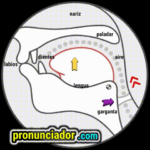
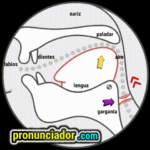
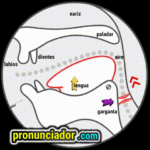
- Takes the Shape of the NEXT VOWEL! (The Magic Chameleon!) This is the most amazing (and crucial!) feature of /h/! Your mouth, lips, and tongue don’t have their own specific shape for the /h/ itself. Instead, as you say /h/, your mouth, lips, and tongue INSTANTLY move into the position needed for the vowel sound that comes next!
- Say “He” /hi/: Your lips stretch, and your tongue goes high/front, ready for the /i/ vowel, while you breathe out /h/.
- Say “How” /haʊ/: Your mouth drops open wide, and your tongue is low/back, ready for the /aʊ/ diphthong, while you breathe out /h/. The actual reference is for /ɔ,oʊ,u,a,æ/. For ‘how’, /h/ takes shape of /aʊ/ first part.
- The “H” sound basically molds itself around the following vowel! The friction just happens in your throat as your mouth gets ready for the next sound.
Kid-Friendly “Window Breath” Summary for /h/:
“Imagine you’re outside on a cold day and you want to breathe on a window to make it foggy. You breathe out softly: ‘Hhhhhhh.’ That gentle puff of warm air, right from your throat, with your mouth already ready to say the next vowel sound (like an ‘o’ for ‘home’ or ‘a’ for ‘happy’) – that’s your /h/!”
Key Feeling: A very light, effortless whisper of air directly from your throat (glottis). NO tongue action or lip rounding is required for the /h/ itself; just open your mouth a bit and let the air out as your mouth pre-shapes for the vowel coming next.
The “H” Dangers: Omission (H-Dropping) vs. Over-Constriction (Harsh /x/)
Many learners face two big issues with /h/:
- H-Dropping (The Invisible H!): This happens when you completely omit the /h/ sound where it should be pronounced, especially at the beginning of words. This is very common for learners whose native language always has a silent ‘h’ (e.g., “appy” for “happy,” “ospital” for “hospital”).
- Problem: Makes your English sound unclear or like a specific regional dialect (e.g., Cockney in some UK contexts), and can create confusion (“eat” vs “heat”). It’s a common accent marker.
- The Fix: You must remember to breathe out for the /h/ where it’s supposed to be! Get that little breathy whisper out!
- Over-Constriction / Harsh ‘H’ (Like /x/ – the “Throaty Scratchy H”): This happens when you try to make the /h/ too hard. Instead of just letting air out of your throat, you might pull the back of your tongue too far back and up, or squeeze your throat too tightly, making a harsh, guttural, scratchy sound (like /x/ or /χ/, heard in German “Bach” or some Spanish “j” sounds).
- Problem: This sounds very non-native and can be difficult to understand.
- The Fix: RELAX & BE GENTLE! The /h/ is meant to be very light and breathy. Don’t engage your tongue or any mouth muscles beyond getting ready for the next vowel. Just a gentle puff from the throat!
Rule of Thumb: A Soft Breath is GOOD, No Breath is BAD, A Harsh Scratch is TERRIBLE!

Your Mouth’s Gentle Breeze: Making the /h/ Sound (Simple Steps!)
Ready to master that soft, airy /h/ sound? It’s all about breath and anticipation!
Step 1: Mouth Slightly Open, Lips & Tongue Neutral.
Keep everything relaxed. Your mouth should be slightly open. Your lips are neutral and relaxed (just natural). Your tongue is also relaxed and in a neutral, resting position (it’s basically not doing anything active for the /h/ itself!).
Step 2: Breathe Out! (Subtle Throat Friction)
- Now, just breathe out normally – like a sigh, but make a soft, audible sound with the air flowing from your throat.
- Your vocal cords (glottis) are slightly constricted (narrowed), creating that very light, airy friction. It’s almost like a voiceless cough or a silent sigh. “Hhhhhhhhhh!”
Step 3: Automatically Pre-Shape for the NEXT Vowel! (The Magic!)
This is the brilliant part of /h/! While you’re making that airy /h/ sound from your throat, your mouth should already be forming the shape for the vowel that comes immediately after the /h/!
- If saying “He” /hi/, your lips are already spreading slightly and your tongue is already rising for the /i/ sound, as you make the /h/.
- If saying “How” /haʊ/, your jaw is already dropping wide and your tongue is getting low/back for the /aʊ/ sound, as you make the /h/.
Kid-Friendly “Magic Mirror” Cue: “Imagine you’re breathing warm air onto a mirror. Say ‘Hhhhhh.’ As you breathe, silently make your mouth ready for the vowel coming next. For ‘Home,’ your lips are rounding a bit like ‘O’ as you breathe out ‘H.’ For ‘Head,’ your mouth opens slightly for ‘E’ as you breathe out ‘H.’ It’s a magic sound that changes its shape to fit!”
Feeling Check: Are you making the /h/ mostly from your throat/lungs? Is there minimal mouth tension? Does your mouth quickly shift shape for the NEXT vowel? Awesome! You’re making a great /h/!
Common Mistakes and HoWhen H is Heard: Spelling the /h/ Sound!
Good news! This sound has a super-simple spelling rule when it is pronounced.
- The Letter ‘H’: When you hear the /h/ sound, it is ALWAYS represented by the letter ‘H’!
- he, have, here, him, her, how, home, happy, head, hand, hold, health, help, happen, hope, hard, horse, history.
- There are NO common words where other letters spell the /h/ sound in standard American English. This makes it much easier than many other English sounds!
When H is a Ghost! Common SILENT ‘H’ Words!
This is where the ‘H’ becomes tricky – when it’s there on the page, but you DON’T say it! About 14% of words with an ‘H’ have a silent ‘H’ You just have to memorize these common words and patterns.
Top 3 Places to Spot a Silent ‘H’:
- After ‘W’ in ‘WH-‘ words: (For most American English speakers, the ‘H’ is silent, making ‘WH’ sound like /w/).
- what /wʌt/, where /wɛr/, when /wɛn/, why /waɪ/, who /hu/ (H is ALWAYS silent here!), whose /huz/, whom /hum/, while /waɪl/.
- (There is a “whoosh” sound associated with ‘WH’ (e.g. older English speakers often pronounced WH as /hw/), but for modern General American, the H is largely silent and the sound is just /w/).
- (Exception: “Who” /hu/, “whom” /hum/, “whose” /huz/ always have silent H even though W comes first!)
- In words of Latin/French origin (often ‘H’ after EX-, RHY- or initially):
- Initially (no ‘H’ sound, ‘honor’ rule!):
- hour /aʊər/
- honest /ˈɑnɪst/ or /ˈʌnɪst/
- honor /ˈɑnər/ or /ˈʌnər/
- heir /ɛr/ (inheritor)
- ‘H’ after ‘EX-‘ (sometimes silent):
- exhausted /ɪɡˈzɑstɪd/ (often a silent H; the X can also be voiced /ɡz/ or voiceless /ks/ which leads to no /h/ or some reduction)
- exhibition /ˌɛksəˈbɪʃən/ (same situation)
- exhibit /ɪɡˈzɪbɪt/ (same situation)
- (This often means the /h/ disappears to simplify articulation. For simplicity for learners, it’s easier to say that the H is typically silent when after ‘ex-‘ if followed by certain sounds/unstressed vowel).
- ‘H’ after ‘RH-‘ or ‘RHY-‘ (Greek origins): The ‘H’ is silent.
- rhyme /raɪm/
- rhythm /ˈrɪðəm/
- rhino /ˈraɪnoʊ/
- catarrh /kəˈtɑr/
- Initially (no ‘H’ sound, ‘honor’ rule!):
- In other irregular/foreign loanwords:
- ghost /ɡoʊst/ (GH is not pronounced here as a Hard G – it’s silent)
- cheetah /ˈtʃitə/ (CH makes /tʃ/ sound here, not /h/)
- vehicle /ˈviəkəl/ or /ˈvihɪkəl/ (Some speakers (often in faster, more informal speech) pronounce it as 2 syllables with silent H; others keep the /h/ as 3 syllables)
Silent ‘H’ – Quick Reminder List!
- WH- (most words like what, when, why – except ‘who’)
- hour, honest, honor, heir, herb (in AmE sometimes silent), ghost
- After X, RH, RHY (exhaust, rhyme, rhythm)
- Some foreign words: vehicle (can be silent), ghoul, phlegm.
Crucial: Don’t drop H’s that should be there (e.g., “hat,” “happy”)!
Whoops! Common /h/ Hangups & How to Handle Them!
Let’s clear up those tricky ‘H’ habits!
- MISTAKE #1: H-DROPPING (Omitting the /h/ completely!)
- Problem: “appy” for “happy,” “ospital” for “hospital.” Makes your speech sound like some specific dialects or very non-native. This is THE MOST COMMON MISTAKE for many learners!
- THE FIX: BREATHE OUT FOR ‘H’! Always remember that gentle breath of air for /h/ at the start of words where it should be pronounced. Practice a gentle, voiceless puff before the vowel starts. “H-appy!”
- MISTAKE #2: THE “HARSH H” (Too much constriction, sounding like /x/)
- Problem: Instead of a soft breath, it’s a rough, scratchy sound made with tongue too high/back, or too much throat squeeze.
- THE FIX: RELAX YOUR MOUTH & THROAT! For /h/, the tongue stays neutral/relaxed. Don’t pull the back of your tongue up to block air. Just a soft breath. Think a gentle sigh. Less is more here!
- MISTAKE #3: PRONOUNCING SILENT ‘H’s!
- Oops: Saying “HUH-our” for “hour” or “HUH-onest” for “honest.”
- Easy Fix: MEMORIZE the Silent H list! For words like ‘hour,’ ‘honest,’ ‘honor,’ ‘heir,’ and words with ‘rh-‘ or ‘exh-‘, the ‘H’ takes a break!
- MISTAKE #4: Forgetting the “H” takes the shape of the NEXT VOWEL!
- Problem: Trying to make one “fixed” mouth shape for /h/, regardless of the following vowel. This can make the transition between /h/ and the vowel sound awkward.
- Fix: PRE-SHAPE! Consciously position your mouth, lips, and tongue for the upcoming vowel (like shaping your lips for ‘O’ when saying “home”) as you make the soft /h/ breath. This creates a super smooth blend.

“Happy Hour!” American /h/ Sound Practice!
Let’s get that gentle ‘H’ sound perfectly placed!
Exercise 1: The “Soft Breath” H – Pure /h/ Warm-up!
- Mouth slightly open, lips neutral, tongue neutral.
- Breathe out a long, gentle, continuous “Hhhhhhhhhhhhhhh…” from your throat.
- Hold it for 5-10 seconds. Feel minimal tension, just a soft breath. NO buzzing (that’s /v/!).
Exercise 2: “H” Taking Vowel Shapes!
Focus on shaping your mouth for the vowel immediately after the ‘H’ breath.
- He [hi] (H + stretched lips/high tongue for I)
- How [haʊ] (H + wide open mouth/low back tongue for AH of OW)
- Home [hoʊm] (H + rounded lips/back tongue for O)
- Here [hɪr] (H + slightly open mouth/high front tongue for IH)
- Happy [hæpi] (H + wide open mouth/low front tongue for AH)
- Hard [hɑrd] (H + wide open mouth/low back tongue for AH)
Practice switching rapidly from H to the different vowel shapes.
Exercise 3: H-Dropping vs. Saying “H”! – BE CAREFUL!
For words like “him” “her” “has,” which can drop in fast speech in some dialects or function words:
- Always practice the full H (He has her book!) in careful speech.
- Then be aware that sometimes, in fast connected speech, the ‘H’ in unstressed function words (like “he,” “her,” “him,” “has”) can become very weak or disappear. But master the full ‘H’ first! This topic (h-dropping) is about when native speakers sometimes omit it, not that learners should do it deliberately, especially initially. For the context of this post focusing on correct pronunciation for learners, the strong H in content words is emphasized.
- So, instead, focus on contrasting words where ‘H’ IS vs. ISN’T pronounced.
- “H” IS Pronounced: Hat, Head, Happy, Him, Home, Hard, Hold, Help, Hand, Hear, Hello.
- “H” IS NOT Pronounced: Hour, Honor, Honest, Heir, Ghost, Rhyme, Rhythm, Vehicle (optional), What, Where, When, Why, Who. (Note: These lists make a point, not suggesting optional dropping. Just highlighting where it is ALWAYS silent).
Exercise 4: Silent ‘H’ Ninja Drill! (DO NOT Say the ‘H’!)
Practice these common silent ‘H’ words.
- hour, honor, honest, heir, ghost.
- rhyme, rhythm, rhinoceros.
- vehicle (for some speakers).
- exhaust (in ‘exh-‘), exhibition.
- what, where, when, why, who, whose (the ‘H’ is silent).
Exercise 5: Top 30 H-Word Workout!
| PHONETICAL PRONUNCIATION |
| PHONETICAL PRONUNCIATION |
For EACH word:
- Make that soft, breathy /h/ at the start.
- Pre-shape your mouth for the next vowel as you breathe out for /h/.
- Listen to the audio, confirm if ‘H’ is pronounced or silent (for exception words like ‘hour’).
RECORD yourself and listen critically! Is your /h/ gentle? Is it always there (when it should be)?
Exercise 6: “Heavenly H” Sentences! + RECORD!
Put your /h/ into full sentences. Record and listen for softness, vowel-shaping, and proper omission of silent H’s.
- “He [h] has [h] a happy [h] habit [h] at home [h].”
- “How [h] heavy [h] has [h] his hand [h] hit [h] the hard [h] head [h]?”
- “I hope [h] you heard [h] the whole (silent H) story!” (Whole = /hoʊl/)
- “The honest (silent H) man [mæn] lives in that house [haʊs].”
- “Who [h!] is the hero [h] here [h]? Is he honest (silent H)?” (Correcting ‘who’ where ‘h’ is silent.)
- Revised: “How [h] is the healthy [h] hero [h] at home [h] today?”
FAQs: Your American /h/ Questions Answered!
What’s the secret to making the American /h/ sound correctly? (Kid-Friendly Answer!)
It’s just a soft puff of air right from your throat! Imagine breathing on a cold window pane. The air should flow out easily, with NO buzzing (it’s voiceless!), and as you breathe out, your mouth should automatically get ready to say the vowel that comes next! So, “he” is “breathy-EE!” and “how” is “breathy-OW!”
Why do some English words have a letter ‘H’ but it’s not pronounced (silent)?
This is due to the history of English borrowing words from other languages (like French or Latin) where ‘H’ was silent. Or, in some old English words (like ‘wh-‘), the sound used to be pronounced differently and over time changed, but the spelling stayed the same. You just have to memorize these common words where ‘H’ is silent (like “hour,” “honest,” “what,” “ghost“).
My “H” sounds too harsh, like the “ch” in German “Bach” or like I’m clearing my throat. How do I soften it?
You’re making too much friction (tightening) too high up in your mouth (with your tongue). The /h/ sound should be made only by slightly narrowing your vocal cords (in your throat) as you breathe out. RELAX your tongue (keep it neutral, not raised in the back!) and breathe out gently and easily from your throat. Less muscle, more air!
Is it ever okay to drop the ‘H’ sound in American English, like saying “appy” for “happy”?
No, it is NOT standard practice for learners to intentionally drop the /h/ sound. In General American English, the /h/ is always pronounced at the beginning of content words (nouns, verbs, adjectives, adverbs like “happy,” “home,” “healthy”). While native speakers might weaken or drop ‘h’ in unstressed function words (like “he,” “her,” “him”) in very fast, casual speech, this is an advanced phenomenon and not a target for learners who are developing their accent. Focus on pronouncing the /h/ where it’s spelled (unless it’s a known silent ‘H’ word).
What does it mean that the /h/ takes the shape of the NEXT vowel?
It’s a cool trick! The /h/ doesn’t have its own specific mouth shape (lips, tongue position) in the way ‘p’ or ‘s’ do. Instead, as you breathe out for the /h/, your mouth, lips, and tongue instantly start moving into the position for the vowel that comes right after it.
- For “he” /hi/, your lips are stretching for ‘ee’ /i/.
- For “how” /haʊ/, your jaw is dropping for ‘ah’ /ɑ/ from ‘ow’ /aʊ/.
This helps make the /h/ sound incredibly smooth and natural when connecting to a vowel.
Final Takeaways: Your American /h/ Will Be “Hearable” and “Happy”!
Fantastic! You’ve tackled the American /h/ sound, that soft, breathy whisper that uniquely shapes itself to the following vowel. You know how to make it sound perfectly native – not a harsh ‘ch’, and not a missing ghost!
Remember your “H”-elpful hints:
- /h/ = GENTLE BREATH (WHOOSH!) from your THROAT + NO VOICE! (Voiceless Glottal Fricative).
- THE CHAMELEON H! It pre-shapes itself for the mouth position of the NEXT vowel.
- H-DROPPING is NOT STANDARD for learners (always pronounce ‘H’ at the start of content words like ‘happy’ unless it’s known to be silent).
- NO HARSH ‘H’ (like /x/ or ‘ch’)! Keep your tongue relaxed, breath comes easily from throat.
- SILENT ‘H’: Crucial words to memorize (hour, honest, honor, ghost, rhyme, rhythm, and ‘H’ in most ‘WH-‘ words).
- SPELLING: Always just ‘H’ where it’s pronounced!
Keep practicing that soft, effortless breath. Pay attention to how your mouth gets ready for the next vowel as you breathe out the ‘H’. Drill your silent ‘H’ words regularly. Listen carefully to native speakers say words starting with ‘H’. Your American English is about to sound so much more harmonious /hɑrˈmoʊnjəs/ and natural! You’ve got this!
👇🔥👇🔥👇🔥👇🔥👇🔥👇🔥
👉 RETURNS in the YEAR 2031 ! WHO? CLICK HERE ! 🔥




👇🔥👇🔥👇🔥👇🔥👇🔥👇🔥
👉 RETURNS in the YEAR 2031 ! WHO? CLICK HERE ! 🔥
👇🔥👇🔥👇🔥👇🔥👇🔥👇🔥
👉 RETURNS in the YEAR 2031 ! WHO? CLICK HERE ! 🔥
👉 RETURNS in the YEAR 2031 ! WHO? CLICK HERE ! 🔥
👉 RETURNS in the YEAR 2031 ! WHO? CLICK HERE ! 🔥