

Struggle with endings like -er/-or? Stop saying “teach-ERRR”! This guide reveals the secret to the lazy American unstressed ER /ɚ/ (Schwar) for natural pronunciation.
Hey there, American accent achievers! Get ready for a pronunciation secret that will make you sound SO MUCH more natural and fluent in American English. We’re talking about the sound at the end of words like “teacher,” “after,” “doctor,” “dollar,” even “nature” or “sugar“! Its special phonetic code is /ɚ/, and it’s affectionately nicknamed Schwar (think “Schwa” + “R”). This little sound is EVERYWHERE, and it’s probably THE most distinctive sound of an American accent!
So, what’s the big deal? The problem is, if you don’t know about Schwar /ɚ/, or if you confuse it with its loud, strong cousin /ɝ/ (the Stressed ER in “first” or “bird”), your English can sound really… effortful, a bit robotic, and the rhythm will be off. Do you say “teach-ERRRRR!” with a strong R at the end? Or maybe “doct-ORRRR!”? That’s a super common learner mistake! You might also be trying to make a clear “o” or “a” sound before the R in “doctor” or “dollar,” when native speakers often just… don’t! And if you use your native language’s R sound (like a trill or a tap) – that’s another instant accent flag! It’s confusing because the spelling is all over the place: ER, OR, AR, UR, RE… how can they all sound the same weak “er”?! You feel stuck!
But what if I told you the secret to Schwar /ɚ/ is actually about doing… LESS? This ULTIMATE, super-easy guide (so simple, an 8-year-old could totally get it!) will turn you into a Schwar /ɚ/ superstar:
- Meet Schwar /ɚ/ – The LAZY R-Vowel: What is this sound, and why is it a “weak” version of the Stressed ER /ɝ/?
- The #1 KEY: UNSTRESSED & RELAXED! We’ll hammer this home – if there’s no STRESS on the syllable, you need Schwar!
- Your Mouth on CHILL MODE: Step-by-step, incredibly simple instructions to make Schwar /ɚ/. (Hint: Lazy “uh” + gentle, quick American R).
- The Spelling MIRACLE! Why -ER, -OR, -AR, -UR, -RE, -OUR all sound like /ɚ/! (This will blow your mind, then make perfect sense!).
- Zap Common Schwar Blunders: Stop over-stressing, over-R-ing, or using the wrong vowel!
- Practice Makes Purrfect Schwar! Easy exercises with everyday words (“never,” “remember,” “paper,” “author,” “sugar,” “figure“) so you can automate it!
Get ready to transform the way you pronounce a HUGE number of common English words! Your endings will sound smoother, your rhythm more American, and your overall accent much more natural. Let’s explore the magic of Schwar /ɚ/!

What IS This Unstressed /ɚ/ “Schwar” Sound? (The LAZIEST R-Vowel!)
First, let’s get friendly with /ɚ/, often called Schwar because it’s like the famous lazy Schwa vowel /ə/ (the “uh” in “about” or “sofa“) mixed with an American R sound.
The /ɚ/ is an R-Colored Vowel, meaning the R quality is baked right into the vowel sound – they’re one blended unit.
The BIGGEST Thing to Know about /ɚ/:
It’s the UNSTRESSED (weak, no emphasis) and RELAXED (lazy mouth) version of the TENSE, STRESSED /ɝ/ vowel sound (the “ERRRR” in “first,” “bird,” “work”).
Schwar /ɚ/ = The “er” sound when the syllable is WEAK and said QUICKLY & SOFTLY.
Think about these pairs:
- “prefER” (verb, stress on -FER): /prɪˈfɝr/ (Strong, TENSE /ɝ/)
- “teachER” (noun, stress on TEACH-): /ˈtiːtʃɚ/ (Weak, RELAXED /ɚ/)
- “ocCUR” (verb, stress on -CUR): /əˈkɝr/ (Strong, TENSE /ɝ/)
- “doctOR” (noun, stress on DOC-): /ˈdɑːktɚ/ (Weak, RELAXED /ɚ/)
The SAME -ER or -OR spelling makes a DIFFERENT sound depending on STRESS and TENSION!
Its Secret Features (Kid-Style Explanation!)
Experts call /ɚ/ a “mid, relaxed, central R-Colored vowel.” Here’s the simple version:
- Central (Tongue in the Middle-ish): Before the “R” part really kicks in, your tongue is chilling in the middle of your mouth. Not front, not super back.
- Mid (Tongue Kinda Medium Height): It’s not high near the roof, not flat on the floor. Just comfortably in the middle height range. Your JAW is only open A LITTLE BIT (slightly).
- RELAXED!!! (SUPER LAZY!): This is the ABSOLUTE KEY! Even more relaxed than /ʌ/ (cup)! For /ɚ/, your TONGUE, LIPS, and JAW are all super floppy and loose. Almost zero effort.
- R-COLORED (The Gentle “R” Flavor): It still has that American R quality, but it’s made with less muscle and is quicker.
- Lips: Slightly rounded, but RELAXED. No firm “whistle” shape.
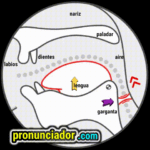
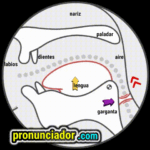
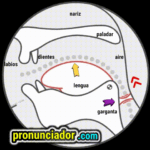
- Tongue for R (RELAXED version):
- Retroflex (Curled Tip): Tip gently curls UP & BACK, not too far, no tension, DON’T TOUCH.
- Bunched (Humped Body): Tip stays down, body of tongue gently bunches/pulls back a bit, less intensely.
- No Trilling/Tapping! Still the American continuous R-quality, just softer and quicker.
Super-Duper Easy Summary for Schwar /ɚ/ (“teachER” ending):
- Open your mouth just a tiny bit.
- Keep your lips gently rounded BUT TOTALLY RELAXED.
- Let your tongue be LAZY. Briefly make a soft, quick American R gesture (curl tip back a bit OR bunch body back a bit, no tension, no touching).
- The sound is a short, weak, blurry “er” or “uh-r”. It’s almost swallowed!
Think of it as the shortest, laziest, most “don’t care” way to make an R-ish vowel sound for those unimportant word endings!
The #1 Showdown AGAIN: UNSTRESSED /ɚ/ (AftER) vs. STRESSED /ɝ/ (FIrst)
This is worth repeating because it’s THE MOST CRITICAL THING for American rhythm and sounding natural with ER/IR/UR/OR/AR words!
| Feature | /ɚ/ Schwar (aftER, doctOR) | /ɝ/ Stressed ER (fIRst, wORk) |
| SYLLABLE STRESS? | ALWAYS UNSTRESSED (WEAK BEAT!) | ALWAYS STRESSED (STRONG BEAT!) |
| MOUTH MUSCLES? | RELAXED! (Lazy, floppy) | TENSE! (Strong, active) |
| SOUND LENGTH? | SHORT & QUICK | LONGER & DRAWN OUT |
| SOUND QUALITY? | Weak, blurry “er” (like “uh-r”) | Strong, clear “ERRRRR” |
It’s all about WHERE THE WORD’S ENERGY IS!
- “WAT-er”: WAT is strong (/ɑ/), -er is weak (/ɚ/). –> /ˈwɔːt̬ɚ/ or /ˈwɑːt̬ɚ/
- “pre-FER”: pre- is weak (/prə/), -FER is strong (/fɝr/). –> /prəˈfɝr/
Mastering this distinction is like learning the basic beat of American English music!

Making the LAZY /ɚ/ (Schwar): Your Mouth’s Chill Mode!
Let’s make this easy, effortless sound! Remember, RELAX is the name of the game.
Step 1: Mouth – Just a Crack, Super Chill.
Let your jaw be loose. Mouth only slightly open. Zero effort.
Step 2: Lips – Gently Rounded, Totally Relaxed.
- Slightly round your lips. Just a hint of a circle.
- But make SURE they are COMPLETELY RELAXED. No pursing, no tension. Floppy lips! […and keep them RELAXED].
Step 3: Tongue – The Relaxed R-Maker!
This is just like making the Stressed ER /ɝ/ tongue position, but with WAY LESS TENSION!
- RELAX YOUR TONGUE! Let it be soft.
- Now, one of these (gentler version):
- Retroflex Light (Soft Curl): Gently curl the tip of your tongue UP and BACK towards (but not touching!) the ridge behind your top teeth. Less curl, less back, less tension than for /ɝ/.
- Bunched Light (Soft Hump): Gently pull the body of your tongue UP and BACK a little, keeping the tip down. Less bunching, less tension than for /ɝ/.
- Middle of tongue: Might lower slightly.
- SIDES of tongue: Might lightly press upper back teeth (for bunched R).
Step 4: The Sound – A Quick, Weak “er” or “uh-r”!
- With your mouth slightly open, lips gently rounded & relaxed, and tongue in a relaxed R-position, let out a SHORT, QUIET, VOICED puff of air.
- It should be a very quick, indistinct “er” sound. Almost like a voiced “hrr.” That’s /ɚ/!
- It happens so fast because it’s in an unstressed syllable.
Kid-Friendly Cues: “Imagine you’re super tired and you just mumble ‘er…’ That’s Schwar!” OR “Think of a tiny kitten’s purr, very soft and quick: ‘rr’ (but it’s a vowel, so it’s more like ‘er’).”
Feeling Check: Are your lips and tongue mostly relaxed? Is the sound short and weak? Coming from the middle of your mouth with a gentle R-flavor? You’re making Schwar /ɚ/!
The GREAT Unstressed Spelling Mystery: ER, OR, AR, UR, RE, OUR… All Become /ɚ/! WHY?!
This is where Schwar /ɚ/ shows its true magic and simplifies a HUGE part of English spelling for you (for unstressed endings, at least!).
The Golden Rule of UNSTRESSED Syllables (Easy Version):
In American English, when a vowel is in an UNSTRESSED (weak) syllable, especially at the END of a word, it often gets lazy and transforms into the Schwa /ə/ sound (that super-quick, neutral “uh” like in “about”).
Now, add an ‘R’ to that lazy Schwa /ə/… What do you get?
Schwa /ə/ (“uh”) + American R /r/ (“rrr”) = SCHWAR /ɚ/ (“er” relaxed)!
THAT’S WHY SO MANY DIFFERENT SPELLINGS SOUND THE SAME AT THE END OF WORDS!
If the ending syllable (like -ER, -OR, -AR, -UR, -RE, etc.) is NOT STRESSED (it’s weak), the vowel in it often just becomes a lazy Schwa /ə/, and then that Schwa + R simply merge into our good friend Schwar /ɚ/!
It doesn’t matter so much what vowel letter is written if that syllable is weak and ends in R. The “weakness” makes them all sound like /ɚ/!
Common Spellings for Schwar /ɚ/ (The Unstressed ER Vowel):
Here’s what the Sounds American web source shows as the most frequent spellings that make the /ɚ/ sound IN UNSTRESSED SYLLABLES. This is amazing to know!
- ‘-ER’: The CHAMPION, By Far! (~72%)
- This makes perfect sense! Unstressed -ER is the classic /ɚ/.
- teacher, never, after, other, better, father, mother, brother, water, remember, answer, sister, summer, winter, paper, number, letter, under, over, ever.
- ‘-OR’: The Close Second! (~13%)
- Unstressed -OR endings? Also usually /ɚ/!
- doctor, actor, author, honor, favor, mayor, mirror, error, sailor, visitor, governor.
- ‘-AR’: The Sneaky One! (~6%)
- Yes, even unstressed -AR endings typically reduce to /ɚ/!
- dollar, sugar, collar, grammar, calendar, liar*, similar, regular, particular, peculiar, scholar. (‘Liar’ is /laɪər/ – triptongo, so not really /ɚ/). -> Better: beggar, cedar.
- ‘-UR’: The “Figure” Group! (~6%)
- Unstressed -URE, -UR often becomes /ɚ/ too.
- figure, measure, pleasure, nature, picture, future, treasure, leisure, capture, creature.
- saturate, murmur.
- ‘-RE’ (Often from British English spelling but used in AmE): (~1-2% ‘etc.’)
- Unstressed -RE also often gets the /ɚ/ sound.
- centre (AmE ‘center’), theatre (AmE ‘theater’), metre (AmE ‘meter’), fibre, litre.
- ‘-OUR’, ‘-EUR’, ‘-YR’ etc. (Very Rare, <1-2% ‘etc.’ group)
- Unstressed -OUR: colour (AmE ‘color’), neighbour (AmE ‘neighbor’), favour (AmE ‘favor’), honour (AmE ‘honor’). Mostly British spellings but they do appear.
- Unstressed -EUR: amateur /’æmətʃər/ (final syllable is /tʃər/ which includes /ɚ/).
- Unstressed -YR: martyr /ˈmɑrtər/. Zephyr /ˈzɛfər/.
Mega-Important Takeaway: If you see a word ending in -ER, -OR, -AR, -UR, -RE (and sometimes -OUR etc.) and that ending ISN’T the STRONG, STRESSED PART of the word, it will ALMOST ALWAYS be pronounced with the RELAXED /ɚ/ SCHWAR SOUND! This is a HUGE key to sounding American!
Spelling → SOUND Transformation in UNSTRESSED Syllables:
- WRITTEN -ER → Sounds like /ɚ/ (teacher)
- WRITTEN -OR → Sounds like /ɚ/ (doctor)
- WRITTEN -AR → Sounds like /ɚ/ (dollar)
- WRITTEN -UR(E) → Sounds like /ɚ/ (figure)
- WRITTEN -RE → Sounds like /ɚ/ (centre)
It’s like magic! They all melt into the lazy /ɚ/!
“Uh-Oh!” Common Schwar /ɚ/ Mistakes & Easy Fixes!
What trips learners up with this super common but super LAZY sound?
- MISTAKE #1: TOO MUCH STRESS & TENSION! (Using Stressed /ɝ/ instead of Relaxed /ɚ/)
- What it sounds like: Saying “teach-ERRRRR!” or “doct-ORRRR!” You’re making the ending strong and tense like in “bird” or “work”.
- THE #1 FIX: RELAX & WEAKEN! Remember /ɚ/ is for UNSTRESSED (weak) syllables. Use very little muscle energy. Make it short and quick. It’s the opposite of the strong /ɝ/. Think “teach-uh-r” very fast.
- MISTAKE #2: USING YOUR NATIVE LANGUAGE “R”! (Trilled, Tapped, etc.)
- Problem: Your R from your first language sneaks in, even if you try to make it soft. (e.g., “docto-[ɾ]” or “teache-[r̄]”).
- The Fix: Even the /ɚ/ needs a gentle American R quality. Quick, soft tongue curl/bunch (NO TOUCHING!), relaxed lips slightly rounded. No taps, no trills EVER.
- MISTAKE #3: Making a Clear Vowel BEFORE the R (Instead of Blended Schwar /ɚ/)
- Problem: You might try to say a very clear ‘O’ in “doctOr” or a clear ‘A’ in “dollAr”, then add an R. This sounds like two separate sounds and is too strong.
- The Fix: THINK LAZY “UH” + R! The unstressed vowel usually melts into a Schwa /ə/ (“uh”) and then immediately blends with a soft R. So, “doct-uh-r” → “doct-ɚ”. “Doll-uh-r” → “doll-ɚ”. It’s one quick, blended, weak “er” sound.
- MISTAKE #4: Dropping the “R” Sound Completely (Especially if used to non-rhotic accents).
- Problem: Saying “teacha” or “docta” with just a Schwa /ə/ and no R-coloring at all.
- The Fix: AMERICAN ENGLISH IS RHOTIC! The ‘R’ (even a weak /ɚ/) is pronounced at the end of these words. You need that little bit of R-flavor. Don’t let it disappear entirely!
- MISTAKE #5: Being Totally Confused by Spelling (Saying “doll-ARRR” because it’s ‘AR’).
- Problem: Letting the letters dictate a strong vowel sound when the syllable is actually weak.
- The Fix: THE STRESS RULE IS KING! If the ending -er/-or/-ar/-ur/-re is UNSTRESSED, it will almost certainly be the weak /ɚ/ sound, regardless of the vowel letter written!

Schwar /ɚ/ Practice Time! Relax and Let It Flow!
Ready to practice the laziest (but most important!) R-vowel?
Exercise 1: Find Your SUPER Lazy Schwa /ə/
- Mouth totally relaxed, open just a tiny bit. Tongue doing nothing in the middle.
- Shortest, weakest “uh” you can make. Like when you hesitate: “uh… uh…”. That’s /ə/.
Exercise 2: The Gentle American R (Relaxed Version)
- Remember the R from Stressed ER /ɝ/? (Lips slightly round/tense, tongue tense + curled/bunched).
- Now do that R with HALF the effort. Lips very gently rounded, tongue just a soft curl/bunch. No real muscle tension. Quick “rrr” feel.
Exercise 3: Schwar Fusion! /ə/ + Gentle /r/ = /ɚ/
- Start with your lazy Schwa /ə/ (“uh”).
- Immediately and smoothly, add that gentle R quality (Exercise 2).
- Blend it FAST: “uh-rrr” → /ɚ/. It should be SHORT, WEAK, and RELAXED.
- Try it after a strong syllable: TEA-ch[ɚ], DOC-t[ɚ], DOLL-[ɚ].
Exercise 4: STRESSED /ɝ/ (First) vs. UNSTRESSED /ɚ/ (After) – The ULTIMATE Workout!
This is your golden ticket! FEEL the TENSE/STRONG vs. RELAXED/WEAK.
- PERFECT /ˈpɝrfɪkt/ (TENSE first syllable ER)
- PERfectly /ˈpɝrfɪkli/ (TENSE first) vs. MASTER /ˈmæstɚ/ (RELAXED end)
- FUR /fɝr/ (TENSE) — FIGURE /ˈfɪɡjɚ/ (RELAXED)
- SIR /sɝr/ (TENSE) — FATHER /ˈfɑːðɚ/ (RELAXED)
- WORD /wɝrd/ (TENSE) — AUTHOR /ˈɔːθɚ/ (RELAXED)
- LEARN /lɝrn/ (TENSE) — SUGAR /ˈʃʊɡɚ/ (RELAXED)
Exercise 5: The “All Endings Sound the Same” /ɚ/ Challenge!
Read these aloud, focusing on making ALL the bolded UNSTRESSED endings sound like the SAME, WEAK, RELAXED /ɚ/ (“er” or “uh-r”).
- After, teacher, worker, remember, answer, order, water, other.
- Doctor, author, sailor, honor, color, mayor, error, favor.
- Dollar, sugar, collar, altar, calendar, regular, similar.
- Figure, nature, picture, future, pleasure, measure, creature.
- Centre, theatre, metre, litre.
- Neigbour (Br. spelling of neighbor).
Exercise 6: Source Top 30 Unstressed /ɚ/ Word List!
| PHONETICAL PRONUNCIATION |
| PHONETICAL PRONUNCIATION |
Exercise 7: Real American Rhythm! Sentences with Schwar + RECORD!
RECORD yourself! Are those unstressed ER/OR/AR/UR endings sounding weak and lazy?
- “My father [ɚ] and mother [ɚ] are coming over [ɚ] for dinner [ɚ].”
- “Never [ɚ] remember [ɚ] the answer [ɚ] to that matter [ɚ].”
- “The author [ɚ] of the dollar [ɚ] picture [ɚ] is a doctor [ɚ].”
- “What ever [ɚ] happens after [ɚ], understand [ɚ] that the order [ɚ] is better [ɚ].”
FAQs: Your American Unstressed /ɚ/ (Schwar) Questions Answered!
Q1: What IS “Schwar” /ɚ/? And is it the SAME as “Schwa” /ə/?
Schwar /ɚ/ is the name for the R-Colored Vowel sound found in UNSTRESSED syllables, like the “-er” in “teacher.”
It’s VERY similar to Schwa /ə/ (the lazy “uh” in “about”) BUT with an American R sound blended in right after it. So, think: Lazy UH /ə/ + Gentle American R /r/ = Schwar /ɚ/. They are not exactly the same, as /ɚ/ has that distinct R-flavor.
Q2: Why do spellings like -OR, -AR, -UR all sound like -ER /ɚ/ at the end of words?
It’s the magic of UNSTRESSED syllables! In American English, when those endings are NOT the strong part of the word, the vowel letter (O, A, U) often gets “weakened” and pronounced as a Schwa /ə/ (“uh”). When that Schwa /ə/ is followed by an R, the whole thing just melts into the single, relaxed Schwar /ɚ/ sound! So, doctor → doct-uh-r → doctɚ. Dollar → doll-uh-r → dollɚ.
Q3: What’s the BIGGEST difference between Stressed ER /ɝ/ (“first”) and Unstressed ER /ɚ/ (“teacher”)?
STRESS and TENSION!
- /ɝ/ (first): ALWAYS in a STRESSED (strong) syllable. Made with TENSE tongue and lip muscles. Longer and clearer “ERRRR.”
- /ɚ/ (teacher): ALWAYS in an UNSTRESSED (weak) syllable. Made with RELAXED tongue and lip muscles. Shorter, quicker, blurrier “er.”
This is a critical distinction for sounding American!
Q4: I still sometimes use my native language’s “R” for /ɚ/. How do I stop?
This is tough but doable! For the American R quality in /ɚ/:
- Think RELAXED.
- Lips only slightly rounded (and relaxed).
- Your tongue needs to make a gentle American R gesture: EITHER a very slight curl of the tip back (not touching anything!) OR a slight bunching of the tongue body up and back.
- Crucially: NO TAPPING the tongue tip, NO VIBRATING (trilling) the tongue tip! It must be a smooth, continuous (though quick and weak) R-flavor. Keep practicing just the American R sound softly.
Q5: If the syllable is unstressed, can I just drop the /ɚ/ sound completely, like say “teach-uh”?
No, not usually in standard American English. American English is “rhotic,” meaning Rs are generally pronounced where they are spelled. While /ɚ/ is weak and relaxed, that “R-coloring” IS still present. Omitting it entirely would sound like some non-rhotic British or regional American accents, not General American. Keep that gentle “er” flavor!
Key Takeaways: Your American UNSTRESSED /ɚ/ Will Make You Sound Like a Pro!
Incredible work! You’ve just unlocked THE most common R-colored vowel and a cornerstone of the American accent: the Unstressed ER /ɚ/ (Schwar)! You know its secret is RELAXATION and its home in UNSTRESSED syllables.
Remember these golden rules:
- /ɚ/ (Schwar) = LAZY, WEAK “er” (like “uh-r”): Used ONLY in UNSTRESSED syllables.
- Vs. STRESSED /ɝ/ (“first”) = RELAXED & SHORT vs. TENSE & LONG! This is your #1 focus.
- ARTICULATION = MOUTH/LIPS/TONGUE ALL RELAXED. Gentle lip rounding, quick/soft American R tongue gesture (no trills/taps!).
- SPELLING MAGIC: Unstressed -ER, -OR, -AR, -UR, -RE, etc. → ALL usually melt into /ɚ/!
- COMMON MISTAKES: Too much stress/tension (using /ɝ/), foreign R sound, making a clear vowel + separate R.
Keep training your ear for STRESSED vs. UNSTRESSED syllables. Practice making that short, quick, relaxed /ɚ/ for all those common word endings (-er, -or, -ar, -ur). Listen to native speakers and mimic their effortless unstressed endings. Your rhythm, flow, and overall American sound will improve dramatically!erstood by native speakers. It’s often cited as one of the most distinctive features of the American accent.
👇🔥👇🔥👇🔥👇🔥👇🔥👇🔥
👉 RETURNS in the YEAR 2031 ! WHO? CLICK HERE ! 🔥



👇🔥👇🔥👇🔥👇🔥👇🔥👇🔥
👉 RETURNS in the YEAR 2031 ! WHO? CLICK HERE ! 🔥
👇🔥👇🔥👇🔥👇🔥👇🔥👇🔥
👉 RETURNS in the YEAR 2031 ! WHO? CLICK HERE ! 🔥
👉 RETURNS in the YEAR 2031 ! WHO? CLICK HERE ! 🔥