
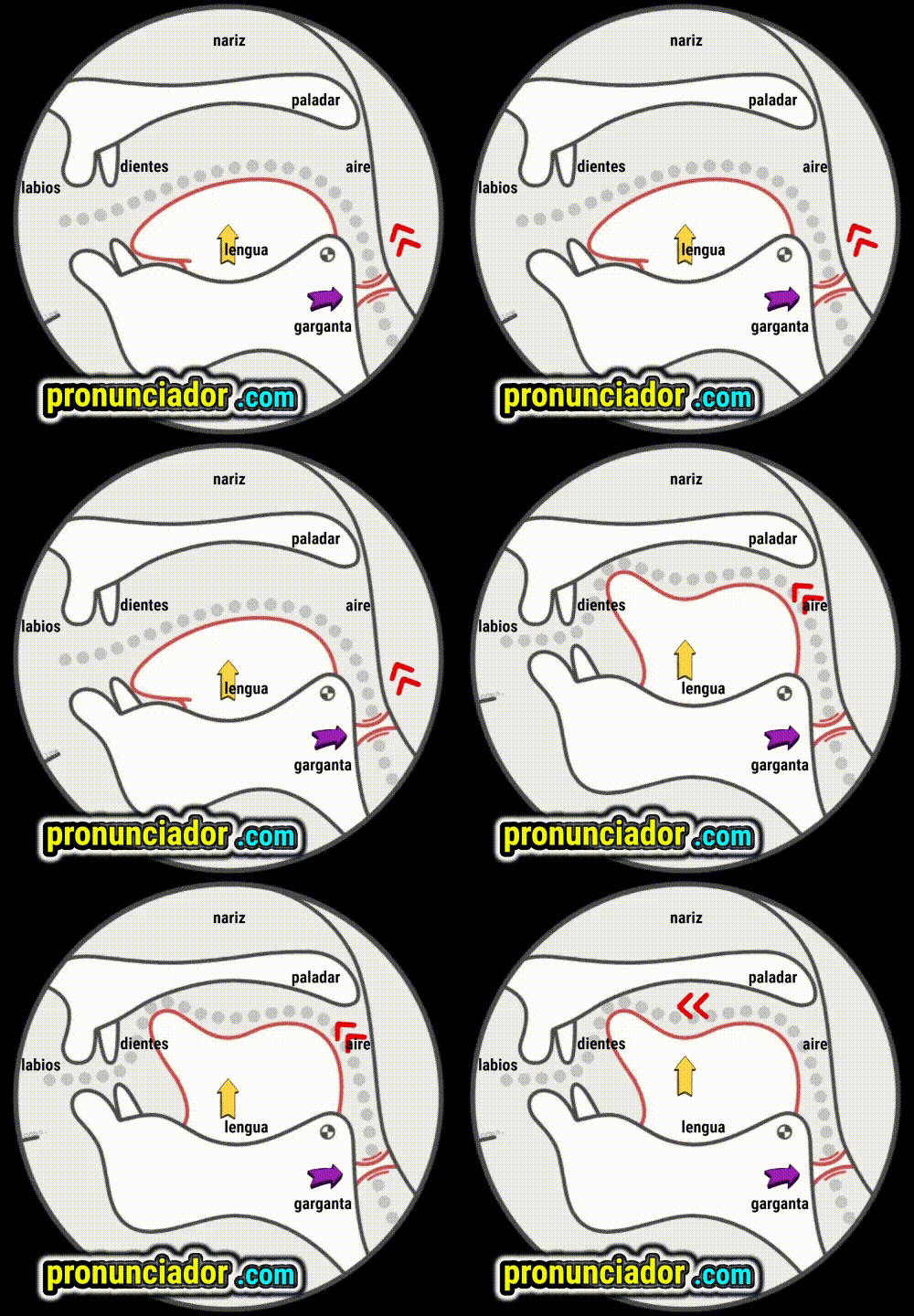
Is your ‘P’ sound weak or sounding like a ‘B’? This guide unlocks the secret to the American P [pʰ]. Learn WHEN to puff (and when not!) to finally sound clear and confident.
Have you ever felt like your pronunciation of English words just doesn’t sound quite “American”? You might be nailing the grammar and vocabulary, but something still feels off. Often, the secret lies in mastering specific consonant sounds, anHey there, American accent champions! Ready to pop your way to clearer English? Today, we’re tackling a sound that seems super basic, but trust me, getting it just right is a HUGE key to sounding genuinely American: the voiceless P sound, like in “pie,” “put,” “cup,” or “speak”! Its special phonetic alphabet code is /p/ (easy peasy!).
You’re probably thinking, “The letter P? I learned that in kindergarten!” And you’re spot on – we all know how to spell it. But here’s the exciting (and sometimes tricky) part about the American English /p/: it’s not always the same as the ‘P’ you might use in other languages. The big secret? It’s often made with a special PUFF OF AIR! But sometimes… that puff disappears! Knowing WHEN to puff and when NOT to puff is what separates a good accent from a great one.
Have you ever felt your “paper” or “pen” sounded a bit… flat? Or maybe you worry that your “cup” at the end of a sentence sounds too much like “cub” (a baby bear!)? That missing puff or that little bit of accidental voice can make a HUGE difference! And then there are words like “speak” where the ‘P’ changes again! Plus, ever seen “psychology” or “receipt” and wondered if that ‘P’ is just there for decoration? It can feel like a pronunciation puzzle!
But no more “P” panic! This ULTIMATE, super-duper-EASY guide (seriously, your 8-year-old self could totally nail this!) will make you a /p/ pronunciation PRO:
- Meet the “Popping P” /p/: What IS this sound, and why is it called a “voiceless bilabial stop”? (Spoiler: Lips + No Voice + POP!).
- The AIR PUFF SECRET [pʰ] UNLOCKED! This is the #1 Game-Changer! What IS aspiration? How do you DO it? And THE 3 GOLDEN RULES: When to PUFF STRONG, when to have NO PUFF (Held P [p̚]), and when to have a CLEAN P (after S!).
- Mouth Mechanics Made SIMPLE: Step-by-step instructions for perfect lip action (and what your voice box should NOT be doing!).
- P vs. B BATTLE! The ultimate showdown: No Voice (/p/) vs. Voice ON (/b/). Never mix them up again!
- Easy Peasy Spelling! (P & PP): Finally, some simple spelling rules!
- The Mysterious SILENT P: Unmasking words where ‘P’ is just a quiet bystander (psychology, receipt, pneumonia!).
- Zap Common “P” Pitfalls! We’ll fix those flat P’s and accidental B’s!
- “Practice Makes Perfect Puffs!” Super fun and effective exercises (yes, using paper!) with everyday words (‘people’, ‘please’, ‘stop’, ‘help’, ‘happy’, ‘up’) to make your American P sound spot on!
Get ready for your “pen,” “paper,” “people,” and “party” to pop with American precision! Let’s get this pronunciation party /ˈpɑrti/ started! 🎉

What is This /p/ Sound? The “Lips Together, No Voice, POP!”
Alright, let’s get to know the American /p/ sound. You hear it at the start of “pie” and “pay,” in the middle of “happy” and “paper,” and at the end of “cup” and “stop.” It’s one of the six stop consonants in American English (the others are /b, t, d, k, ɡ/).
Stop Consonant = Build Pressure & POP!
This means to make the sound, you first completely STOP the airflow somewhere in your mouth for a tiny moment, build up a little air pressure, and then release that pressure with a small burst or “pop.”
Its Key Features (Kid-Friendly Version!):
The fancy expert words are “voiceless bilabial stop.” Let’s break that down for us humans:
- Bilabial (Lips TOGETHER!): “Bi” means two, “labial” means lips. So, this sound is made by pressing your TWO LIPS firmly together to stop the air. Easy! Just like for its voiced twin, the /b/ sound (“boy”).
- Voiceless (Voice Box OFF!): This is super, SUPER important. “Voiceless” means your vocal cords (those little vibrating things in your throat) are turned OFF. They are NOT buzzing or humming. The /p/ sound is made with AIR ONLY, no throat vibration.This is the MAIN difference between /p/ and /b/!
- Stop (The POP!): You stop the air with your lips, then you let it out with a little explosion or “pop.”
Super Simple “P” How-To:
- Gently press your lips together.
- Make sure your voice is OFF (no humming in your throat).
- Quickly part your lips and let out a puff of air: “p!” (If you’re doing it right, sometimes you get a big puff, sometimes a little one, sometimes almost no puff – we’ll learn why soon!)
The EPIC Battle: /p/ (Pay – NO VOICE) vs. /b/ (Bay – VOICE ON!)
These two sounds are like identical twins who look the same (both use your lips pressed together!) but sound different because one talks with their voice box OFF (/p/) and one talks with it ON (/b/)!
| Feature | /p/ (Pay, Cup, Speak) | /b/ (Bay, Cub, Sbeak*-No!*) |
| Mouth Action? | Lips PRESS together, then RELEASE | Lips PRESS together, then RELEASE |
| Voice Box (Throat)? | OFF! (No Buzz – Voiceless) | ON! (Buzz! – Voiced) |
| Air Puff (Aspiration)? | YES! Strong Puff (Usually at start) | YES! Slight Puff (Usually at start) |
| Sound Quality? | Sharp, airy “puh!” | Softer, buzzy “buh!” |
* “Sbeak” isn’t a word, but helps illustrate if ‘b’ was in that spot.
The #1 Learner Mix-Up: Accidentally turning the voice box ON when trying to make /p/ (so “pie” sounds like “buy”), OR turning it OFF for /b/ (so “big” sounds like “pig”). This is especially tricky at the END of words (“cap” vs “cab”).
The Ultimate Fix: The THROAT CHECK!
- Put your fingers lightly on your throat (your “Adam’s apple” area).
- Whisper “pppppppp.” Feel that? NO VIBRATION. That’s /p/!
- Now say “bbbbbbbb” (like a motor). Feel that? YES, VIBRATION! That’s /b/!
Mastering this ON/OFF voice switch while keeping the lip action the same is a game-changer!
American /p/ vs. The /p/ You Might Know: It’s ALL About The AIR!
Many languages have a /p/ sound made with the lips and no voice. BUT the American English /p/ often has a secret weapon: ASPIRATION (that puff of air!).
If your native language ‘P’ doesn’t have this strong puff (many don’t!), your American ‘P’ will sound “flat,” weak, and very noticeably different, sometimes even like a /b/ to native ears because it lacks that expected airy burst.
The Big Goal: Learn to control that PUFF OF AIR! Know when to use a BIG puff [pʰ], when to use NO puff (or a tiny one [p̚]), and when it’s just a clean [p]. That’s the key to an authentic American /p/!

The “PUFF Power” Rules: Aspirated [pʰ] vs. Unaspirated [p̚]/[p]
This is where the REAL magic (and the main learning) happens for the American /p/ sound! Aspiration is just a fancy word for that extra burst or puff of air that you release when you say voiceless stop consonants (/p/, /t/, /k/) in certain spots. Think of it as a tiny, voiceless “h” sound right after the /p/: [pʰ].
Learning these 3 GOLDEN RULES for when to puff (and when not to!) will make your /p/ sound instantly more American!
Rule #1: ASPIRATED /p/ [pʰ] – The BIG PUFF! “P-Huh!” 💨
Use a STRONG puff of air with your /p/ when it’s:
- A) At the VERY BEGINNING of a Word:
- Pay /pʰeɪ/
- Pen /pʰɛn/
- Pie /pʰaɪ/
- Put /pʰʊt/
- Park /pʰɑrk/
- Power /ˈpʰaʊər/
- People /ˈpʰipəl/
- B) At the BEGINNING of a STRESSED (Strong) Syllable (even if it’s not the first letter of the word):
- Appear /əˈpʰɪr/ (stress on -PEAR)
- Repeat /rɪˈpʰit/ (stress on -PEAT)
- Compare /kəmˈpʰɛr/ (stress on -PARE)
- Suppose /səˈpʰoʊz/ (stress on -POSE)
- Paper /ˈpʰeɪpər/ (stress on PA-)
- Happy /ˈhæpʰi/ (stress on HA-) (though some might slightly de-aspirate here)
- Important /ɪmˈpʰɔrʔn̩t/ (stress on -POR-)
Paper Test: Hold a small, light piece of paper (like a tissue or a Post-it note) a couple of inches in front of your lips. When you say “Pay” or “Pen” with strong aspiration [pʰ], the paper should JUMP or FLUTTER noticeably from the puff of air! If it doesn’t move much, you’re not aspirating enough!
Rule #2: UNASPIRATED & OFTEN UNRELEASED (“Held”) /p/ [p̚] or [p] – NO PUFF! 🛑
The /p/ has NO (or very little) puff of air when it’s:
- A) At the VERY END of a Word (before a pause or silence): This is the “Final Stop Rule.” You bring your lips together to form the /p/, but you either don’t release the air at all (Held P [p̚]) OR you release it very, very softly with no audible puff.
- Cup /kʌp̚/
- Stop /stɑp̚/
- Map /mæp̚/
- Keep /kip̚/
- Help /hɛlp̚/
- Up /ʌp̚/
- Cheap /tʃip̚/
- The Feeling: Your lips press together, stop the sound, and… that’s often it! The word ends with that closed-lip feeling. There’s no “puh” sound escaping.
- B) Often In the MIDDLE of a word BEFORE another CONSONANT sound (not always, but frequently Unreleased/Unaspirated):
- Update /ʌp̚ˈdeɪt/ or /ˈʌpˌdeɪt/ (the P before D is often unreleased).
- Laptop /ˈlæpˌtɑp/ (P before T can be less aspirated or held).
- (This is more nuanced; the key is definitely no strong puff here).
Paper Test (for Held P): Say “map” and hold that final P with your lips closed. The paper should NOT move at all for the [p̚].
Rule #3: UNASPIRATED /p/ [p] – CLEAN POP (No Puff!) AFTER ‘S’! (The “SP” Blend)
This is a super important one! When /p/ comes RIGHT AFTER an /s/ sound (almost always spelled SP-):
- The /p/ is pronounced clearly, but with NO ASPIRATION (no puff of air)! The /s/ sound seems to “soak up” the puff.
- Speak /spik/ (NOT /s-pʰik/!)
- Spring /sprɪŋ/
- Spot /spɑt/
- Spy /spaɪ/
- Spoil /spɔɪl/
- Respect /rɪˈspɛkt/
- Especially /əˈspɛʃəli/
Paper Test (for SP-): Say “Speak.” The paper might move a bit for the ‘S’, but it should NOT jump much, if at all, for the ‘P’ part. It’s a clean [p] sound.
Aspiration Summary – Your /p/ Puff Power Chart:
| /p/ Position | Pronunciation | AIR PUFF? | Examples | Paper Test Result? |
| BEGINNING of Word | [pʰ] | YES! STRONG! | Pay, Pen, Pie | Paper JUMPS! |
| BEGINNING of STRESSED Syllable | [pʰ] | YES! STRONG! | Appear, Repeat | Paper JUMPS! |
| END of Word (before pause) | [p̚] / [p] | NO PUFF! | Cup, Stop, Map | Paper HARDLY MOVES. |
| AFTER /s/ (SP- blend) | [p] | NO PUFF! | Speak, Spot, Spy | Paper HARDLY MOVES. |
Mastering these 3 Aspiration Rules is the absolute KEY to your American /p/ sounding authentic!
Your Mouth’s “P-Pop!” Action Plan: Perfect /p/ Articulation!
Let’s review how to make that bilabial voiceless stop, keeping our “Puff Power” rules in mind!
Step-by-Step /p/ Production:
- Lips Together! (Firmly but Gently):
- Bring your top lip and bottom lip together, pressing them firmly enough to completely STOP the airflow from your mouth. Not too tense, but a definite seal.
- Voice Box OFF! (No Buzzing!):
- This is crucial for the /p/ (voiceless) vs /b/ (voiced) distinction. Ensure your vocal cords are NOT vibrating. Place your fingers on your throat – you should feel no hum or buzz when you prepare the /p/.
- The Release! (Puff or No Puff?):
- Quickly part your lips, releasing the air that was built up behind them.
- IF RULE #1 APPLIES (Beginning of Word/Stressed Syllable): Release with a STRONG PUFF of air [pʰ]. Think of really letting that air EXPLODE out sharply. (As shown by the little “fan” icon in the SoundsAmerican “Aspirated /p/” diagrams.
- IF RULE #2 APPLIES (End of Word): Release with NO PUFF (or hold it [p̚]). Lips part minimally, or not at all, cutting off the sound cleanly. (As shown by the “no fan” icon in “Unaspirated /p/” diagrams
- IF RULE #3 APPLIES (After /s/): Release with a CLEAN POP [p] but NO extra PUFF. (Also shown as “no fan” icon in “/sp/ cluster” diagrams
Practice Tip – Feeling the PUFF vs. NO PUFF:
NO PUFF (After S) [p]: Say “Spy.” The ‘s’ has air, but the ‘p’ itself shouldn’t add much more. It’s a quick, clean stop after the hiss.
PUFF [pʰ]: Say “Pay!” loudly and hold your hand a few inches from your mouth. You should feel a strong burst of air.
NO PUFF (End) [p̚]: Say “Stop.” (and pause). Feel your lips close. Did much air hit your hand? Shouldn’t!
When /p/ G”P” is for… Predictable Spelling! (Mostly!)
Hooray! Unlike many English sounds, the spelling for /p/ is actually pretty simple and reliable!
- Letter ‘P’: The ABSOLUTE KING! (~95%)
- The VAST majority of the time, if you see the letter ‘P’, it’s our /p/ sound!
- Examples: pie, up, people, help, stop, put, keep, place, play, speak, part.
- (Source screenshot indicates ‘P’ accounts for ~95% of /p/ spellings).
- Double ‘PP’: STILL just ONE /p/ Sound! (~5%)
- When you see ‘PP’ together, it almost always makes a single /p/ sound. It does NOT mean you say /p/ twice or hold it longer because of the double letter.
- Examples: happy /ˈhæpi/, suppose /səˈpoʊz/, appear /əˈpɪr/, supper /ˈsʌpər/, apple /ˈæpəl/, opportunity /ˌɑpərˈtunəti/.
- (Source screenshot indicates ‘PP’ for ~5%).
BUT… Beware the Mysterious SILENT ‘P’! (P is for Phantom!) 👻
Ah, English spelling wouldn’t be fun without some tricky silent letters! There are specific situations where a ‘P’ is written but NOT pronounced at all! You just have to learn these common patterns and words:
- ‘P’ before ‘S’ at the BEGINNING of a Word (PS-):
- Usually from Greek roots. The ‘P’ is silent.
- psychology /saɪˈkɑlədʒi/ (starts with /s/!)
- psychiatrist /saɪˈkaɪətrɪst/
- psalm /sɑm/
- pseudo /ˈsudoʊ/ (as in “pseudonym”)
- Psst! (interjection, just /st/)
- ‘P’ before ‘N’ at the BEGINNING of a Word (PN-):
- Also often Greek origin. ‘P’ is silent.
- pneumonia /nuˈmoʊnjə/ or /njuˈmoʊnjə/ (starts with /n/!)
- pneumatic /nuˈmæɾɪk/ or /njuˈmæɾɪk/
- ‘P’ before ‘T’ at the BEGINNING of a Word (PT-):
- Again, Greek origin. ‘P’ is silent. (This one is rarer for common words).
- pterodactyl /ˌtɛrəˈdæktəl/ (starts with /t/!)
- Ptolemy /ˈtɑləmi/ (the astronomer)
- ‘P’ in Specific Words (often in the middle or tricky spots):
- Receipt /rɪˈsit/ (P is SILENT! Ends in /t/.)
- Cupboard /ˈkʌbərd/ (P is SILENT! Sounds like “cubberd.”)
- Raspberry /ˈræzˌbɛri/ (P is usually SILENT, or very, very reduced.)
- Coup /ku/ (French loanword – like a “coup d’état”. P is silent.)
- Contretem**ps* /ˌkɑntrəˈtɑ̃/ (French, rare – P silent)
- (Some less common medical/technical terms might have silent ‘p’ too.)
Key for Silent P: Mostly at the start with PS-, PN-, PT-. And memorize “receipt,” “cupboard,” “raspberry”!
Uh Oh! Common /p/ Pitfalls & How to POP Past Them!
What are the main slip-ups for learners with the American /p/?
- MISTAKE #1: NO AIR PUFF! (Missing Aspiration [pʰ] at Start of Words/Stressed Syllables)
- What Happens: Your “pen” sounds flat, weak, or too much like “ben”. This is the biggest one!
- THE FIX: POWER PUFF! Practice that sharp burst of air [pʰ]! Use the paper test. Exaggerate it initially. Feel the air on your hand. It should feel stronger than for /bʰ/.
- MISTAKE #2: WRONG AIR PUFF! (Aspirating Final [p̚] or After ‘S’ [p])
- Problem: You puff air at the end of “cup” (cu[pʰ]!) or in “speak” (s[pʰ]eak!). Sounds unnatural.
- The Fix: LEARN THE 3 RULES! Final /p/ is usually HELD (no puff, [p̚]). /p/ after /s/ is CLEAN (no puff, [p]). Save your puffs for the starts!
- MISTAKE #3: VOICE BOX ON! (Accidentally saying /b/ instead of /p/)
- Problem: Your vocal cords vibrate, making “pie” sound like “buy.” Especially easy to do if you’re not aspirating the initial /p/ properly.
- Fix: THROAT CHECK! For /p/, NO VIBRATION. It’s all air and lip pop. Practice minimal pairs: pay/bay, pin/bin, park/bark, cup/cub.
- MISTAKE #4: LIPS NOT FIRMLY TOGETHER (Weak Seal).
- Problem: Air leaks out before the “pop,” making the /p/ sound mushy or even like an /f/.
- Fix: Ensure your lips press together to make a complete, firm seal before you release the air. Think of holding water in your mouth with just your lips!
- MISTAKE #5: PRONOUNCING A SILENT ‘P’!
- Problem: Saying the ‘P’ in “psychology” or “receipt.”
- Fix: MEMORIZE THE SILENT P PATTERNS! Especially PS-, PN- at the start, and the words “receipt,” “cupboard.” When in doubt with an odd ‘P’ word, look it up!

“Pass the Paper, Please!” /p/ Power Practice!
Time to make that American /p/ pop perfectly!
Exercise 1: Feel the PUFF [pʰ] vs. NO PUFF [p̚] (Aspirated vs. Unreleased)
Use a light piece of paper in front of your mouth!
- Aspirated [pʰ] (PAPER JUMPS!):
- Pay! Pen! Pie! Park! Paper! Peak!
- Repeat! Suppose! Apply! Important!
- Unreleased/Held [p̚] (End of word – PAPER STAYS STILL!):
- Cup (lips stay closed). Map. Stop. Help. Keep. Up.
- Group. Sleep. Shape. Tape. Cheap.
- Can you feel and see the difference in airflow?
Exercise 2: The Great /p/ vs. /b/ Divide! (NO VOICE vs. VOICE ON)
Hand on throat for the BUZZ check!
- Pin (no buzz, strong puff) — Bin (buzz, slight puff)
- Pat (no buzz, strong puff) — Bat (buzz, slight puff)
- Cap (no buzz, no puff end) — Cab (buzz, no puff end)
- Rip (no buzz, no puff end) — Rib (buzz, no puff end)
- Slopy (no buzz P) — Slobby (buzz B)
Exercise 3: The “SP-” Blend – CLEAN /p/ (No Puff!)
Paper should move for ‘S’, then very little (if any) for ‘P’.
- Speak, spring, spoil, spot, spy, spill, spin, spit, spite, spoke.
- Crisp, wasp, gasp. (SP at the end behaves similarly – no aspiration on P).
Exercise 4: Spot the Silent P! (Don’t Say It!)
Practice saying these correctly, skipping the ‘P’.
- Psychology (/saɪˈkɑlədʒi/)
- Psalm (/sɑm/)
- Pneumonia (/nuˈmoʊnjə/)
- Receipt (/rɪˈsit/)
- Cupboard (/’kʌbərd/)
- Raspberry (/’ræzˌbɛri/ – P often dropped)
Exercise 5: Top 30 Word Drill !
| PHONETICAL PRONUNCIATION |
| PHONETICAL PRONUNCIATION |
This list from the video needs careful aspiration application, e.g.:
- Aspirated [pʰ]: people, please, put, place, play, problem, paper (from screenshot of video example of aspiration /p/ as in “pay”, not “paper“. Paper has P asp. then unasp /p/), pretty (flap T!), pay, police, part, plan, point, probably, person, pick, party, promise, important, power.
- Unaspirated [p̚]/[p] Final: up, help, stop, keep, hope.
- Unaspirated [p] after S: speak, spring (from /sp/ cluster screen).
- Tricky ones: “open” often /oʊpən/ with clear but maybe less aspirated /p/ because middle of word and stress is on ‘o’. “suppose” /səˈpʰoʊz/ definitely asp.
Exercise 6: “Peter Piper Picked a Peck…” – /p/ Aspiration Sentences!
Record yourself! Listen for those PUFFS at the starts, and NO PUFFS at the ends or after ‘S’!
- “Peter [pʰ] Piper [pʰ] picked [pʰ] a peck [p̚] of pickled [pʰ] peppers [pʰ].” (Classic!)
- “Please [pʰ] pass [pʰ] the paper [pʰ] and the pen [pʰ].”
- “I hope [p̚] to stop [p̚] at the shop [p̚] up [p̚] top [p̚].”
- “Speak [p] up [p̚]; don’t spoil [p] the party [pʰ]!”
- “Perhaps [pʰ][p̚] the problem [pʰ] is the puppy [pʰ] on the lap [p̚].”
F
FAQs: Your American /p/ “Puff” Questions Answered!
Q1: What is the “puff of air” (aspiration [pʰ]) for the English /p/ sound?
It’s like a tiny, voiceless “h” sound or a burst of air that you release RIGHT AFTER you make the “pop” of the /p/ with your lips. It happens when /p/ is at the beginning of a word (“Pie” [pʰaɪ]) or at the beginning of a stressed syllable (“appear” [əˈpʰɪr]). It gives the /p/ its energetic American sound!
Q2: So, WHEN do I make that [pʰ] puff and when do I NOT? The 3 Rules!
Super important!
- BIG PUFF [pʰ]: At the START of a word (Pen) AND at the START of a STRESSED syllable (rePeat).
- NO PUFF / HELD [p̚]: At the END of a word before a pause (cup, stop). Your lips close and often just stay that way!
- NO PUFF (Clean [p]): When /p/ comes AFTER an ‘S’ sound (speak, spot).
Get these down, and your /p/ will be perfect!
Q3: How is the American /p/ different from /p/ in many other languages?
It’s mainly that ASPIRATION (air puff)! Many languages (like Spanish, French, Italian, etc.) have a /p/ sound, but it’s usually “unaspirated” – meaning it’s a clean “pop” without that extra puff of air, even at the beginning of words. So, an American “pen” [pʰɛn] has more air than a Spanish “pan” [pan].
Q4: My “P” still sounds like a “B”! (“Pie” sounds like “Buy”). What’s wrong?
You’re likely VIBRATING YOUR VOCAL CORDS! For /p/, your voice box in your throat must be totally OFF (voiceless). Put your fingers on your throat:
- Whisper “P-P-P”: No buzz.
- Say “B-B-B”: BUZZ!
Practice keeping it silent for /p/. Also, make sure you’re giving that initial /p/ a good [pʰ] puff if it’s at the start of the word; that puffiness also helps distinguish it from /b/.
Q5: Are there really words where ‘P’ is written but NOT pronounced?
Yes! Silent P! Most commonly:
- PS- at the start: psychology, psalm. (Say /s…/)
- PN- at the start: pneumonia. (Say /n…/)
- And in these common words: receipt (say /rɪˈsit/), cupboard (say /ˈkʌbərd/).
You just have to memorize them!
Wrapping It Up: Your “P” Power is Unleashed!
Phenomenal work! You’ve now demystified the American /p/ sound and its critical aspiration rules! You know it’s not just about pressing your lips together; it’s about how and when you release that air!
Key “P-ointers” to remember:
- /p/ = Lips Together, VOICE OFF, then POP! (Voiceless Bilabial Stop).
- ASPIRATION IS KING! The 3 Puff Rules:
- BIG PUFF [pʰ]: Start of Word / Stressed Syllable (Pen, aPpear).
- NO PUFF (Held) [p̚]: End of Word (cuP, maP).
- NO PUFF (Clean) [p]: After ‘S’ (SPeak).
- P vs. B = NO VOICE vs. VOICE ON! Use your throat check!
- SPELLING = Easy P or PP.
- SILENT P words are special agents! (Psychology, receipt…).
Keep practicing with the paper test! Exaggerate the puffs (and lack of puffs) at first. Record yourself on those P/B minimal pairs and the “SP” words. Before you know it, your American /p/ will be powerful, precise, and perfectly pronounced!
👇🔥👇🔥👇🔥👇🔥👇🔥👇🔥
👉 RETURNS in the YEAR 2031 ! WHO? CLICK HERE ! 🔥



👇🔥👇🔥👇🔥👇🔥👇🔥👇🔥
👉 RETURNS in the YEAR 2031 ! WHO? CLICK HERE ! 🔥
👇🔥👇🔥👇🔥👇🔥👇🔥👇🔥
👉 RETURNS in the YEAR 2031 ! WHO? CLICK HERE ! 🔥
👉 RETURNS in the YEAR 2031 ! WHO? CLICK HERE ! 🔥