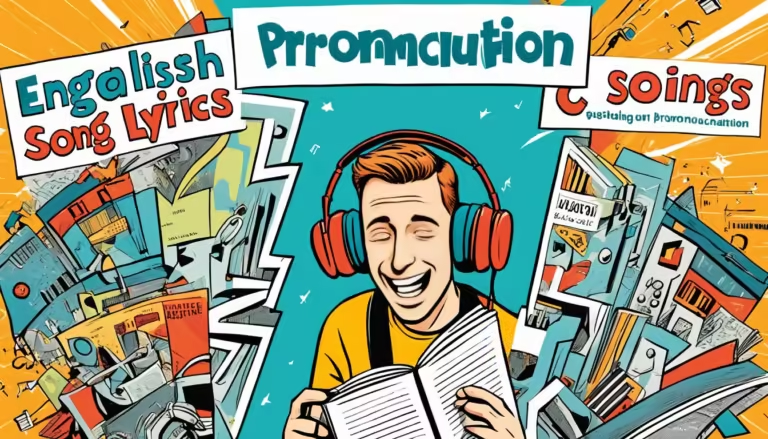
Hey there, awesome English learners! Get ready to master a sound that’s a bit of a secret agent in American English: the CH sound, as in “chair”, “check”, or “catch**”! Its super-secret IPA code is /tʃ/ (looks like a ‘t’ and that curvy ‘sh’ symbol had a baby!).
Now, why a “secret agent”? Because while it sounds like ONE quick, sharp sound, it’s actually made of TWO sounds blended together super fast! It’s like a high-five between the /t/ sound (like in “top”) and the /ʃ/ SH sound (like in “shop”)! If you don’t get this T+SH combo just right, your “CH” can sound a bit off – maybe too soft, like just an SH sound (“share” instead of “chair”), or maybe even like a ‘TS’.
This is a BIG deal for your American accent! Think about words like “child”, “coach“, “nature” (yes, that ‘T’ can sound like CH!), or “catch“. They’re everywhere! Mispronouncing /tʃ/ can make your speech unclear and definitely marks your accent. Plus, the spelling! CH is obvious, but what about TCH (“watch”)? Or that sneaky ‘T’ in “question” or “future” that magically becomes a CH sound? It’s enough to make you say “What?!” 😵
But don’t you worry! Today, we’re cracking the CH code wide open! This guide, explained so simply an 8-year-old can nail it, will turn YOU into a /tʃ/ ninja:
Meet the CH Sound /tʃ/: The voiceless “palato-alveolar affricate” explained like it’s a fun combo move! (It’s just T + SH!).
Mouth & Tongue Magic: Simple, step-by-step instructions to make that perfect T-stop flow into a smooth SH-release!
The NO-BUZZ Rule: Why your voice box needs to be quiet for this one (it’s voiceless!).
Sound-Alike Battles: How to stop confusing CH /tʃ/ with SH /ʃ/ (its softer cousin) and J /dʒ/ (its buzzing twin brother!).
Spelling Decoded! CH, TCH, T (in -TURE, -TION), and even C! We’ll show you when these letters make the /tʃ/ sound.
Zap Those Errors! Fixing common mistakes (like skipping the ‘T’ part) to make your CH crisp and clear.
Practice Power Hour! Fun, easy exercises and word lists (‘much’, ‘question’, ‘future’, ‘kitchen’) to train your mouth!
Get ready for your “choose,” “change,” “lunch,” and “teacher” to sound authentically American and super clear! Let’s chat about it! 😉
What is this “CHoo-CHoo Train” /tʃ/ Sound, Really?
Okay, first things first! The /tʃ/ sound (think of the sound that starts “chair” or ends “watch“) is one of only two affricate consonants in American English. “Affricate” sounds super fancy, right? But all it means is that it’s a combo sound!
Think of it like a quick 1-2 punch:
PUNCH 1 (The STOP): You start by making a quick /t/ sound. Your tongue tip goes up behind your top teeth and briefly STOPS the air. T-
PUNCH 2 (The FRICTION): THEN, immediately, you release that /t/ stop into an /ʃ/ SH sound. The air whooshes out with that “shhhh” friction. -SH!
So, /tʃ/ = a quick /t/ stop + an immediate /ʃ/ SH release! All blended into one smooth, sharp sound: “CH!”
You hear it in words like:
choose /tʃuz/
church /tʃɜrtʃ/
each /itʃ/
much /mʌtʃ/
teacher /ˈtitʃər/
question /ˈkwɛstʃən/ (That ‘T’ makes a /tʃ/ sound here!)
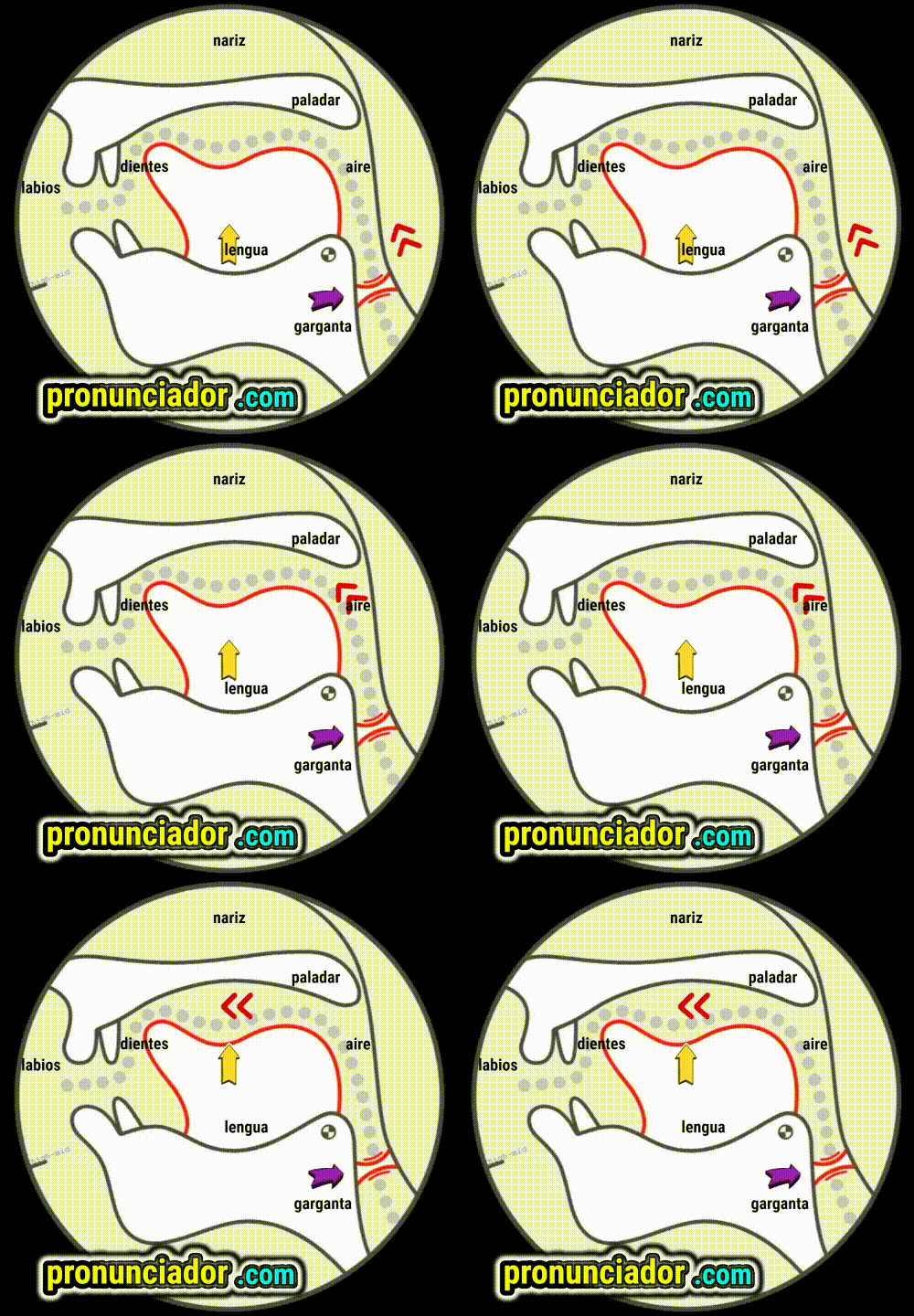
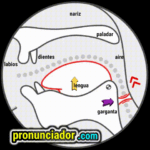
Palato-Alveolar (Tongue Action Spot!): This is where the SH part (/ʃ/) happens. The blade (not the very tip) and front of your tongue make a ramp and get close to the area just behind the bumpy ridge (alveolar ridge) and the hard roof (palate) of your mouth. . The /t/ part starts with the tongue tip at the alveolar ridge.
Voiceless (Voice Box OFF!): Just like /t/ and /ʃ/ are voiceless, their combo /tʃ/ is ALSO voiceless. No buzzing in your throat. Just air!
Affricate (Stop + Rub!): This means it starts like a STOP (air blocked completely for the /t/ part) and then immediately releases into a FRICATIVE (air squeezed out with rubbing for the /ʃ/ part).
Super Simple Kid Summary: To make the /tʃ/ (CH sound in ‘chair’):
Touch your tongue tip quickly behind your top teeth (like for ‘T’).
Push your lips out a bit and make them roundish (like for ‘SH’).
Release the ‘T’ and right away let the air “whoosh” out like an ‘SH’ sound, keeping your tongue arched up but not touching the roof.
Keep your voice box OFF! No hum. It’s a quick, sharp “T-SH!” all in one go!
The EPIC Sound-Alike Battle: /tʃ/ (Chip) vs. /ʃ/ (Ship) vs. /dʒ/ (Jip/Gin)
Getting these straight is key!
/tʃ/ (CHip) vs. /ʃ/ (SHip) – The Quick “T” is Missing!
/tʃ/ (CHip): Starts with a very quick BLOCK of air using the tongue tip (the /t/ part), THEN releases into the /ʃ/ “whoosh.” → T-SH!
/ʃ/ (SHip): Is ONLY the “whoosh” /ʃ/. Air flows smoothly from the start. No block. → SHHHHH!
Mistake: Saying /ʃ/ for /tʃ/. “Chair” /ˈtʃɛr/ becomes “Share” /ˈʃɛr/. “Choose” /tʃuz/ becomes “Shoes” /ʃuz/. The CH loses its sharpness.
Fix: Make sure you feel that little tongue-tip stop for the ‘T’ part RIGHT before the ‘SH’ part. It’s very quick, but it’s there! Chop (/tʃ/) vs. Shop (/ʃ/).
/tʃ/ (CHurCH – Voiceless) vs. /dʒ/ (JuDGe – Voiced) – The BUZZ!
These two are TWIN BROTHERS! They are made with the EXACT SAME mouth and tongue movements (a quick D-like stop flowing into a ZH-like friction for /dʒ/; a quick T-like stop flowing into an SH-like friction for /tʃ/).
The ONLY difference: /tʃ/ is VOICELESS (no throat buzz). /dʒ/ (like J in ‘judge’ or ‘gym’) is VOICED (throat BUZZES ON!).
Mistake: Using voiceless /tʃ/ when it should be voiced /dʒ/, or vice-versa. “Cheap” /tʃip/ vs “Jeep” /dʒip/. “Chin” /tʃɪn/ vs “Gin” /dʒɪn/.
Fix: THROAT BUZZ TEST! Hand on throat. “CHurCH” = NO buzz. “JuDGe” = YES buzz! Practice feeling that ON/OFF for the voice box while doing the T-SH or D-ZH mouth move.
Your Mouth’s CHoo-CHoo Moves: Making the /tʃ/ Sound (Kid-Style!)
Let’s make this sound together! It’s a fast train: T stop + SH woosh!
Step 1: Mouth a Little Open, Lips “Choo-Choo” Ready!
Open your mouth just slightly, not too wide.
Round your lips a little bit and push them out slightly. Like you’re about to blow a tiny kiss or imitate a train: “Choo-choo!”
Step 2: Tongue Part 1 – The “T” Stop!
Place the TIP of your tongue on the bumpy ridge right behind your upper front teeth (the alveolar ridge).
For a split second, press your tongue tip there to STOP the airflow completely. This is the /t/ part.
Step 3: Tongue Part 2 & Airstream – The “SH” Release!
This happens SUPER FAST after Step 2!
Immediately pull your tongue tip SLIGHTLY back and down from the alveolar ridge.
As you do that, the BLADE (middle/front part) of your tongue arches UP towards the roof of your mouth (hard palate), creating a narrow channel like for the /ʃ/ SH sound (but remember, it doesn’t touch the roof).
Release the blocked air from the ‘T’ stop and let it WHOOSH out through this SH-channel and your rounded lips.
Step 4: Voice Box – Zzzzz… (OFF!)
For /tʃ/, your vocal cords must be quiet, not vibrating. It’s all air, no hum.
Putting it All Together (T → SH → CH!):
Lips ready (rounded).
Tongue tip up to alveolar ridge (T position, block air).
Quickly pull tip back a bit, arch tongue blade up (SH position).
Release air from T-stop straight into the SH-whoosh.
NO voice box buzz. The result is ONE quick, sharp sound: CH! /tʃ/.
Practice Feeling it:
Say “T” /t/. Feel the tip stop.
Say “SH” /ʃ/. Feel the lips round, tongue arch, air whoosh.
Now try to blend them: quickly touch the T-spot, then immediately release into the SH-whoosh: “T-SH… TSH… CH!”
Spelling CHaos! How Do You Write the /tʃ/ Sound?
The /tʃ/ sound is spelled in a few ways, some obvious, some tricky! Let’s check out the main ones, based on the video’s data.
The Main Man: ‘CH’ (~61%)
Good old ‘CH’ is the MOST common way to spell /tʃ/! Thank goodness!
chair /tʃɛr/, check /tʃɛk/, choose /tʃuz/, church /tʃɜrtʃ/, child /tʃaɪld/, chance /tʃæns/, cheer /tʃɪr/, lunch /lʌntʃ/, much /mʌtʃ/, each /itʃ/, teach /titʃ/, rich /rɪtʃ/, approach /əˈproʊtʃ/.
The “Question Mark” ‘T’: In -TION, -TURE (~25%)
This is a BIG one that confuses many! The letter ‘T’ often makes the /tʃ/ sound, especially in these common suffixes before a ‘U’ sound or in ‘-stion’:
-TURE: nature /ˈneɪtʃər/, future /ˈfjutʃər/, picture /ˈpɪktʃər/, feature /ˈfitʃər/, creature /ˈkritʃər/, mixture /ˈmɪkstʃər/, culture /ˈkʌltʃər/, adventure /ədˈvɛntʃər/, furniture /ˈfɜrnɪtʃər/, capture /ˈkæptʃər/. (The ‘U’ often sounds like an unstressed vowel /ə/ or is part of a /jʊ/ Yod-U).
-TION (but only in ‘QUESTION’ for /tʃ/): question /ˈkwɛstʃən/. Note: Most other -TION words are /ʃən/ (nation, station)! ‘Question’ is special.
-TUAL: actual /ˈæktʃuəl/, virtual /ˈvɜrtʃuəl/.
The pattern is often: T + U-like vowel → /tʃ/.
The Partner in Crime: ‘TCH’ (~13%)
If you see ‘TCH’ together, it’s pretty much always going to be the /tʃ/ sound! The ‘T’ is silent here, just making the CH sharp.
Let’s tackle the ways this T+SH combo goes wrong for learners!
Mistake #1: Just Saying SH /ʃ/ (Losing the “T” Stop)!
What Happens: Your /tʃ/ sounds too soft, like just an SH. “Chair” becomes “Share”. “Chip” becomes “Ship”. You miss the sharp “attack” of the ‘T’.
The Fix:FEEL THE STOP! Briefly touch your tongue tip to the ridge behind your top teeth (T-spot!) RIGHT before you make the SH whoosh. It needs that tiny, quick block of air first. Practice: T…SH… T-SH… CH!
Mistake #2: Voicing It! (Accidentally Saying /dʒ/ J as in Judge)!
What Happens: Your voice box turns ON, making the CH sound like J. “Cheap” /tʃip/ becomes “Jeep” /dʒip/.
The Fix:VOICE OFF! Keep your throat quiet. /tʃ/ is all air. /dʒ/ has a buzz. Use the throat buzz test (hand on throat): “CHoke” (no buzz) vs “Joke” (buzz!).
Mistake #3: Lips Not Rounded Enough (Or Too Spread).
What Happens: The SH part of /tʃ/ sounds weak or too much like an S.
The Fix: Gentle “Choo-Choo” lips! Slightly round and push them out a bit for that SH-whoosh. It helps channel the air correctly.
Mistake #4: Confusing ‘TR’ with /tʃ/.
What Happens: Words like “tree” /tri/ might get confused with CH. Or trying to say ‘TR’ by making a /tʃ/ sound.
The Fix: They are different! /tr/ is T + American R (tongue tip up for T, then tongue pulls back for R). /tʃ/ is T + American SH (tongue tip up for T, then blade arches for SH). Different tongue end points and lip shapes!
CHoo-CHoo Train Your Mouth! Easy /tʃ/ Exercises!
Time to build that sharp American CH!
Exercise 1: The T+SH Combo Drill
Slowly: Say a clear /t/ (tip up, stop air). Then say a clear /ʃ/ (lips round, tongue arch, whoosh air).
T….. SH….. T….. SH…..
Faster: T-SH… T-SH… T-SH…
Even Faster: CH! CH! CH! /tʃ/ /tʃ/ /tʃ/
Feel the two parts merging into one sharp sound.
Exercise 2: CH /tʃ/ vs SH /ʃ/ – Sharp vs. Smooth!
Critical difference!
Chop /tʃɑp/ (T-stop first) — Shop /ʃɑp/ (Smooth SH start)
Chin /tʃɪn/ — Shin /ʃɪn/
Cheer /tʃɪr/ — Sheer /ʃɪr/ (pure, transparent)
Catch /kætʃ/ — Cash /kæʃ/
Watch /wɑtʃ/ — Wash /wɑʃ/
Exercise 3: Voicing ON vs. OFF – CH /tʃ/ vs J /dʒ/
Hand on throat!
Choke /tʃoʊk/ (NO buzz) — Joke /dʒoʊk/ (BUZZ!)
Chin /tʃɪn/ (NO buzz) — Gin* /dʒɪn/ (BUZZ!)
Rich /rɪtʃ/ (NO buzz) — Ridge /rɪdʒ/ (BUZZ!)
Batch /bætʃ/ (NO buzz) — Badge /bædʒ/ (BUZZ!)
Exercise 4: Spelling Variations for /tʃ/ – Practice!
Record yourself! Is your CH /tʃ/ sharp and clear? Not soft SH? Not buzzy J?
“Each [tʃ] child [tʃ] likes the chicken [tʃ] sandwich [tʃ].”
“Choose a church [tʃ] [tʃ] for your future [tʃ].”
“Watch [tʃ] the creature [tʃ] catch [tʃ] the ball.”
“That’s a good question [tʃ] about [t] culture [tʃ].” (Mix with plain T!)
“The teacher’s [tʃ] mixture [tʃ] was an adventure [tʃ]!”
FAQs: Your American CH /tʃ/ Sound Questions Answered!
Q1: So, is the CH /tʃ/ sound ONE sound or TWO sounds? (Kid version!)
It’s like a secret combo move! It starts with a tiny, quick ‘T’ sound (tongue tip taps!), and instantly turns into a ‘SH’ sound (lips make an “O”, air whooshes!). T + SH = CH! /tʃ/! All super fast, like one sound!
Q2: What’s the #1 mistake people make with /tʃ/?
Usually, it’s missing the first ‘T’ part and just saying the ‘SH’ /ʃ/ part. So “chair” sounds like “share”. You need that little tongue-tip STOP before the SH-release to make it sharp!
Q3: How is /tʃ/ (chair) different from /dʒ/ (jar, judge)?
It’s all about the VOICE BOX BUZZ!
/tʃ/ (chair): NO BUZZ in your throat. Voice is OFF. Just air.
/dʒ/ (jar): YES BUZZ! Voice is ON. The mouth moves are pretty much the same (quick D-like stop + ZH-like friction for /dʒ/), but the voicing is the key!
Q4: When ‘T’ is spelled, like in “future” or “question”, does it ALWAYS sound like CH /tʃ/?
Often, but not always! It’s very common when ‘T’ is followed by a ‘U’ sound (like in -ture, -tual) or in ‘-stion’.
FUTURE → /ˈfjutʃər/
QUESTION → /ˈkwɛstʃən/
ACTUAL → /ˈæktʃuəl/ BUT, a ‘T’ can also be a normal /t/ (“top”), a Flap T (“water”), or a Glottal T (“button”)! You have to learn these specific “T-becomes-CH” patterns.
Q5: Are CH and TCH spelled words pronounced exactly the same?
YES! The ‘T’ in ‘TCH’ is just there to tell you the vowel before it is usually SHORT (like in ‘watch’, ‘catch’, ‘kitchen’). But the sound at the end is the same sharp /tʃ/. The ‘T’ itself is silent in TCH.
Final Takeaways: Your CH /tʃ/ is Now Sharp as a Tack!
You’ve done it! You’ve decoded the American CH /tʃ/ sound! You know it’s that quick T-stop flowing into an SH-release, with no voice!
KEY MOUTH MOVE: Tip touches for T, then pulls back slightly as blade arches for SH. Lips rounded.
Vs /ʃ/ (Share): CH has the T-stop first, SH is smooth air.
Vs /dʒ/ (Jar): CH is NO buzz. J has BUZZ!
SPELLING: CH (most common!), TCH (always CH sound), T (in -ture, -tual, -stion often CH).
COMMON ERROR: Skipping the T-stop (sounds like SH).
The secret is feeling that quick block-then-release of air, making sure the T-part is there. Practice words like “chair,” “watch,” “future,” and “question.” Record yourself, listen closely. You’ll be “CHoosing” the right sound in no time!
Master English pronunciation with proven techniques like shadowing, IPA mechanics, and prosody training. A comprehensive strategy for learners seeking clarity and intelligibility.
<em><strong><span style="vertical-align: inherit;"><span style="vertical-align: inherit;">Javascript no detectado.</span></span></strong></em><span style="vertical-align: inherit;"><span style="vertical-align: inherit;"> Se requiere Javascript para que este sitio funcione. Habilítelo en la configuración de su navegador y actualice esta página.</span></span>
<em><strong><span style="vertical-align: inherit;"><span style="vertical-align: inherit;"> Javascript no detectado.</span></span></strong> </em><span style="vertical-align: inherit;"><span style="vertical-align: inherit;"> Se requiere Javascript para que este sitio funcione. Actívalo en la configuración de tu navegador y actualiza esta página.</span></span>
<em><strong><span style="vertical-align: inherit;"><span style="vertical-align: inherit;"> Javascript no detectado.</span></span></strong></em><span style="vertical-align: inherit;"><span style="vertical-align: inherit;"> Se requiere Javascript para que este sitio funcione. Actívalo en la configuración de tu navegador y actualiza esta página.</span></span>