

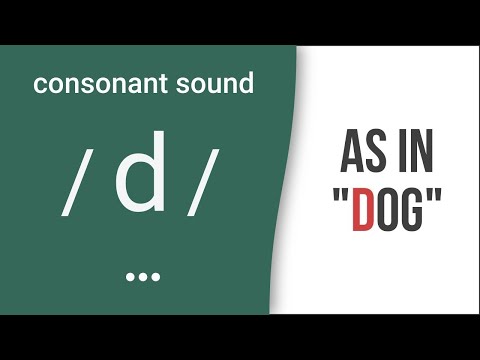
Master the American /d/ sound for a clearer accent. This guide explains tongue placement, voicing, and the key difference from /t/ with practice words to fix your pronunciation.

Stepping into Clear American English: The Deal with /d/
Have you ever said a word like “day” or “daddy” and felt it didn’t sound quite right? Or maybe someone confused your “bed” with “bet“? You’re not alone! The American English /d/ sound, found in countless common words, can be surprisingly tricky for learners. While you know the letter ‘D’, producing its specific sound consistently in American English involves precise movements and understanding a key difference: voicing.
Getting this sound right is vital for clear communication. A slight mispronunciation can change the meaning entirely, leading to confusion or making your accent sound less natural. This guide cuts through the complexity. We’ll explore exactly how your mouth makes the /d/ sound, tackle the crucial difference between /d/ and its similar-sounding partner /t/, figure out the rules for that little puff of air (aspiration), and dive into practice. Ready to make your American English sound clearer and more confident? Let’s get started.
Decoding the /d/: What Makes This Sound Tick?
To really master the /d/, let’s understand its phonetic identity. Think of it like knowing the ingredients before you cook.
- The Symbol: /d/ (This is its unique identifier in the International Phonetic Alphabet – IPA)
- Sound Type: It’s a Stop Consonant. This means you completely stop the flow of air coming from your lungs for a split second, build up a tiny bit of pressure, and then release it. American English has six main stop sounds (/p/, /b/, /t/, /d/, /k/, /g/), and /d/ is a frequent one.
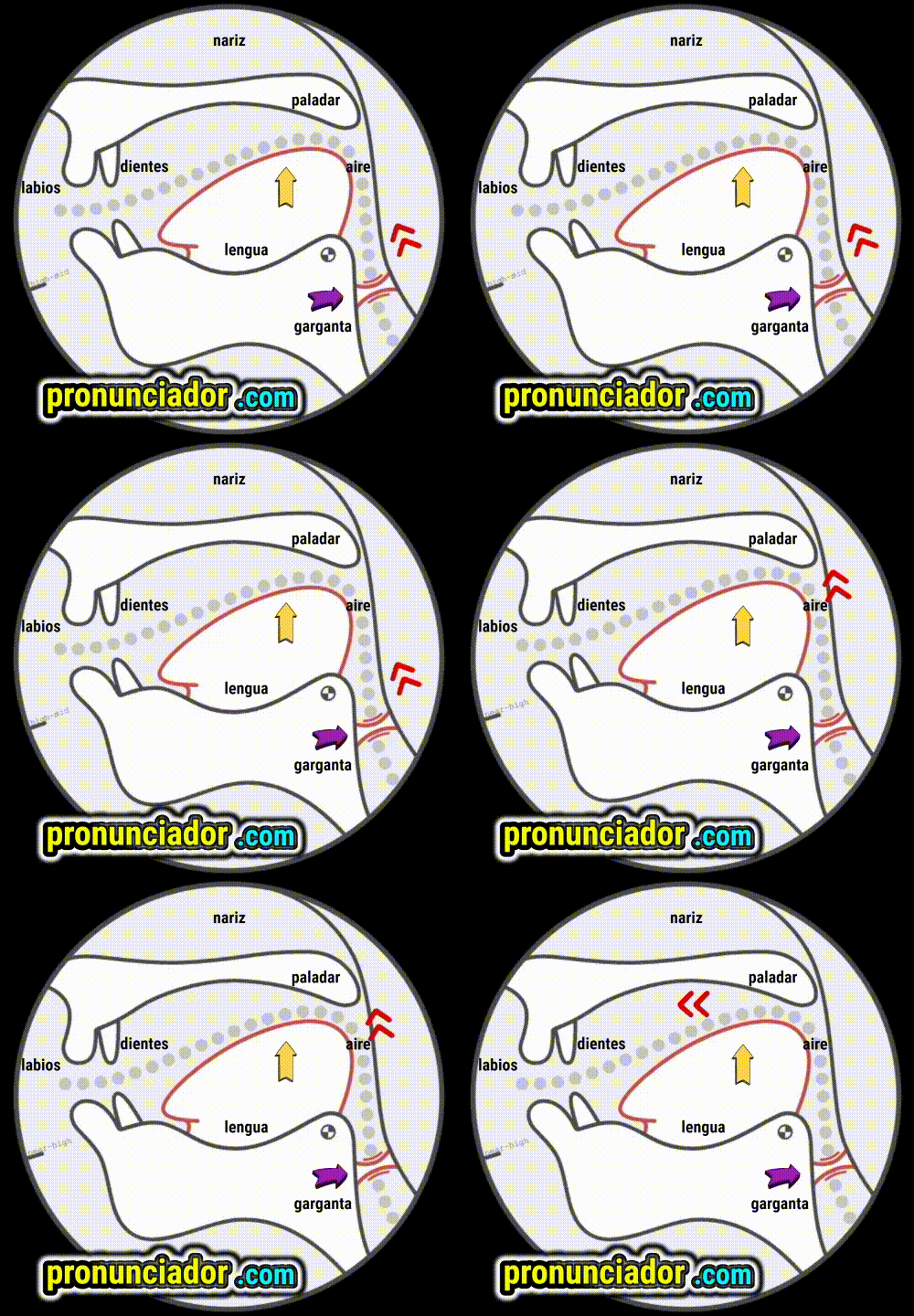
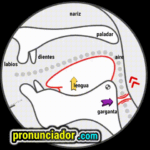
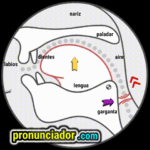
- Place of Action: It’s Alveolar. This means the action happens at your alveolar ridge – that firm, slightly bumpy area on the roof of your mouth just behind your upper front teeth. Your tongue tip makes contact here. Go on, feel it with your tongue tip – that’s the target zone!
- The Crucial Ingredient: Voicing: It’s Voiced. This is non-negotiable for /d/. Your vocal cords (in your throat) must vibrate when you make this sound. Gently touch your throat and say “zzzzzzz” – feel the buzz? That’s voicing. The /d/ sound needs that vibration.
So, the /d/ is a voiced alveolar stop consonant. Broken down: Stop the air with your tongue tip on the ridge, let it go, and make your vocal cords buzz as you release it.
Quick Fact: The /d/ sound is incredibly common – estimates suggest it appears in about 1 out of every 5 English words!

Why the /d/ Might Be a Pronunciation Puzzle
If /d/ seems simple on paper, why do so many learners find it challenging? Here are common reasons:
- The /t/ Trap (Voicing Confusion): The most frequent issue is confusing /d/ with /t/ (like in “toy”). Physically, they are made in the exact same place in the mouth (alveolar ridge) with the exact same tongue action (stop). The only difference is voicing: /d/ vibrates, /t/ doesn’t. If your vocal cords don’t vibrate when you intend to say /d/, it will sound like /t/ to native speakers. This often happens if your native language handles voiced/voiceless sounds differently.
- The Aspiration Mystery: American English has specific nuances about releasing a small puff of air (aspiration) with stop sounds. While strong aspiration is key for voiceless stops like /t/ at the start of stressed syllables, the situation with /d/ is more subtle. Some sources describe a slight puff or less intense release for initial /d/, while others state voiced stops are essentially never aspirated in the same forceful way as voiceless ones. The key takeaway is the release must be voiced, contrasting with the airy release of /t/. Ending /d/ is generally unaspirated (no puff). Confusion about this voiced release vs. voiceless aspiration is common.
- Tongue Placement Precision: Although the target is the alveolar ridge, accidentally touching the teeth (dental) or slightly further back can alter the sound quality. English /d/ is specifically alveolar. Some languages (like Spanish) might use a more dental ‘d’.
- Native Language Habits (L1 Interference): Your brain is wired for the sounds of your first language. If its ‘d’ sound or voicing rules differ, those old habits naturally try to take over.
Understanding these hurdles helps you target your practice effectively.
The Core Contrast: Feeling the /d/ Buzz vs. the Silent /t/ Air
Let’s laser-focus on the most critical difference: voicing.
- /d/ = Voiced: Vocal cords VIBRATE. Creates a buzzing sensation in the throat.
- /t/ = Voiceless: Vocal cords DO NOT vibrate. Air simply passes through.
Feel the Difference:
- Place your fingertips lightly on your throat (your Adam’s apple area).
- Make a continuous “ddd-ddd-ddd” sound. You must feel that vibration. That’s the ‘voice’ of the /d/.
- Now, make a sharp “ttt-ttt-ttt” sound. There should be no vibration. Feel the air puff out instead (if you hold your hand close to your mouth)
Remember: The only physical difference is the vocal cord activity.
This voicing difference creates distinct words (minimal pairs):
- down vs. town
- dry vs. try
- ride vs. write
- ladder vs. latter
- bed vs. bet
- need vs. neat
Practicing these pairs helps train your ear and your vocal production.

Your Step-by-Step Guide: Crafting the Perfect /d/
Let’s build the /d/ sound precisely:
- Mouth Position: Open your mouth slightly, relaxed.
- Lip Position: Keep lips neutral – no need to round or spread them.
- Tongue Action (The Star Player):
- Lift the very tip of your tongue (the apical part). Some sources describe the tongue as being wide and flat, with sides touching the upper molars.
- Firmly press the tongue tip against the alveolar ridge (the bumpy gum ridge just behind your upper front teeth, but not touching the teeth directly). Ensure you create a complete seal to stop the airflow briefly.
- Airflow Stop: Momentarily block the air from escaping your mouth using this tongue seal. You’ll feel slight pressure build.
- The Release: Quickly pull your tongue tip down and slightly away from the ridge. This releases the built-up air. The nature of this release depends on the position (see Aspiration section below).
- Turn on the Voice! (Crucial Timing): As you release your tongue, simultaneously vibrate your vocal cords. The sound and the voicing start together. Think “d-d-d,” merging the tongue release with the throat buzz.
Nailing the Tongue Spot: Alveolar Precision
Focus on using just the tip against that ridge. It’s a precise contact. Touching the teeth makes it dental (common L1 interference, e.g., for Spanish speakers). Touching too far back on the roof changes the sound. Keep it right behind the teeth, on that ridge.
Activating the Voice Reliably
If the /d/ consistently comes out voiceless (/t/), practice connecting it to an already voiced sound:
- Hold a “zzzzzz” sound, feeling the vibration. While still buzzing, quickly tap your tongue tip to the alveolar ridge and release it back into the “zzzz”: “zzzdzzzdzzz.”
- Try with “vvvvv”: “vvvdvvvdvvv.”
This helps you associate the tongue movement with continuous vocal cord vibration.
Understanding the Release: Aspiration & the /d/ Sound
Okay, let’s clarify the “puff of air” (aspiration) concept for /d/, contrasting it with /t/.
- Voiceless Stops (/p/, /t/, /k/): These have a noticeable puff of air (aspiration) when they start a word or a stressed syllable (e.g., “top,” “attack”). They are unaspirated after /s/ (e.g., “stop”) or at the end of words/syllables.
- Voiced Stops (/b/, /d/, /g/): Linguistically, voiced stops in English are technically considered unaspirated. They have a very short Voice Onset Time (VOT), meaning the vocal cords start vibrating almost immediately upon release.
- So, what about the “slight puff” mentioned for /d/ in some sources? This likely refers to the audible release of voiced air. It’s crucial to distinguish this voiced release from the stronger, voiceless puff of air characteristic of initial /t/, /p/, /k/. The key difference remains voicing.
Practical Rules for American /d/ Release:
- /d/ at the Beginning of a Word or Stressed Syllable: Release the stop with clear voicing. Ensure the vibration starts immediately with the release. It will feel less forceful and airy than an initial /t/.
- Examples: dog /dɔɡ/, do /du/, day /deɪ/, address /əˈdrɛs/, depend /dɪˈpɛnd/, idea /aɪˈdiə/.
- /d/ at the End of a Word or Before Another Consonant: Often unaspirated or “unreleased.” This means you bring your tongue tip up to the alveolar ridge to make the stop, maintain voicing briefly, but you might not fully release the tongue down before moving to the next sound or ending the word. The stop position is reached, but the audible release “pop” might be very weak or absent. The voicing (buzzing) is still key.
- Examples: bed /bɛd/, good /ɡʊd/, need /nid/, mad /mæd/, said /sɛd/. Listen to “goood-night.” You might hold the /d/ in ‘good’.
- /d/ Between Vowels (Flap D): In American English, when /d/ (like /t/) falls between two vowel sounds, and the second vowel is unstressed, it often changes to a very fast tap or “flap” sound (IPA symbol: /ɾ/). The tongue quickly taps the alveolar ridge without fully stopping the air. It sounds similar to the ‘dd’ in “ladder” or the ‘tt’ in “butter”.
- Examples: ladder /ˈlæɾər/, mad about /ˈmæɾəˌbaʊt/, need it /ˈniɾɪt/.
Key Distinction Recap: Focus on voicing for /d/ in all positions. Contrast the voiced release of initial /d/ with the voiceless aspirated puff of initial /t/. Recognize the unaspirated/unreleased nature of final /d/, still maintaining voicing.
Spelling the /d/ Sound: Common Patterns
Generally straightforward:
- ‘d’: The vast majority of /d/ sounds are spelled with a single ‘d’. (e.g., day, middle, end) (~98% according to one source).
- ‘dd’: Double ‘dd’ usually represents a single /d/ sound (e.g., add, daddy, oddle).
- ‘ed’: The past tense ending ‘-ed’ is often pronounced as /d/ when following a voiced sound (other than /d/ itself). (e.g., played /pleɪd/, called /kɔld/, lived /lɪvd/).
Always trust the sound over the spelling!
Practice Zone: Training Your Tongue and Ears
Time to put theory into practice! Consistent, focused repetition is how you build muscle memory for new sounds.
Practice Strategy:
- Use online dictionaries (Merriam-Webster, Oxford Learner’s Dictionaries) or pronunciation sites to hear native speaker examples.
- Focus intensely on the /d/ sound: Is it clearly voiced? How is it released (clear voiced release or unreleased)?
- Repeat the word aloud 5-10 times, aiming to match the native speaker. Exaggerate the voicing at first if needed.
- Record yourself! Comparing your production to the model is incredibly helpful for identifying differences.
Part 1: Words Starting with /d/ (or stressed syllable)
Focus: Clear VOICED release, contrast with /t/.
- do /du/
- day /deɪ/
- dog /dɔɡ/
- down /daʊn/
- dad /ˈdæd/ (initial D)
- daily /ˈdeɪli/
- damage /ˈdæmɪdʒ/
- dance /dæns/
- dark /dɑrk/
- daughter /ˈdɔtər/
- deal /dil/
- delight /dɪˈlaɪt/ (Stress on ‘light’, initial D has voiced release)
- design /dɪˈzaɪn/ (Stress on ‘sign’)
- desk /dɛsk/
- dessert /dɪˈzɜrt/ (Stress on ‘sert’)
- dew /du/
- dial /ˈdaɪəl/
- dirt /dɜrt/
- discover /dɪˈskʌvər/ (Stress on ‘scov’)
- doctor /ˈdɑktər/
- drugstore /ˈdrʌɡˌstɔr/
- during /ˈdʊrɪŋ/
- idea /aɪˈdiə/ (Stress on ‘dea’)
- address /əˈdrɛs/ (Stress on ‘dress’)
- depend /dɪˈpɛnd/ (Stress on ‘pend’)
Part 2: Words Ending with /d/
Focus: VOICED but UNASPIRATED/UNRELEASED quality.
- and /ænd/
- good /ɡʊd/
- did /dɪd/ (final D)
- would /wʊd/
- had /hæd/
- need /nid/
- could /kʊd/
- should /ʃʊd/
- said /sɛd/
- find /faɪnd/ (Be careful not to drop the /d/ – say ‘find’, not ‘fine’)
- god /ɡɑd/
- friend /frɛnd/ (Commonly dropped /d/ here in casual speech, but practice pronouncing it)
- old /oʊld/
- around /əˈraʊnd/
- kid /kɪd/
- made /meɪd/
- kind /kaɪnd/
- hand /hænd/
- world /wɜrld/ (Tricky combination, ensure the /d/ is voiced)
- bad /bæd/
- add /æd/
- afraid /əˈfreɪd/
- avoid /əˈvɔɪd/
- card /kɑrd/
- cold /koʊld/
- crowd /kraʊd/
- field /fild/
- food /fud/
- hard /hɑrd/
- hood /hʊd/
- loud /laʊd/
- wood /wʊd/
- yard /jɑrd/
Part 3: Words Featuring Multiple /d/ Sounds or Flap /d/
Pay attention to each /d/ – is it initial/stressed (voiced release) or final/before consonant (unaspirated/unreleased)? Or is it a flap?
- dad /dæd/ (Voiced release, Unaspirated final)
- daddy /ˈdædi/ (Voiced release, Flap /ɾ/ between vowels)
- deed /did/ (Voiced release, Unaspirated final)
- decided /dɪˈsaɪdɪd/ or /dɪˈsaɪɾəd/ (Voiced release, Unaspirated, Final /ɪd/ or flap)
- demand /dɪˈmænd/ (Voiced release, Unaspirated final)
- indeed /ɪnˈdid/ (Voiced release [stress on ‘deed’], Unaspirated final)
- hundred /ˈhʌndrəd/ or /ˈhʌnɾəd/ (Often unreleased in blend ‘dr’, final /əd/ or flap)
- roadside /ˈroʊdˌsaɪd/ (Unaspirated, Unaspirated)
- standard /ˈstændərd/ (Unaspirated in blend ‘st’, Unaspirated final)
- understand /ˌʌndərˈstænd/ (Unaspirated in blend ‘st’, Unaspirated final)
| PHONETICAL PRONUNCIATION |
| PHONETICAL PRONUNCIATION |
Fixing Common /d/ Sound Hiccups
- Mistake: My /d/ always sounds like /t/.
- Fix: Exaggerate the voicing. Hum slightly before saying a word starting with /d/ (mmmmday). For final /d/, hold the voicing longer: “beeeddd.” Feel the vibration in your throat consistently. Minimal pairs (“den/ten,” “bad/bat”) are your best friends here.
- Mistake: My /d/ sounds “muddy” or unclear, especially at the end.
- Fix: Ensure a firm tongue tip seal on the alveolar ridge. Even if unreleased, the stop position needs to be clear. Don’t let the tongue be lazy or touch too softly. Practice making just the stop clearly: Hold the tongue up for ‘bed’, then release silently after a moment. Then add the voice back.
- Mistake: Initial /d/ sounds too weak or too strong (like /t/).
- Fix: Focus on the voiced release. It should be less forceful than /t/ but definitely have that vocal cord vibration right at the start. Contrast “Dddd-ay” (voiced start) with “T-huh-ay” (voiceless puff start).
- Mistake: Using a dental ‘d’ (tongue on teeth).
- Fix: Consciously aim for the ridge behind the teeth. Look in a mirror if needed. The feeling is different. Practice shifting from your native ‘d’ (if dental) to the alveolar /d/.
Remember, changing pronunciation habits takes time and repetition. Be patient and persistent!

El Patrón de “-mente” a “-ly” – Cómo Crear Adverbios al Instante

El Patrón de “-ico” a “-ic” – Simplificando Adjetivos al Instante
Frequently Asked Questions
What’s the absolute key difference between American /d/ and /t/?
Voicing. /d/ has vocal cord vibration, /t/ does not. They share the same tongue position (alveolar ridge) and manner (stop).
Should the American /d/ sound have a puff of air like /t/?
No, not in the same way. Initial /t/ has a strong, voiceless puff (aspiration). Initial /d/ has a voiced release, which might feel like a very slight puff but is fundamentally different because the vocal cords vibrate immediately. Final /d/ usually has no puff (unaspirated/unreleased).
Where exactly does my tongue tip go for the /d/ sound?
It should press firmly against the alveolar ridge – the hard, slightly bumpy area just behind your upper front teeth. Don’t touch the teeth themselves.
Can I just ignore the /d/ sound at the end of words like “and” or “friend”?
While native speakers often reduce or drop sounds in fast, casual speech (especially final /d/ after /n/ like in “and”), it’s crucial for learners to first master the correct pronunciation. Dropping sounds incorrectly can lead to misunderstanding (e.g., “mine” vs. “mind”). Learn the full sound first, then you can learn about reductions later.
Quiz: Test Your /d/ Sound Skills
Check your understanding of the American /d/!
In fast American speech, the ‘d’ in “ladder” often sounds like:
(a) A standard, clear /d/
(b) A /t/ sound
(c) A quick flap or tap sound (/ɾ/)
(d) It is silents your tongue and mouth learn the correct movements automatically, leading to clearer pronunciation.
To make the American /d/ sound, your vocal cords should:
(a) Not vibrate (voiceless)
(b) Vibrate (voiced)
(c) Vibrate only at the end of words
(d) Vibrate only at the beginning of words
The tongue tip touches which part of the mouth for /d/?
(a) Soft palate (back roof)
(b) Back of the upper teeth
(c) Alveolar ridge (behind upper teeth)
(d) Lower teeth
In the word “good“, the final /d/ sound is typically:
(a) Voiced and strongly aspirated (puffed)
(b) Voiceless and aspirated
(c) Voiced and unaspirated (no puff)
(d) Voiceless and unaspirated
How does the release of an initial /d/ (like in “dog”) differ from an initial /t/ (like in “top”)?
(a) There is no difference
(b) /d/ release is voiced; /t/ release is voiceless with aspiration
(c) /t/ release is voiced; /d/ release is voiceless with aspiration
(d) Both are released with strong aspiration
Quiz Answers:
- (b) Vibrate (voiced) – This is the defining feature of /d/.
- (c) Alveolar ridge (behind upper teeth) – This is the correct place of articulation.
- (c) Voiced and unaspirated (no puff) – Final /d/ follows the final stop rule.
- (b) /d/ release is voiced; /t/ release is voiceless with aspiration – This highlights the key difference in initial position.
- (c) A quick flap or tap sound (/ɾ/) – This is common for intervocalic /t/ and /d/ in American English when the following vowel is unstressed.
Speaking Clearer American English
Improving your American /d/ sound is a practical step toward clearer, more confident communication. You now have the tools and knowledge:
- Master Voicing: The vibration in your throat is paramount. It’s the core distinction from /t/.
- Pinpoint Tongue Placement: Alveolar ridge is your target. Be precise.
- Understand the Release: Voiced release initially/stressed, often unreleased finally. Recognize the flap possibility.
- Practice Makes Progress: Use the word lists, listen actively, record yourself, and focus on the physical sensations.
Changing pronunciation takes conscious effort and repetition. Don’t expect instant perfection. Focus on making small, steady improvements. Listen to American English daily, paying attention to how native speakers handle the /d/ sound in different contexts. Apply what you’ve learned here consistently. Soon, saying words like “dog,” “daddy,” and “need” will feel natural and sound authentically American. Keep practicing – you’re on the right path!
👇🔥👇🔥👇🔥👇🔥👇🔥👇🔥
👉 RETURNS in the YEAR 2031 ! WHO? CLICK HERE ! 🔥



👇🔥👇🔥👇🔥👇🔥👇🔥👇🔥
👉 RETURNS in the YEAR 2031 ! WHO? CLICK HERE ! 🔥
👇🔥👇🔥👇🔥👇🔥👇🔥👇🔥


👉 RETURNS in the YEAR 2031 ! WHO? CLICK HERE ! 🔥

👉 RETURNS in the YEAR 2031 ! WHO? CLICK HERE ! 🔥
