

Still say ‘leave’ for ‘live’? Master the American Short I /ɪ/ pronunciation. Discover the secret to the relaxed “ih” sound, fix common mistakes & master tricky spellings.
Hey there, future American accent superstars! Get ready to tackle one of the most common, yet most TRICKY vowel sounds in American English! It’s the sound we call the Short I, the one you hear in super basic words like “it”, “is”, “in”, or “big. Its secret phonetic symbol is /ɪ/ (kinda like a little capital ‘I’ without the top and bottom lines).
Now, why is this super common sound (it’s the SECOND most used vowel!) such a pain for non-native English speakers? Because in many languages, there’s only ONE main “ee” or “ih” type of sound. But English has TWO BIG ONES:
- The Long, Tense /i/ sound (like in “eat”, “see”, “feel” – the one where you smile wide and your mouth is TIGHT!).
- And our star today: the Short, RELAXED /ɪ/ sound (like in “it”, “sit”, “fill” – where your mouth is much LAZIER!).
And guess what? Learners almost ALWAYS use the tense /i/ (or their native language’s “i”) for BOTH! Disaster! Suddenly, you want to say you “live” /lɪv/ somewhere, and it sounds like you want to “leave” /liv/! Or you need a “ship” /ʃɪp/, but you ask for a “sheep” /ʃip/! It’s frustrating, confusing, and a dead giveaway of a non-native accent. You know something is off, but you can’t quite pinpoint what your mouth should be doing differently for “sit” versus “seat”. And the SPELLING! Why can ‘I’, ‘E’, ‘Y’, ‘A’, or even ‘UI’ sometimes make this short “ih” sound? Madness!
But hold on! Today, we are ENDING the Short I confusion FOR GOOD! This is your ultimate, super-simple guide to mastering the American /ɪ/ vowel sound – the relaxed “Ih” that will transform your clarity! We’re going to make this so easy, an 8-year-old will be teaching it by the end:
- Meet the Relaxed “Ih” /ɪ/: What is this “lazy I” sound really? (Secret: It’s all about doing LESS!).
- The EPIC “I” BATTLE: /ɪ/ (Sit – Short & LAX) vs. /i/ (Seat – Long & TENSE!) We’ll finally make this distinction CRYSTAL CLEAR! This is THE key!
- Mouth Magic Explained (Kid-Friendly!): Super easy, step-by-step instructions for the perfect, lazy /ɪ/ mouth! (Hint: Almost no effort!).
- Crazy Spelling UNMASKED! Why I, E, Y, A, UI… can all hide the /ɪ/ sound! We’ve got the treasure map!
- Zap Those Common Mistakes! No more “leev” for “live”! We’ll fix the #1 error (too much tension!) and others.
- Practice Power-Up! Fun, easy exercises with super common words (‘it’, ‘is’, ‘this’, ‘big’, ‘think’, ‘little’) to make your /ɪ/ automatic and awesome!
Get ready for your “this,” “in,” “if,” “will,” “give,” “think,” and “little” to sound perfectly American – relaxed, clear, and confident! Let’s dig in! 😉

What’s This /ɪ/ “Short I” Sound Anyway? (The “Lazy Ih”)
Okay, let’s formally meet this little vowel that causes so much trouble: the /ɪ/ sound. It’s one of the core “single” vowel sounds in American English. And like we said, it’s insanely common!
You hear it in hundreds of everyday words:
- it /ɪt/
- is /ɪz/ (the ‘s’ is actually /z/ here!)
- in /ɪn/
- if /ɪf/
- this /ðɪs/
- with /wɪð/
- big /bɪɡ/
- kid /kɪd/
- live /lɪv/ (the verb!)
- give /ɡɪv/
- think /θɪŋk/
- will /wɪl/
- English /ˈɪŋɡlɪʃ/
- busy /ˈbɪzi/ (Yes, with a ‘U’!)
- gym /dʒɪm/ (Yes, with a ‘Y’!)
Its Secret Recipe (EASY Version!)
The phonetics experts call it a “Near-high, relaxed, front vowel.” What does that mean for us normal folks?
- Front Vowel (Tongue Forward!): Your tongue is doing its work in the FRONT part of your mouth, kind of behind your lower teeth. Not way back.
- Near-High (Tongue Pretty High… But Not Touching the Ceiling!): Your tongue is quite HIGH in your mouth, but – and this is KEY – it’s a little bit LOWER than for the /i/ long “ee” sound (like in “see“). It’s near high, but not super high. This means your jaw (mouth) is open just a TINY bit more than for the long /i/.
- RELAXED Vowel (LAZY Mode ON!): ★★★ THIS IS THE ABSOLUTE #1 SECRET! ★★★ Unlike the tense /i/ “ee” sound (which needs muscle!), for the /ɪ/ “ih” sound, your tongue, lips, and jaw are all RELAXED, loose, floppy. Think “chill out.” No effort!
- Lips? Barely Doing Anything! (Neutral or Slightly Spread – Relaxed):
- Your lips can be completely NEUTRAL and relaxed, almost as if you’re not thinking about them.
- OR, you can slightly stretch the corners of your mouth (like a very, very faint, lazy smile), but make sure they stay RELAXED.
- Definitely NO tight smiling and NO rounding!
Super-Simple Summary for /ɪ/ (the “ih” in “it”):
- Open your mouth just a tiny bit.
- Let your lips be totally lazy (neutral or a tiny bit spread, no tension).
- Let your tongue be lazy too! Have it high-ish in the front of your mouth, but a bit lower and much more relaxed than for a long “eeeee” (/i/) sound.
- Make a SHORT, quick “ih” sound. It should feel effortless!
The BATTLE OF THE “I”s: SHORT /ɪ/ (Sit) vs. LONG /i/ (Seat) – The Showdown!
If you master this one difference, your American accent will skyrocket! This is the confusion that catches almost EVERYONE!
| Feature | SHORT I /ɪ/ (Sit, Live, Ship) | LONG I /i/ (Seat, Leave, Sheep) |
| Effort Level? | RELAXED (Lazy, floppy) | TENSE (Muscles working!) |
| Tongue Height? | High-ish (but LOWER than /i/) | SUPER HIGH (Almost touching roof) |
| Tongue Position? | Front | MORE Front & Higher |
| LIP Shape? | Relaxed (Neutral or Slight lazy spread) | WIDE SMILE (Spread & Tense!) |
| JAW Opening? | Slightly MORE Open than for /i/ | Very Little Opening (Almost Closed) |
| Sound LENGTH? | SHORT | LONG |
| How it SOUNDS? | Quick, soft “Ih” | Bright, sharp “Eeeeee” |
Why is this SO HARD? Because many languages (like Spanish) only have ONE “i” sound, and it’s usually tense like the English long /i/. So we use that tense “ee” for both English “i” sounds, and boom – “ship” sounds like “sheep”!
THE FIX: Learn to RELAX for /ɪ/! Feel the difference in your mouth muscles. Long /i/ (“see”) feels tight and stretched. Short /ɪ/ (“sit”) feels loose and effortless. Practice the minimal pairs (“leave”/”live”, “seat”/”sit”, “feel”/”fill”, “sheep”/”ship”, “heat”/”hit”) until you can hear AND feel the difference clearly! This is your #1 mission!
Your Mouth’s Lazy Day Out: Making the Short /ɪ/ (Easy Steps!)
Okay, let’s learn to make this “effortless ih” sound. It’s really about doing LESS!
Step 1: Mouth – Barely Open, Just a Smidge!
Let your jaw relax and your mouth open just slightly. Not wide, not completely closed. Think natural, resting mouth.
Step 2: Lips – Zero Effort! (Relaxed Neutral or Tiny Relaxed Spread)
Your lips are on vacation for this sound!
- You can leave them completely neutral and relaxed.
- OR, if it helps you find the sound, stretch the corners just a tiny bit to the sides (like a super faint smile), but the key is they MUST stay RELAXED. No tension!
Step 3: Tongue – Chilling in the Front, Pretty High (But Lazy!)
This is where it all comes together!
- Relax your whole tongue! Floppy and soft.
- Now, let the front/middle part of your relaxed tongue rise up HIGH-ISH in the front of your mouth. Remember, NOT as high as for the long /i/ (“see”)! It needs to be a little lower.
- Gently push it forward a bit.
- The tip of your tongue can lightly rest behind your bottom front teeth.
- The main feeling is: tongue forward, fairly high, but totally loose and without strain.
Step 4: The Sound – “Ih” (Short, Soft, Quick!)
- Now, with this relaxed mouth, lips, and tongue setup, just let out a short, soft puff of voiced air: “ih”.
- It should be quick. It should feel easy. If you’re tensing or stretching too much, it’s not /ɪ/!
Feeling Check: Everything lazy? Mouth barely open? Lips doing almost nothing? Tongue soft and high-ish in the front? Sound short and simple? You NAILED the Short I /ɪ/!
The /ɪ/ Spelling Game: I, E, Y, A, UI – Surprise!
Hold on to your hats! This simple little “ih” sound hides behind a CRAZY variety of letters! The letter ‘I’ is the most common, but get ready for some surprises!
The Main Player: Letter ‘I’! (~73% – 75%)
Good! Most of the time (about 3 out of 4 times), if you see the letter ‘I’ in a stressed, closed syllable (ends in a consonant), it’s going to be our Short I /ɪ/! This is your #1 clue!
- it, is, in, if, ill, inch.
- big, kid, him, his, did, give, live (verb!), win, think, bring.
- kiss, miss, fill, little, minute, limit, primitive, district.
Top Tip: Stressed ‘I’ + Consonant? → Very often /ɪ/! (BUT watch for ‘i_e’ like ‘like’ /aɪ/ or rare /i/ like ‘ski’).
The Sneaky ‘E’ (Mostly in Unstressed Bits & Pieces)! (~20% – 23%)
Aha! The letter ‘E’ is the SECOND most common speller for /ɪ/! This happens a LOT in:
- Unstressed Prefixes (be-, de-, re-, pre-, se-):
- begin /bɪˈɡɪn/, before /bɪˈfɔr/, decide /dɪˈsaɪd/, return /rɪˈtɜrn/, prepare /prɪˈpɛr/, secure /sɪˈkjʊr/.
- Unstressed Suffixes (-es, -ed, -est, -age, -ate, -et, -ace, -ain, etc.):
- boxes /ˈbɑksɪz/, wanted /ˈwɑntɪd/, biggest /ˈbɪɡɪst/, village /ˈvɪlɪdʒ/, chocolate /ˈtʃɔklɪt/, ticket /ˈtɪkɪt/, palace /ˈpælɪs/, mountain /ˈmaʊntɪn/.
- Some common words: English /ˈɪŋɡlɪʃ/, enough / ɪˈnʌf/, effect / ɪˈfɛkt/.
Rule of Thumb: ‘E’ in an UNSTRESSED syllable, especially a prefix or suffix? Good chance it’s /ɪ/!
The Chameleon ‘Y’: (~2-3% from “etc.”)
‘Y’ can be /aɪ/ (my) or /i/ (city), but sometimes it’s /ɪ/ too!
- gym /dʒɪm/
- system /ˈsɪstəm/
- crystal /ˈkrɪstəl/
- myth /mɪθ/
- typical /ˈtɪpɪkəl/
- symbol /ˈsɪmbəl/
The REALLY Weird Ones: ‘A’, ‘UI’, ‘U’ (all in the “etc.” <1% category)
These are rarer, but key words use them!
- ‘A’ (usually in unstressed -age, -ate endings):
- message /ˈmɛsɪdʒ/, village /ˈvɪlɪdʒ/, luggage /ˈlʌɡɪdʒ/, private /ˈpraɪvɪt/, chocolate /ˈtʃɔklɪt/, senate /ˈsɛnɪt/.
- ‘UI’:
- build /bɪld/ (U is silent!)
- guilty /ˈɡɪlti/
- biscuit /ˈbɪskɪt/ (TWO /ɪ/ sounds!)
- ‘U’ (just in a couple!):
- busy /ˈbɪzi/!
- business /ˈbɪznɪs/!
- ‘O’ (only ONE!):
- women /ˈwɪmɪn/! (Plural of woman – the ‘o’ is /ɪ/!)
Spelling Maze Summary for Short I /ɪ/:
| Spelling | Freq. (Web) | Key Clue | Top Examples (/ɪ/) | WATCH OUT! Often sounds like… |
| I | ~75% (BOSS!) | STRESSED, closed syllable | it, is, big, kid, think | /aɪ/ (like), /i/ (ski) |
| E | ~20% | UNSTRESSED prefix/suffix, some words | begin, wanted, English | /ɛ/ (bed), /i/ (be) |
| Y | Low % | Specific words (‘gym’, ‘system’) | gym, system, typical | /aɪ/ (my), /i/ (city) |
| A | Low % | Unstressed final -age, -ate | message, private, village | /æ/ (cat), /eɪ/ (lake), /ɑ/ (spa) |
| UI / U / O | Super Rare % | MEMORIZE! Build, Busy, Business, Women | build, busy, women | Most UI=/u/ (fruit), Most U/O other sounds |
Biggest News: ‘I’ is your main bet! For the others, learn the common patterns (UNSTRESSED E, Y in gym, A in -age) and memorize the super weird one-offs (busy, women, build)! When truly in doubt, an online dictionary with IPA (/ɪ/) is your best friend!

Bye-Bye Tense “I”! Fixing Common /ɪ/ Blunders!
Where do we most often get tripped up by this “lazy ih”? Let’s sort it out!
- Mistake #1: THE BIG ONE! Using Tense /i/ (“leave”) for Relaxed /ɪ/ (“live”)!
- The Problem: Your tongue is too high and tense, lips stretched too wide (like a big smile). “Ship” → “Sheep”. This is THE error for non-natives.
- The Fix: RELAX EVERYTHING! Drop your jaw slightly more. Relax your lips (no big smile). Let your tongue be lower and looser. Think quick, soft, effortless. It’s the difference between “feel” (tense) and “fill” (relaxed).
- Mistake #2: Confusing with /ɛ/ (Short E, “bed”)!
- The Problem: Mouth opens too much, tongue drops too low. “Sit” /sɪt/ → “Set” /sɛt/.
- The Fix: Keep mouth only slightly open for /ɪ/. Tongue stays higher than for /ɛ/. Lips might be a bit more spread for /ɛ/ than for a neutral-lip /ɪ/. Compare: Lid /lɪd/ (tongue highish) vs. Led /lɛd/ (tongue mid-low).
- Mistake #3: Too Much TENSION in general.
- The Problem: Even if not full /i/ “ee”, any unnecessary muscle tightness makes /ɪ/ sound unnatural or strained.
- The Fix: Channel your inner lazy cat! Soft tongue, soft lips, minimal jaw movement. /ɪ/ should feel super easy.
- Mistake #4: Being Thrown by Weird Spellings (E, A, Y, U, UI).
- The Problem: Seeing ‘English’ and wanting to say ‘E’. Seeing ‘busy’ and wanting to say ‘U’.
- The Fix: English spelling is crazy! TRAIN YOUR EAR for the /ɪ/ SOUND itself. Learn the common words where weird letters make the /ɪ/ sound (begin, gym, message, build, busy, women).
- Mistake #5: Making it too short and indistinct (almost disappearing).
- The Problem: Sometimes, in trying to be relaxed and quick, the /ɪ/ almost vanishes.
- The Fix: It is short, but it IS a clear vowel sound. Ensure you actually make a discernible “ih” sound, especially in stressed syllables like “in” or “think.”
Best Mental Cue: Think of the LAZIEST, SHORTEST “ih” you can make with your tongue pretty high and forward but totally floppy. That’s your target!
“Ih-Ih-It’s Easy!” Exercises for Your Relaxed /ɪ/
Time to train that “lazy I”!
Exercise 1: Just the Sound – Your “Relaxed Ih”
- Slightly open mouth. Relax lips completely (or very faint lazy spread). Relax tongue high-ish and forward, tip can be down.
- Make a super short, soft, quick “ih”: /ɪ/, /ɪ/, /ɪ/. Almost no effort!
Exercise 2: The ULTIMATE SHOWDOWN: /ɪ/ (Sit) vs /i/ (Seat)
This is 90% of the battle! Feel RELAX vs TENSE! JAW position! LIP shape!
- Sit /sɪt/ (Relax, Jaw a bit open) — Seat /sit/ (Tense, Jaw closed, Lips SMILE)
- Live /lɪv/ — Leave /liv/
- Ship /ʃɪp/ — Sheep /ʃip/
- Fill /fɪl/ — Feel /fil/
- Hit /hɪt/ — Heat /hit/
- Grin /ɡrɪn/ (smile) — Green /ɡrin/ (color)
- Will /wɪl/ — Wheel /wil/
- Did /dɪd/ — Deed /did/ (act)
Exercise 3: Spot the Weird Spelling – SAME /ɪ/ SOUND!
Train your ear! All these have the relaxed /ɪ/ “ih” sound:
- I: it, is, in, big, did, still, miss, give, little, finish.
- E (unstressed): begin, decide, English, wanted, pretty, system.
- Y: gym, crystal, typical, syllable.
- A (unstressed suffix): message, village, luggage, chocolate, private.
- UI/U/O: build, guilty, busy, business, women.
Exercise 4: More Minimal Pairs! /ɪ/ (Bit) vs. /ɛ/ (Bet)
Jaw more open for /ɛ/, higher for /ɪ/!
- Bit /bɪt/ — Bet /bɛt/
- Pin /pɪn/ — Pen /pɛn/
- Did /dɪd/ — Dead /dɛd/ (EA = /ɛ/ here!)
- Lift /lɪft/ — Left /lɛft/
- Mix /mɪks/ — Mess /mɛs/
Exercise 5: Common Words Workout (From Source)
(Use the source’s Top 30 word list: it, is, in, this, with… sit, bit). Really FOCUS on that SHORT, RELAXED mouth posture! NO tension!)
Exercise 6: Short I Sentences + Recording Time!
RECORD yourself! Can you HEAR your short /ɪ/ distinct from a long /i/? Is it relaxed?
- “It [ɪ] is [ɪ] in [ɪ] this [ɪ] big [ɪ] kitchen [ɪ].”
- “If [ɪ] he [i] will [ɪ] give [ɪ] me [i] six [ɪ] things [ɪ], I [aɪ] will [ɪ] live [ɪ].” (Lots of contrasts!)
- “Begin [ɪ] [ɪ] thinking [ɪ] [ɪ] like this [ɪ] little [ɪ] kid [ɪ].”
- “Women [ɪ] [ɪ] in [ɪ] English [ɪ] [ɪ] business [ɪ] [ɪ] are busy [ɪ].”
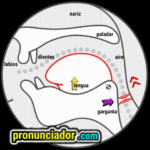
| PHONETICAL PRONUNCIATION |
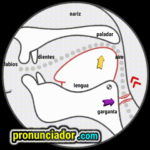
| PHONETICAL PRONUNCIATION |
FAQs: Your Short I /ɪ/ (“it”) Questions Answered!
Q1: So, the Short I /ɪ/ (“it”) is just a shorter version of Long I /i/ (“eat”)?
NO! That’s the biggest trap! They are TWO COMPLETELY DIFFERENT VOWEL SOUNDS, made with different MOUTH TENSION and TONGUE/JAW POSITIONS:
- Short I /ɪ/ (it): Tongue/lips RELAXED. Tongue high-ish & front. Jaw slightly open. Sound is SHORT.
- Long I /i/ (eat): Tongue/lips TENSE. Tongue SUPER high & front. Jaw almost closed, lips wide SMILE. Sound is LONG.
It’s not about length only, it’s about muscle RELAXATION vs. TENSION!
Q2: My “ship” still sounds like “sheep”! What’s the #1 thing to fix?
RELAX YOUR MOUTH MUSCLES! Especially your tongue and lips.
- For “sheep” /ʃip/ (long /i/): You TENSE your tongue high, spread lips TIGHTLY.
- For “ship” /ʃɪp/ (short /ɪ/): Let your tongue be SOFTER, a bit LOWER. Let your lips be RELAXED (neutral or very slight lazy spread).
It’s the difference between smiling for a photo (/i/) and just having a relaxed face (/ɪ/).
Q3: How can the letter ‘E’ or ‘A’ or ‘Y’ possibly make an “IH” /ɪ/ sound?
Welcome to the beautiful chaos of English spelling! It’s due to history and how sounds changed over time.
- ‘E’ often makes /ɪ/ in unstressed parts (begin, decided).
- ‘Y’ makes /ɪ/ in some specific words (gym, system).
- ‘A’ makes /ɪ/ in some unstressed suffixes (message, chocolate).
You can’t always guess by the letter! Learn common words and patterns.
Q4: Is the /ɪ/ in “English” the same as in “it”?
Yes! That first ‘E’ in “English” is the Short I /ɪ/ sound: /ˈɪŋɡlɪʃ/. So is the ‘i’ in the second syllable!
Q5: Can I just use my own language’s “i” sound?
If your native language “i” is TENSE and high like the English Long I /i/ (as in “see”), then NO, it will often sound wrong for English Short I /ɪ/ words (like “sit”). You need to learn to make that new, RELAXED, slightly lower /ɪ/ vowel for thousands of common English words!
Parting Words: Your Relaxed Short I /ɪ/ is In!
Fantastic job getting through this! You’ve now officially met (and hopefully befriended!) the American English Short I /ɪ/ vowel – the “lazy ih” sound. You know it’s all about RELAXATION, a slightly open mouth, and a tongue that’s high and forward but totally chill.
Keep these gems in your pocket:
- /ɪ/ = RELAXED “Ih”! Short, front, high-ish, tongue/lips LAZY. Think ‘it’, ‘sit’.
- CRUCIAL vs. Long /i/ (“see”) = RELAX vs. TENSE! Mouth LESS spread, JAW more open for /ɪ/.
- NOT YOUR NATIVE TENSE “I”! You need the new, relaxed English version.
- SPELLING = WILD! ‘I’ is most common, but E, Y, A, UI, U can pop up (often unstressed).
- #1 MISTAKE: Using tense /i/ instead of relaxed /ɪ/. RELAX, RELAX, RELAX!
The secret is training your mouth to find that new, relaxed “ih” position. Practice contrasting /ɪ/ (sit) with /i/ (seat) every single day. Listen to native speakers saying “this,” “if,” “big.” Record yourself. Slowly but surely, that relaxed Short I /ɪ/ will click, and your American accent will sound MUCH clearer and more natural! You got this!
👇🔥👇🔥👇🔥👇🔥👇🔥👇🔥
👉 RETURNS in the YEAR 2031 ! WHO? CLICK HERE ! 🔥



👇🔥👇🔥👇🔥👇🔥👇🔥👇🔥
👉 RETURNS in the YEAR 2031 ! WHO? CLICK HERE ! 🔥
👇🔥👇🔥👇🔥👇🔥👇🔥👇🔥
👉 RETURNS in the YEAR 2031 ! WHO? CLICK HERE ! 🔥
👉 RETURNS in the YEAR 2031 ! WHO? CLICK HERE ! 🔥