

Struggling with ‘leave’ vs. ‘live’? Master the tense Long E /i/ vowel sound. Our simple guide teaches the ‘smile’ trick, mouth position & spelling secrets
Hey there, future American accent icons! Today, we’re zeroing in on a sound that seems super friendly but is actually a major source of confusion for English learners: the Long E sound, the one that makes words like “be”, “see”, “need”, and “free” shine! Its special code in the sound alphabet (IPA) is simply /i/ (just like the letter ‘i’!).
“Easy peasy!” you might be thinking. “It’s just like the ‘ee’ in ‘tree’!” And you’re SO close! In fact, if you speak a language like Spanish, your regular ‘i’ sound (like in “sí“) is a fantastic starting point. So, where’s the problem? Why do we even need a whole guide for it?
Well, here’s the plot twist: English has a secret twin for this sound!
- There’s our star today: the Long, TENSE /i/ sound (the one in “seat” or “leave“).
- And then there’s its sneaky, almost identical-sounding (to non-natives!) sibling: the Short, RELAXED /ɪ/ sound (the one in “sit” or “live“).
And that, my friends, is where the trouble begins! Most learners use their native “ee”-like sound for BOTH, or they can’t quite nail the tension and lip spread needed for the true American Long E /i/. The result? You want to say you will “leave” /liv/ (go away) but it sounds like you “live” /lɪv/ (reside) somewhere! You try to talk about the “sheep” /ʃip/ (animal) but people hear “ship” /ʃɪp/ (boat)! It’s confusing, it’s frustrating, and it’s a major accent flag! Plus, the spelling! How can E, EE, EA, EY, IE, I, and even Y sometimes ALL make this SAME Long E “eeeee” sound? AAAHHH!
But don’t you worry! Today, you become the BOSS of the Long E /i/! This ultimate guide, explained so simply an 8-year-old could get it, will make you a pronunciation pro:
- Meet the “Smiling EEEEE”: What IS the /i/ sound really? (Hint: BIG SMILE + TONGUE HIGH & TIGHT!).
- The GREAT “I” DIVIDE: The #1 secret weapon – learning the HUGE difference between Long E /i/ (leave – TENSE) and its tricky twin, Short I /ɪ/ (live – RELAXED!).
- Your Native “i” – Friend or Foe?: How your own language’s “i” sound can help (and sometimes hinder!).
- Mouth Magic Made Easy: Simple, step-by-step instructions to get that perfect “EEEEEE” smile and tongue position!
- Crazy Spelling CRACKED! E, EE, EA, Y, IE, EI, I – we’ll navigate the maze and find the /i/ sound!
- Zap Those Common Mistakes: No more “ship” for “sheep”! We’ll fix the main errors (not enough TENSION, not SMILING wide!).
- Practice Power-Up! Fun exercises and key words (‘be’, ‘see’, ‘need’, ‘feel’, ‘really’, ‘people’) to make your Long E /i/ shine!
Get ready for your “me,” “we,” “three,” “please,” “believe,” and “team” to sound incredibly sharp, clear, and totally American! Let’s see how it’s done! 😉

What IS This Long E /i/ Sound? (The “Smiling Eeeee”!)
Let’s formally introduce the Long E /i/ sound. It’s a super common vowel in American English. We hear it everywhere:
- be /bi/
- me /mi/
- we /wi/
- see /si/
- eat /it/
- key /ki/
- three /θri/
- free /fri/
- need /nid/
- feel /fil/
- people* /ˈpipəl/ (Yes, EO too!)
Its Secret Recipe (Kid-Friendly Explanation!)
The sound experts describe /i/ as a “High, Tense, Front vowel.” What on earth does that mean in normal human language?
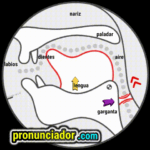
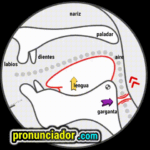
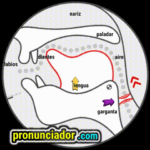
- Front Vowel (Tongue Pushed FORWARD!): For this sound, the main action of your tongue happens at the FRONT of your mouth. Your tongue is reaching forward, almost like it wants to peek out behind your teeth!
- High Vowel (Tongue WAY UP HIGH!): Your tongue, especially the front part, goes SUPER HIGH in your mouth, almost touching the roof of your mouth (the hard palate) just behind your top front teeth. It’s the highest your tongue can go for a vowel without actually blocking air like a consonant! . This means your JAW (mouth opening) is very NARROW, almost closed.
- TENSE Vowel (Muscles WORKING!): This is MEGA KEY #1! Making the /i/ sound requires MUSCLE TENSION. Your tongue becomes firm and strong (tense). Your lips also become tense as they spread. It’s not a floppy, lazy sound! You can feel the effort!
- Lips SPREAD WIDE (Big SMILE!): This is MEGA KEY #2! For the true American Long E /i/, your lips stretch out to the sides as wide as possible, like you’re making a big, exaggerated SMILE! “Cheeeeese!” It’s an unrounded vowel (no kissy face!).
Super-Duper Simple Summary: To make the Long E /i/ sound (like in “see”):
- SMILE REALLY BIG (stretch your lips wide to the sides and make them a bit tight).
- Push the FRONT of your tongue WAY UP HIGH and FORWARD in your mouth, almost touching the roof right behind your top teeth. Make your tongue TENSE and strong.
- Keep your mouth almost closed (jaw high).
- Turn on your voice and say a long, bright “EEEEEEEEEEEEE!”
It should feel very high, very front, very tense, and very smiley!

The #1 Most Important Battle: LONG E /i/ (Seat) vs. SHORT I /ɪ/ (Sit)
If you conquer this distinction, you’ve unlocked a massive secret to a clearer American accent! These two “I” sounds are the ultimate frenemies for learners.
| Feature | LONG E /i/ (Seat, Leave) | SHORT I /ɪ/ (Sit, Live) |
| Muscle TENSION? | YES! TENSE! (Tongue & Lips) | NO! RELAXED! (Tongue & Lips) |
| TONGUE Height? | SUPER HIGH (almost touches) | High-ish (but LOWER than /i/) |
| TONGUE Frontness? | VERY FORWARD | Forward (but a bit further back) |
| LIP Shape? | WIDE SMILE! (Stretched tight) | Neutral or SLIGHT lazy spread |
| JAW Position? | Almost CLOSED | Slightly MORE OPEN than /i/ |
| Sound LENGTH? | LONGER | Shorter |
| Feels Like? | Effortful, Stretched, Bright | Effortless, Loose, Softer |
Why the confusion? Many languages only have one “i-type” vowel, which is usually tense, like the English Long E /i/. So, learners use that tense sound for both English /i/ and /ɪ/, leading to mix-ups like:
- “Leave me alone!” (Long /i/) vs. “I live alone.” (Short /ɪ/)
- “Look at the sheep!” (Long /i/) vs. “Look at the ship!” (Short /ɪ/)
- “My feet hurt.” (Long /i/) vs. “It will fit.” (Short /ɪ/)
THE FIX: Master TENSION vs. RELAXATION! The Long E /i/ is your “on-stage, performing, muscles flexed” sound. The Short I /ɪ/ is your “chilling on the sofa, muscles floppy” sound. Actively FEEL this difference when you practice!
Your “Say Cheese!” Mouth Guide: Making the Long E /i/ Perfectly!
Let’s get those smile muscles working for the perfect, tense Long E /i/!
Step 1: Mouth – Just a Tiny Slit!
Relax your jaw, then bring your teeth very close together. Your mouth should only be open a tiny little bit. Almost like it’s closed, but not quite.
Step 2: Lips – SMILE Like You Mean It! (Wide & Tense)
This is key for the American Long E!
- Stretch your lips out to the sides AS WIDE AS YOU CAN! Imagine you’re trying to touch your ears with the corners of your mouth! A big, broad smile.
- And make those stretched lips TENSE! Feel the muscles pulling at the sides of your mouth. It’s an active, strong smile.
Step 3: Tongue – HIGH, FRONT, and TENSE!
Your tongue is doing some serious work here!
- TENSE your tongue! Make it firm and strong, not floppy.
- Push the FRONT part of your tongue FORWARD in your mouth, towards your front teeth.
- Raise that front/middle part VERY HIGH UP, almost touching the hard palate (the roof of your mouth right behind your top teeth). It should feel like there’s very little space for air to pass.
- The tip of your tongue can lightly rest behind your bottom front teeth, helping to anchor it forward.
Step 4: The Sound – “EEEEE!” (Bright & Long!)
- Now, with your mouth in this “super smile, high tense tongue” position, push voiced air out.
- You should produce a long, bright, clear, and somewhat high-pitched “EEEEEEEEE!” sound.
- Because it’s a TENSE vowel, it naturally tends to be a bit longer than relaxed vowels like /ɪ/.
Feeling Check: Lips stretched TIGHTLY in a smile? Front of tongue SUPER HIGH and FORWARD, feeling tense? Jaw almost closed? Sound is bright and “eeeee”? You’re NAILING the American Long E /i/!
E, EE, EA, Y, IE…?! Crazy Spellings for Long E /i/!
Okay, if making the /i/ sound is mostly about TENSION and SMILING, figuring out when to use it from the SPELLING can feel like cracking a secret code! There are SO many ways the Long E /i/ sound is written! Let’s look at the most common culprits, using data from the Sounds American web page spelling chart (as it appears more detailed and consistent than some video chart versions).
#1 The Winner (in American English for final sound): Letter ‘Y’ (~49%!)
Surprise! In American English, when the letter ‘Y’ comes at the end of a word with more than one syllable, it’s very often pronounced as a Long, Tense E /i/ sound! This is a big difference from British English, where it’s often a Short I /ɪ/.
- city /ˈsɪti/
- happy /ˈhæpi/
- baby /ˈbeɪbi/ (AY is /eɪ/, but final Y is /i/)
- lady /ˈleɪdi/
- very /ˈvɛri/
- really /ˈriəli/
- many /ˈmɛni/ (Initial A is /ɛ/ short E!)
- sorry /ˈsɑri/
- family /ˈfæməli/
- company /ˈkʌmpəni/
- Remember, this final ‘Y’ as /i/ is very American!
#2 The Classic Duo: ‘EE’ (~9% – 11%)
This is one of the most RELIABLE spellings for the Long E /i/! When you see ‘EE’, think “eeeeee”!
- see, feel, keep, need, three, green, sleep, meet, feet, queen, week.
#3 The Teamwork Letters: ‘EA’ (~10% – 12%)
‘EA’ is also VERY common for /i/, BUT BE CAREFUL! ‘EA’ is a chameleon – it can also sound like Short E /ɛ/ (head, bread) or even Long A /eɪ/ (great, break)! You need to learn the common /i/ ones.
- eat, each, please, leave, mean, speak, clean, team, dream, read (present tense!), sea, tea.
- NOT /i/: head /hɛd/, bread /brɛd/, great /ɡreɪt/.
#4 The Simple ‘E’ (Open Syllable, or E_E) (~14% – 15%)
A single ‘E’ can be Long E /i/:
- At the end of short words (open syllable): be, me, he, she, we.
- In the “Magic E” or “Split Digraph” pattern (E + Consonant + silent E): these /ðiz/, scene /sin/, theme /θim/, compete /kəmˈpit/, Eve /iv/, Chinese /tʃaɪˈniz/.
- Sometimes in unstressed prefixes like ‘be-‘, ‘de-‘, ‘re-‘ IF it’s a clear /i/ (often more like /ɪ/ but some analyses show /i/): report (some say /riˈpɔrt/), detail (some /diˈteɪl/). (This is tricky and varies, easier to focus on the clear cases above).
#5 The Lone ‘I’ (Usually Foreign Words/Exceptions) (~12% – 14%)
Usually, ‘I’ alone is Short I /ɪ/ (it) or Long I Diphthong /aɪ/ (like). BUT, for a few words (often from other languages), it’s Long E /i/!
- ski /ski/
- machine /məˈʃin/
- police /pəˈlis/
- magazine /ˌmæɡəˈzin/
- marine /məˈrin/
- routine /ruˈtin/
- valise /vəˈlis/
- prestige* /prɛˈstiʒ/ (GI is /iʒ/ here, very French!)
#6 The ‘IE’ Friends (~3% – often before final consonant or -ce)
- piece /pis/ (sounds like ‘peace’!)
- field /fild/
- believe /bɪˈliv/ (first e is /ɪ/!)
- achieve /əˈtʃiv/
- niece /nis/
- chief /tʃif/
- brief /brif/
- (Careful! ‘IE’ at the very end of a word is often /aɪ/ like in ‘die’, ‘lie’, ‘tie’, ‘pie’!)
#7 The Sneaky ‘EI’ (Very Few Common Words!) (<2-3% ‘etc’)
Only in a few key words!
- receive /rɪˈsiv/
- deceive /dɪˈsiv/
- conceive /kənˈsiv/
- ceiling /ˈsilɪŋ/
- seize /siz/
- protein /ˈproʊtin/ (or /ˈproʊtiən/)
- (Careful! ‘EI’ is often /eɪ/ like ‘eight’, ‘weight’ or /aɪ/ like ‘height’!)
#8 The ‘EY’ Outlier (Mainly ‘Key’!) (<2-3% ‘etc’)
- key /ki/ is the big one!
- (Sometimes ‘money‘, ‘honey‘ ‘valley‘ are transcribed with final /i/ in AmE by some, but /ɪ/ is often also standard/more common for these). Let’s stick to clear-cut ‘key’.
#9 The ‘EO’ Surprise (One HUGE Word!) (<2-3% ‘etc’)
- people /ˈpipəl/! Yes, that ‘EO’ is /i/!
Spelling Takeaway for Long E /i/:
- Final Y in multi-syllable words (American English!) is surprisingly common for /i/.
- EE is your most reliable buddy.
- EA is very common but tricky (can be /ɛ/ or /eɪ/ too!).
- E (open syllable; E_E) is important.
- I, IE, EI, EY, EO have key exception words to learn.
When confused? LISTEN to native speakers and use a dictionary with IPA /i/!

Zap Those “I” Mistakes! Common Long E /i/ Errors & How to Fix ‘Em!
Let’s nail the main ways learners stumble on the Long E “eeeee”!
- MISTAKE #1: NOT ENOUGH TENSION! (Using Relaxed Short I /ɪ/ Instead!)
- Problem: This is the KING of all “I” mistakes! Your tongue is too low/loose, lips not spread enough. “Leave” sounds like “Live”. “Seat” sounds like “Sit”.
- Fix: TENSE UP & SMILE WIDE! Seriously, engage those muscles! Feel the front of your tongue go SUPER HIGH and tense. Spread your lips WIDE like a big photo smile and make them firm. The Long E /i/ is an “athletic” sound, not a lazy one!
- Mistake #2: LIPS NOT SPREAD ENOUGH (Weak Smile).
- Problem: Lips are too neutral. The sound lacks brightness and can drift towards /ɪ/.
- Fix: Exaggerate the WIDE SMILE initially. Really feel those corners pull. It helps lift the tongue and create the right resonance for /i/.
- Mistake #3: TONGUE NOT HIGH ENOUGH or NOT FORWARD ENOUGH.
- Problem: If the tongue isn’t extremely high and front, the sound can become more like /eɪ/ (lake) or /ɛ/ (bed) or a muddled version.
- Fix: Think “TONGUE TO THE SKY, POINTING AT YOUR TEETH!” Aim for the highest, most forward tongue position possible while still letting air pass.
- Mistake #4: Making it TOO SHORT (Sounds like /ɪ/ due to length).
- Problem: Even if tense, if it’s too brief, it can still be misheard.
- Fix: Elongate it slightly, especially when practicing or in stressed syllables. “Seeeeee”, “Freeeeee”. The tension helps it feel naturally longer.
- Mistake #5: Getting Fooled by Inconsistent Spelling!
- Problem: Seeing ‘EA’ and automatically thinking /ɛ/ (head), or ‘E’ and only thinking /ɛ/ (bed).
- Fix: MEMORIZE SPELLING PATTERNS! Know that EE, EA, E (final/E_E), Y (final AmE), IE (mid) are very common for Long E /i/. Learn the high-frequency words.
Long E “Smile Power” Workout! Exercises for a Perfect /i/!
Time to get those smile muscles and tongue in TENSE /i/ formation!
Exercise 1: The Extreme “EEEEE” Hold!
- HUGE smile, lips wide and TENSE.
- Tongue SUPER high, SUPER forward, TENSE.
- Jaw almost closed.
- Hold a long, bright, tense “EEEEEEEEEEEEEEEEEEE!” (/i/). Feel the muscle work!
Exercise 2: THE ULTIMATE BATTLE: LONG /i/ (Seat) vs. SHORT /ɪ/ (Sit)
Drill this daily! TENSE vs. RELAX! SMILE vs. NEUTRAL LIPS! HIGH TONGUE vs. LOWER TONGUE!
- Seat /sit/ — Sit /sɪt/
- Leave /liv/ — Live /lɪv/
- Sheep /ʃip/ — Ship /ʃɪp/
- Feel /fil/ — Fill /fɪl/
- Heat /hit/ — Hit /hɪt/
- Peak /pik/ (cima) — Pick /pɪk/ (recoger)
- Bean /bin/ (frijol) — Bin /bɪn/ (papelera)
- Green /ɡrin/ — Grin /ɡrɪn/ (sonrisa amplia)
Exercise 3: Spell It Out Loud! All Roads Lead to /i/!
Practice the Long E /i/ sound with all its sneaky spellings. Focus on TENSION!
- EE: see, feel, keep, need, three, green, sleep, meet, feet.
- EA: eat, each, please, leave, mean, speak, clean, team, dream, read (present).
- E (final/E_E): be, me, he, she, we, these, scene, theme, complete.
- Y (final AmE): city, happy, baby, lady, very, really, many, family, story, country.
- IE (mid-word): piece, field, believe, achieve, chief, niece.
- I (exceptions): ski, machine, police, magazine, routine.
- EI/EY/EO: receive, ceiling, key, people.
Exercise 4: Sentence Smile Time + Recording!
Record yourself! Does your /i/ sound long, tense, and bright? Is it DIFFERENT from your /ɪ/?
- “We [i] see [i] three [i] green [i] sheep [i] on the field [i].”
- “Please [i], eat [i] these [i] peas [i] and cheese [i].” (Cheese often has /i/).
- “Me [i] and my family [i] believe [i] in being [i] free [i].” (Being uses /i/, careful not to make it /ɪ/).
- “The key [i] to this machine [i] is keeping [i] it clean [i].”
- “Even [i] people [i] in the city [i] need [i] to feel [i] peace [i].”
| PHONETICAL PRONUNCIATION |
| PHONETICAL PRONUNCIATION |
FAQs: Your American Long E /i/ (See) Questions Answered!
Q1: Is the Long E /i/ (“see”) just like my native language’s “i” sound?
Probably VERY close, if your “i” is tense! Many languages (like Spanish) have a high, front, tense “i” [i] sound. The American Long E /i/ is essentially the same but maybe even MORE tense, with a WIDER lip spread (big smile), and an even HIGHER/MORE FORWARD tongue position. Think of it as your “i” on STEROIDS!
Q2: What’s the ABSOLUTE EASIEST way to make sure I’m not confusing Long E /i/ (“leave”) with Short I /ɪ/ (“live”)?
Focus on MUSCLE TENSION and LIP SHAPE!
- Long E /i/ (“leave”): Think TIGHT & SMILE! Tense tongue high and front. Lips spread WIDE like a big “CHEEEESE!” smile, and TENSE.
- Short I /ɪ/ (“live”): Think LOOSE & LAZY! Relax tongue (still high-ish front, but lower and softer). Lips relaxed (neutral or tiny soft spread).
If you feel the muscle work and the big smile, it’s likely /i/. If it feels effortless and your lips are chill, it’s likely /ɪ/.
Q3: Why does ‘Y’ at the end of words like “city” or “happy” sound like Long E /i/ in American English?
It’s an American English feature! In British English, that final ‘y’ is often a Short I /ɪ/. But in AmE, words like “city,” “happy,” “baby,” “very” all typically end with that tense Long E /i/ sound. It’s one of those cool accent markers!
Q4: ‘EA’ is so confusing! Is it Long E /i/ (“eat”) or Short E /ɛ/ (“head”)?
You’re right, ‘EA’ is a troublemaker! It can be:
- Long E /i/: Very common (eat, read, sea, team, please).
- Short E /ɛ/: Also common (head, bread, dead, weather).
- Long A /eɪ/: Rare, but in key words (great, break, steak).
There’s NO single rule. You have to learn which words use which sound for ‘EA’. Start by memorizing the most common ones in each category.
Q5: What about ‘EI’ and ‘IE’? They look similar but can sound different from /i/ too!
Correct!
- IE: When in the middle or before a final consonant, it’s often Long E /i/ (piece, field, believe). BUT, if ‘IE’ is at the VERY END of a short word, it’s usually the Long I diphthong /aɪ/ (die, lie, tie, pie).
- EI: Can be Long E /i/ (receive, ceiling, seize), but ALSO Long A /eɪ/ (eight, weight, vein) OR Long I /aɪ/ (height). ‘EI’ is super tricky and depends on the specific word!
Lasting Impressions: Your Long E /i/ Shines Bright!
Incredible work! You’ve journeyed through the tense, high, front world of the American Long E /i/ vowel. You know it’s the “big smile, high tongue” sound that needs TENSION, and critically, you understand its vital difference from the relaxed Short I /ɪ/.
Your Long E /i/ takeaways:
- /i/ = SUPER SMILE + TONGUE HIGH/FRONT + TENSE! (Longer sound).
- THE KEY vs Short I /ɪ/ (it/sit) = TENSION & MOUTH SHAPE! (/i/ is smile & tense, /ɪ/ is relax & neutral/less spread lips, jaw more open).
- Your Native “i” is a GOOD START, but crank up the SMILE and TENSION for American /i/.
- SPELLING MAYHEM: EE (good bet!), EA (common but tricky!), E (final/E_E), Y (AmE final multi-syllable), IE (mid), I/EI/EO (exceptions!). LEARN PATTERNS & KEY WORDS!
- #1 MISTAKE = CONFUSING with /ɪ/! Practice tense vs. relax.
Keep practicing that wide smile and high, tense tongue! Drill those /i/ vs. /ɪ/ minimal pairs relentlessly. Record yourself saying “green beans” versus “grin bins.” Listen to native speakers. Your mastery of the Long E /i/ will make your American English sound SO much clearer, brighter, and more authentic! You can do it!
👇🔥👇🔥👇🔥👇🔥👇🔥👇🔥
👉 RETURNS in the YEAR 2031 ! WHO? CLICK HERE ! 🔥



👇🔥👇🔥👇🔥👇🔥👇🔥👇🔥
👉 RETURNS in the YEAR 2031 ! WHO? CLICK HERE ! 🔥
👇🔥👇🔥👇🔥👇🔥👇🔥👇🔥
👉 RETURNS in the YEAR 2031 ! WHO? CLICK HERE ! 🔥
👉 RETURNS in the YEAR 2031 ! WHO? CLICK HERE ! 🔥