

Struggling with words like ‘bird’ or ‘work’? Master the tense American /ɜr/ vowel. Our easy guide decodes the spelling & shows you how to sound American
Hey there, future American accent stars! Get ready to conquer one of THE most defining – and often most challenging – vowel sounds of American English: the strong, tense “ER” sound you hear in words like “first,” “bird,” “her**,” “work,” or “turn“! Its secret IPA code is /ɜr/ (sometimes written as /ɝ/ – they mean the same stressed “ER” sound!).
This sound is a true American signature! But for many learners, it feels like a pronunciation puzzle. You see ‘IR’ in “girl,” ‘UR’ in “burn,” ‘ER’ in “person,” ‘OR’ in “word,” even ‘EAR’ in “learn” – and somehow, they can ALL make this same “ERRRR” sound! How is that possible?! You try to say it, and maybe your ‘R’ comes out too weak, or you accidentally vibrate it like a drumroll, or you try to say a separate vowel then an ‘R’ (“buh-urd” for “bird”). You end up sounding a bit off, your speech doesn’t flow as smoothly, and words that should rhyme (like “herd” and “bird”) end up sounding completely different when you say them. It’s frustrating, right?
But guess what? That STRONG, TENSE “ER” sound is about to become your superpower! This ultimate, super-easy guide will make you an /ɜr/ Vowel Champion! We’ll break it down so simply:
- Meet the “Strong ER” /ɜr/: What exactly IS this “R-Colored Vowel” and why is it so special (and TENSE!)?
- The EPIC Showdown: Tense /ɜr/ (First) vs. Relaxed /ɚ/ (TeachER): Why “SIR” is strong but “ANSWer” is weak. This is a GAME CHANGER!
- Mouth & Tongue Magic (Kid-Style!): EASY, step-by-step instructions to get your tongue TIGHT and in the right spot for that perfect American “ERRRR” (two ways to do it!).
- Crazy Spelling CRACKED! ER, IR, UR, OR, EAR… we’ll sort through the spelling mess and find the patterns!
- Zap Common “ERRRRor-s”! Stop weak Rs, trilled Rs, and saying “vowel + R” separately.
- Practice Power! Awesome drills with common words (‘work’, ‘learn’, ‘girl’, ‘early’, ‘perfect’) to make your /ɜr/ solid as a rock!
Get ready to finally nail that distinctive American “ER” sound in words like “third,” “serve,” “purple,” and “world”! Let’s learn /lɜrn/! 💪

What is This /ɜr/ Sound? The “Strong, Tense ER” (Like in BIRD!)
Alright, let’s get up close and personal with the /ɜr/ sound. This is the “ER” you hear when the syllable is STRONG (stressed). It’s a core part of the American accent, making it “rhotic” – meaning the ‘R’ quality is very prominent.
Essentially, an R-colored vowel is like a regular vowel sound that got married to the American /r/ sound, and now they’re one single, inseparable sound. The ‘R’ part “colors” or changes the quality of the vowel it’s with.
For the /ɜr/ sound (“first”, “bird”):
- It starts with a vowel sound that’s made in the MIDDLE-CENTER of your mouth (not front like “ee”, not back like “oo”).
- And the key features are: TENSE muscles and that strong American R quality blended right in from start to finish.
Think of it like this: You’re not saying “BUH… RRR… D.” You’re making ONE smooth sound in the middle: “B-[ɜr]-D.” The /ɜr/ is the heart of the word.
The ULTIMATE Showdown: STRESSED /ɜr/ (FIRST) vs. UNSTRESSED /ɚ/ (aftER)
THIS is where so many learners stumble! English has TWO main “ER” type R-colored vowels:
| Feature | STRESSED /ɜr/ (FIRST, BIRD, WORK) | UNSTRESSED /ɚ/ (aftER, teachER) |
| IPA Symbol | /ɜr/ (or /ɝ/ in some systems) | /ɚ/ (Schwa with an R-hook) |
| Nickname | “Strong ER”, “NURSE vowel” | “Weak ER”, “Schwar” |
| STRESS (Strength)? | ALWAYS in STRONG syllables! | ALWAYS in WEAK syllables! |
| Tongue/Lip Tension? | TENSE! (Muscles working hard!) | RELAXED! (Lazy muscles) |
| Duration? | Longer, more sustained | Shorter, quicker |
| Clarity? | Clear, distinct “ERRRR” | Softer, less distinct “er” or “uhr” |
Why is this SO important? Using the strong /ɜr/ in a weak syllable (like saying “teach-ERRRR”) or the weak /ɚ/ in a strong syllable (like saying “f(uh)rst”) makes your English rhythm sound very unnatural and “foreign.” Native speakers do this stress/unstress dance without thinking!
- “Prefer” /prɪˈfɜr/ (FER is strong = /ɜr/)
- “Preference” /ˈprɛfɚəns/ (er is weak = /ɚ/)
Mastering the difference between strong /ɜr/ and weak /ɚ/ is like unlocking a secret level in American pronunciation! Today, we focus on the STRONG /ɜr/!

Mouth Gymnastics: How to Make the STRONG /ɜr/ Sound (Tense ER!)
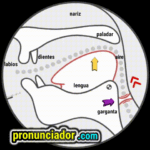
Okay, ready to get your tongue in shape? The /ɜr/ sound requires TENSION and a specific tongue position. There are two main ways native speakers often make the R-part of this sound – try both and see which feels more natural for YOU to get that strong “ERRRR”!
No matter which tongue technique you use, these first parts are the same:
Prep Steps: Mouth & Lips
- Mouth Slightly Open: Just a little bit. Not wide open like for “AH /ɑ/”.
- Lips Slightly Rounded & TENSE: Purse your lips just a tiny bit, like you’re about to whistle very softly or say “oooo.” And importantly, make them TENSE – feel the muscles around your mouth working a little.
The TONGUE – Your “ER” Power Tool! (TENSE!)
This is where the magic happens! The key is TENSION in your tongue.
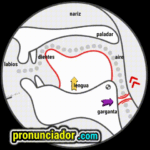
Option 1: The “Retroflex R” Tongue (Tip Curls Back)
This is what the primary source (Sounds American) focuses on.
- TENSE Your Whole Tongue: Imagine it’s a strong muscle.
- Raise Tongue Tip TOWARDS Ridge: Lift the tip of your tongue up towards (but NOT touching!) that bumpy part behind your upper front teeth (the alveolar ridge).
- CURL Tongue Tip BACK: Now, this is the “retroflex” part. Gently curl the very tip of your tongue slightly backwards away from the ridge, so it’s pointing up and back into your mouth.
- Middle of Tongue Dips S
- Back of Tongue Might Be Up: (Source also notes the ‘bunched’ alternative).
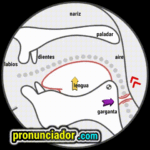
Option 2: The “Bunched R” Tongue (Tip Down, Body Up/Back)
Many native speakers actually use this one, or a mix.
- TENSE Your Whole Tongue.
- Tongue Tip DOWN (or neutral): Keep the tip of your tongue down, maybe resting behind your bottom front teeth.
- BUNCH UP the Middle/Back: Squeeze or “bunch up” the body of your tongue, pulling it UP and BACK towards the roof and back of your mouth. The sides of your tongue often press against your upper back teeth.
Which one to choose? Experiment! Some find retroflex easier, others bunched. The GOAL for BOTH is to create that characteristic American “ERRRR” sound by shaping the tongue to make air flow in a specific way, with TENSION, and without the tip vibrating or tapping the roof of your mouth.
Make the Sound! “ERRRRRR” (Voiced & Continuous)
- With your mouth, lips, and TENSE tongue in position (Retroflex or Bunched)…
- Turn your voice ON! This is a voiced sound.
- Let the air flow smoothly from your throat, over your tensed and shaped tongue, and out your slightly rounded, tense lips.
- It should be ONE continuous, strong, rumbling “ERRRRRRRR” sound. No separate “eh” then “rrr.” It’s all blended from the start.
- The TENSION in your tongue and lips is what makes it /ɜr/ (strong ER) vs. the relaxed /ɚ/ (weak er).
Kid-Friendly Cue: “Imagine you’re a little bear growling, but friendly: ‘Grrrrrr’. Now, keep your mouth mostly still, make your tongue strong and pull it back a bit (like you’re hiding a yummy berry under it!), round your lips just a little like you’re saying ‘oooo’, and make that growl again, but smooth: ‘ERRRRRR’. Don’t let your tongue tap the top of your mouth like a woodpecker!”
Spelling the Beast! How ER, IR, UR, OR, EAR = /ɜr/ ???
This is where it gets WILD! The /ɜr/ sound has SO many different spellings. It’s one of the trickiest parts for learners because you can’t just trust the letters!
| Spelling | Approx. % of /ɜr/ Words | Key Examples with /ɜr/ | Other Common Sounds for THIS Spelling (BEWARE!) |
| ER | ~34% (The Champ!) | her, person, serve, term, verb, clerk, German, prefer, determine, expert | /ɚ/ (teacher), /ɪər/ (here), /ɛər/ (there) |
| UR | ~30% (Very Common) | turn, burn, hurt, nurse, purse, curl, fur, Saturday, occur, purpose | /jʊər/ (pure), /ʊər/ (sure) – see below |
| IR | ~13% (Common) | first, girl, bird, sir, shirt, third, dirt, firm, skirt, circle, stir | /aɪər/ (fire) |
| OR | ~9% (Watch out!) | work, word, world, worm, worse, worth, attorney | /ɔr/ (for), /ɔ/ (hot – some accents) |
| EAR | ~5% (Tricky!) | learn, earth, heard, search, early, earn, pearl | /ɪər/ (ear), /ɛər/ (bear), /ɑr/ (heart) |
| OUR | RARE (~1%) | journey, courage, adjourn | /aʊər/ (flour), /ɔr/ (four) |
| URR | RARE (<1%) | hurry*, current* | (usually a clear /r/ after vowel) |
| Etc. | RARE (<1%) | squirrel, worry*, myrrh |
What does this all mean for YOU?
- ER, UR, IR are STRONG clues for /ɜr/ when in a STRESSED syllable.
- OR after W (work, word) is a good bet for /ɜr/.
- EAR in learn, earth, heard, search, early are /ɜr/ – MEMORIZE these!
- DON’T assume! The same letters (especially EAR, OR, ER) can make MANY other sounds in other words! Always listen or check the IPA /ɜr/ or /ɝ/.
Uh-Oh! Common /ɜr/ Mistakes & How to Fix Them!
Let’s get rid of those pesky “ER” errors!
- MISTAKE #1: VOWEL + SEPARATE R! (e.g., “beh-rrr-d” for “bird”)
- What’s Wrong: You’re not FUSING the vowel and the R into ONE smooth sound.
- THE FIX: THINK ONE SOUND “ERRRR”! The R-quality should be there from the very beginning of the vowel. It’s not V + R; it IS an R-ish Vowel! Blend it.
- MISTAKE #2: THE TRILLED OR TAPPED ‘R’ (Spanish R!)
- Problem: Your tongue tip vibrates or taps the roof of your mouth (like in “perro” or “caro”). This is the #1 giveaway of a non-native R.
- THE FIX: TONGUE TENSE & NO TOUCHING! The American R /r/ (and therefore /ɜr/) does NOT involve tapping or trilling. Your tongue tip curls back (Retroflex) or the body bunches up (Bunched), it’s TENSE, but the tip never makes full contact to vibrate. Air flows continuously. Practice the sustained “Rrrrrrr” (like a soft growl) WITHOUT any tapping.
- MISTAKE #3: NOT ENOUGH TONGUE TENSION! (A Weak /ɜr/)
- Problem: Your “ER” sounds too light, too relaxed, maybe even like the weak /ɚ/ (Schwar) sound.
- THE FIX: TIGHTEN UP! Feel the muscles in your tongue (and a bit in your lips/jaw) working. /ɜr/ is a TENSE vowel. It needs energy! “Fiiirrrst” not “fuhst”.
- MISTAKE #4: WRONG STARTING VOWEL (Too much “eh” or “ih” before the R feel).
- Problem: If you start with a very clear /ɛ/ (bed) or /ɪ/ (sit) and then try to add R, it won’t quite be /ɜr/. /ɜr/ starts more central.
- THE FIX: Think of the sound starting already “R-flavored.” The vowel part is mid-central, and immediately influenced by the R tongue position. Don’t aim for a super clear ‘E’ or ‘I’ first.
- MISTAKE #5: CONFUSING WITH WEAK /ɚ/ (Schwar – “teacher”).
- Problem: Using the strong, tense /ɜr/ in unstressed syllables (“teach-ERRRR”).
- THE FIX: LISTEN FOR STRESS! Strong syllable = tense /ɜr/ (“learn”). Weak syllable = relaxed /ɚ/ (“learn-ER”). Stress is your guide!

“ERRRR-cise” Time! Practice Your Strong /ɜr/!
Ready to make that tense American “ER” sound like a pro? Let’s do it!
Exercise 1: Just the /ɜr/ – The Tense “ERRRR” Growl!
- Mouth slightly open. Lips a bit rounded & TENSE.
- Tongue TENSE (Retroflex tip curled back, OR Bunched body up/back).
- Voice ON. Make a strong, continuous “ERRRRRRRRRRRR.”
- Feel the TENSION in your tongue and around your mouth. No tongue tapping!
- Can you hold it steady for 5 seconds? That’s your /ɜr/!
Exercise 2: THE BIG ONE: TENSE /ɜr/ (Sir) vs. RELAXED /ɚ/ (Answer)
FEEL the tension vs. relaxation! STRESSED vs UNSTRESSED!
- Sir /sɜr/ (STRONG, TENSE) — Answer /ˈænsɚ/ (WEAK, RELAXED)
- Prefer /prɪˈfɜr/ (STRONG) — Preference /ˈprɛfɚəns/ (WEAK)
- Bird /bɜrd/ (STRONG) — Former /ˈfɔrmɚ/ (WEAK)
- Work /wɜrk/ (STRONG) — Doctor /ˈdɑktɚ/ (WEAK)
- Learn /lɜrn/ (STRONG) — Better /ˈbɛtɚ/ (WEAK)
(Remember, final -er, -or, -ar often are /ɚ/).
Exercise 3: Navigate the Spelling Maze!
Practice making the SAME strong /ɜr/ sound for ALL these different spellings!
- ER: her, serve, term, prefer, expert, alert, certain*, concern*. (Certain/concern video examples were stressed /ɜr/).
- IR: first, girl, bird, sir, shirt, third, dirt, firm, circle, virgin, thirty.
- UR: turn, burn, hurt, nurse, purse, curl, fur, Saturday, occur, purpose, urgent.
- OR (after W, or special): work, word, world, worm, worse, worth, attorney.
- EAR (special group): learn, earth, heard, search, early, earn, pearl.
- OUR (rare): journey, courage, adjourn.
Exercise 4: Top 30 Word Power Drill (From Source List)
| PHONETICAL PRONUNCIATION |
| PHONETICAL PRONUNCIATION |
- CRITICAL: As you practice this list from “Sounds American,” pay VERY close attention to your own ear and mouth FEELING. Some words on their list (like “sure”, “were”, “worry”, “hurry”, “during”, “security”, “certainly”) are often pronounced with DIFFERENT R-colored vowels or include weak syllables in other analyses (e.g., “sure” is typically /ʃʊr/ or /ʃɔr/; “were” can be weak /wər/; “worry” and “hurry” often /ʌr/ or /ɔr/; “during” /dʊrɪŋ/; “security” /sɪˈkjʊrəti/ often has /jʊr/ not /ɜr/, “certainly” often /sɜrtnli/ with the last ER being weak /ɚ/ or even just /li/).
- The SOURCE itself puts /ɜr/ ONLY IN STRESSED SYLLABLES. So, for words like “certainly”, the first “cer-” IS /sɜr/, but the final “-ly” is not.
- FOCUS on the words from the list that are CLEAR, one-syllable /ɜr/ words (first, sir, girl, turn, word, hurt, earth, burn, worth, search) and the STRESSED syllable in multi-syllable words (HER, WORk, LEarn, EARly, PERfect, SERvice, JOURney…). This will build your core /ɜr/ skill.
Exercise 5: Strong /ɜr/ Sentences + RECORDING!
Record yourself! Is your “ERRRR” TENSE and FUSED? No Spanish R?
- “The girl [ɜr] learns [ɜr] the first [ɜr] word [ɜr].”
- “It’s her [ɜr] turn [ɜr] to search [ɜr] the earth [ɜr].”
- “The nurse [ɜr] firmly [ɜr] served [ɜr] the burnt [ɜr] turkey.” (Not from list, just good example).
- “Were [ɜr] you thirsty [ɜr] on Thursday [ɜr]?” (Be careful, ‘were’ here implies stressed pronunciation, usually it’s weak /wər/)
- “This person [ɜr] is worth [ɜr]y of a perfect [ɜr] ten.”
FAQs: Your American /ɜr/ (Bird, First) Questions Answered!
Q1: What’s the ABSOLUTE simplest way to think about making the /ɜr/ sound (“first”)?
Think STRONG, TENSE “ERRRRR”.
- Lips slightly rounded AND TENSE.
- Tongue TENSE and pulled back/curled (don’t let the tip tap or vibrate!).
- Voice ON. Make ONE smooth, long-ish sound.
It’s NOT “eh + rrr” or “ih + rrr.” It’s a single fused vowel from the get-go!
Q2: How is /ɜr/ (stressed ER – “bird”) different from /ɚ/ (unstressed ER – “teacher”)? They sound so alike!
STRESS and TENSION are the twins’ secret identifiers!
- /ɜr/ (“bird,” “first”): ALWAYS in a STRONG (stressed) syllable. Your mouth/tongue muscles are TENSE. Sound is clearer, longer.
- /ɚ/ (“teacher,” “after”): ALWAYS in a WEAK (unstressed) syllable. Mouth/tongue RELAXED. Sound is shorter, softer, more “uh-er.”
Listen for the BEAT of the word. Strong beat “ER” = /ɜr/. Weak beat “er” = /ɚ/.
Q3: Why do spellings like IR (bird), UR (turn), ER (her), OR (word), EAR (learn) all sound the SAME with /ɜr/?
English spelling is crazy! These different letter groups, over time, all came to be pronounced with this same mid-central R-colored vowel sound /ɜr/ when they are in a stressed syllable. There aren’t perfect “rules,” you mostly have to learn which spelling pattern leads to /ɜr/ in common words. ER, IR, UR are your best bets for /ɜr/ in stressed syllables.
Q4: I keep making my “R” sound like a Spanish R (trilled or tapped). HELP!
This is the #1 battle! For American R (and thus /ɜr/):
- NO TONGUE TIP TAPPING/VIBRATING! Your tongue tip should NOT hit the roof of your mouth repeatedly.
- TONGUE TENSION IS KEY: The body of your tongue is TENSE.
- TWO MAIN TONGUE SHAPES:
- Retroflex: Curl the TENSE tip up and back (not touching).
- Bunched: Keep TENSE tip down/neutral, and bunch/raise the TENSE middle/back of tongue up and back.
Experiment to see which “non-tapping” R you can make with TENSION.
Q5: The source video shows a symbol like a “3” with a tilde /ɝ/ for this sound. You’re using /ɜr/. What’s up?
Great question! Both /ɝ/ and /ɜr/ are used by phoneticians to represent this same stressed, tense, R-colored vowel.
- /ɝ/ (often called “epsilon reversed hook” or just “stressed-schwar”) is a single symbol sometimes preferred to show it’s truly ONE fused sound. “Sounds American” uses this.
- /ɜr/ (the vowel in British “bird” /bɜːd/ WITHOUT the R, PLUS the /r/ consonant symbol) is very commonly used in many American dictionaries and teaching materials to show the R-coloring explicitly.
They effectively represent the same sound for learners aiming for American English. We’re using /ɜr/ for consistency with broader resources, but know that /ɝ/ means the same TENSE, STRESSED ER.
Key Takeaways: Your American /ɜr/ – Strong, Tense, and Spot On!
Phenomenal job! You’ve dug deep into the American “Strong ER” /ɜr/ sound. You know it’s a single, TENSE, R-FLAVORED VOWEL that lives ONLY IN STRESSED SYLLABLES. And you’re ready to banish that tricky trilled R!
Lock in these power points:
- /ɜr/ = STRONG, TENSE “ERRRR”! (Bird, First, Her, Work, Turn). One fused sound.
- STRESSED SYLLABLES ONLY! (Unstressed is weak /ɚ/).
- TENSION IS YOUR FRIEND! Lips rounded/tense. Tongue TENSE (Retroflex or Bunched).
- NO SPANISH R! No tapping, no trilling. R-quality is continuous.
- SPELLING NIGHTMARE, BUT PATTERNS HELP: ER, IR, UR are common in stressed syllables for /ɜr/. OR (after W) and specific EAR words too. When in doubt, listen up!
- BIGGEST MISTAKES: Using separate vowel + R, trilled/tapped R, not enough tension, confusing with /ɚ/.
Focus on that TENSE TONGUE creating the unique American “ER” quality. Practice the different spellings. Drill the /ɜr/ vs /ɚ/ contrast until the stress-based difference is second nature. Record yourself often! You’re on your way to making your “bird,” “first,” and “work” sound truly American! Keep at it!
👇🔥👇🔥👇🔥👇🔥👇🔥👇🔥
👉 RETURNS in the YEAR 2031 ! WHO? CLICK HERE ! 🔥



👇🔥👇🔥👇🔥👇🔥👇🔥👇🔥
👉 RETURNS in the YEAR 2031 ! WHO? CLICK HERE ! 🔥
👇🔥👇🔥👇🔥👇🔥👇🔥👇🔥
👉 RETURNS in the YEAR 2031 ! WHO? CLICK HERE ! 🔥
👉 RETURNS in the YEAR 2031 ! WHO? CLICK HERE ! 🔥