

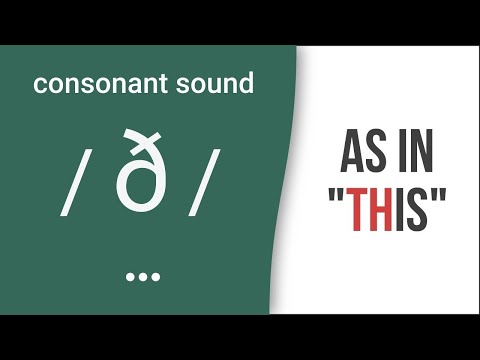
Finally fix your TH pronunciation! If “this” sounds like “dis,” you’re in the right place. Learn the simple tongue trick and buzzing to master the /ð/ sound.

Hey there, American accent adventurers! Get ready to finally conquer one of the trickiest, yet MOST essential, sounds in American English: the voiced TH sound, the one you hear buzzing in words like “this”, “that”, “the”, “they”, and “mother”! Its secret IPA symbol looks like this: /ð/ (kind of like a ‘d’ with a cross, or a letter called ‘eth’).
Now, why is this sound such a big deal? Because even though it only exists in about 10% of the world’s languages, the words that use it are SUPER common function words (the, this, that, they, them, there…). You basically can’t say a single sentence in English without needing it! And here’s the kicker: most non-native speakers really struggle with it!
Does this sound like you? You try to say “they” /ðeɪ/ but it comes out more like “dey” /deɪ/? Or maybe “this” /ðɪs/ sounds like “zis” /zɪs/ or even “vis” /vɪs/? It’s SO frustrating! You know what sound you want to make, but your tongue and voice box seem to have a mind of their own. Plus, didn’t we just talk about ANOTHER TH sound in “think” (/θ/)? Are they the same? Do they buzz? Help!
Deep breaths! Today, we’re ending the TH confusion for GOOD! This guide is your super-easy roadmap to mastering the VOICED, BUZZING TH /ð/ sound, explained so simply you’ll get it instantly:
- Meet the “Buzzing TH”: What IS this /ð/ sound really? (Spoiler: It’s /θ/’s twin, but with the VOICE turned ON!).
- The #1 Key: Voiceless /θ/ (think) vs. Voiced /ð/ (this) – We’ll nail the ON/OFF switch for your voice box!
- Super Simple Mouth Moves: EASY step-by-step guide: Tongue PEEKS OUT + Voice BOX ON = /ð/!
- Spelling = Easy Win! Guess how /ð/ is spelled? 😉
- Zap Those Mistakes! Why you might be saying D, Z, or V instead – and how to stop INSTANTLY!
- Practice Makes Perfect! Fun exercises with essential words (the, this, that, they, them, other, mother…) to train your mouth and ears!
Get ready for your “this”, “that”, “the”, “other”, “mother”, “father”, “brother” to finally sound clear, natural, and unmistakably American! Let’s get this buzz right!

What is This “Buzzing” TH /ð/ Sound? (It’s Simpler Than You Think!)
Okay, let’s introduce the /ð/ sound properly. It’s one of the core consonant sounds of American English, famous for being tricky! [Implied from intro]. You hear it everywhere:
- the /ðə/ (or /ði/)
- that /ðæt/
- this /ðɪs/
- there /ðɛər/
- they /ðeɪ/
- them /ðɛm/
- other /ˈʌðər/
- mother /ˈmʌðər/
- father /ˈfɑðər/
- brother /ˈbrʌðər/
- breathe /brið/ (the verb!)
Like its twin /θ/ (‘think’), it belongs to the fricative family – sounds made by squeezing air through a small gap.
Its Secret Recipe (Easy Peasy Ingredients!)
Experts use fancy terms: “interdental, voiced, fricative consonant.” Let’s break that down, kid-style!
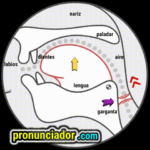
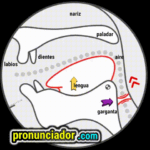
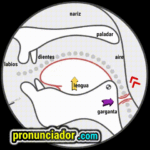
- Interdental (Tongue PEEKS OUT!): Just like the other TH sound (/θ/)! Your tongue tip gently peeks out a tiny bit BETWEEN your top and bottom front teeth. Easy!
- Fricative (Air SQUEEZES & RUBS!): Again, just like /θ/! The air has to squeeze through the small gap between your tongue tip and your upper teeth, making a continuous friction sound.
- VOICED (Voice Box ON! BUZZING!): ★★★ THIS IS THE ONLY DIFFERENCE FROM /θ/! ★★★ For /ð/, your vocal cords (the little muscles in your throat) MUST be VIBRATING! You need to add your voice to that airy friction sound.
Super Simple Kid Summary: To make the /ð/ (TH in ‘this’):
- Let your tongue tip peek out gently between your teeth.
- Let the air squeeze out continuously over your tongue.
- Turn ON your voice box and make it BUZZ like a bee! “Thzzzzzzzzzzz”.
It should feel like the voiceless “thhhhhh” but with a tickle or vibration in your throat! [Implied feeling difference].
The TH Twin Battle: Voiceless /θ/ (Think) vs. VOICED /ð/ (This) – The BUZZ!
Remember this, and you’ve cracked the TH code! They are MADE THE SAME WAY IN THE MOUTH! Only the throat buzz separates them!
| Feature | Voiceless TH /θ/ (Think, Bath) | Voiced TH /ð/ (This, Bathe) |
| Mouth/Tongue Place? | SAME! Tongue tip peeks. | SAME! Tongue tip peeks. |
| Airflow Type? | SAME! Friction (squeeze). | SAME! Friction (squeeze). |
| VOICE BOX (Vibrates?) | OFF (NO Buzz!) | ON (YES Buzz!) |
| Resulting Sound? | Airy “thhhhh” | Buzzy “thzzzzz” |
Why Does This Matter SO Much?
Because English uses this voicing difference to distinguish words!
- Thigh /θaɪ/ (muslo – NO buzz) vs. Thy /ðaɪ/ (tu – old word – BUZZ)
- Wreath /riθ/ (corona – NO buzz) vs. Wreathe /rið/ (envolver – BUZZ)
- Tooth /tuθ/ (diente – NO buzz) vs. Teethe /tið/ (dentar – BUZZ)
- Breath /brɛθ/ (aliento – NO buzz) vs. Breathe /brið/ (respirar – BUZZ)
The Fix: MASTER the Throat Buzz Test! Hand gently on your throat:
- “Think” = NO buzz.
- “This” = BUZZ!
Practice turning the buzz ON and OFF while keeping your tongue in the exact same spot! That’s the ninja move!

Your Mouth’s Mission (If You Choose to Accept It): Making the /ð/ BUZZ!
Okay, let’s get that voiced TH sound working perfectly. It uses the same mouth setup as the voiceless one, just add the buzz!
Step 1: Mouth Slightly Open
Just relax your jaw, open a little bit.
Step 2: Tongue PEEK-A-BOO Time!
- Gently place the very tip of your tongue between your upper and lower front teeth. [1:21 Put tip… between…].
- Let it lightly touch the bottom of your upper teeth and the top of your lower teeth. [1:24 gently touching].
- Remember: Just the tip! Don’t push hard! Gentle does it.
Step 3: Let the Air SQUEEZE Out…
- Keep your tongue in place and blow air gently but steadily out of your mouth.
- Make sure the air is flowing over your tongue tip and between the tongue and upper teeth, creating that soft friction sound.
Step 4: …AND Turn on the BUZZ! (Voice ON!)
- THIS IS THE KEY for /ð/! As the air flows, activate your vocal cords. Make them vibrate!
- You should feel a buzzing or vibration in your throat AND maybe even slightly on your tongue tip where the air is passing!
- The sound is a continuous, buzzy friction: “thzzzzzzzzzzz“.
Practice Tip:
- Start by making the voiceless /θ/ (“thhhhh”). Keep the air flowing.
- NOW, simply turn ON your voice box. Try to “hum” while keeping the /θ/ airflow. “Thhhhh” → “Thzzzzz”! That buzz is the /ð/!
How it Should Feel: Tongue gently between teeth, air squeezing out continuously, AND a noticeable vibration or buzz in your throat/mouth.
Spelling? SO Easy! (Mostly!)
Just like its voiceless twin, the spelling for the VOICED TH /ð/ sound is incredibly straightforward!
The Winner (Again!): ‘TH’ (~100%)
Yep! The voiced /ð/ sound is almost always represented by the letters ‘TH’ together!
- the, that, this, there, they, them, then, these.
- father, mother, brother, other, another, together.
- though, although, thus.
- smooth, breathe, bathe, clothe.
- Whether, neither (or /aɪðər/), farther*, further*. (Father/farther may or may not merge)
Easy Rule: See TH? It’s either voiceless /θ/ OR voiced /ð/. Now you just need to know which one!
Wait! How DO I Know if TH is Voiced /ð/ or Voiceless /θ/?
Ah, that’s the million-dollar question! Unfortunately, there’s NO simple spelling rule to know for sure just by looking. 😭 You largely have to learn through exposure and memorization.
BUT, here are some HELPFUL TENDENCIES (NOT 100% rules!):
- Voiced /ð/ is VERY common in:
- Function Words (short grammar words): the, this, that, these, those, they, them, their, there, then, than, though, although, thus. (Learn these!)
- Between two vowels: mother, father, brother, weather, leather, rhythm, bother.
- At the END of verbs with ‘THE’ ending: breathe, bathe, clothe, soothe, teethe. (Compare nouns: breath/θ/, bath/θ/, cloth/θ/!).
- Voiceless /θ/ is VERY common in:
- At the beginning of Content Words (nouns, verbs, adj, adv): think, three, thank, thought, theory, theme, thin.
- At the end of Content Words: bath, mouth, tooth, path, math, truth, health, both.
- Before consonants (usually): something, anything, bathroom, worthless.
Best Advice? Memorize the function words (the, this…). For others, LISTEN carefully! If you’re unsure, look up the word’s pronunciation (IPA: /ð/ means BUZZ, /θ/ means AIR only).

Don’t Do That! Fixing Common /ð/ Mistakes!
Let’s squash those common errors people make with the buzzing TH!
- Mistake #1: Using /d/! (The “Dis” for “This” Problem)
- Why?: Your tongue touches the ridge behind the teeth and stops the air instead of letting it flow between teeth with friction. And both /d/ and /ð/ are voiced!
- The Fix: TONGUE FORWARD & AIR FLOWS! Get that tongue tip PEEKING between teeth. Crucially, DO NOT STOP the air. It must flow continuously (“thzzzzzz”) – it’s a fricative (rubbing), not a stop. Feel the continuous buzz.
- Mistake #2: Using /z/! (The “Zis” for “This” Problem)
- Why?: Your tongue is too far back (near the alveolar ridge like for /s/ and /z/) instead of between the teeth. Both /z/ and /ð/ are voiced friction sounds, but in the wrong place!
- The Fix: TONGUE PEEK-A-BOO! Seriously, get that tip BETWEEN the front teeth. /z/ is made behind the teeth. /ð/ is made at the teeth. Big difference!
- Mistake #3: Using /v/! (The “Vis” for “This” Problem)
- Why?: This often happens because learners lack any dental fricative and substitute with the closest voiced fricative they do have, which is often the labiodental /v/. They use bottom lip + top teeth instead of tongue tip + top teeth.
- The Fix: IT’S A TONGUE SOUND! Keep your bottom lip OUT of the way! The friction happens between your tongue tip and your upper teeth.
- Mistake #4: Making it Voiceless! (Using /θ/ when it should BUZZ /ð/)
- Why?: Forgetting to turn on the voice box, maybe because /θ/ is more common overall or feels easier.
- The Fix: VOICE ON! Feel the buzz! Remember the function words (the, this, that, they…) almost always use the BUZZING /ð/! Practice the contrast.
TH Buzz Practice! Easy Exercises for Voiced /ð/
Let’s train that tongue tip and voice box!
Exercise 1: The Buzzing Feeling – /ð/ Alone
- Tongue tip PEEKS between teeth gently.
- Blow air AND turn ON your voice box. Feel the BUZZ in your throat and maybe on your tongue/teeth.
- Hold the buzzy friction sound: “Thzzzzzzzzzzzz…” /ð ð ð ð ð/.
Exercise 2: The ON/OFF Switch! Voiced /ð/ vs. Voiceless /θ/
This is YOUR MOST IMPORTANT PRACTICE! Same mouth, different throat!
- Alternate: /ð/ (Buzz ON) — /θ/ (Buzz OFF) — /ð/ — /θ/… (Thzzzz – Thhhh – Thzzzz – Thhhh…)
- Minimal Pairs:
- Then /ðɛn/ — Thin /θɪn/
- There /ðɛər/ — Threa? (Not a word) -> Better: There /ðɛər/ vs. Throw /θroʊ/
- Bathe /beɪð/ — Bath /bæθ/
- Clothe /kloʊð/ (verb) — Cloth /klɔθ/ (noun)
- Soothe /suð/ — Sooth* /suθ/ (Noun is less common)
Exercise 3: Beating the Substitutes! /ð/ vs. /d/ vs. /z/ vs. /v/
Force the right sound!
- /ð/ (THIS): Tongue PEEKS + AIR + BUZZ!
- /d/ (DIS): Tongue BEHIND teeth + STOPS AIR + BUZZ!
- /z/ (ZIS): Tongue BEHIND teeth + AIR (hiss) + BUZZ!
- /v/ (VIS): BOTTOM LIP + Top Teeth + AIR + BUZZ!
- Practice switching: They /ðeɪ/ — Day /deɪ/ — Zey — Vey*.
- Practice: Then /ðɛn/ — Den /dɛn/ — Zen /zɛn/ — Ven.
Exercise 4: Common VOICED /ð/ Words
Practice these super frequent words!
- Function Words: the, that, this, these, those, they, them, their, there, then, than, though, although, thus.
- Between Vowels: mother, father, brother, other, another, weather, leather, rather, gather, worthy, smooth.
- Verb Endings: breathe, bathe, clothe, teethe, soothe.
Exercise 5: Top 30 Word Workout (Source List) + Recording!
| PHONETICAL PRONUNCIATION |
| PHONETICAL PRONUNCIATION |
FAQs: Your Voiced TH /ð/ (THIS) Questions Answered!
Q1: What’s the #1 difference between the TH in “think” (/θ/) and the TH in “this” (/ð/)?
THE BUZZ! (Voicing!)
- /θ/ (“think”): Voice Box OFF. Just airy sound.
- /ð/ (“this”): Voice Box ON. Buzzy sound.
Mouth and tongue are in the SAME “peek-a-boo” position for both!
Q2: Why do I keep saying /d/ or /z/ instead of the voiced TH /ð/?
- For /d/: You’re likely stopping the air with your tongue behind the teeth instead of letting air flow with friction between the teeth. Keep the air moving!
- For /z/: Your tongue is too far back (near the bumpy ridge), not forward between the teeth. Bring that tongue tip right to the front!
Q3: Do I HAVE to stick my tongue OUT? It feels weird!
Just the very tip needs to peek out, gently touching the teeth. Not your whole tongue! For some people, lightly touching the back of the top teeth can work too, as long as you get the buzzy friction and don’t stop the air (/d/) or pull back (/z/). Experiment to find what works for YOU and sounds right.
Q4: Are there ANY spelling rules to know if TH is voiced /ð/ or voiceless /θ/?
Not really simple ones based just on spelling, unfortunately! 😥 BUT, remembering that grammar/function words (‘the’, ‘this’, ‘that’, ‘they’, ‘them’…) are almost always voiced /ð/, and TH between vowels (‘mother’, ‘father’) is usually voiced /ð/ helps a LOT! For others, listening and learning the word is key.
Q5: The word list had “bother”. Does that TH buzz too?
Yes! “Bother” is pronounced /ˈbɑðər/, with the voiced /ð/ sound, because the TH is between two vowel sounds (‘o’ /ɑ/ and ‘er’ /ɚ/). Great catch!
Final Thoughts: You’ve Got the BUZZ! Master Your Voiced /ð/!
Awesome job! You’ve tackled the American voiced TH /ð/, the buzzy twin that lives in so many essential words. You know it’s all about that tongue peek + AIR + VOICE ON!
Your voiced TH mission checklist:
- /ð/ = Tongue Tip PEEKS + AIR Flows + VOICE ON (BUZZ)! Think ‘this’, ‘the’, ‘mother’.
- KEY vs /θ/ (think) = BUZZ vs NO BUZZ! Master the throat vibration.
- MOUTH = SAME as /θ/! Don’t change the tongue/teeth part.
- AIR MUST FLOW! Don’t make it a /d/ stop. Continuous friction.
- SPELLING = TH. (Learn patterns: function words, between vowels = usually /ð/).
- ERRORS = D / Z / V or NO BUZZ /θ/. Fix with tongue position & voice control.
Keep practicing that buzzing friction! Use the throat test. Record yourself comparing “think”/”this”, “bath”/”bathe”. Listen closely to native speakers saying “the”, “that”, “they”. Soon, that /ð/ buzz will feel natural and your American accent will thank you for it!
👇🔥👇🔥👇🔥👇🔥👇🔥👇🔥
👉 RETURNS in the YEAR 2031 ! WHO? CLICK HERE ! 🔥




👇🔥👇🔥👇🔥👇🔥👇🔥👇🔥
👉 RETURNS in the YEAR 2031 ! WHO? CLICK HERE ! 🔥
👇🔥👇🔥👇🔥👇🔥👇🔥👇🔥


👉 RETURNS in the YEAR 2031 ! WHO? CLICK HERE ! 🔥

👉 RETURNS in the YEAR 2031 ! WHO? CLICK HERE ! 🔥

👉 RETURNS in the YEAR 2031 ! WHO? CLICK HERE ! 🔥